Species · Flowering plants
Hairy Cola Cola greenwayi
The scientific name of the Hairy Cola is Cola greenwayi. It is a species of flowering plant in the family Malvaceae (mallow family), order Malvales.
- Scientific name
- Cola greenwayi Brenan
- Common name
- Hairy Cola
- Genus
- Cola
- Family
- Malvaceae (Mallow Family)
- Order
- Malvales
- Class
- Magnoliopsida
- Recorded in
- 8 countries
- Name status
- accepted in the Catalogue of Life

Overview
Hairy cola is an evergreen tree with a small to medium-sized growth form. It grows in dense forest, often on steep slopes, from sea level to approximately 1,100 metres elevation. Its leaves have a hairy swelling called a pulvinus at the base of each blade, which functions as a hinge.
Written 27 November 2026 from the sources listed below. Each statement was checked against the passage it cites; statements that could not be supported were removed.
Appearance
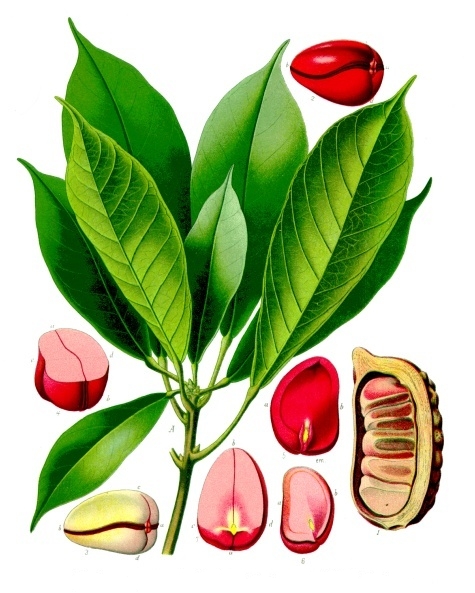
The smaller branches and twigs are initially brown and densely covered in hairs. Young leaves are purplish-brown, while mature leaves are dark green and leathery.[1][2]
The tree can grow to approximately 20 metres tall. Its leaves can measure up to 15 by 5 centimetres.[3][4]
The leaves are alternate, stalked and simple, with either elliptical or oblanceolate shapes and prominent veins. Each leaf has a hairy swelling called a pulvinus at the base of its blade, which functions as a hinge.[5][6][7]
The flowers grow in clusters in the leaf axils and have small, rusty-brown and hairy bracts. They have a calyx with four to six lobes and lack petals.[8][9][10]
The species produces four to five carpels that become yellowish-orange when ripe. The fruit is sub-globose and initially hairy, developing a thin, brittle rind.[11][12]
Habitat
Hairy cola grows in dense forest, often on steep slopes, from sea level to approximately 1,100 metres elevation.[13][14]
The species is part of the characteristic flora of the Southern African Sand Forest. This habitat grows on ancient sand dunes along the border of northern KwaZulu-Natal and southern Mozambique.[15][16]
The species is native to southeastern Africa. Its geographical range extends from Kenya and Tanzania southwards to Zimbabwe, Mozambique, Transvaal and eastern KwaZulu-Natal.[17][18]
Reproduction and life cycle
The species can be either monoecious or dioecious. Its fruit usually contains one or two seeds.[19][20]
Classification of the Hairy Cola
| Kingdom | Plantae |
|---|---|
| Subkingdom | Pteridobiotina |
| Phylum | Tracheophyta |
| Class | Magnoliopsida |
| Order | Malvales |
| Family | Malvaceae (Mallow Family) |
| Subfamily | Sterculioideae |
| Genus | Cola (Kola Nut) |
| Species | Cola greenwayi Brenan |
Where the Hairy Cola is found
Checklists and occurrence records place Cola greenwayi in 8 countries across Africa. GBIF holds 244 georeferenced records of it.
Countries
Regions and cities with the most records
- KwaZulu-Natal, South Africa 79
- Morogoro, Tanzania 27
- Tanga, Tanzania 10
- Zambezia Province, Mozambique 9
- Mpumalanga, South Africa 8
- Kidatu, Tanzania 7
- Morogoro, Tanzania 7
- Ruaha, Tanzania 7
- Kidodi, Tanzania 6
- Barberton, South Africa 5
- Madizini, Tanzania 5
- Lubata, Tanzania 4
- Nhamatanda, Mozambique 4
- Sofala, Mozambique 4
- Dar es Salaam Region, Tanzania 3
- Kibaha, Tanzania 3
- Kilifi County, Kenya 3
- Mtubatuba, South Africa 3
- Murang'A, Kenya 3
- Pwani, Tanzania 3
- Schoemansdal, South Africa 3
Range as the checklists state it
Kenya; Tanzania; Zambia; Malawi; Zimbabwe; Mozambique; South Africa (Mpulamanga, KwaZulu-Natal); Eswatini [Swaziland]
A number beside a place is its count of GBIF occurrence records. A place without a number comes from a checklist alone. Records show where a species has been observed or collected, which can include escapes and vagrants.
Common names
English
- Hairy Cola
Names in 3 other languages
- Afrikaans
- Harige kola
- Finnish
- tansaniankoolapuu
- Zulu
- iNthandoti
Synonyms
One other scientific name has been used for this species and is now treated as a synonym of Cola greenwayi.
- Cola microcarpa Brenan
Subspecies and varieties
- Cola greenwayi var. greenwayi variety
- Cola greenwayi var. keniensis variety
Related species
-
 True KolaCola acuminata
-
 Kola NutCola nitida
-
 Large-Leaved ColaCola mossambicensis
- Owé ColaCola verticillata
- Bamenda ColaCola anomala
- Club-fruited ColaCola clavata
-
 Laurel-leaved KolaCola laurifolia
-
 Giant ColaCola gigantea
Compare
Questions and answers
What is the scientific name of the Hairy Cola?
The scientific name of the Hairy Cola is Cola greenwayi. Written with its author, the full name is Cola greenwayi Brenan.
Which family does the Hairy Cola belong to?
Cola greenwayi belongs to the family Malvaceae, in the order Malvales and the class Magnoliopsida.
Where is the Hairy Cola found?
Checklists and occurrence records place Cola greenwayi in 8 countries, including South Africa, Tanzania, Mozambique, Kenya, Malawi and Zimbabwe.
Sources
Passages the profile rests on
- The smaller branches and twigs are initially brown and densely covered in hairs. Source passage: “The smaller branches and twigs are brown and densely hairy at first.” — English Wikipedia
- Young leaves are purplish-brown, while mature leaves are dark green and leathery. Source passage: “The leaves are alternate, purplish-brown when young and dark green and leathery when older” — English Wikipedia
- The tree can grow to approximately 20 metres tall. Source passage: “growing to around 20 m (66 ft)” — English Wikipedia
- Its leaves can measure up to 15 by 5 centimetres. Source passage: “up to 15 by 5 cm (6 by 2 in).” — English Wikipedia
- The leaves are alternate, stalked, simple and either elliptical or oblanceolate, with prominent veins. Source passage: “They are stalked, simple, elliptical or oblanceolate, and have prominent veins.” — English Wikipedia
- Each leaf has a hairy swelling called a pulvinus at the base of its blade. Source passage: “There is a hairy swelling known as a pulvinus at the base of each leaf-blade” — English Wikipedia
- The pulvinus at the base of each leaf-blade functions as a hinge. Source passage: “which acts as a hinge.” — English Wikipedia
- Its flowers grow in clusters in the leaf axils. Source passage: “The flowers are in clusters growing in the axils of the leaves.” — English Wikipedia
- The flowers have small, rusty-brown and hairy bracts. Source passage: “They have small, rusty-brown, hairy bracts.” — English Wikipedia
- The flowers have a calyx with four to six lobes and lack petals. Source passage: “The calyx has four to six lobes and there are no petals.” — English Wikipedia
- The species produces four to five carpels that become yellowish-orange when ripe. Source passage: “The four to five carpels turn yellowish-orange when ripe” — English Wikipedia
- The fruit is sub-globose and initially hairy, developing a thin, brittle rind. Source passage: “making a sub-globose fruit, hairy at first, and later with a thin, brittle rind.” — English Wikipedia
- The species grows in dense forest, often on steep slopes. Source passage: “Its habitat is dense forest, often on steep slopes” — English Wikipedia
- The species occurs from sea level to approximately 1,100 metres elevation. Source passage: “from sea level up to about 1,100 m (3,600 ft).” — English Wikipedia
- The species is part of the characteristic flora of the Southern African Sand Forest. Source passage: “It is also part of the typical flora of the Southern African Sand Forest” — English Wikipedia
- The Southern African Sand Forest habitat grows on ancient sand dunes along the border of northern KwaZulu-Natal and southern Mozambique. Source passage: “which grows on ancient sand dunes on the border of northern KwaZulu-Natal and southern Mozambique.” — English Wikipedia
- Cola greenwayi is native to southeastern Africa. Source passage: “It is native to southeastern Africa.” — English Wikipedia
- Its geographical range extends from Kenya and Tanzania southwards to Zimbabwe, Mozambique, Transvaal and eastern KwaZulu-Natal. Source passage: “its range extending from Kenya and Tanzania southwards to Zimbabwe and Mozambique, Transvaal and eastern KwaZulu-Natal.” — English Wikipedia
- The species can be either monoecious or dioecious. Source passage: “either monoecious or dioecious.” — English Wikipedia
- The fruit usually contains one or two seeds. Source passage: “It usually contains one or two seeds.” — English Wikipedia
Data
- Catalogue of Life, 2026-10-16 XR cc by
- Global Biodiversity Information Facility CC BY 4.0
- Wikidata CC0
- GeoNames CC BY 4.0
- Wikimedia Commons per image; credit shown with each image
- Within the Catalogue of Life, this name comes from Synonymic Checklists of the Vascular Plants of the World cc by
References
- Brenan. (1956). Kew Bull. [11]: 144 (1956). where the name was published
This species in other databases
Page built on 27 November 2026. See how the catalog is made and all sources and licences.
Cite this page
ScientificNames.org. (2026). Cola greenwayi (Hairy Cola). Retrieved November 27, 2026, from https://scientificnames.org/species/cola-greenwayi
“Cola greenwayi (Hairy Cola).” ScientificNames.org, 2026, scientificnames.org/species/cola-greenwayi. Accessed 27 Nov. 2026.
ScientificNames.org. “Cola greenwayi (Hairy Cola).” Accessed November 27, 2026. https://scientificnames.org/species/cola-greenwayi.
@misc{scientificnames_cola_greenwayi_hairy_cola,
  author = {{ScientificNames.org}},
  title = {Cola greenwayi (Hairy Cola)},
  year = {2026},
  url = {https://scientificnames.org/species/cola-greenwayi},
  note = {Accessed 2026-11-27}
}