Species · Fishes
Largespot Eel Blenny Congrogadus amplimaculatus
The scientific name of the Largespot Eel Blenny is Congrogadus amplimaculatus. It is a species of fish in the family Pseudochromidae (dottyback), order Perciformes. The name dates from 1980.
- Scientific name
- Congrogadus amplimaculatus (Winterbottom, 1980)
- Common name
- Largespot Eel Blenny
- Genus
- Congrogadus
- Family
- Pseudochromidae (Dottyback)
- Order
- Perciformes
- Class
- Teleostei
- Red List category
- DD Data Deficient
- Environment
- marine
- Recorded in
- 1 country
- Name status
- accepted in the Catalogue of Life

Overview
Wikidata describes Congrogadus amplimaculatus as “species of fish”.
Classification of the Largespot Eel Blenny
| Kingdom | Animalia |
|---|---|
| Phylum | Chordata |
| Subphylum | Vertebrata |
| Infraphylum | Gnathostomata |
| Parvphylum | Osteichthyes |
| Gigaclass | Actinopterygii |
| Superclass | Actinopteri |
| Class | Teleostei (Teleost) |
| Order | Perciformes |
| Suborder | Percoidei |
| Family | Pseudochromidae (Dottyback) |
| Subfamily | Congrogadinae |
| Genus | Congrogadus |
| Species | Congrogadus amplimaculatus (Winterbottom, 1980) |
Where the Largespot Eel Blenny is found
Checklists and occurrence records place Congrogadus amplimaculatus in 1 country. GBIF holds 44 georeferenced records of it.
Countries
A number beside a place is its count of GBIF occurrence records. A place without a number comes from a checklist alone. Records show where a species has been observed or collected, which can include escapes and vagrants.
Common names
English
- Largespot Eel Blenny
- Large-spot Eel-blenny
Names in 3 other languages
- Czech
- sapínovec velkoskvrnný
- Portuguese
- Blênio-enguia-manchado
- Spanish
- Blenio Anguila punteado
Synonyms
One other scientific name has been used for this species and is now treated as a synonym of Congrogadus amplimaculatus.
- Congrogadoides amplimaculatus Winterbottom, 1980
Related species
-
 Carpet Eel BlennyCongrogadus subducens
-
 Spiny Eel BlennyCongrogadus spinifer
-
 Congrogadus hierichthys
- Aru EelblennyCongrogadus malayanus
- Pilbara EelblennyCongrogadus winterbottomi
-
 Orchid DottybackPseudochromis fridmani
-
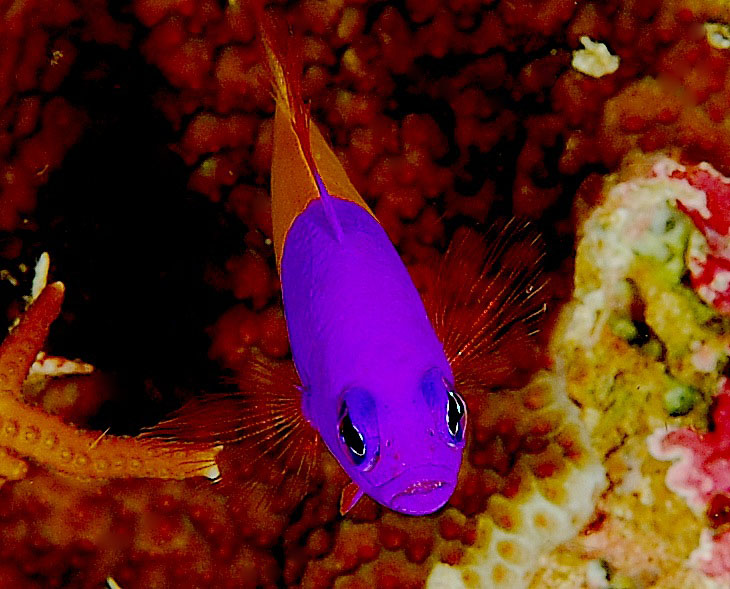 Royal DottybackPictichromis paccagnellae
-
 Orange DottybackPseudochromis aldabraensis
Compare
Questions and answers
What is the scientific name of the Largespot Eel Blenny?
The scientific name of the Largespot Eel Blenny is Congrogadus amplimaculatus. Written with its author, the full name is Congrogadus amplimaculatus (Winterbottom, 1980).
Which family does the Largespot Eel Blenny belong to?
Congrogadus amplimaculatus belongs to the family Pseudochromidae, in the order Perciformes and the class Teleostei.
Where is the Largespot Eel Blenny found?
Checklists and occurrence records place Congrogadus amplimaculatus in 1 country: Australia.
What is the conservation status of the Largespot Eel Blenny?
The IUCN Red List category recorded for Congrogadus amplimaculatus is Data Deficient (DD).
What other names does the Largespot Eel Blenny have?
Congrogadus amplimaculatus is also known in English as Large-spot Eel-blenny.
Sources
Data
- Catalogue of Life, 2026-10-16 XR cc by
- Global Biodiversity Information Facility CC BY 4.0
- Wikidata CC0
- GeoNames CC BY 4.0
- Wikimedia Commons per image; credit shown with each image
- Within the Catalogue of Life, this name comes from World Register of Marine Species cc by
This species in other databases
- Catalogue of Life XLPJ
- Wikidata Q5098305
- iNaturalist 98338
- WoRMS urn:lsid:marinespecies.org:taxname:280375
- ITIS 645427
Page built on 27 November 2026. See how the catalog is made and all sources and licences.
Cite this page
ScientificNames.org. (2026). Congrogadus amplimaculatus (Largespot Eel Blenny). Retrieved November 27, 2026, from https://scientificnames.org/species/congrogadus-amplimaculatus
“Congrogadus amplimaculatus (Largespot Eel Blenny).” ScientificNames.org, 2026, scientificnames.org/species/congrogadus-amplimaculatus. Accessed 27 Nov. 2026.
ScientificNames.org. “Congrogadus amplimaculatus (Largespot Eel Blenny).” Accessed November 27, 2026. https://scientificnames.org/species/congrogadus-amplimaculatus.
@misc{scientificnames_congrogadus_amplimaculatus_largespot_eel_blenny,
  author = {{ScientificNames.org}},
  title = {Congrogadus amplimaculatus (Largespot Eel Blenny)},
  year = {2026},
  url = {https://scientificnames.org/species/congrogadus-amplimaculatus},
  note = {Accessed 2026-11-27}
}