Species · Fishes
Arctic Cisco Coregonus autumnalis
The scientific name of the Arctic Cisco is Coregonus autumnalis. It is a species of fish in the family Salmonidae (trouts), order Salmoniformes. The name dates from 1776.
- Scientific name
- Coregonus autumnalis (Pallas, 1776)
- Common name
- Arctic Cisco
- Genus
- Coregonus
- Family
- Salmonidae (Trouts)
- Order
- Salmoniformes
- Class
- Teleostei
- Red List category
- LC Least Concern
- Environment
- brackish, freshwater, marine
- Recorded in
- 2 countries
- Name status
- accepted in the Catalogue of Life

Overview
Coregonus autumnalis inhabits Arctic freshwater environments and can also occupy marine waters, occurring in the Beaufort Sea and the lower reaches of the Colville River. It is an anadromous species that spawns in freshwater and can feed and overwinter in saltwater.
Written 26 November 2026 from the sources listed below. Each statement was checked against the passage it cites; statements that could not be supported were removed.
Appearance
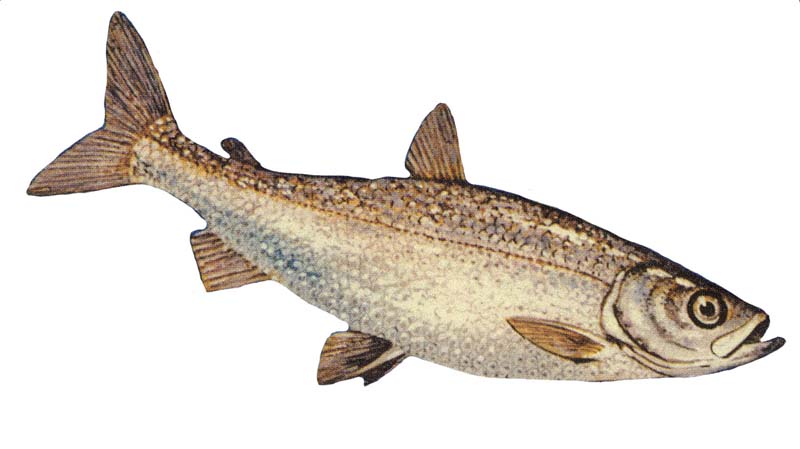
Arctic Cisco has a metallic silver body, a brown to dark green back, and pale, nearly colorless fins. It has no spots on its body.[1][2]
It has a relatively small head and a non-prominent snout. It has no teeth on its jaws but has a patch of teeth on its tongue.[3][4][5]
The species can reach 508 millimeters in length and weigh up to one kilogram. Most individuals are shorter than 40 centimeters and weigh less than one kilogram.[6][7][8]
Habitat
Arctic Cisco inhabits Arctic freshwater environments and can also occupy marine waters. It spawns in freshwater but can feed and overwinter in saltwater.[9][10]
The species occurs in the Beaufort Sea and the lower reaches of the Colville River.[11]
Diet
Arctic Cisco feeds on plankton, crustaceans, and small fishes. Adult individuals consume crustaceans including crabs, shrimp, and krill, as well as small fishes.[12][13]
The feeding habits of juvenile individuals are unknown.[14]
Behaviour
Arctic Cisco is an anadromous species. Young individuals migrate westward along the Beaufort Sea coast after hatching, and easterly winds assist their migration toward the Colville River delta.[15][16][17]
Young individuals can travel more than 160 kilometers from their hatching location to the Colville River delta. They remain in the Colville River area until reaching sexual maturity.[18][19]
Mature individuals migrate back to the Mackenzie River to reproduce. They do not feed while migrating upstream.[20][21]
Reproduction and life cycle
Arctic Cisco can reproduce from eight or nine years of age. It spawns in September in Canada's Mackenzie River but does not reproduce in Alaskan waters.[22][23][24]
Females may spawn only two or three times during their lives and may not produce eggs every year. They can produce up to 90,000 eggs.[25][26][27]
Conservation
The abundance and production of Arctic Cisco in Alaska are poorly understood. Climate change and oil and gas development are identified as major threats to the species.[28][29]
Juvenile survival and migration depend partly on currents exceeding five kilometers per hour.[30]
Uses
Arctic Cisco is an important commercial and subsistence fish for North Slope villages. Commercial and subsistence fishers both target the species.[31][32]
There are no directed sport fisheries for Arctic Cisco in Alaska.[33]
Similar species
Arctic Cisco has a close freshwater relative in several lakes in Ireland, known as the pollan.[34]
Classification of the Arctic Cisco
| Kingdom | Animalia |
|---|---|
| Phylum | Chordata |
| Subphylum | Vertebrata |
| Infraphylum | Gnathostomata |
| Parvphylum | Osteichthyes |
| Gigaclass | Actinopterygii |
| Superclass | Actinopteri |
| Class | Teleostei (Teleost) |
| Order | Salmoniformes |
| Family | Salmonidae (Trouts) |
| Subfamily | Coregoninae |
| Genus | Coregonus (Whitefishes) |
| Species | Coregonus autumnalis (Pallas, 1776) |
Where the Arctic Cisco is found
Checklists and occurrence records place Coregonus autumnalis in 2 countries. GBIF holds 1,113 georeferenced records of it.
Countries
Regions and cities with the most records
2 more countries have a few records outside this range
These countries hold a few records of Coregonus autumnalis but lie outside the range the checklists give for it. Such records are often zoo or garden specimens, museum material or vagrants, so the species is not counted as occurring there.
A number beside a place is its count of GBIF occurrence records. A place without a number comes from a checklist alone. Records show where a species has been observed or collected, which can include escapes and vagrants.
Common names
English
- Arctic Cisco
- Pollan
Names in 21 other languages
- Arabic
- كورجون خريفي
- Catalan
- Corègon àrtic
- Chinese
- 秋白鮭
- Danish
- Arktisk helt
- Dutch
- Arctische houting
- Finnish
- Omulsiika
- French
- Cisco de l'Arctique, cisco arctique
- Georgian
- ომული
- German
- Arktische Maräne
- Japanese
- エニセイシロマス
- Kazakh
- Түрке балық
- Latvian
- Omulis
- Lithuanian
- Arktinis omulis
- Polish
- omul
- Russian
- Омуль
- Vietnamese
- Cá hồi trắng Bắc Cực
- Welsh
- Polaniaid, polan
- bxr
- Омоли
- iku
- Kapisilik
- ipk
- Qaaktaq
- sah
- Уомул
Synonyms
10 other scientific names have been used for this species and are now treated as synonyms of Coregonus autumnalis.
- Coregonus autumnalis autumnalis (Pallas, 1776)
- Coregonus autumnalis jenisejensis Smitt, 1883
- Coregonus autumnalis novajaesemljae Smitt, 1883
- Coregonus lepechini Warpachowski, 1901
- Coregonus omul Pallas, 1814
- Coregonus omul polylepidotus Smitt, 1886
- Coregonus omul var. oligolepidotus Smitt, 1886
- Goregonus autumnalis (Pallas, 1776)
- Salmo autumnalis Pallas, 1776
- Salmo omul Pallas, 1814
Related species
-
 VendaceCoregonus albula
-
 Lake WhitefishCoregonus clupeaformis
-
 OmulCoregonus migratorius
-
 European WhitefishCoregonus lavaretus
-
 CiscoCoregonus artedi
-
 GwyniadCoregonus pennantii
-
 BloaterCoregonus hoyi
-
 MuksunCoregonus muksun
Compare
Questions and answers
What is the scientific name of the Arctic Cisco?
The scientific name of the Arctic Cisco is Coregonus autumnalis. Written with its author, the full name is Coregonus autumnalis (Pallas, 1776).
Which family does the Arctic Cisco belong to?
Coregonus autumnalis belongs to the family Salmonidae, in the order Salmoniformes and the class Teleostei.
Where is the Arctic Cisco found?
Checklists and occurrence records place Coregonus autumnalis in 2 countries: Canada and United States.
What is the conservation status of the Arctic Cisco?
The IUCN Red List category recorded for Coregonus autumnalis is Least Concern (LC).
What other names does the Arctic Cisco have?
Coregonus autumnalis is also known in English as Pollan.
What do ciscoes eat?
Arctic Cisco feeds on plankton, crustaceans, and small fishes. Adults consume crabs, shrimp, krill, and small fishes, while the feeding habits of juveniles are unknown.[12][13][14]
What type of fish is a cisco?
Arctic Cisco is a fish in the family Salmonidae, order Salmoniformes, and class Teleostei. It is an anadromous species.[15]
Sources
Passages the profile rests on
- The species has a metallic silver body, a brown to dark green back, and pale, nearly colorless fins. Source passage: “Arctic cisco have a metallic silver body with a brown to dark green back; pale, almost colorless fins, and no spots.” — adfg.alaska.gov
- The species has no spots on its body. Source passage: “It has neither spots nor teeth on its jaw.” — English Wikipedia
- The species has a relatively small head and a non-prominent snout. Source passage: “The Arctic cisco has a relatively small head with a non-prominent snout.” — English Wikipedia
- The species has no teeth on its jaws. Source passage: “They have no teeth on their jaws, but have a patch of teeth on their tongue.” — adfg.alaska.gov
- The species has a patch of teeth on its tongue. Source passage: “They have no teeth on their jaws, but have a patch of teeth on their tongue.” — adfg.alaska.gov
- The species can reach 508 millimeters in length. Source passage: “Arctic cisco may reach 508 millimeters (20 inches) in length” — adfg.alaska.gov
- The species can weigh up to one kilogram. Source passage: “and can weigh up to one kilogram (~two pounds).” — adfg.alaska.gov
- Most individuals are shorter than 40 centimeters and weigh less than one kilogram. Source passage: “but is usually less than 40 cm (16 in) in length and 1 kg (2.2 lbs) in weight.” — English Wikipedia
- The species inhabits Arctic freshwater environments and can also occupy marine waters. Source passage: “is an anadromous species of freshwater whitefish that inhabits the Arctic parts of Siberia especially Yenisey Gulf.” — English Wikipedia
- The species spawns in freshwater but can feed and overwinter in saltwater. Source passage: “it spawns in freshwater, but can feed and overwinter in saltwater.” — adfg.alaska.gov
- The species occurs in the Beaufort Sea and the lower reaches of the Colville River. Source passage: “Arctic cisco are in the Beaufort Sea and in the lower reaches of the Colville River” — adfg.alaska.gov
- The species feeds on plankton, crustaceans, and small fishes. Source passage: “The Arctic cisco preys upon plankton, crustaceans and small fishes.” — English Wikipedia
- Adult individuals consume crustaceans including crabs, shrimp, and krill, as well as small fishes. Source passage: “Adult Arctic cisco eat crustaceans (crabs, shrimp, krill) and small fishes.” — adfg.alaska.gov
- The feeding habits of juvenile individuals are unknown. Source passage: “The feeding habits of juvenile Arctic cisco are unknown.” — adfg.alaska.gov
- The species is anadromous. Source passage: “The Arctic cisco is a member of the whitefish family and is anadromous” — adfg.alaska.gov
- Young individuals migrate westward along the Beaufort Sea coast after hatching. Source passage: “After hatching, the young fish migrate west along the Beaufort Sea coast.” — adfg.alaska.gov
- Easterly winds assist juvenile migration toward the Colville River delta. Source passage: “Easterly winds help "push" the young fish to the Colville River delta west of the Canadian Border” — adfg.alaska.gov
- Young individuals can travel more than 160 kilometers from their hatching location to the Colville River delta. Source passage: “more than 160 kilometers (100 miles) from where they began.” — adfg.alaska.gov
- Individuals remain in the Colville River area until reaching sexual maturity. Source passage: “Arctic cisco remain in the Colville River area until they are sexually mature” — adfg.alaska.gov
- Mature individuals migrate back to the Mackenzie River to reproduce. Source passage: “at which time they migrate back to the Mackenzie River to spawn.” — adfg.alaska.gov
- Individuals do not feed while migrating upstream. Source passage: “They do not feed while migrating upwards.” — English Wikipedia
- The species can reproduce from eight or nine years of age. Source passage: “The Arctic cisco is able to spawn at 8 or 9 years of age.” — English Wikipedia
- The species spawns in September. Source passage: “The Arctic cisco reproduces in September.” — English Wikipedia
- The species reproduces in Canada's Mackenzie River but not in Alaskan waters. Source passage: “Arctic cisco spawn in Canada's Mackenzie River in September, but do not reproduce in Alaskan waters.” — adfg.alaska.gov
- Females may spawn only two or three times during their lives. Source passage: “Females may not produce eggs every year and may only spawn two or three times in their lifetime.” — adfg.alaska.gov
- Females may not produce eggs every year. Source passage: “and do not necessarily produce eggs every year.” — English Wikipedia
- Females can produce up to 90,000 eggs. Source passage: “Females have up to 90,000 eggs.” — English Wikipedia
- The abundance and production of the species in Alaska are poorly understood. Source passage: “We know very little about the abundance and production of Arctic cisco in Alaska” — adfg.alaska.gov
- Climate change and oil and gas development are identified as major threats to the species. Source passage: “The largest threats to the Arctic cisco appear to be climate change and oil and gas development.” — English Wikipedia
- Juvenile survival and migration depend partly on currents exceeding five kilometers per hour. Source passage: “Juvenile Arctic cisco need enough current [greater than 5 kilometers per hour (3 miles per hour)] to help them move to productive rearing areas in Alaskan waters.” — adfg.alaska.gov
- The species is an important commercial and subsistence fish for North Slope villages. Source passage: “The Arctic cisco is the most important commercial and subsistence fish species for people of the North Slope villages.” — adfg.alaska.gov
- Commercial and subsistence fishers both target the species. Source passage: “Both commercial and subsistence fishers target Arctic cisco.” — adfg.alaska.gov
- There are no directed sport fisheries for the species in Alaska. Source passage: “There are no directed sport fisheries for Arctic cisco in Alaska.” — adfg.alaska.gov
- The species has a close freshwater relative in several lakes in Ireland, known as the pollan. Source passage: “It has a close freshwater relative in several lakes of Ireland, known as the pollan” — English Wikipedia
Data
- Catalogue of Life, 2026-10-16 XR cc by
- Global Biodiversity Information Facility CC BY 4.0
- Wikidata CC0
- GeoNames CC BY 4.0
- Wikimedia Commons per image; credit shown with each image
- Within the Catalogue of Life, this name comes from World Register of Marine Species cc by
References
- Pallas, Peter S. 1776. [Untitled volume]. [Unspecified Publisher] Vol. 3: [1-20], 1-760, index. where the name was published
This species in other databases
- Catalogue of Life YD8D
- Wikidata Q6714971
- iNaturalist 98440
- WoRMS urn:lsid:marinespecies.org:taxname:127179
- ITIS 161933
Page built on 27 November 2026. See how the catalog is made and all sources and licences.
Cite this page
ScientificNames.org. (2026). Coregonus autumnalis (Arctic Cisco). Retrieved November 27, 2026, from https://scientificnames.org/species/coregonus-autumnalis
“Coregonus autumnalis (Arctic Cisco).” ScientificNames.org, 2026, scientificnames.org/species/coregonus-autumnalis. Accessed 27 Nov. 2026.
ScientificNames.org. “Coregonus autumnalis (Arctic Cisco).” Accessed November 27, 2026. https://scientificnames.org/species/coregonus-autumnalis.
@misc{scientificnames_coregonus_autumnalis_arctic_cisco,
  author = {{ScientificNames.org}},
  title = {Coregonus autumnalis (Arctic Cisco)},
  year = {2026},
  url = {https://scientificnames.org/species/coregonus-autumnalis},
  note = {Accessed 2026-11-27}
}