Species · Fishes
Blackfin Cisco Coregonus nigripinnis
The scientific name of the Blackfin Cisco is Coregonus nigripinnis. It is a species of fish in the family Salmonidae (trouts), order Salmoniformes. The name dates from 1874.
- Scientific name
- Coregonus nigripinnis (Milner, 1874)
- Common name
- Blackfin Cisco
- Genus
- Coregonus
- Family
- Salmonidae (Trouts)
- Order
- Salmoniformes
- Class
- Teleostei
- Red List category
- DD Data Deficient
- Environment
- freshwater
- Recorded in
- 2 countries
- Name status
- accepted in the Catalogue of Life

Overview
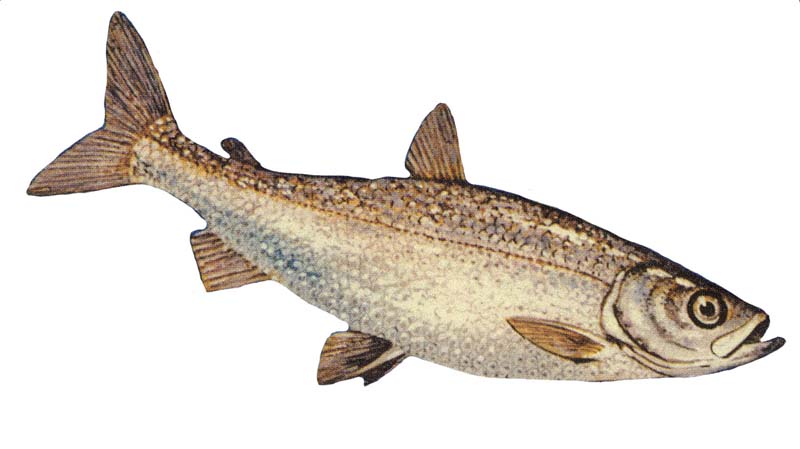
Coregonus nigripinnis formerly inhabited the Great Lakes of North America and preferred cold lakes. It had a dark silvery body, a dark green to black back, pink or purple sides and black outer fin halves.
Written 26 November 2026 from the sources listed below. Each statement was checked against the passage it cites; statements that could not be supported were removed.
Appearance
Blackfin Cisco had a silvery, deep-bodied appearance, large eyes, a blunt snout and a terminal mouth. Its body was dark silvery, with a dark green to black back and pink or purple sides.[1][2]
The outer halves of its fins were black.[3]
Habitat
Blackfin Cisco preferred cold lakes and lake depths reaching up to 180 metres. It was once found at depths of 110 to 146 metres in Lakes Michigan and Huron.[4][5][6]
Diet
Introduced alewives and introduced rainbow smelt were reported to prey aggressively on juvenile Blackfin Cisco.[7][8]
Behaviour
Blackfin Cisco was preyed upon by the invading sea lamprey.[9]
Reproduction and life cycle
Interbreeding with lake herring was identified as a potential threat to any remaining Blackfin Cisco populations.[10]
Conservation
Overfishing during the 1950s contributed substantially to the decline of Blackfin Cisco. Commercial fishing continued until the early 1960s, when declining stocks made the fishery uneconomic.[11][12]
The IUCN Red List classified Blackfin Cisco as extinct in 1996. COSEWIC classified it as threatened in 1988 and as data deficient in 2007 because of uncertainty about its taxonomic status.[13][14][15]
Reintroduction of cisco populations into the Great Lakes, particularly Lake Michigan, has been considered.[16]
Uses
Blackfin Cisco was commercially harvested in a fishery that became uneconomic by the early 1960s.[17]
Similar species
Blackfin Cisco belongs to the Coregonus artedi species complex, whose taxonomy remains unresolved. Some specimens were difficult to distinguish from Coregonus kiyi.[18][19][20]
Coregonus nigripinnis cyanopterus was subsequently synonymized with Coregonus zenithicus. In 2003, Turgeon and Bernatchez proposed merging Blackfin Cisco with several other cisco species into Coregonus artedi sensu lato.[21][22]
Classification of the Blackfin Cisco
| Kingdom | Animalia |
|---|---|
| Phylum | Chordata |
| Subphylum | Vertebrata |
| Infraphylum | Gnathostomata |
| Parvphylum | Osteichthyes |
| Gigaclass | Actinopterygii |
| Superclass | Actinopteri |
| Class | Teleostei (Teleost) |
| Order | Salmoniformes |
| Family | Salmonidae (Trouts) |
| Subfamily | Coregoninae |
| Genus | Coregonus (Whitefishes) |
| Species | Coregonus nigripinnis (Milner, 1874) |
Where the Blackfin Cisco is found
Checklists and occurrence records place Coregonus nigripinnis in 2 countries. GBIF holds 683 georeferenced records of it.
Countries
Regions and cities with the most records
- Ontario, Canada 425
- Michigan, United States 139
- Wisconsin, United States 29
- Northwest Territories, Canada 22
- Marquette, United States 13
- Minnesota, United States 13
- Saskatchewan, Canada 6
- Manitoba, Canada 5
- Kenora, Canada 4
- Cudahy, United States 3
- Greenfield, United States 3
- Illinois, United States 3
- Milwaukee, United States 3
- South Milwaukee, United States 3
- Wauwatosa, United States 3
- West Allis, United States 3
A number beside a place is its count of GBIF occurrence records. A place without a number comes from a checklist alone. Records show where a species has been observed or collected, which can include escapes and vagrants.
Common names
English
- Blackfin Cisco
Names in 1 other language
- French
- cisco à nageoires noires
Synonyms
8 other scientific names have been used for this species and are now treated as synonyms of Coregonus nigripinnis.
- Argyrosomus nigripinnis Milner, 1874
- Argyrosomus prognathus (Smith, 1895)
- Coregonus nigripinnis (Gill in Hoy, 1872)
- Coregonus nigripinnis nigripinnis (Milner, 1874)
- Coregonus nigripinnis regalis (Koelz, 1929)
- Coregonus prognathus Smith, 1895
- Leucichthys nigripinnis
- Leucichthys nigripinnis regalis Koelz, 1929
Related species
-
 VendaceCoregonus albula
-
 Lake WhitefishCoregonus clupeaformis
-
 OmulCoregonus migratorius
-
 European WhitefishCoregonus lavaretus
-
 CiscoCoregonus artedi
-
 GwyniadCoregonus pennantii
-
 BloaterCoregonus hoyi
-
 MuksunCoregonus muksun
Compare
Questions and answers
What is the scientific name of the Blackfin Cisco?
The scientific name of the Blackfin Cisco is Coregonus nigripinnis. Written with its author, the full name is Coregonus nigripinnis (Milner, 1874).
Which family does the Blackfin Cisco belong to?
Coregonus nigripinnis belongs to the family Salmonidae, in the order Salmoniformes and the class Teleostei.
Where is the Blackfin Cisco found?
Checklists and occurrence records place Coregonus nigripinnis in 2 countries: Canada and United States.
What is the conservation status of the Blackfin Cisco?
The IUCN Red List category recorded for Coregonus nigripinnis is Data Deficient (DD).
How big do cisco fish get?
Blackfin Cisco reached a maximum recorded length of 510 mm (21 inches).[23]
Sources
Passages the profile rests on
- The blackfin cisco had a silvery, deep-bodied appearance, large eyes, a blunt snout and a terminal mouth. Source passage: “This silvery, deep-bodied fish with black fins, large eyes, a blunt snout and a terminal mouth” — English Wikipedia
- The blackfin cisco had a dark silvery body, a dark green to black back, and pink or purple sides. Source passage: “It was a dark silvery color, with a dark green to black back, and pink or purple on the sides” — English Wikipedia
- The outer halves of the blackfin cisco's fins were black. Source passage: “the outer half of the fins was black.” — English Wikipedia
- The blackfin cisco preferred cold lakes. Source passage: “Its preferred habitat was cold lakes” — English Wikipedia
- The blackfin cisco preferred lake depths reaching up to 180 metres. Source passage: “at depths of up to 180 metres (590 ft).” — English Wikipedia
- The blackfin cisco was once found at depths of 110 to 146 metres in Lakes Michigan and Huron. Source passage: “This species was once found at depths of 110 to 146 m in lakes Michigan and Huron.” — mnfi.anr.msu.edu
- Introduced alewives were reported to prey aggressively on juvenile blackfin ciscoes. Source passage: “The introduced alewife (Alosa pseudoharengus) and rainbow smelt (Osmerus mordax) were also aggressive predators of juveniles.” — English Wikipedia
- Introduced rainbow smelt were reported to prey aggressively on juvenile blackfin ciscoes. Source passage: “The introduced alewife (Alosa pseudoharengus) and rainbow smelt (Osmerus mordax) were also aggressive predators of juveniles.” — English Wikipedia
- The blackfin cisco was preyed upon by the invading sea lamprey. Source passage: “The decline of the species was largely caused by overfishing, which occurred during the 1950s as the result of mismanagement in an unregulated fishery, and predation from the invading sea lamprey.” — English Wikipedia
- Interbreeding with lake herring was identified as a potential threat to any remaining blackfin cisco populations. Source passage: “Current threats to any remaining populations include commercial fishing, predation by rainbow smelt and interbreeding with lake herring (Coregonus artedi).” — English Wikipedia
- Overfishing during the 1950s contributed substantially to the decline of the blackfin cisco. Source passage: “The decline of the species was largely caused by overfishing, which occurred during the 1950s” — English Wikipedia
- Commercial fishing of blackfin ciscoes continued until the early 1960s, when declining stocks made the fishery uneconomic. Source passage: “Blackfin ciscoes were commercially fished until the early 1960s when declining stocks made the fishery uneconomic.” — English Wikipedia
- The IUCN Red List classified the blackfin cisco as extinct in 1996. Source passage: “The IUCN Red List lists it as extinct in 1996.” — English Wikipedia
- COSEWIC classified the blackfin cisco as threatened in 1988. Source passage: “The Committee on the Status of Endangered Wildlife in Canada listed it as threatened in 1988” — English Wikipedia
- COSEWIC classified the blackfin cisco as data deficient in 2007 because of uncertainty about its taxonomic status. Source passage: “and as data deficient in 2007, due to the uncertainty of its taxonomic status.” — English Wikipedia
- Reintroduction of cisco populations into the Great Lakes, particularly Lake Michigan, has been considered. Source passage: “Efforts are being made to consider reintroducing populations of cisco into the Great lakes, specifically Lake Michigan.” — English Wikipedia
- The blackfin cisco was commercially harvested in a fishery that became uneconomic by the early 1960s. Source passage: “Blackfin ciscoes were commercially fished until the early 1960s when declining stocks made the fishery uneconomic.” — English Wikipedia
- The blackfin cisco belongs to the Coregonus artedi species complex. Source passage: “The blackfin cisco is a member of the C. artedi complex” — English Wikipedia
- The taxonomy of the blackfin cisco and other members of the Coregonus artedi complex remains unresolved. Source passage: “The taxonomy of C. nigripinnis, along with other ciscoes in the C. artedi complex, is unresolved.” — English Wikipedia
- Some blackfin cisco specimens were difficult to distinguish from Coregonus kiyi. Source passage: “but he had difficulty distinguishing some specimens from C. kiyi.” — English Wikipedia
- Coregonus nigripinnis cyanopterus was subsequently synonymized with Coregonus zenithicus. Source passage: “C. n. cyanopterus was later synonymized with C. zenithicus” — English Wikipedia
- Turgeon and Bernatchez proposed merging the blackfin cisco with several other cisco species into Coregonus artedi sensu lato in 2003. Source passage: “Turgeon and Bernatchez proposed in 2003 to merge several cisco species, including the blackfin cisco, into the taxon C. artedi sensu lato.” — English Wikipedia
- The blackfin cisco reached a maximum recorded length of 510 mm (21 inches). Source passage: “Blackfin ciscoes measured up to 510 mm (21 inches in length).” — English Wikipedia
- The blackfin cisco formerly inhabited the Great Lakes of North America. Source passage: “The blackfin cisco used to inhabit the Great Lakes of North America until recently” — English Wikipedia
- The historically recognized subspecies Coregonus nigripinnis nigripinnis occurred in Lakes Huron and Michigan. Source passage: “C. n. nigripinnis in Lake Huron and Lake Michigan” — English Wikipedia
- The historically recognized subspecies Coregonus nigripinnis cyanopterus occurred in Lake Superior. Source passage: “C. n. cyanopterus in Lake Superior” — English Wikipedia
- The historically recognized subspecies Coregonus nigripinnis prognathus occurred in Lake Ontario. Source passage: “C. n. prognathus in Lake Ontario” — English Wikipedia
- The historically recognized subspecies Coregonus nigripinnis regalis occurred in Lake Nipigon. Source passage: “C. n. regalis in Lake Nipigon.” — English Wikipedia
Data
- Catalogue of Life, 2026-10-16 XR cc by
- Global Biodiversity Information Facility CC BY 4.0
- Wikidata CC0
- GeoNames CC BY 4.0
- Wikimedia Commons per image; credit shown with each image
- Within the Catalogue of Life, this name comes from World Register of Marine Species cc by
This species in other databases
Page built on 27 November 2026. See how the catalog is made and all sources and licences.
Cite this page
ScientificNames.org. (2026). Coregonus nigripinnis (Blackfin Cisco). Retrieved November 27, 2026, from https://scientificnames.org/species/coregonus-nigripinnis
“Coregonus nigripinnis (Blackfin Cisco).” ScientificNames.org, 2026, scientificnames.org/species/coregonus-nigripinnis. Accessed 27 Nov. 2026.
ScientificNames.org. “Coregonus nigripinnis (Blackfin Cisco).” Accessed November 27, 2026. https://scientificnames.org/species/coregonus-nigripinnis.
@misc{scientificnames_coregonus_nigripinnis_blackfin_cisco,
  author = {{ScientificNames.org}},
  title = {Coregonus nigripinnis (Blackfin Cisco)},
  year = {2026},
  url = {https://scientificnames.org/species/coregonus-nigripinnis},
  note = {Accessed 2026-11-27}
}