Species · Fishes
Least Cisco Coregonus sardinella
The scientific name of the Least Cisco is Coregonus sardinella. It is a species of fish in the family Salmonidae (trouts), order Salmoniformes. The name dates from 1848.
- Scientific name
- Coregonus sardinella Valenciennes, 1848
- Common name
- Least Cisco
- Genus
- Coregonus
- Family
- Salmonidae (Trouts)
- Order
- Salmoniformes
- Class
- Teleostei
- Red List category
- LC Least Concern
- Environment
- brackish, freshwater, marine
- Recorded in
- 3 countries
- Name status
- accepted in the Catalogue of Life

Overview
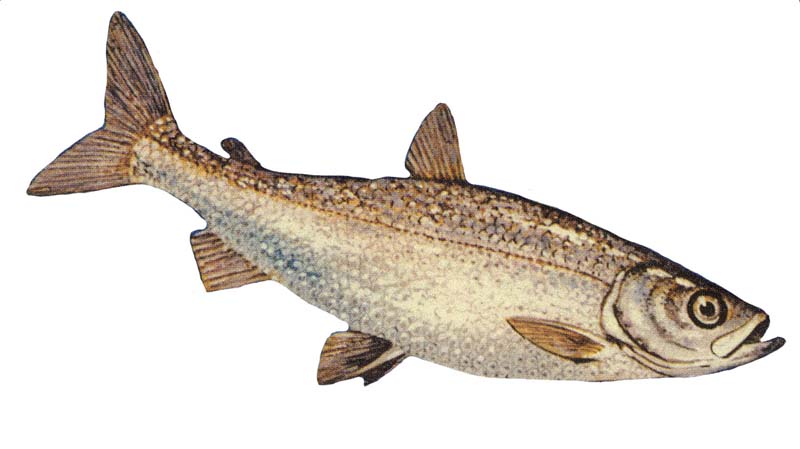
Coregonus sardinella inhabits freshwater and brackish waters, including rivers, estuaries, coastal waters, and large lakes. It has a slender body, a high separate dorsal fin, and a small adipose fin ahead of its deeply forked caudal fin.
Written 26 November 2026 from the sources listed below. Each statement was checked against the passage it cites; statements that could not be supported were removed.
Appearance
The least cisco has a slender body and a salmonid-like appearance. Its high, separate dorsal fin is followed by a small adipose fin positioned just ahead of its deeply forked caudal fin.[1][2]
Adult least ciscos generally have brownish to dark green backs, silvery lower sides and bellies, and pelvic fins ranging from dusky to black. Their lower jaws extend slightly beyond their upper jaws when their mouths are closed.[3][4][5]
Least ciscos living in the ocean have dark spots on their heads, backs, dorsal fins, and adipose fins. They can exceed 19 inches in length, although most individuals are smaller.[6][7]
Habitat
The least cisco inhabits freshwater and brackish waters, including rivers, estuaries, coastal waters, and large lakes.[8]
Least cisco eggs are deposited over gravel, sand, or rock substrates in rivers and lakes.[9]
Diet
The least cisco feeds on zooplankton, including copepods, cladocerans, crustaceans, and mysids. Its diet also includes aquatic insects, adult and larval insects, and small fishes.[10][11]
The least cisco may also consume plant material.[12]
Behaviour
Alaskan least cisco populations may be anadromous or remain in freshwater throughout their lives. Anadromous least ciscos generally migrate into freshwater systems between late spring and late summer.[13][14]
Adult least ciscos do not feed during spawning migrations. After hatching, young least ciscos descend downstream and feed and grow in river deltas, estuaries, and near-coastal river environments.[15][16]
Reproduction and life cycle
Riverine and lake-resident least cisco populations appear to spawn between late September and early October. Dwarf least ciscos appear to spawn from mid to late September.[17][18][19]
Least ciscos typically reach sexual maturity between three and eight years of age. Depending on her size, a female may release between 10,000 and 80,000 eggs.[20][21]
Least cisco eggs are negatively buoyant and non-adhesive. They presumably hatch in spring.[22][23]
Least ciscos may spawn in rivers, streams, lakes, and small ponds. They are known to spawn in the Chatanika, Alatna, and Innoko Rivers.[24][25]
Conservation
Potential overharvesting by commercial, recreational, and subsistence fisheries is identified as the main threat to least cisco populations. Dams and habitat degradation may also threaten the species because of its migratory behaviour.[26][27]
Climate-related ecological changes may adversely affect least cisco populations. Chatanika River least cisco populations have not recovered to their pre-1980s fishery-collapse abundance.[28][29]
Estimated harvest rates for least cisco in the Colville region averaged below 10 percent between 1985 and 1993.[30]
Uses
Least ciscos are part of subsistence fisheries in Alaska.[31]
Similar species
The least cisco is closely related to the European cisco, also known as vendace, and the Siberian peled whitefish. It has been argued to be conspecific with the European cisco.[32][33][34]
Classification of the Least Cisco
| Kingdom | Animalia |
|---|---|
| Phylum | Chordata |
| Subphylum | Vertebrata |
| Infraphylum | Gnathostomata |
| Parvphylum | Osteichthyes |
| Gigaclass | Actinopterygii |
| Superclass | Actinopteri |
| Class | Teleostei (Teleost) |
| Order | Salmoniformes |
| Family | Salmonidae (Trouts) |
| Subfamily | Coregoninae |
| Genus | Coregonus (Whitefishes) |
| Species | Coregonus sardinella Valenciennes, 1848 |
Where the Least Cisco is found
Checklists and occurrence records place Coregonus sardinella in 3 countries. GBIF holds 1,467 georeferenced records of it.
Countries
Regions and cities with the most records
- Northwest Territories, Canada 194
- Alaska, United States 183
- Nunavut, Canada 58
- Yukon, Canada 54
- British Columbia, Canada 8
- Whitehorse, Canada 6
- Chukotka, Russia 3
- Krasnoyarsk Krai, Russia 3
- Novyy Urengoy, Russia 3
A number beside a place is its count of GBIF occurrence records. A place without a number comes from a checklist alone. Records show where a species has been observed or collected, which can include escapes and vagrants.
Common names
English
- Least Cisco
- Sardine Cisco
Names in 2 other languages
- French
- cisco sardinelle
- Russian
- Сибирская ряпушка
Synonyms
6 other scientific names have been used for this species and are now treated as synonyms of Coregonus sardinella.
- Argyrosomus pusillus (Bean, 1889)
- Coregonus merkii Günther, 1866
- Coregonus pusillus Bean, 1889
- Coregonus sardinella sardinella Valenciennes in Cuvier & Valenciennes, 1848
- Leucichthys pusillus (Bean, 1889)
- Leucichthys sardinella (Valenciennes, 1848)
Related species
-
 VendaceCoregonus albula
-
 Lake WhitefishCoregonus clupeaformis
-
 OmulCoregonus migratorius
-
 European WhitefishCoregonus lavaretus
-
 CiscoCoregonus artedi
-
 GwyniadCoregonus pennantii
-
 BloaterCoregonus hoyi
-
 MuksunCoregonus muksun
Compare
Questions and answers
What is the scientific name of the Least Cisco?
The scientific name of the Least Cisco is Coregonus sardinella. Written with its author, the full name is Coregonus sardinella Valenciennes, 1848.
Which family does the Least Cisco belong to?
Coregonus sardinella belongs to the family Salmonidae, in the order Salmoniformes and the class Teleostei.
Where is the Least Cisco found?
Checklists and occurrence records place Coregonus sardinella in 3 countries: Canada, United States and Russia.
What is the conservation status of the Least Cisco?
The IUCN Red List category recorded for Coregonus sardinella is Least Concern (LC).
What other names does the Least Cisco have?
Coregonus sardinella is also known in English as Sardine Cisco.
Sources
Passages the profile rests on
- The least cisco has a slender body and a salmonid-like appearance. Source passage: “The least cisco is a slender salmonid-like fish up to 19 inches in total length.” — adfg.alaska.gov
- The least cisco has a high, separate dorsal fin and a small adipose fin positioned just ahead of its deeply forked caudal fin. Source passage: “Its dorsal fin is high and separate, while its small adipose fin is placed just anterior to its deeply forked caudal fin.” — adfg.alaska.gov
- Adult least ciscos have a lower jaw that extends slightly beyond the upper jaw when the mouth is closed. Source passage: “the lower jaw, which protrudes slightly beyond the upper jaw when the mouth is closed” — adfg.alaska.gov
- Adult least ciscos have pelvic fins that range from dusky to black. Source passage: “the pelvic fins, which are dusky to black in color.” — adfg.alaska.gov
- Adult least ciscos are generally brownish to dark green on their backs, with silvery lower sides and bellies. Source passage: “Adult least ciscos are generally brownish to dark green dorsally with silvery lower sides and belly.” — adfg.alaska.gov
- Least ciscos living in the ocean have dark spots on their heads, backs, dorsal fins, and adipose fins. Source passage: “In the ocean, least ciscos have dark spots on their head, back, dorsal, and adipose fins.” — adfg.alaska.gov
- The least cisco can exceed 19 inches in length, although most individuals are smaller. Source passage: “The least cisco is a slender, medium sized fish known to reach a length of over 19 inches, but is generally smaller.” — adfg.alaska.gov
- The least cisco inhabits freshwater and brackish waters, including rivers, estuaries, coastal waters, and large lakes. Source passage: “is a fresh- and brackishwater salmonid fish that inhabits rivers, estuaries and coastal waters of the marginal seas of the Arctic Basin, as well as some large lakes of those areas.” — English Wikipedia
- Least cisco eggs are deposited over gravel, sand, or rock substrates in rivers and lakes. Source passage: “Eggs are broadcast over substrate composed primarily of gravel, sand, or rock in both lotic (riverine) and lentic (lakes or ponds) environments.” — adfg.alaska.gov
- The least cisco feeds on zooplankton, including crustaceans, aquatic insects, and small fishes. Source passage: “Least cisco also feed on a variety of zooplankton including crustaceans, aquatic insects, and small fishes.” — adfg.alaska.gov
- The least cisco consumes copepods, cladocerans, mysids, adult and larval insects, and small fish. Source passage: “Zooplankton, including various copepods, cladocerans, mysids, the adults and larvae of a variety of insects, small fish.” — adfg.alaska.gov
- The least cisco may also consume plant material. Source passage: “Least cisco may also eat plant material.” — adfg.alaska.gov
- Alaskan least cisco populations may be anadromous or remain in freshwater throughout their lives. Source passage: “Least Cisco populations in Alaska may be anadromous, which means they spend part of their life in the ocean and part of their lives in fresh water or non-anadromous, spending their entire life in freshwater.” — adfg.alaska.gov
- Anadromous least ciscos generally migrate into freshwater systems between late spring and late summer. Source passage: “Anadromous least cisco typically migrates into freshwater systems in late spring to late summer to spawn.” — adfg.alaska.gov
- Adult least ciscos do not feed during spawning migrations. Source passage: “Adult least cisco does not feed during spawning migrations.” — adfg.alaska.gov
- Young least ciscos descend downstream after hatching and feed and grow in river deltas, estuaries, and near-coastal river environments. Source passage: “the young descend downstream to feed and rear in river deltas, estuaries, and nearly coastal environments of rivers which support whitefish populations.” — adfg.alaska.gov
- Riverine least cisco populations appear to spawn between late September and early October. Source passage: “Riverine populations of least cisco appear to spawn between late September and early October.” — adfg.alaska.gov
- Lake-resident least cisco populations also appear to spawn between late September and early October. Source passage: “Lake resident populations of least cisco, similar in size to riverine populations, also appear to spawn between late September and early October.” — adfg.alaska.gov
- Dwarf least ciscos appear to spawn from mid to late September. Source passage: “Dwarf least cisco, which mature younger and at a smaller size, appear to spawn from mid to late September.” — adfg.alaska.gov
- Least ciscos typically reach sexual maturity between three and eight years of age. Source passage: “Least cisco typically reaches sexual maturity between 3 to 8 years of age.” — adfg.alaska.gov
- Depending on her size, a female least cisco may release between 10,000 and 80,000 eggs. Source passage: “Depending on her size, a female least cisco may release from 10,000 to 80,000 eggs.” — adfg.alaska.gov
- Least cisco eggs are negatively buoyant and non-adhesive. Source passage: “Whitefish eggs are negatively buoyant and non-adhesive.” — adfg.alaska.gov
- Least cisco eggs presumably hatch in spring. Source passage: “The eggs presumably hatch in the spring” — adfg.alaska.gov
- Least ciscos may spawn in rivers, streams, lakes, and small ponds. Source passage: “Least cisco may spawn in rivers, streams, lakes, or small ponds.” — adfg.alaska.gov
- Least ciscos are known to spawn in the Chatanika, Alatna, and Innoko Rivers. Source passage: “Least cisco are known to spawn in sections of the Chatanika, Alatna, and Innoko Rivers.” — adfg.alaska.gov
- Potential overharvesting by commercial, recreational, and subsistence fisheries is identified as the main threat to least cisco populations. Source passage: “Potential overharvest from commercial, recreational, or subsistence fisheries is the main threat to the resource.” — adfg.alaska.gov
- Dams and habitat degradation may threaten least cisco because of its migratory behaviour. Source passage: “The migratory behavior of the least cisco makes the species particularly susceptible to obstructions such as dams or habitat degradation.” — adfg.alaska.gov
- Climate-related ecological changes may adversely affect least cisco populations. Source passage: “Other major ecological changes, such as those associated with the effects of global warming, could adversely affect least cisco populations.” — adfg.alaska.gov
- Chatanika River least cisco populations have not recovered to their pre-1980s fishery-collapse abundance. Source passage: “Chatanika River least cisco populations have not returned to the abundance observed before the collapse of the fishery during the 1980s.” — adfg.alaska.gov
- Estimated harvest rates for least cisco in the Colville region averaged below 10 percent between 1985 and 1993. Source passage: “Estimates of harvest rates for the Colville region indicate low to moderate harvest averaging less than 10% from 1985 to 1993.” — adfg.alaska.gov
- Least ciscos are part of subsistence fisheries in Alaska. Source passage: “Least cisco are part of subsistence fisheries in Alaska.” — usgs.gov
- The least cisco is closely related to the European cisco, also known as vendace. Source passage: “Coregonus sardinella is closely related to the European cisco or vendace Coregonus albula” — English Wikipedia
- The least cisco is closely related to the Siberian peled whitefish. Source passage: “and also is close to the Siberian peled whitefish C. peled.” — English Wikipedia
- The least cisco has been argued to be conspecific with the European cisco. Source passage: “Most recently, it has been argued to be the same species as the European cisco.” — English Wikipedia
Data
- Catalogue of Life, 2026-10-16 XR cc by
- Global Biodiversity Information Facility CC BY 4.0
- Wikidata CC0
- GeoNames CC BY 4.0
- Wikimedia Commons per image; credit shown with each image
- Within the Catalogue of Life, this name comes from World Register of Marine Species cc by
References
- Cuvier, G., & Valenciennes, A. (1848). Histoire naturelle des poissons. Tome vingt et unième. Suite du livre vingt et unième et des Clupéoïdes. Livre vingt-deuxième. De la famille des Salmonoïdes. Tome Vingt et Unième. Suite Du Livre Vingt et Unième et Des Clupéoïdes. Livre Vingt-Deuxième. De La Famille Des Salmonoïdes., v. 21: i–xiv + 1 p. + 1–536, Pls. 607–633. https://doi.org/10.1163/9789401210850_021 Link where the name was published
This species in other databases
- Catalogue of Life YDBM
- Wikidata Q2602952
- iNaturalist 1596902
- WoRMS urn:lsid:marinespecies.org:taxname:127181
- ITIS 161938
Page built on 28 November 2026. See how the catalog is made and all sources and licences.
Cite this page
ScientificNames.org. (2026). Coregonus sardinella (Least Cisco). Retrieved November 28, 2026, from https://scientificnames.org/species/coregonus-sardinella
“Coregonus sardinella (Least Cisco).” ScientificNames.org, 2026, scientificnames.org/species/coregonus-sardinella. Accessed 28 Nov. 2026.
ScientificNames.org. “Coregonus sardinella (Least Cisco).” Accessed November 28, 2026. https://scientificnames.org/species/coregonus-sardinella.
@misc{scientificnames_coregonus_sardinella_least_cisco,
  author = {{ScientificNames.org}},
  title = {Coregonus sardinella (Least Cisco)},
  year = {2026},
  url = {https://scientificnames.org/species/coregonus-sardinella},
  note = {Accessed 2026-11-28}
}