Species · Flowering plants
Coriander Coriandrum sativum
The scientific name of the Coriander is Coriandrum sativum. It is a species of flowering plant in the family Apiaceae (umbellifer), order Apiales.
- Scientific name
- Coriandrum sativum L.
- Common name
- Coriander
- Genus
- Coriandrum
- Family
- Apiaceae (Umbellifer)
- Order
- Apiales
- Class
- Magnoliopsida
- Recorded in
- 124 countries
- Name status
- accepted in the Catalogue of Life
Overview
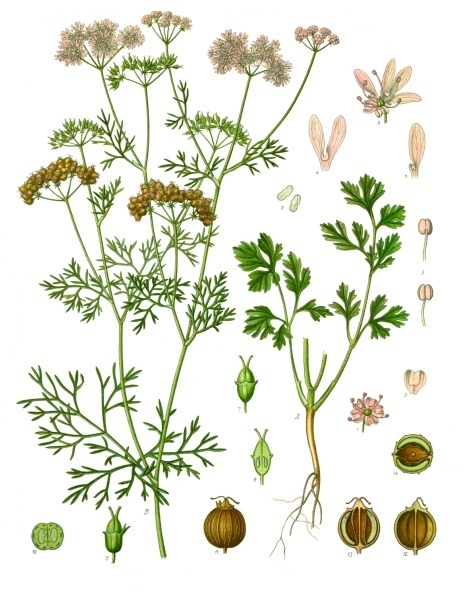
Coriandrum sativum is native to the Mediterranean Basin and grows wild across West Asia and Southern Europe. It has variable leaves, small white or pale pink flowers and globular dry fruits containing seeds.
Written 24 November 2026 from the sources listed below. Each statement was checked against the passage it cites; statements that could not be supported were removed.
Appearance
Coriander is a soft, erect annual herb with a predominant taproot system and thin, soft, branching stems. It can reach a height of 50 cm.[1][2][3]
Its leaves are glabrous and variable in shape. Basal leaves are broadly lobed, while leaves higher on flowering stems are slender and feathery.[4][5]
Its flowers are white or very pale pink and grow in small umbels. They are asymmetrical, with outward-facing petals longer than inward-facing petals.[6][7]
Its leaves, flowers, stems, fruits and seeds contain essential oil.[8]
Habitat
Coriander grows in frost-free, relatively dry tropical and subtropical climates. It occurs in gardens, open spaces, plains, hills and along railroads.[9][10]
It grows well in loamy soil with good drainage and a pH of 8–10. It grows well with average rainfall of 75–100 mm and temperatures of 15–28 °C.[11][12]
The species grows in sunny or lightly shaded locations and particularly well in containers because it prefers free-draining growing conditions.[13][14]
It is cultivated in summer in temperate regions and during cooler seasons in tropical and subtropical regions.[15]
Reproduction and life cycle
Coriander reproduces as an annual plant and dies after setting seed. It flowers when temperatures increase, and hot, dry weather causes it to flower sooner.[16][17][18]
The species can be propagated from seeds sown outdoors in spring or later. Seeds generally germinate within one to three weeks, depending on outdoor temperatures.[19][20]
Each sowing can produce several harvests before flowering begins. Successive small batches can be sown to maintain a continuous supply of leaves.[21][22]
After flowering begins, the species concentrates its growth on seed production. Seeds can be collected for sowing in the following year.[23][24]
Uses
All parts of Coriander are edible. Fresh leaves and dried seeds are the plant parts most commonly used in cooking.[25][26]
The leaves are used in chutneys, salads, salsa and guacamole. They are also used as garnishes for soups, fish and meat.[27][28]
The roots are used in Asian cuisines, particularly in Thai soups and curry pastes. The leaves are also used as a vegetable and in salads.[29][30]
The seeds are used as a spice in garam masala and Indian curries, and in pickling and brining processes. They also flavor certain styles of beer, including Belgian wheat beers, and are among the botanicals used to flavor gin.[31][32][33][34]
The essential oil is used as a flavoring agent and for food preservation. It is investigated for antimicrobial, antioxidant, insecticidal and other biological activities.[35][36]
Similar species
Eryngium foetidum has a similar but more intense taste to Coriander. Persicaria odorata has leaves with an odour and flavour similar to Coriander.[37][38]
Classification of the Coriander
| Kingdom | Plantae |
|---|---|
| Subkingdom | Pteridobiotina |
| Phylum | Tracheophyta |
| Class | Magnoliopsida |
| Order | Apiales |
| Family | Apiaceae (Umbellifer) |
| Subfamily | Apioideae |
| Tribe | Coriandreae |
| Genus | Coriandrum (Cilantro) |
| Species | Coriandrum sativum L. |
Where the Coriander is found
Checklists and occurrence records place Coriandrum sativum in 124 countries across Africa, Asia, Europe, North America, Oceania and South America. GBIF holds 16,956 georeferenced records of it.
Countries where it is native or its origin is not stated
- Afghanistan 41
- Belgium 597
- Bulgaria 10
- Chad
- Cyprus 15
- Czechia 161
- Denmark 154
- Egypt 52
- Estonia 70
- Ethiopia 437
- Finland 116
- Greece 11
- Hong Kong 8
- India 398
- Indonesia 31
- Iran 26
- Iraq 9
- Isle of Man 3
- Israel 237
- Kenya 7
- Kuwait 5
- Kyrgyzstan 5
- Latvia 3
- Lebanon 5
- Lithuania 11
- Luxembourg 16
- Madagascar 7
- Malta 5
- Mayotte 4
- Nepal 14
- Norway 116
- Oman 22
- Palestinian Territory 16
- Reunion 12
- Russia 480
- Saudi Arabia 17
- Slovenia 9
- Somalia 6
- Sweden 828
- Syria 41
- Tanzania 11
- The Netherlands 728
- Turkey 61
- Uganda 5
- Yemen 10
Countries where it has been introduced
- Algeria 55
- Angola 3
- Argentina 131
- Armenia 54
- Australia 68
- Austria 231
- Azerbaijan 68
- Bangladesh 7
- Belarus 31
- Belize 1
- Benin 3
- Bhutan 15
- Bolivia 13
- Brazil 429
- Cabo Verde 1
- Cambodia
- Cameroon 7
- Canada 85
- Central African Republic
- Chile 43
- China 804
- Colombia 127
- Costa Rica 10
- Croatia 11
- Cuba 15
- Dominican Republic 11
- Ecuador 84
- El Salvador 8
- Fiji 8
- France 1,885
- Georgia 119
- Germany 1,579
- Guatemala 39
- Haiti
- Honduras 7
- Hungary 59
- Ireland 6
- Italy 320
- Japan 102
- Kazakhstan 59
- Kosovo 1
- Laos 11
- Libya 12
- Mauritius 5
- Mexico 589
- Mongolia 7
- Montenegro
- Morocco 90
- Mozambique 1
- Myanmar 5
- New Zealand 81
- North Macedonia 1
- Pakistan 137
- Paraguay 31
- Peru 63
- Philippines
- Poland 156
- Portugal 292
- Puerto Rico 21
- Romania 60
- Serbia 4
- Slovakia 34
- South Africa 66
- South Korea 106
- Spain 493
- Sudan 24
- Switzerland 390
- Taiwan 33
- Tajikistan 15
- Thailand 56
- Trinidad and Tobago
- Tunisia 18
- Turkmenistan 1
- Ukraine 106
- United Kingdom 1,640
- United States 1,023
- Uzbekistan 31
- Vietnam 34
- Zimbabwe 1
Regions and cities with the most records
- England, United Kingdom 1,343
- Bavaria, Germany 334
- Auvergne-Rhône-Alpes, France 279
- Île-de-France, France 278
- Hesse, Germany 201
- North Rhine-Westphalia, Germany 178
- Baden-Wurttemberg, Germany 176
- Occitanie, France 165
- Clichy, France 161
- Levallois-Perret, France 161
- Nanterre, France 161
- Paris 07 Palais-Bourbon, France 159
- Suresnes, France 159
- Colombes, France 158
- Courbevoie, France 158
- Neuilly-sur-Seine, France 158
- Rueil-Malmaison, France 158
- Issy-les-Moulineaux, France 157
- Maison Blanche, France 156
- Paris, France 156
- Paris 05 Panthéon, France 156
- Paris 09 Opéra, France 156
- Paris 10 Entrepôt, France 156
- Paris 13 Gobelins, France 156
- Paris 14 Observatoire, France 156
- Saint-Denis, France 156
- Texas, United States 156
- Asnières-sur-Seine, France 155
- Paris 11 Popincourt, France 155
- Épinay-sur-Seine, France 155
- Clamart, France 154
- Paris 15 Vaugirard, France 154
- Paris 12 Reuilly, France 153
- Paris 20 Ménilmontant, France 152
- Argenteuil, France 151
- Boulogne-Billancourt, France 151
6 more countries have a few records outside this range
These countries hold a few records of Coriandrum sativum but lie outside the range the checklists give for it. Such records are often zoo or garden specimens, museum material or vagrants, so the species is not counted as occurring there.
Range as the checklists state it
England [I] (England [I], Wales [I], Isle of Man [I], Scotland [I], Isles of Scilly [I]); Ireland [I] (Ireland [I]); Germany [I]; Switzerland [I]; Austria [I]; Poland [I]; Slovakia [I]; Hungary [I]; Portugal [I]; Spain [I]; France [I]; Channel Isl. [I]; Italy [I]; Sicily [I]; Croatia [I]; Bosnia & Hercegovina [I]; Montenegro [I]; Serbia [I]; Kosovo [I]; North Macedonia [I]; Romania [I]; European Turkey; Greece (scattered in lowlands); Crete (rare); Estonia [c]; Latvia [c]; Lithuania [c]; Belarus [I]; European Russia [I]; Ukraine [I]; Crimea [I]; Morocco [I]; Algeria [I]; Tunisia [I]; Libya [I]; Egypt (Desert Oases, Great Southwestern Desert, Nile Delta, Nile Valley, NW-coastal Egypt); Azores [I] (Sao Miguel Isl. [I], Terceira [I], Faial [I]); Madeira [I] (Madeira Isl. [I], Porto Santo Isl. [I]); Canary Isl. [I] (Lanzarote [I], Fuerteventura [I], Gran Canaria [I], Tenerife [I], La Gomera [I], Hierro [I]); Cape Verde Isl. [I] (Santo Antao Isl. [I], Sao Vicente Isl. [I]); Benin [I]; Cameroon [I]; Central African Republic [I]; Chad [c]; Sudan [I]; Angola [I]; Zimbabwe [I]; Mozambique [I]; South Africa [I]; Mauritius [I]; La Réunion [I]; Rodrigues [I]; Siberia [I] (W-Siberia [I], NW-Siberia [I], SW-Siberia [I]); Russian Far East [I] (Khabarovsk [I], Primorye [I]); Kazakhstan [I]; Turkmenistan [I]; Uzbekistan [I]; Tajikistan [I]; Northern Caucasus [I]; Georgia [Caucasus] [I]; Armenia [I]; Azerbaijan [I]; East Aegaean Isl. (Kalimnos, Kos, Rhodos); Turkey (N-Anatolia, S-Anatolia, SE-Anatolia, WN-Anatolia); Iraq (SE-Iraq: Mesopotamia); Iran (EC-Iran, Iranian Aserbaijan, W-Iran); Afghanistan (Wakhan, Herat, Kabul, Kandahar, Kunar / Nuristan, Nangarhar); Cyprus (C-Mountains, E-Cyprus, N-Cyprus, S-Cyprus, W-Cyprus); Lebanon (coastal W-Lebanon); Syria (coastal W-Syria); Israel (coastal W-Israel, Rift Valley, N-Israel); Sinai peninsula (N-Sinai, S-Sinai); Jordania (W-Jordania); Saudi Arabia (NE-Saudi Arabia, Hejaz, Nejd Desert); Yemen (N-Inner Yemen); China [I]; Mongolia [I]; South Korea [I]; Japan [I]; Taiwan [I]; Pakistan [I]; Nepal [c]; Bhutan [I]; India [c]; Bangladesh [I]; Andaman Isl. [I]; Nicobar Isl. [I]; Myanmar [I]; Thailand [I]; Laos [I]; Cambodia [I]; Vietnam [I]; Philippines [I]; Sulawesi [I]; Jawa [I]; Lesser Sunda Isl. [I]; Moluccas [I]; Australia [I] (Queensland [I]); New Zealand [I]; Chatham Isl. [I]; Fiji [I]; Cook Isl. [I] (Rarotonga [I]); Hawaii [I] (Kauai [I], Oahu [I], East Maui [I]); Canada [I] (Nova Scotia [I], Ontario [I], Québec [I]); USA [I] (Arizona [I], California [I], Connecticut [I], Delaware [I], Florida [I], Illinois [I], Louisiana [I], Massachusetts [I], Maryland [I], Michigan [I], Missouri [I], Montana [I], North Carolina [I], North Dakota [I], New Jersey [I], New Mexico [I], Nevada [I], New York [I], Ohio [I], Oklahoma [I], Oregon [I], Pennsylvania [I], Rhode Island [I], South Carolina [I], South Dakota [I], Tennessee [I], Texas [I], Virginia [I], Washington State [I]); Mexico [I]; Guatemala [I]; Belize [I]; El Salvador [I]; Honduras [I]; Costa Rica [I]; Cuba [I]; Dominican Republic [I]; Haiti [I]; Puerto Rico [I]; Trinidad & Tobago [I]; Colombia [I]; Ecuador [I]; Peru [I]; Bolivia [I]; Brazil [I]; Paraguay [I]; Argentina [I] (Chaco [I], Chubut [I], Santa Cruz Prov. [I]); Chile [I] (Los Lagos [I]); Juan Fdz. Isl. [I]
A number beside a place is its count of GBIF occurrence records. A place without a number comes from a checklist alone. Records show where a species has been observed or collected, which can include escapes and vagrants.
Common names
English
- Coriander
- Chinese Parsley
- Chinese-parsley
- Cilantro
Names in 86 other languages
- Afrikaans
- koljander, koljandersaad
- Albanian
- Korianderi
- Arabic
- كزبرة
- Armenian
- Գինձ, համեմ
- Azerbaijani
- Keşniş
- Basque
- Martorri
- Belarusian
- Каляндра пасяўная
- Bengali
- ধনে
- Breton
- Koriandrez
- Bulgarian
- Кориандър
- Burmese
- နံနံပင်
- Cebuano
- Kulantro
- Chinese
- yan sui, 芫茜, 芫荽
- Croatian
- Sjetveni korijandar
- Czech
- koriandr setý
- Dutch
- Koriander
- Esperanto
- Koriandro, Kultiva koriandro
- Estonian
- Aedkoriander
- Finnish
- Korianteri, maustekorianteri
- French
- coriandre, coriandre cultivé, coriandre cultivée
- Galician
- Coandro
- German
- Echter Koriander
- Greek
- Κορίανδρον το ήμερον
- Gujarati
- કોથમીર
- Hebrew
- גד השדה, כוסברה
- Hindi
- dhaniya, धनिया
- Hungarian
- kerti koriander
- Icelandic
- Kóríandrajurt
- Indonesian
- ketumbar
- Irish
- Lus an choire
- Italian
- coriandolo
- Japanese
- コエンドロ, コリアンダー
- Kannada
- ಕೊತ್ತುಂಬರಿ
- Kazakh
- Егістік күнзе
- Korean
- 고수
- Latvian
- Koriandrs
- Lithuanian
- Blakinė kalendra
- Macedonian
- Коријандер
- Malayalam
- മല്ലി
- Marathi
- कोथिंबीर
- Mongolian
- Таримал үсүү
- Nepali
- धनियाँ
- Persian
- گشنیز
- Polish
- Kolendra siewna
- Portuguese
- coentro, coriandro
- Punjabi
- ਧਨੀਆ
- Romanian
- Coriandru
- Russian
- Кориандр посевной
- Scottish Gaelic
- Coireaman
- Sinhala
- කොත්තමල්ලි
- Slovak
- koriander siaty
- Spanish
- culantro
- Swedish
- koriander
- Tagalog
- Unsoy, Wansoy
- Tamil
- கொத்தமல்லி
- Telugu
- ధనియాలు
- Thai
- ผักชี
- Turkish
- Kişniş
- Ukrainian
- Коляндра сійна, Коріандр
- Vietnamese
- Rau mùi
- Welsh
- Brwysgedlys, Llysiau'r Bara
- amh
- ድምብላል
- arz
- كزبره
- asm
- ধনিয়া
- bod
- འུ་སུ།
- bos
- Korijander
- csb
- Séwny kòlãder
- div
- ކޮތަނބިރި
- hbs
- Korijandar
- kir
- Кориандр
- kur
- Gijnîj
- nap
- Petiáttera
- ori
- ଧଣିଆ
- oss
- Чиндзи
- pam
- Ongsoy
- pnb
- دھنیا
- que
- Kulantru
- san
- कुस्तुम्बरी
- sco
- Corrydander
- snd
- ڌاڻا
- som
- Kamsar
- sun
- Katuncar
- tcy
- ಕೊತ್ತಂಬರಿ
- tgk
- Кашнич
- wuu
- 香菜
- xmf
- ქინძი
Synonyms
25 other scientific names have been used for this species and are now treated as synonyms of Coriandrum sativum.
- Bifora loureiroi Kostel.
- Coriandropsis syriaca H.Wolff
- Coriandrum diversifolium Gilib.
- Coriandrum globosum Salisb.
- Coriandrum majus Gouan
- Coriandrum majus Garsault
- Coriandrum melphitense Guss. & Ten.
- Coriandrum saticum L.
- Coriandrum sativum subsp. asiaticum Stolet.
- Coriandrum sativum subsp. indicum Stolet.
- Coriandrum sativum subsp. vavilovii Stolet.
- Coriandrum sativum var. afghanicum Stolet.
- Coriandrum sativum var. africanum Stolet.
- Coriandrum sativum var. anatolicum Stolet.
- Coriandrum sativum var. arabicum Stolet.
- Coriandrum sativum var. asiaticum Stolet.
- Coriandrum sativum var. indicum Stolet.
- Coriandrum sativum var. melphitense (Ten. & Guss.) Thell.
- Coriandrum sativum var. microcarpum DC.
- Coriandrum sativum var. pygmaeum Stolet.
- Coriandrum sativum var. vavilovii Stolet.
- Coriandrum sativum var. vulgare Alef.
- Cuminum cyminum Wall.
- Selinum coriandrum (Vest) E.H.L.Krause
- Sium coriandrum Vest
Related species
- Coriandrum tordylium
-
 HemlockConium maculatum
-
 FennelFoeniculum vulgare
-
 AnisePimpinella anisum
-
 CuminCuminum cyminum
-
 CarawayCarum carvi
-
 ParsnipPastinaca sativa
-
 ParsleyPetroselinum crispum
Compare
Questions and answers
What is the scientific name of the Coriander?
The scientific name of the Coriander is Coriandrum sativum. Written with its author, the full name is Coriandrum sativum L..
Which family does the Coriander belong to?
Coriandrum sativum belongs to the family Apiaceae, in the order Apiales and the class Magnoliopsida.
Where is the Coriander found?
Checklists and occurrence records place Coriandrum sativum in 124 countries, including Sweden, The Netherlands, Belgium, Russia, Ethiopia and India.
What other names does the Coriander have?
Coriandrum sativum is also known in English as Chinese Parsley, Chinese-parsley and Cilantro.
Are cilantro and coriander the same?
Cilantro and coriander are English names recorded for Coriander, the species Coriandrum sativum L.[1]
What is coriander called in America?
Cilantro is one of the English names recorded for Coriander.[1]
Why is coriander called cilantro?
The English word coriander derives from Old French coriandre, which originated from Latin coriandrum.[39]
What environment does coriander grow in?
Coriander grows in frost-free, relatively dry tropical and subtropical climates. It grows well in loamy, well-drained soil with a pH of 8–10, average rainfall of 75–100 mm and temperatures of 15–28 °C. It grows in sunny or lightly shaded locations.[9][11][12][14]
Is coriander a fruit or vegetable?
Coriander is a flowering plant. Its fruits are globular dry schizocarps measuring 3–5 mm in diameter, and its leaves are used as a vegetable.[1][40][30]
Sources
Passages the profile rests on
- Coriandrum sativum is a soft, erect annual herb with variable leaf shapes. Source passage: “It is a soft plant growing to 50 cm (20 in) tall. The leaves are variable in shape” — English Wikipedia
- The plant can reach a height of 50 cm. Source passage: “It is a soft plant growing to 50 cm (20 in) tall.” — English Wikipedia
- The plant has a predominant taproot system and thin, soft, branching stems. Source passage: “This erect annual herb has a predominant taproot system and thin, soft branching stems” — pmc.ncbi.nlm.nih.gov
- Its basal leaves are broadly lobed, while leaves higher on flowering stems are slender and feathery. Source passage: “broadly lobed at the base of the plant, and slender and feathery higher on the flowering stems.” — English Wikipedia
- Its leaves are glabrous, lanceolate, lobed and variable in shape. Source passage: “The pale/dark green leaves are glabrous, lanceolate, lobed, and variable in shape.” — pmc.ncbi.nlm.nih.gov
- Its flowers are white or very pale pink and grow in small umbels. Source passage: “The flowers are borne in small umbels, white or very pale pink” — English Wikipedia
- Its flowers are asymmetrical, with outward-facing petals longer than inward-facing petals. Source passage: “with the petals pointing away from the centre of the umbel longer (5–6 mm” — English Wikipedia
- Its leaves, flowers, stems, fruits and seeds contain essential oil. Source passage: “Coriandrum sativum L. is one such high EO bearing medicinal plant that contains EO in its leaves, stems, flowers, fruits, and seeds.” — pmc.ncbi.nlm.nih.gov
- The species grows in frost-free, relatively dry tropical and subtropical climates. Source passage: “Coriandrum sativum is a tropical crop that thrives best in a frost-free, relatively dry tropical and subtropical climate.” — pmc.ncbi.nlm.nih.gov
- The species grows in gardens, open spaces, plains, hills and along railroads. Source passage: “including gardens, open spaces, plains, hills, and railroads” — pmc.ncbi.nlm.nih.gov
- The species grows well in loamy soil with good drainage and a pH of 8–10. Source passage: “The plant prefers to grow in loamy soil that drains well with a soil pH of 8–10.” — pmc.ncbi.nlm.nih.gov
- The species grows well with average rainfall of 75–100 mm and temperatures of 15–28 °C. Source passage: “It grows well in a climate with an average rainfall of 75–100 mm and a temperature between 15–28 ℃.” — pmc.ncbi.nlm.nih.gov
- The species grows particularly well in containers because it prefers free-draining growing conditions. Source passage: “Coriander grows particularly well in containers, as it likes the free-draining conditions.” — rhs.org.uk
- The species grows in sunny or lightly shaded locations. Source passage: “Sow coriander seeds from spring to autumn in a sunny or lightly shaded spot” — rhs.org.uk
- The species is cultivated in summer in temperate regions and during cooler seasons in tropical and subtropical regions. Source passage: “The best season to grow coriander is summer in temperate zones and cooler season in subtropical/tropical zones” — pmc.ncbi.nlm.nih.gov
- The species reproduces as an annual plant and dies after setting seed. Source passage: “As coriander is an annual, plants will die after setting seed.” — rhs.org.uk
- Hot, dry weather causes the species to flower sooner. Source passage: “This will happen sooner in hot, dry weather” — rhs.org.uk
- The species flowers when temperatures increase. Source passage: “Flowering usually occurs when the temperatures increase.” — chhs.colostate.edu
- The species can be propagated from seeds sown outdoors in spring or later. Source passage: “Coriander is easy to grow from seed sown outdoors, in the ground or in containers , from spring onwards.” — rhs.org.uk
- Seeds generally germinate within one to three weeks, depending on outdoor temperatures. Source passage: “takes one to three weeks, depending on outdoor temperatures.” — rhs.org.uk
- Each sowing can produce several harvests before flowering begins. Source passage: “Each sowing should give you several harvests before the plants start to flower.” — rhs.org.uk
- The species can be sown in successive small batches to maintain a continuous supply of leaves. Source passage: “sow small batches every few weeks (known as successional sowing ) for continual harvests” — rhs.org.uk
- The species concentrates its growth on seed production after flowering begins. Source passage: “plants will then stop producing leaves to concentrate on setting seed.” — rhs.org.uk
- The species can be allowed to produce seeds for sowing in the following year. Source passage: “It’s worth leaving a few plants to go to seed though, to provide you with some to sow next year.” — rhs.org.uk
- All parts of the species are edible. Source passage: “All parts of the plant are edible.” — English Wikipedia
- Fresh leaves and dried seeds are the plant parts most commonly used in cooking. Source passage: “The fresh leaves and dried seeds are the most commonly used in cooking.” — English Wikipedia
- The leaves are used in chutneys, salads, salsa and guacamole. Source passage: “such as chutneys and salads, salsa, guacamole” — English Wikipedia
- The leaves are used as garnishes for soups, fish and meat. Source passage: “as a widely used garnish for soup, fish, and meat.” — English Wikipedia
- The roots are used in Asian cuisines, particularly in Thai soups and curry pastes. Source passage: “are used in a variety of Asian cuisines, particularly in Thai dishes such as soups or curry pastes.” — English Wikipedia
- The leaves are used as a vegetable and in salads. Source passage: “is used as a vegetable and in salads” — pmc.ncbi.nlm.nih.gov
- The seeds are used as a spice in garam masala and Indian curries. Source passage: “Coriander seed is a spice in garam masala, and Indian curries” — English Wikipedia
- The seeds are used in pickling and brining processes. Source passage: “Coriander seeds are employed in pickling and brining processes.” — pmc.ncbi.nlm.nih.gov
- The seeds are used to flavor certain styles of beer, including Belgian wheat beers. Source passage: “Coriander seeds are used in brewing certain styles of beer, particularly some Belgian wheat beers.” — English Wikipedia
- The seeds are among the botanicals used to flavor gin. Source passage: “Coriander seeds are one of the key botanicals used to flavor gin.” — English Wikipedia
- The essential oil is used as a flavoring agent and for food preservation. Source passage: “It is also used as a flavoring agent and for food preservation.” — pmc.ncbi.nlm.nih.gov
- The essential oil is investigated for antimicrobial, antioxidant, insecticidal and other biological activities. Source passage: “such as antimicrobial, anthelmintic, insecticidal, allelopathic, antioxidant” — pmc.ncbi.nlm.nih.gov
- Eryngium foetidum has a similar but more intense taste to this species. Source passage: “Eryngium foetidum, also a member of the Apiaceae, has a similar but more intense taste.” — English Wikipedia
- Persicaria odorata has leaves with an odour and flavour similar to this species. Source passage: “The leaves have a similar odour and flavour to coriander.” — English Wikipedia
- The English word coriander derives from Old French coriandre, which originated from Latin coriandrum. Source passage: “the word "coriander" derives from the Old French coriandre, which comes from Latin coriandrum” — English Wikipedia
- Its globular dry schizocarp fruits measure 3–5 mm in diameter. Source passage: “The fruit is a globular, dry schizocarp 3–5 mm” — English Wikipedia
- The species is native to the Mediterranean Basin. Source passage: “The species is native to the Mediterranean Basin.” — English Wikipedia
- The species grows wild across a wide area of West Asia and Southern Europe. Source passage: “It grows wild over a wide area of West Asia and Southern Europe” — English Wikipedia
Data
- Catalogue of Life, 2026-10-16 XR cc by
- Global Biodiversity Information Facility CC BY 4.0
- Wikidata CC0
- GeoNames CC BY 4.0
- Wikimedia Commons per image; credit shown with each image
- Within the Catalogue of Life, this name comes from Synonymic Checklists of the Vascular Plants of the World cc by
References
- L. (1753). Sp. Pl. [Linnaeus] 1: 256 (1753). where the name was published
This species in other databases
Page built on 24 November 2026. See how the catalog is made and all sources and licences.
Cite this page
ScientificNames.org. (2026). Coriandrum sativum (Coriander). Retrieved November 24, 2026, from https://scientificnames.org/species/coriandrum-sativum
“Coriandrum sativum (Coriander).” ScientificNames.org, 2026, scientificnames.org/species/coriandrum-sativum. Accessed 24 Nov. 2026.
ScientificNames.org. “Coriandrum sativum (Coriander).” Accessed November 24, 2026. https://scientificnames.org/species/coriandrum-sativum.
@misc{scientificnames_coriandrum_sativum_coriander,
  author = {{ScientificNames.org}},
  title = {Coriandrum sativum (Coriander)},
  year = {2026},
  url = {https://scientificnames.org/species/coriandrum-sativum},
  note = {Accessed 2026-11-24}
}