Species · Flowering plants
Jubata Grass Cortaderia jubata
The scientific name of the Jubata Grass is Cortaderia jubata. It is a species of flowering plant in the family Poaceae (turf), order Poales.
- Scientific name
- Cortaderia jubata (Lemoine) Stapf
- Common name
- Jubata Grass
- Genus
- Cortaderia
- Family
- Poaceae (Turf)
- Order
- Poales
- Class
- Liliopsida
- Recorded in
- 10 countries
- Name status
- accepted in the Catalogue of Life
Overview
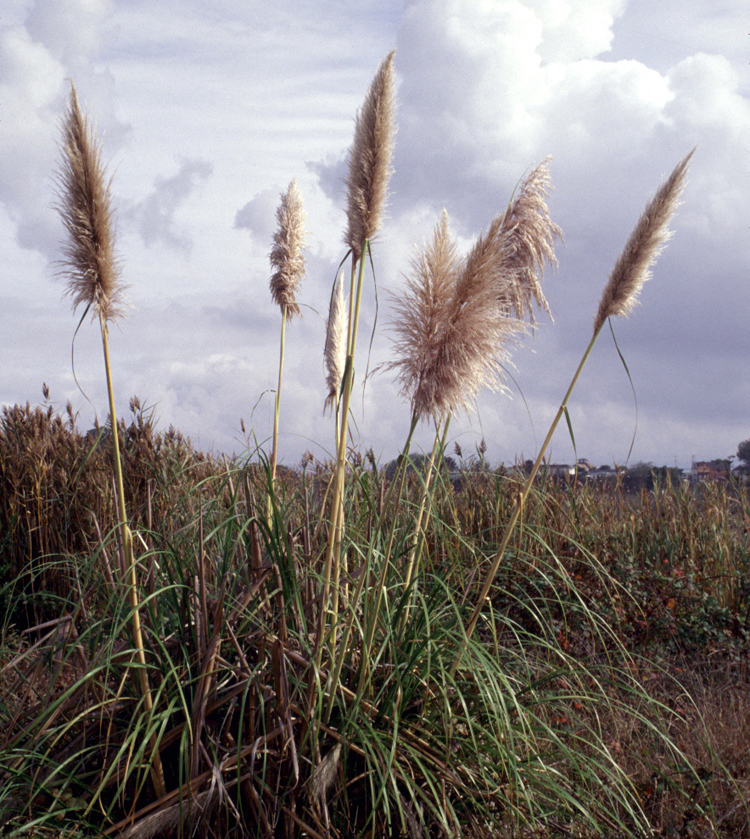
Jubata Grass (Cortaderia jubata) is a flowering plant in the family Poaceae, order Poales, and class Liliopsida. The species is native to the northern Andes and grows in cool, moist coastal areas. Its pinkish flowering plumes and long, sharp-edged leaves distinguish its appearance.
Written 26 November 2026 from the sources listed below. Each statement was checked against the passage it cites; statements that could not be supported were removed.
Appearance
Jubata Grass has long, thin leaves with razor-sharp edges that form a large tussock. Mature leaves are bright green and extend both upward and horizontally, with sharp edges capable of cutting exposed skin.[1][2][3]
Its inflorescences consist of plume-like spikelets growing at the tops of tall stems. Flowering panicles are pink or purplish when young and gradually become cream or white, while mature flowering plumes fade to pinkish or tan.[4][5][6]
Habitat
Jubata Grass grows in cool, moist coastal areas. Its documented habitats include dunes, drainage ditches, roadsides, cut slopes, and forestry operations.[7][8]
The species readily establishes on bare soil where competition from other plants is limited. It forms dense clumps along steep cliffs, riverbanks, roadsides, and disturbed open areas.[9][10]
Behaviour
The species can form dense stands that impede access and increase fire risk. Mature plants develop robust root systems that can require heavy equipment for removal.[11][12]
Reproduction and life cycle
All individuals of Jubata Grass are female. The species reproduces through apomixis, allowing embryos to develop without fertilization, and produces viable seeds despite having effectively all-female flowers.[13][14][15]
An individual plant produces millions of seeds annually, and each flowering plume can produce approximately 100,000 seeds. Its seeds are shorter than 0.1 inches.[16][17][18]
Seeds require moist bare ground in spring to germinate and establish. They remain viable for less than six months.[19][20]
Conservation
Jubata Grass occurs as an invasive weed in coastal areas of the western United States. It is established in California's Redwood National and State Parks, Central Coast region, and Big Sur, following its introduction to California several decades ago.[21][22][23]
The species is listed as an invasive alien species of Union concern in the European Union. Commercial sale, propagation, and distribution are prohibited under New Zealand's National Pest Plant Accord.[24][25]
The species contributes to wildfire hazards through the accumulation of dry foliage. Its sharp leaves can physically injure animals and humans, and its dense growth can clog waterways and wetlands.[26][27][28]
Uses
Jubata Grass was formerly used by logging companies as a barrier to prevent deer from eating reforested areas.[29]
Similar species
Jubata Grass is morphologically similar to Cortaderia selloana. Its pinkish flowering plumes help distinguish it from that species.[30][31]
Classification of the Jubata Grass
| Kingdom | Plantae |
|---|---|
| Subkingdom | Pteridobiotina |
| Phylum | Tracheophyta |
| Class | Liliopsida |
| Order | Poales |
| Family | Poaceae (Turf) |
| Genus | Cortaderia (Pampas Grass) |
| Species | Cortaderia jubata (Lemoine) Stapf |
Where the Jubata Grass is found
Checklists and occurrence records place Cortaderia jubata in 10 countries across Africa, North America, Oceania and South America. GBIF holds 11,678 georeferenced records of it.
Countries where it is native or its origin is not stated
Countries where it has been introduced
Regions and cities with the most records
- Hawaii, United States 8,735
- Kīhei, United States 3,088
- Kahului, United States 2,213
- Wailuku, United States 2,209
- California, United States 1,550
- Marina, United States 721
- Seaside, United States 718
- Monterey, United States 717
- Pacific Grove, United States 717
- Salinas, United States 693
- Prunedale, United States 363
- South San Francisco, United States 186
- San Bruno, United States 177
- Millbrae, United States 170
- Pacifica, United States 166
- Daly City, United States 159
- Auckland, New Zealand 157
- Burlingame, United States 157
- San Mateo, United States 154
- Tasmania, Australia 151
- Bayview-Hunters Point, United States 138
- San Francisco, United States 123
- McKinleyville, United States 119
- Avondale, New Zealand 106
- New Lynn, New Zealand 105
- Foster City, United States 101
- Mount Eden, New Zealand 96
- Belmont, United States 95
- Arcata, United States 92
- Bayside, United States 89
- Oakland, United States 88
- Live Oak, United States 86
- Santa Cruz, United States 86
- New South Wales, Australia 85
- Auckland, New Zealand 84
- Eureka, United States 82
1 more country has a few records outside this range
These countries hold a few records of Cortaderia jubata but lie outside the range the checklists give for it. Such records are often zoo or garden specimens, museum material or vagrants, so the species is not counted as occurring there.
A number beside a place is its count of GBIF occurrence records. A place without a number comes from a checklist alone. Records show where a species has been observed or collected, which can include escapes and vagrants.
Common names
English
- Jubata Grass
- Andean Pampas Grass
- Purple Pampas
- Pampas Grass
- Pink Pampas Grass
- Purple Pampas Grass
Names in 8 other languages
- Afrikaans
- Pampa, Perspampasgras, pampasgras
- Dutch
- Hoog pampagras, hoog pampasgras
- Finnish
- rusopampaheinä
- German
- Anden-Pampasgras, Purpur-Pampasgras, Rosa Pampasgrasköpfchen
- Russian
- Кортадерия гривастая
- Slovak
- kortadéria hrivnatá
- Spanish
- Pasto morado de la pampa, sacuara
- Swedish
- andinskt pampasgräs
Synonyms
4 other scientific names have been used for this species and are now treated as synonyms of Cortaderia jubata.
- Cortaderia selloana subsp. jubata (Lemoine) Testoni & Villamil
- Gynerium jubatum Lemoine
- Gynerium neesii Meyen
- Gynerium pygmaeum Meyen
Related species
-
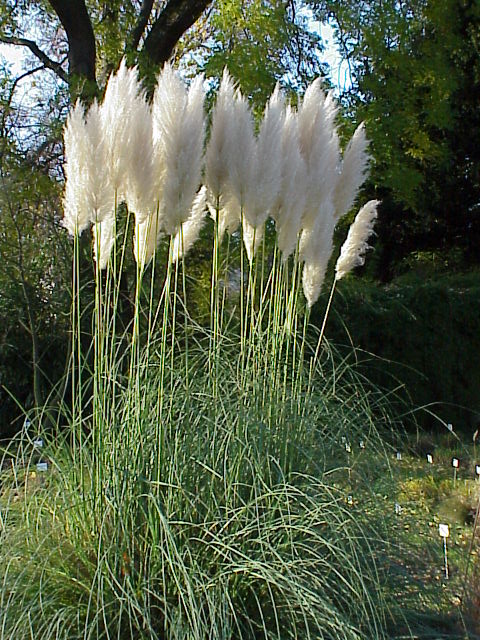 Pampas GrassCortaderia selloana
- Cortaderia nitida
- Cortaderia hapalotricha
- Cortaderia bifida
- Cortaderia hieronymi
- Cortaderia columbiana
- Cortaderia egmontiana
- Cortaderia sericantha
Compare
Questions and answers
What is the scientific name of the Jubata Grass?
The scientific name of the Jubata Grass is Cortaderia jubata. Written with its author, the full name is Cortaderia jubata (Lemoine) Stapf.
Which family does the Jubata Grass belong to?
Cortaderia jubata belongs to the family Poaceae, in the order Poales and the class Liliopsida.
Where is the Jubata Grass found?
Checklists and occurrence records place Cortaderia jubata in 10 countries, including Ecuador, Bolivia, Peru, Argentina, Colombia and Chile.
What other names does the Jubata Grass have?
Cortaderia jubata is also known in English as Andean Pampas Grass, Purple Pampas, Pampas Grass, Pink Pampas Grass and Purple Pampas Grass.
Is pampas grass an invasive plant?
Jubata Grass occurs as an invasive weed in coastal areas of the western United States. It competes with and displaces native vegetation and is listed as an invasive alien species of Union concern in the European Union.[21][32][24]
Why is pampas grass illegal?
Jubata Grass is listed as an invasive alien species of Union concern in the European Union. In New Zealand, its commercial sale, propagation, and distribution are prohibited under the National Pest Plant Accord.[24][25]
What kind of environment does pampas grass need?
Jubata Grass grows in cool, moist coastal areas and readily establishes on bare soil where competition from other plants is limited. Its seeds require moist bare ground in spring to germinate and establish.[7][9][19]
Where does pampas grass grow naturally?
Jubata Grass is native to the northern Andes.[33]
Sources
Passages the profile rests on
- The plant has long, thin leaves with razor-sharp edges that form a large tussock. Source passage: “long, thin, razor-edged leaves forming a large bunch grass tussock” — English Wikipedia
- Its mature leaves are bright green and extend both upward and horizontally. Source passage: “Bright green leaves ascend and spread horizontally.” — solvepestproblems.oregonstate.edu
- Its mature leaves have sharp edges capable of cutting exposed skin. Source passage: “Leaf edges are sharp and can easily cut exposed skin.” — solvepestproblems.oregonstate.edu
- Its flowering panicles are pink or purplish when young and gradually become cream or white. Source passage: “These panicles are pink or purplish when new and they gradually turn cream or white.” — English Wikipedia
- Its inflorescences consist of plume-like spikelets growing at the top of tall stems. Source passage: “At the top of a stem several meters in height is an inflorescence of plumelike spikelets.” — English Wikipedia
- Its mature flowering plumes fade to pinkish or tan. Source passage: “Mature flowering plumes of jubatagrass fade to pinkish or tan color.” — solvepestproblems.oregonstate.edu
- The species grows in cool, moist coastal areas. Source passage: “Jubatagrass grows in moist, cool coastal areas.” — solvepestproblems.oregonstate.edu
- Its documented habitats include dunes, drainage ditches, roadsides, cut slopes, and forestry operations. Source passage: “It is found in dunes, drainage ditches, roadsides, cut slopes, forestry operations, and disturbed areas.” — solvepestproblems.oregonstate.edu
- The species readily establishes on bare soil where competition from other plants is limited. Source passage: “this well adapted plant will come up just about any place where there is little competition and will quickly establish on bare soil.” — ucanr.edu
- It forms dense clumps along steep cliffs, riverbanks, roadsides, and disturbed open areas. Source passage: “It forms massive clumps along roadsides, steep cliffs, riverbanks, and open areas” — ucanr.edu
- The species can form dense stands that impede access and increase fire risk. Source passage: “They crowd out desired vegetation, impede site access, and increase fire risk.” — solvepestproblems.oregonstate.edu
- Its mature plants develop robust root systems that can require heavy equipment for removal. Source passage: “Mature jubatagrass forms a robust root system that often requires heavy equipment to remove.” — solvepestproblems.oregonstate.edu
- All individuals of this species are female. Source passage: “all individuals are female.” — English Wikipedia
- The species reproduces through apomixis, allowing embryos to develop without fertilization. Source passage: “It reproduces by apomixis, in which embryos develop without fertilization.” — English Wikipedia
- The species produces viable seeds despite having effectively all-female flowers. Source passage: “Jubatagrass flowers are effectively all female; however, plants produce viable seeds.” — solvepestproblems.oregonstate.edu
- An individual plant produces millions of seeds annually. Source passage: “Each plant produces millions of seeds per year.” — English Wikipedia
- Each flowering plume can produce approximately 100,000 seeds. Source passage: “Each jubatagrass flowering plume can create roughly 100,000 seeds.” — solvepestproblems.oregonstate.edu
- Its seeds are shorter than 0.1 inches. Source passage: “Seeds are less than 0.1 inches long” — solvepestproblems.oregonstate.edu
- Its seeds require moist bare ground in spring to germinate and establish. Source passage: “require moist bare ground in spring to germinate and grow new plants.” — solvepestproblems.oregonstate.edu
- Its seeds remain viable for less than six months. Source passage: “Seeds live less than six months” — solvepestproblems.oregonstate.edu
- The species occurs as an invasive weed in coastal areas of the western United States. Source passage: “Cortaderia jubata, was introduced and has since become a primary invasive weed in coastal areas of the West.” — ucanr.edu
- The species is established in California's Redwood National and State Parks, Central Coast region, and Big Sur. Source passage: “It is a common weed of Redwood National and State Parks, the Central Coast region, and Big Sur” — English Wikipedia
- The species was introduced to California several decades ago. Source passage: “Several decades ago another species, Cortaderia jubata, was introduced” — ucanr.edu
- The species is listed as an invasive alien species of Union concern in the European Union. Source passage: “The plant features on the list of invasive alien species of Union concern.” — English Wikipedia
- Commercial sale, propagation, and distribution of the species are prohibited under New Zealand's National Pest Plant Accord. Source passage: “In New Zealand C. jubata is listed on the National Pest Plant Accord prohibiting it from sale, and commercial propagation and distribution.” — English Wikipedia
- The species contributes to wildfire hazards through the accumulation of dry foliage. Source passage: “produces large amounts of dry foliage which is a wildfire hazard.” — English Wikipedia
- Its sharp leaves can physically injure animals and humans. Source passage: “The sharply serrated leaf blades can cause physical harm to animals and humans.” — ucanr.edu
- Its dense growth can clog waterways and wetlands. Source passage: “It takes over, clogging waterways and wetlands and causing environmental chaos.” — ucanr.edu
- The species was formerly used by logging companies as a barrier to prevent deer from eating reforested areas. Source passage: “it was once used by logging companies to keep deer from eating reforested areas.” — ucanr.edu
- The species is morphologically similar to Cortaderia selloana. Source passage: “C. jubata is morphologically similar to the related invasive plant, C. selloana.” — English Wikipedia
- Its pinkish flowering plumes help distinguish it from Cortaderia selloana. Source passage: “It is generally distinguished by a pinkish flower plume, but otherwise difficult to tell apart from C. selloana.” — ucanr.edu
- The species competes with and displaces native vegetation. Source passage: “The plant competes with native vegetation” — English Wikipedia
- The species is native to the northern Andes. Source passage: “This grass is native to the northern Andes” — English Wikipedia
Data
- Catalogue of Life, 2026-10-16 XR cc by
- Global Biodiversity Information Facility CC BY 4.0
- Wikidata CC0
- GeoNames CC BY 4.0
- Wikimedia Commons per image; credit shown with each image
- Within the Catalogue of Life, this name comes from The World Checklist of Vascular Plants (WCVP) cc by
References
- Bot. Mag. 124: t. 7607 (1898) where the name was published
This species in other databases
- Catalogue of Life YHTW
- Wikidata Q5173212
- iNaturalist 52714
- World Flora Online wfo-0000860590
- GRIN 403448
Page built on 27 November 2026. See how the catalog is made and all sources and licences.
Cite this page
ScientificNames.org. (2026). Cortaderia jubata (Jubata Grass). Retrieved November 27, 2026, from https://scientificnames.org/species/cortaderia-jubata
“Cortaderia jubata (Jubata Grass).” ScientificNames.org, 2026, scientificnames.org/species/cortaderia-jubata. Accessed 27 Nov. 2026.
ScientificNames.org. “Cortaderia jubata (Jubata Grass).” Accessed November 27, 2026. https://scientificnames.org/species/cortaderia-jubata.
@misc{scientificnames_cortaderia_jubata_jubata_grass,
  author = {{ScientificNames.org}},
  title = {Cortaderia jubata (Jubata Grass)},
  year = {2026},
  url = {https://scientificnames.org/species/cortaderia-jubata},
  note = {Accessed 2026-11-27}
}