Species · Flowering plants
Turkish Hazel Corylus colurna
The scientific name of the Turkish Hazel is Corylus colurna. It is a species of flowering plant in the family Betulaceae (birch family), order Fagales.
- Scientific name
- Corylus colurna L.
- Common name
- Turkish Hazel
- Genus
- Corylus
- Family
- Betulaceae (Birch Family)
- Order
- Fagales
- Class
- Magnoliopsida
- Red List category
- LC Least Concern
- Recorded in
- 42 countries
- Name status
- accepted in the Catalogue of Life
Overview
Corylus colurna is native to southeastern Europe and southwestern Asia, from the southern Balkans through northern Anatolia to the Caucasus. It is distinguished by its corky bark and clusters of three to eight nuts enclosed in thick, bristly husks.
Written 26 November 2026 from the sources listed below. Each statement was checked against the passage it cites; statements that could not be supported were removed.
Appearance
Turkish Hazel has pale grey-buff bark with a thick, corky texture. Young trees have a slender, conical crown that becomes broader and irregular with age.[1][2]
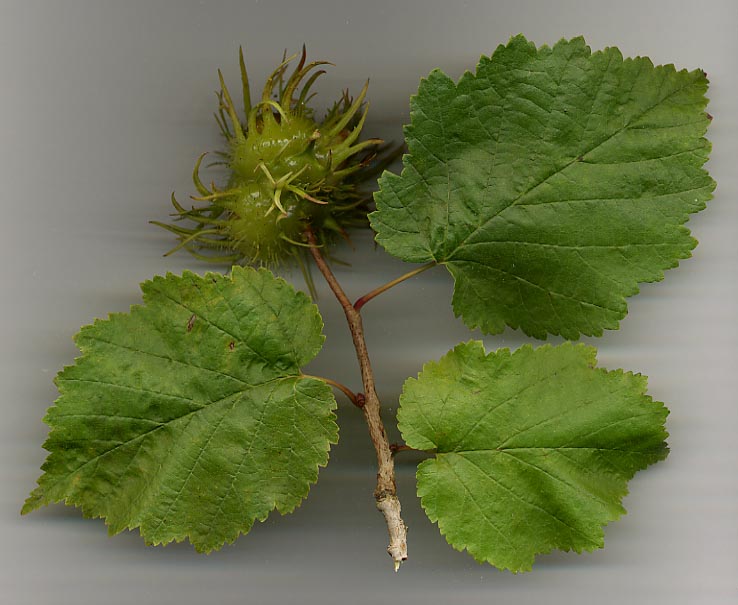
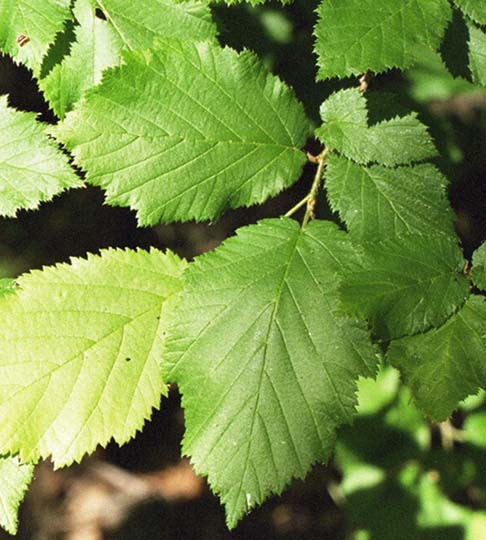
Its deciduous leaves are rounded and softly hairy on both surfaces, with margins that are coarsely double-serrate to shallowly lobed. The leaves measure 7–13 cm long and 6–14 cm wide.[3][4][5]
The male flowers occur in conspicuous, pale-yellow catkins measuring 5–10 cm long. The female flowers are inconspicuous and have bright-red styles measuring 1–3 mm.[6][7][8]
The fruits are nuts enclosed in thick, softly spiny and bristly husks. The nuts occur in clusters of three to eight, with their husks fused at the base.[9][10]
The nuts measure approximately 1–2 cm long and have shells approximately 3 mm thick.[11][12]
The species typically reaches 25–30 metres in height, although exceptional individuals can reach 33 metres. Its trunk can reach one metre in diameter and exceptionally 1.6 metres.[13][14][15]
Habitat
Turkish Hazel occurs mainly on shallow, nutrient-poor limestone soils. It occupies elevations ranging from 100 metres in the Balkans to 1,700 metres in the Caucasus.[16][17]
At lower elevations, it occurs in thermophilous oak forests alongside Hungarian oak, Oriental hornbeam and flowering ash. At higher elevations, it occurs alongside beech and sycamore maple.[18][19]
The species becomes dominant mainly in very dry sites because it is relatively uncompetitive. In cultivation, it prefers moist, well-drained soil and full sun.[20][21]
Behaviour
Turkish Hazel is light-demanding. Once established, it tolerates heat, cold and drought.[22][23]
Reproduction and life cycle
Turkish Hazel is monoecious, producing male and female flowers on the same tree. The flowers appear in late winter or early spring before the leaves emerge.[24][25]
The fruits mature between September and October. Nut production is irregular and generally occurs every two to three years.[26][27]
Conservation
Turkish Hazel is generally uncommon across its natural range but can be locally abundant in suitable habitats.[28]
Uses
Turkish Hazel is cultivated as an ornamental tree in Europe and North America. Its dense shade makes it suitable for use as a shade tree.[29][30]
Its narrow crown and tolerance of air pollution make it suitable for planting along urban streets. It is also used as a single-stemmed rootstock for grafting common hazel cultivars.[31][32]
Similar species
Corylus jacquemontii is a closely related species that was formerly treated as a variety of Corylus colurna.[33]
Classification of the Turkish Hazel
| Kingdom | Plantae |
|---|---|
| Subkingdom | Pteridobiotina |
| Phylum | Tracheophyta |
| Class | Magnoliopsida |
| Order | Fagales |
| Family | Betulaceae (Birch Family) |
| Subfamily | Coryloideae |
| Tribe | Coryleae |
| Genus | Corylus (Hazel) |
| Species | Corylus colurna L. |
Where the Turkish Hazel is found
Checklists and occurrence records place Corylus colurna in 42 countries across Asia and Europe. GBIF holds 3,688 georeferenced records of it.
Countries where it is native or its origin is not stated
- Afghanistan 8
- Albania 3
- Armenia 11
- Austria 92
- Azerbaijan 10
- Belarus 8
- Belgium 166
- Bosnia and Herzegovina 8
- Bulgaria 15
- Croatia 7
- Czechia 221
- Denmark 40
- Estonia 15
- France 71
- Georgia 19
- Greece 12
- Hungary 41
- India 38
- Iran
- Ireland 6
- Italy 9
- Kosovo
- Latvia 19
- Luxembourg 14
- Montenegro
- North Macedonia 1
- Poland 97
- Romania 26
- Russia 25
- Serbia 31
- Slovakia 47
- Slovenia 5
- Spain 13
- Sweden 76
- Switzerland 104
- The Netherlands 147
- Turkey 47
- Ukraine 39
- United States 441
- Uzbekistan 3
Countries where it has been introduced
Regions and cities with the most records
- England, United Kingdom 702
- Willesden, United Kingdom 347
- Harlesden, United Kingdom 346
- Shepherds Bush, United Kingdom 344
- Cricklewood, United Kingdom 342
- Acton, United Kingdom 340
- Barnes, United Kingdom 340
- Golders Green, United Kingdom 339
- City of Westminster, United Kingdom 337
- London, United Kingdom 336
- Wembley, United Kingdom 336
- Camden Town, United Kingdom 334
- Chalk Farm, United Kingdom 334
- Fulham, United Kingdom 334
- New York, United States 334
- Richmond, United Kingdom 332
- Stepney, United Kingdom 332
- West Ealing, United Kingdom 331
- Islington, United Kingdom 330
- Shadwell, United Kingdom 330
- Highbury, United Kingdom 329
- Finchley, United Kingdom 327
- Archway, United Kingdom 326
- Blackheath, United Kingdom 326
- Stratford, United Kingdom 326
- Canning Town, United Kingdom 325
- Isleworth, United Kingdom 325
- West Ham, United Kingdom 324
- Brockley, United Kingdom 323
- Greenford, United Kingdom 323
- Streatham, United Kingdom 323
- Earlsfield, United Kingdom 322
- Harringay, United Kingdom 321
- Catford, United Kingdom 320
- Manor Park, United Kingdom 320
- Walthamstow, United Kingdom 320
2 more countries have a few records outside this range
These countries hold a few records of Corylus colurna but lie outside the range the checklists give for it. Such records are often zoo or garden specimens, museum material or vagrants, so the species is not counted as occurring there.
Range as the checklists state it
England [I] (England [I], Wales [I], Scotland [I]); Germany [I]; Slovakia; Hungary; Croatia; Bosnia & Hercegovina; Montenegro; Serbia; Kosovo; North Macedonia; Albania; Romania; Bulgaria; European Turkey; Greece (N- & C-Greece, rare Peloponnisos); Northern Caucasus; Georgia [Caucasus] (Abkhazia); Armenia; Azerbaijan; Turkey (Inner Anatolia, N-Anatolia, NW-Anatolia: Bithynia); Iran (EC-Iran, N-Iran)
A number beside a place is its count of GBIF occurrence records. A place without a number comes from a checklist alone. Records show where a species has been observed or collected, which can include escapes and vagrants.
Common names
English
- Turkish Hazel
- Byzantine Filbert
- Constantinople-nut
- Turkish Filbert
- Turkish Hazelnut
- Beaked Hazel
- Clusternut
- Hazelnut
Names in 30 other languages
- Azerbaijani
- Ağacvari fındıq
- Basque
- Turkiako hurritza
- Bulgarian
- Турска леска
- Catalan
- Avellaner turc
- Chinese
- 土耳其榛
- Croatian
- Divoljeska, Drvolika lijeska, Medvjeđa lijeska, Turska lijeska
- Czech
- líska turecká
- Danish
- tyrkisk hassel
- Dutch
- Boomhazelaar, Turkse boomhazelaar, Turkse hazelaar
- Esperanto
- Turkia korilo
- Estonian
- kõrgetüveline sarapuu
- Finnish
- turkinpähkinäpensas
- French
- Coudrier de Byzance, noisetier de Byzance, noisetier de Turquie
- German
- Baum-Hasel, Baumhasel, Byzantinische Hasel, Türkische Haselnuss, türkische Baumhasel, türkische Hasel
- Hungarian
- Török mogyoró
- Irish
- Coll Turcach
- Lithuanian
- Turkinis lazdynas
- Macedonian
- Дива леска
- Norwegian Bokmål
- tyrkerhassel
- Norwegian Nynorsk
- tyrkarhassel
- Polish
- Leszczyna turecka
- Russian
- leščina drevovidnaja, medvežnij orech, Лещина древовидная, Орешник древовидный
- Serbian
- Mečja leska
- Slovak
- lieska turecká
- Slovenian
- Turška leska
- Spanish
- avellano de Turquía
- Swedish
- turkhassel, turkisk hassel
- Turkish
- Türk Fındığı
- Ukrainian
- Ліщина деревовидна, Ліщина турецька
- Welsh
- Collen Twrci, Cyll Twrci
Synonyms
31 other scientific names have been used for this species and are now treated as synonyms of Corylus colurna.
- Corylus abchasica Kem.
- Corylus abchasica Kem.-Nath.
- Corylus avellana var. arborescens Merrem
- Corylus avellana var. glomerata Aiton
- Corylus avellana var. macrochlamys Spach
- Corylus bizantina Desf.
- Corylus byzantina Mill., The Gardeners Dictionary
- Corylus cervorum Petrov
- Corylus colurna var. avellanoides Spach
- Corylus colurna var. bachycarpa Spach
- Corylus colurna var. brachycarpa Spach
- Corylus colurna var. colurna
- Corylus colurna var. leptochlamys Spach
- Corylus colurna var. macrochlamys Spach
- Corylus colurna var. trichochlamys Spach
- Corylus eggrissiensis Kem.-Nath.
- Corylus egrissiensis Kem.
- Corylus glomerata (Aiton) Nois.
- Corylus iberica Kem.
- Corylus iberica Wittm. ex Bobrov
- Corylus iberica var. glandulosa Kem.
- Corylus iberica var. glandulosa Kem.-Nath.
- Corylus kachetica Kem.-Nath.
- Corylus kachetica Kem.
- Corylus kachetuca Kem.-Nath.
- Corylus macedonica V.Cordus & Gesner ex Strelin
- Corylus nana Tourrette & Rozier
- Corylus arborescens Münchh. ambiguous synonym
- Corylus avellana f. glomerata (Aiton) W.T.Aiton ambiguous synonym
- Corylus colurna var. glandulifera Jess. ambiguous synonym
- Corylus colurna var. glandulifera A.DC. ambiguous synonym
Related species
-
 Common HazelCorylus avellana
-
 American HazelCorylus americana
-
 FilbertCorylus maxima
-
 Beaked HazelnutCorylus cornuta
-
 Siberian HazelCorylus heterophylla
-
 Indian Tree HazelCorylus jacquemontii
-
 Chinese HazelCorylus chinensis
-
 Himalayan HazelCorylus ferox
Compare
Questions and answers
What is the scientific name of the Turkish Hazel?
The scientific name of the Turkish Hazel is Corylus colurna. Written with its author, the full name is Corylus colurna L..
Which family does the Turkish Hazel belong to?
Corylus colurna belongs to the family Betulaceae, in the order Fagales and the class Magnoliopsida.
Where is the Turkish Hazel found?
Checklists and occurrence records place Corylus colurna in 42 countries, including United States, Czechia, Belgium, The Netherlands, Switzerland and Poland.
What is the conservation status of the Turkish Hazel?
The IUCN Red List category recorded for Corylus colurna is Least Concern (LC).
What other names does the Turkish Hazel have?
Corylus colurna is also known in English as Byzantine Filbert, Constantinople-nut, Turkish Filbert, Turkish Hazelnut, Beaked Hazel and Clusternut.
Sources
Passages the profile rests on
- Corylus colurna has a pale grey-buff bark with a thick, corky texture. Source passage: “The bark is pale grey-buff, with a thick, corky texture.” — English Wikipedia
- Young trees have a slender, conical crown that becomes broader and irregular as they age. Source passage: “The crown is slender and conical in young trees, becoming broader and irregular with age.” — English Wikipedia
- Its leaves are deciduous, rounded and softly hairy on both surfaces. Source passage: “The leaves are deciduous, rounded, 7–13 centimetres (2.8–5.1 in) long and 6–14 cm (2.4–5.5 in) across, softly hairy on both surfaces” — English Wikipedia
- The leaf margins are coarsely double-serrate to shallowly lobed. Source passage: “with a coarsely double-serrate to shallowly lobed margin.” — English Wikipedia
- Its leaves measure 7–13 cm long and 6–14 cm wide. Source passage: “7–13 centimetres (2.8–5.1 in) long and 6–14 cm (2.4–5.5 in) across” — English Wikipedia
- The male flowers occur in conspicuous, pale-yellow catkins. Source passage: “the male catkins are conspicuous, pale yellow and 5–10 cm long” — English Wikipedia
- The female flowers are inconspicuous and have bright-red styles measuring 1–3 mm. Source passage: “the female very small and inconspicuous, largely concealed in the buds, with only the bright red 1–3 mm long styles visible.” — English Wikipedia
- Its male catkins measure 5–10 cm in length. Source passage: “the male catkins are conspicuous, pale yellow and 5–10 cm long” — English Wikipedia
- Its fruits are nuts enclosed in thick, softly spiny and bristly husks. Source passage: “It is about 1–2 cm long, surrounded by a thick, softly spiny and bristly involucre (husk) 3 cm diameter” — English Wikipedia
- The nuts occur in clusters of three to eight, with their husks fused at the base. Source passage: “the nuts are borne in tight clusters of 3–8 together, with the involucres fused at the base.” — English Wikipedia
- Its nuts measure approximately 1–2 cm in length. Source passage: “It is about 1–2 cm long” — English Wikipedia
- Its nut shells are approximately 3 mm thick. Source passage: “very hard, thick nut shell (3 mm thick)” — English Wikipedia
- The species typically reaches 25–30 metres in height. Source passage: “It typically grows 25–30 metres (82–98 ft) tall” — English Wikipedia
- Exceptional individuals can reach 33 metres in height. Source passage: “reaching 25 m (82 ft) tall, exceptionally to 33 m (108 ft) tall” — English Wikipedia
- Its trunk can reach one metre in diameter and exceptionally 1.6 metres. Source passage: “with a stout trunk up to 1 m (3 ft) in diameter, rarely to 1.6 m (5 ft).” — English Wikipedia
- The species occurs mainly on shallow, nutrient-poor limestone soils. Source passage: “mostly on shallow, nutrient-poor lime soils.” — English Wikipedia
- The species occupies elevations ranging from 100 metres in the Balkans to 1,700 metres in the Caucasus. Source passage: “C. colurna occurs in a wide altitudinal range between 100 (in the Balkans) and 1,700 m (in the Caucasus)” — English Wikipedia
- At lower elevations, it occurs in thermophilous oak forests alongside Hungarian oak, Oriental hornbeam and flowering ash. Source passage: “At lower altitudes, it constitutes a member thermophilous oak forests alongside, for example, Hungarian oak (Quercus frainetto), Oriental hornbeam (Carpinus orientalis), and flowering ash (Fraxinus ornus)” — English Wikipedia
- At higher elevations, it occurs alongside beech and sycamore maple. Source passage: “whereas at higher elevations, it occurs together with beech (Fagus sylvatica, F. orientalis) and sycamore maple (Acer pseudoplatanus).” — English Wikipedia
- It becomes dominant mainly in very dry sites because it is relatively uncompetitive. Source passage: “It is light-demanding and relatively uncompetitive, becoming dominant only in very dry sites.” — English Wikipedia
- In cultivation, it prefers moist, well-drained soil and full sun. Source passage: “However, it prefers moist, well-drained soil, as well as full sun.” — English Wikipedia
- The species is light-demanding. Source passage: “It is light-demanding” — English Wikipedia
- Once established, the species tolerates heat, cold and drought. Source passage: “Once established C. colurna is tolerant of heat, cold, and drought.” — English Wikipedia
- Corylus colurna is monoecious, producing male and female flowers on the same tree. Source passage: “the species is monoecious, with the individual catkins single-sex, but both sexes on the same tree” — English Wikipedia
- The flowers appear in late winter or early spring before the leaves emerge. Source passage: “The flowers are produced in late winter or early spring before the leaves” — English Wikipedia
- The fruits mature between September and October. Source passage: “The fruit matures in September to October” — English Wikipedia
- Nut production is irregular and generally occurs every two to three years. Source passage: “Nut production is irregular and occurs every two to three years” — English Wikipedia
- The species is generally uncommon across its natural range but can be locally abundant in suitable habitats. Source passage: “Although generally uncommon, it can be locally abundant in suitable sites.” — English Wikipedia
- The species is cultivated as an ornamental tree in Europe and North America. Source passage: “C. colurna is widely cultivated as an ornamental tree in Europe and North America.” — English Wikipedia
- Its dense shade makes it suitable for use as a shade tree. Source passage: “Turkish hazel makes a good shade tree since it produces dense shade” — English Wikipedia
- Corylus colurna is used as a single-stemmed rootstock for grafting common hazel cultivars. Source passage: “Corylus colurna is commonly used as a single-stemmed, non-suckering rootstock for common hazel (Corylus avellana) scions.” — English Wikipedia
- Its narrow crown and tolerance of air pollution make it suitable for planting along urban streets. Source passage: “its narrow crown and ability to withstand air pollution make it well suited for use as a street tree in urban areas” — English Wikipedia
- Corylus jacquemontii is a closely related species that was formerly treated as a variety of Corylus colurna. Source passage: “Similar species Corylus jacquemontii, once considered as a variety of Coryllus colurna” — English Wikipedia
- The species is native to southeastern Europe and southwestern Asia. Source passage: “C. colurna is native to southeast Europe and southwest Asia” — English Wikipedia
- Its native range extends from the southern Balkans through northern Anatolia to the Caucasus. Source passage: “from the southern Balkans through northern Anatolia to the Caucasus.” — English Wikipedia
Data
- Catalogue of Life, 2026-10-16 XR cc by
- Global Biodiversity Information Facility CC BY 4.0
- Wikidata CC0
- GeoNames CC BY 4.0
- Wikimedia Commons per image; credit shown with each image
- Within the Catalogue of Life, this name comes from Synonymic Checklists of the Vascular Plants of the World cc by
References
- L. (1753). Sp. Pl. [Linnaeus] 2: 999 (1753). where the name was published
This species in other databases
- Catalogue of Life 6B78B
- Wikidata Q148939
- iNaturalist 367960
- World Flora Online wfo-0000925290
- GRIN 11645
Page built on 27 November 2026. See how the catalog is made and all sources and licences.
Cite this page
ScientificNames.org. (2026). Corylus colurna (Turkish Hazel). Retrieved November 27, 2026, from https://scientificnames.org/species/corylus-colurna
“Corylus colurna (Turkish Hazel).” ScientificNames.org, 2026, scientificnames.org/species/corylus-colurna. Accessed 27 Nov. 2026.
ScientificNames.org. “Corylus colurna (Turkish Hazel).” Accessed November 27, 2026. https://scientificnames.org/species/corylus-colurna.
@misc{scientificnames_corylus_colurna_turkish_hazel,
  author = {{ScientificNames.org}},
  title = {Corylus colurna (Turkish Hazel)},
  year = {2026},
  url = {https://scientificnames.org/species/corylus-colurna},
  note = {Accessed 2026-11-27}
}