Species · Insects
Cosmopterix nyctiphanes
Cosmopterix nyctiphanes has no English name on record in the checklists used here. It is a species of insect in the family Cosmopterigidae (cosmet moths), order Lepidoptera. The name dates from 1915.
- Scientific name
- Cosmopterix nyctiphanes Meyrick, 1915
- Genus
- Cosmopterix
- Family
- Cosmopterigidae (Cosmet Moths)
- Order
- Lepidoptera
- Class
- Insecta
- Name status
- accepted in the Catalogue of Life
Overview
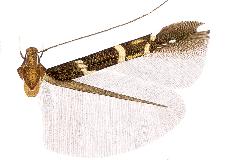
The species is recorded from Ecuador. It is distinguished by its dark brown forewings with pale-golden metallic fasciae and spots, and a bluish-silver apical spot.
Written 28 November 2026 from the sources listed below. Each statement was checked against the passage it cites; statements that could not be supported were removed.
Appearance
The moth has a shining greyish-white frons with a golden reflection. Its vertex and neck tufts are dark bronze-brown with a golden reflection, and its collar is shining dark bronze-brown.[1][2]
The labial palpus has a very short white first segment, a dark-brown second segment with white longitudinal lines, and a white third segment lined with dark brown. The antenna is shining dark grey, with two greyish-white subapical rings separated by one dark-grey segment.[3][4]
The thorax and tegulae are shining dark bronze brown with golden reflections and reddish gloss. The foreleg has a white line on its tibia and first two tarsal segments, while the midleg and hindleg femora are shining golden brown.[5][6][7]
The midleg tibia has silver-metallic oblique basal and medial lines with a greenish reflection and a white apical ring.[8]
The forewing is shining dark brown with a reddish gloss. At one-fifth of its length, it has an irregular, inwardly oblique pale-golden metallic fascia consisting of two short streaks and a dorsal streak twice as long as either of them.[9][10][11]
The middle of the forewing has a broad, slightly outwardly bent, tubercular pale-golden metallic fascia. At three-quarters of its length, it has a small pale-golden metallic costal spot and a dorsal pale-golden metallic spot three times larger than the costal spot.[12][13][14]
The forewing has a bluish-silver apical spot preceded by two small silver-scaled streaks. The hindwing is shining dark greyish brown with dark-brown cilia.[15][16]
Classification of Cosmopterix nyctiphanes
| Kingdom | Animalia |
|---|---|
| Phylum | Arthropoda |
| Subphylum | Hexapoda |
| Class | Insecta (Insect) |
| Order | Lepidoptera |
| Superfamily | Gelechioidea |
| Family | Cosmopterigidae (Cosmet Moths) |
| Subfamily | Cosmopteriginae |
| Genus | Cosmopterix |
| Species | Cosmopterix nyctiphanes Meyrick, 1915 |
Synonyms
One other scientific name has been used for this species and is now treated as a synonym of Cosmopterix nyctiphanes.
- Cosmopteryx nyctiphanes Meyrick, 1915 ambiguous synonym
Related species
-
 Marsh CosmetCosmopterix orichalcea
-
 Cosmopterix sibirica
-
 Fen CosmetCosmopterix lienigiella
-
 Cosmopterix attenuatella
-
 Hedge CosmetCosmopterix zieglerella
- Cosmopterix phyladelphella
-
 Cosmopterix pentachorda
- New Marsh CosmetCosmopterix scribaiella
Compare
Questions and answers
What is the forewing length of Cosmopterix nyctiphanes?
The forewing length is 3.6 mm.[17]
Where is Cosmopterix nyctiphanes recorded?
The species is recorded from Ecuador.[18]
Sources
Passages the profile rests on
- The moth has a shining greyish-white frons with a golden reflection and dark bronze-brown vertex and neck tufts with a golden reflection. Source passage: “Head: frons shining greyish white with golden reflection, vertex and neck tufts shining dark bronze brown with golden reflection” — English Wikipedia
- The moth has a dark bronze-brown collar with a shining finish. Source passage: “collar shining dark bronze brown” — English Wikipedia
- Its labial palpus has a very short white first segment, a dark-brown second segment with white longitudinal lines, and a white third segment lined with dark brown. Source passage: “labial palpus first segment very short, white, second segment three-quarters of the length of third, dark brown with white longitudinal lines laterally and ventrally, third segment white, lined dark brown laterally” — English Wikipedia
- Its antenna is shining dark grey and has two greyish-white subapical rings separated by one dark-grey segment. Source passage: “antenna shining dark grey, subapical part with two greyish white rings of one segment each separated by one dark grey segment” — English Wikipedia
- The thorax and tegulae are shining dark bronze brown with golden reflections and reddish gloss. Source passage: “Thorax and tegulae shining dark bronze brown with golden reflection and reddish gloss.” — English Wikipedia
- The foreleg has a white line on its tibia and first two tarsal segments. Source passage: “foreleg with a white line on tibia and tarsal segments one and two” — English Wikipedia
- The midleg and hindleg femora are shining golden brown. Source passage: “femora of midleg and hindleg shining golden brown” — English Wikipedia
- The midleg tibia has silver-metallic oblique basal and medial lines with a greenish reflection and a white apical ring. Source passage: “tibia of midleg with silver metallic oblique basal and medial lines with greenish reflection and a white apical ring” — English Wikipedia
- The forewing is shining dark brown with a reddish gloss. Source passage: “Forewing shining dark brown with reddish gloss” — English Wikipedia
- The forewing has an irregular, inwardly oblique pale-golden metallic fascia at one-fifth of its length. Source passage: “at one-fifth an irregular inwardly oblique pale golden metallic fascia with bluish gloss” — English Wikipedia
- The forewing's first pale-golden fascia consists of two short streaks and a dorsal streak twice as long as either of them. Source passage: “fascia consisting of two short streaks of similar length with the costal of these two closest to base, and a dorsal streak which is twice as long as both other streaks” — English Wikipedia
- The forewing has a broad, slightly outwardly bent, tubercular pale-golden metallic fascia in its middle. Source passage: “a broad, slightly outwardly bent, tubercular pale golden metallic fascia in the middle” — English Wikipedia
- The forewing has a small pale-golden metallic costal spot at three-quarters of its length. Source passage: “a small pale golden metallic costal spot at three-quarters” — English Wikipedia
- The forewing has a dorsal pale-golden metallic spot three times larger than its costal spot. Source passage: “a similarly coloured dorsal spot, more towards base and three times as large as the costal” — English Wikipedia
- The forewing has a bluish-silver apical spot preceded by two small silver-scaled streaks. Source passage: “apical line as a bluish silver spot in the middle of the apical area, preceded by two small streaks of silver scales” — English Wikipedia
- The hindwing is shining dark greyish brown with dark-brown cilia. Source passage: “Hindwing shining dark greyish brown, cilia dark brown.” — English Wikipedia
- The forewing length is 3.6 mm. Source passage: “Forewing length 3.6 mm.” — English Wikipedia
- The species is recorded from Ecuador. Source passage: “It is known from Ecuador.” — English Wikipedia
Data
- Catalogue of Life, 2026-10-16 XR cc by
- Wikidata CC0
- Wikimedia Commons per image; credit shown with each image
- Within the Catalogue of Life, this name comes from Global Lepidoptera Index cc by
This species in other databases
Page built on 29 November 2026. See how the catalog is made and all sources and licences.
Cite this page
ScientificNames.org. (2026). Cosmopterix nyctiphanes. Retrieved November 29, 2026, from https://scientificnames.org/species/cosmopterix-nyctiphanes
“Cosmopterix nyctiphanes.” ScientificNames.org, 2026, scientificnames.org/species/cosmopterix-nyctiphanes. Accessed 29 Nov. 2026.
ScientificNames.org. “Cosmopterix nyctiphanes.” Accessed November 29, 2026. https://scientificnames.org/species/cosmopterix-nyctiphanes.
@misc{scientificnames_cosmopterix_nyctiphanes,
  author = {{ScientificNames.org}},
  title = {Cosmopterix nyctiphanes},
  year = {2026},
  url = {https://scientificnames.org/species/cosmopterix-nyctiphanes},
  note = {Accessed 2026-11-29}
}