Species · Amphibians
Fitzinger's Robber Frog Craugastor fitzingeri
The scientific name of the Fitzinger's Robber Frog is Craugastor fitzingeri. It is a species of amphibian in the family Craugastoridae (robber frogs), order Anura. The name dates from 1857.
- Scientific name
- Craugastor fitzingeri (Schmidt, 1857)
- Common name
- Fitzinger's Robber Frog
- Genus
- Craugastor
- Family
- Craugastoridae (Robber Frogs)
- Order
- Anura
- Class
- Amphibia
- Red List category
- LC Least Concern
- Recorded in
- 7 countries
- Name status
- accepted in the Catalogue of Life
Overview
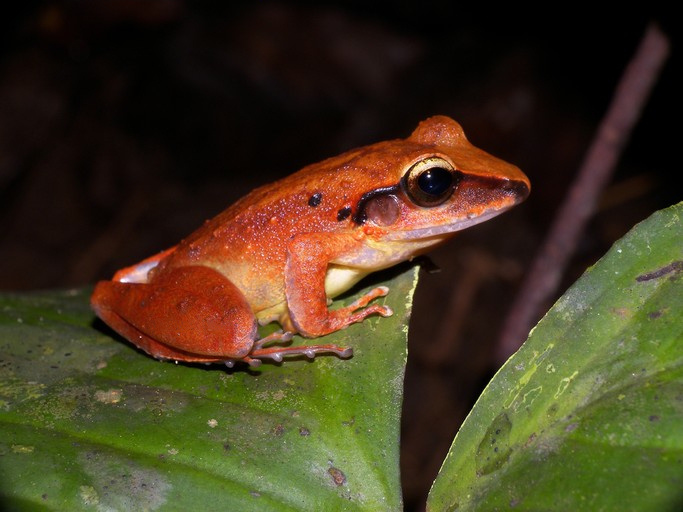
Craugastor fitzingeri inhabits humid lowland and montane forests below 1,520 m elevation in northwestern Colombia, Panama, Costa Rica, eastern Nicaragua, and northeastern Honduras. It has a prominent tympanum, discs on its fingers and toes, moderately webbed toes, and skin typically marked by warts and ridges.
Written 27 November 2026 from the sources listed below. Each statement was checked against the passage it cites; statements that could not be supported were removed.
Appearance
The snout is subacuminate when viewed from above, and the tympanum is prominent. The fingers and toes have discs, and the toes are moderately webbed.[1][2][3]
The skin typically has warts and ridges. Dorsal coloration ranges from gray-brown through brown to orange-brown.[4][5]
Some individuals have a broad, light-colored stripe along the middle of the back. Most individuals have a few blackish spots and an indistinct darker dorsal pattern.[6][7]
The throat is generally grey with a white central line. The belly is pale white or yellow.[8][9]
Adult males measure 24–35 mm in snout–vent length, while adult females measure 35–53 mm.[10][11]
Habitat
Fitzinger's Robber Frog inhabits humid lowland and montane forests below 1,520 m elevation. It frequently occurs in disturbed forests and along forest edges.[12][13]
In the Colombian portion of its range, the species does not occur in secondary forest.[14]
During the dry season, populations in lowland dry forest areas are restricted to riparian gallery forests. During the wet season, the species occupies a wider area of lowland dry forest.[15][16]
Behaviour
During the day, individuals are generally concealed in leaf litter on the forest floor, although they may also be active. At night, they often climb onto logs or into low vegetation.[17][18][19]
Males typically produce advertisement calls at dusk from elevated positions on low herbs and bushes. The calls consist of variable sequences of harsh chirps or clacks.[20][21]
Conservation
The species can be locally abundant, although some populations have declined. No major threats to the species have been identified.[22][23]
Its geographic range overlaps with several protected areas. The species was most recently assessed for the IUCN Red List in 2019.[24][25]
Classification of the Fitzinger's Robber Frog
| Kingdom | Animalia |
|---|---|
| Phylum | Chordata |
| Subphylum | Vertebrata |
| Infraphylum | Gnathostomata |
| Parvphylum | Osteichthyes |
| Megaclass | Tetrapoda |
| Class | Amphibia (Amphibians) |
| Order | Anura (Frogs) |
| Superfamily | Brachycephaloidea |
| Family | Craugastoridae (Robber Frogs) |
| Genus | Craugastor (Northern Rainfrogs) |
| Species | Craugastor fitzingeri (Schmidt, 1857) |
Where the Fitzinger's Robber Frog is found
Checklists and occurrence records place Craugastor fitzingeri in 7 countries. GBIF holds 5,682 georeferenced records of it.
Countries
Regions and cities with the most records
- Puntarenas Province, Costa Rica 871
- Heredia Province, Costa Rica 557
- Alajuela Province, Costa Rica 354
- Chocó, Colombia 294
- Limón Province, Costa Rica 267
- Chilibre, Panama 196
- Alcalde Díaz, Panama 194
- San José, Costa Rica 191
- Panamá, Panama 148
- Guanacaste Province, Costa Rica 136
- San Isidro, Costa Rica 126
- Colón, Panama 117
- Gracias a Dios Department, Honduras 116
- Olancho Department, Honduras 94
- Quibdó, Colombia 92
- Siquirres, Costa Rica 92
- Valle del Cauca Department, Colombia 84
- Cartago Province, Costa Rica 83
- Turrialba, Costa Rica 83
- Panamá Oeste Province, Panama 82
- Antioquia, Colombia 75
- Curundú, Panama 75
- Tadó, Colombia 75
- Darién, Panama 74
- Panama City, Panama 73
- Alajuela, Costa Rica 67
- Ancón, Panama 67
- Río San Juan Department, Nicaragua 67
- Guápiles, Costa Rica 64
- Arraiján, Panama 62
- San Rafael, Costa Rica 61
- Heredia, Costa Rica 59
- San Pablo, Costa Rica 55
- San Miguelito, Panama 52
- San Felipe, Costa Rica 49
- San Rafael Abajo, Costa Rica 48
A number beside a place is its count of GBIF occurrence records. A place without a number comes from a checklist alone. Records show where a species has been observed or collected, which can include escapes and vagrants.
Common names
English
- Fitzinger's Robber Frog
- Common Rain Frog
Names in 5 other languages
- Czech
- bezblanka Fitzingerova
- German
- Fitzingers Räuberfrosch
- Italian
- Rana della pioggia di Fitzinger
- Russian
- Листовая лягушка Фитцингера
- Spanish
- Ranita Común de Lluvia, Ranita Rugosa del Pacífico
Synonyms
10 other scientific names have been used for this species and are now treated as synonyms of Craugastor fitzingeri.
- Craugastor pulchrigulus Cope, 1862
- Eleutherodactylus fitzingeri (Schmidt, 1857)
- Eleutherodactylus griseus (Hallowell, 1861)
- Eleutherodactylus nubilus (Günther, 1901)
- Hyla grisea Hallowell, 1861
- Hylodes fitzingeri Schmidt, 1857
- Hylodes griseus (Hallowell, 1861)
- Hylodes nubilus Günther, 1901
- Hylodes pulchrigulus (Cope, 1862)
- Lithodytes griseus (Hallowell, 1861)
Related species
-
 Barking FrogCraugastor augusti
- Craugastor myllomyllon
- Corquin Robber FrogCraugastor anciano
- Sierra de Omoa Streamside FrogCraugastor omoaensis
-
 Robber FrogCraugastor raniformis
- McCranie's Robber FrogCraugastor chrysozetetes
- Yellow-legged Rain FrogCraugastor andi
-
 Stejneger's Robber FrogCraugastor stejnegerianus
Compare
Questions and answers
What is the scientific name of the Fitzinger's Robber Frog?
The scientific name of the Fitzinger's Robber Frog is Craugastor fitzingeri. Written with its author, the full name is Craugastor fitzingeri (Schmidt, 1857).
Which family does the Fitzinger's Robber Frog belong to?
Craugastor fitzingeri belongs to the family Craugastoridae, in the order Anura and the class Amphibia.
Where is the Fitzinger's Robber Frog found?
Checklists and occurrence records place Craugastor fitzingeri in 7 countries, including Costa Rica, Panama, Colombia, Honduras, Nicaragua and Brazil.
What is the conservation status of the Fitzinger's Robber Frog?
The IUCN Red List category recorded for Craugastor fitzingeri is Least Concern (LC).
What other names does the Fitzinger's Robber Frog have?
Craugastor fitzingeri is also known in English as Common Rain Frog.
Sources
Passages the profile rests on
- The snout is subacuminate when viewed from above. Source passage: “The snout is subacuminate in dorsal view.” — English Wikipedia
- The species has a prominent tympanum. Source passage: “The tympanum is prominent.” — English Wikipedia
- The fingers and toes have discs, and the toes are moderately webbed. Source passage: “The fingers and the toes bear discs; the toes are moderately webbed.” — English Wikipedia
- Its skin typically has warts and ridges. Source passage: “Skin typically bears warts and ridges.” — English Wikipedia
- Its dorsal coloration ranges from gray-brown through brown to orange-brown. Source passage: “The dorsal coloration varies from gray-brown to brown to orange-brown.” — English Wikipedia
- Some individuals have a broad, light-colored stripe along the middle of the back. Source passage: “Some individuals have a wide, light middorsal stripe.” — English Wikipedia
- Most individuals have a few blackish spots and an indistinct darker dorsal pattern. Source passage: “Most individuals have only some blackish spots and a vague, darker dorsal pattern.” — English Wikipedia
- The throat is generally grey with a white central line. Source passage: “The throat is typically grey with a white line down the middle.” — English Wikipedia
- The belly is pale white or yellow. Source passage: “The belly is pale white or yellow.” — English Wikipedia
- Adult males measure 24–35 mm in snout–vent length. Source passage: “Adult males measure 24–35 mm (0.9–1.4 in) and adult females 35–53 mm (1.4–2.1 in) in snout–vent length.” — English Wikipedia
- Adult females measure 35–53 mm in snout–vent length. Source passage: “Adult males measure 24–35 mm (0.9–1.4 in) and adult females 35–53 mm (1.4–2.1 in) in snout–vent length.” — English Wikipedia
- The species inhabits humid lowland and montane forests below 1,520 m elevation. Source passage: “Craugastor fitzingeri occurs in humid lowland and montane forests below 1,520 m (4,990 ft).” — English Wikipedia
- It frequently occurs in disturbed forests and along forest edges. Source passage: “It is often found in disturbed forest or forest edge” — English Wikipedia
- In the Colombian portion of its range, the species does not occur in secondary forest. Source passage: “although it does not occur in secondary forest in the Colombian part of its range.” — English Wikipedia
- During the dry season, populations in lowland dry forest areas are restricted to riparian gallery forests. Source passage: “In lowland dry forest areas, it is restricted to riparian gallery forest in the dry season” — English Wikipedia
- During the wet season, the species occupies a wider area of lowland dry forest. Source passage: “but ranges more widely in the wet season.” — English Wikipedia
- During the day, individuals are generally concealed in leaf litter on the forest floor. Source passage: “By day these frogs are found on the forest floor, usually concealed in leaf litter” — English Wikipedia
- Individuals may also be active during the day. Source passage: “but they can also be active.” — English Wikipedia
- At night, individuals often climb onto logs or into low vegetation. Source passage: “At night, they often climb onto logs or into low vegetation.” — English Wikipedia
- Males typically produce advertisement calls at dusk from elevated positions on low herbs and bushes. Source passage: “Males typically call at dusk from elevated positions on low herbs and in bushes, etc.” — English Wikipedia
- The male advertisement call consists of variable sequences of harsh chirps or clacks. Source passage: “The male advertisement call is a variable series of harsh chirps or clacks.” — English Wikipedia
- The species can be locally abundant, although some populations have declined. Source passage: “This species can be locally abundant, but some populations have declined.” — English Wikipedia
- No major threats to the species have been identified. Source passage: “No major threats to it have been identified.” — English Wikipedia
- The species' geographic range overlaps with several protected areas. Source passage: “Its range overlaps with several protected areas.” — English Wikipedia
- The species was most recently assessed for the IUCN Red List in 2019. Source passage: “Fitzinger's Robber Frog Craugastor fitzingeri has most recently been assessed for The IUCN Red List of Threatened Species in 2019.” — iucnredlist.org
- The species occurs in northwestern Colombia, Panama, Costa Rica, eastern Nicaragua, and northeastern Honduras. Source passage: “It is found in northwestern Colombia, Panama, Costa Rica, eastern Nicaragua, and northeastern Honduras.” — English Wikipedia
Data
- Catalogue of Life, 2026-10-16 XR cc by
- Global Biodiversity Information Facility CC BY 4.0
- Wikidata CC0
- GeoNames CC BY 4.0
- Wikimedia Commons per image; credit shown with each image
- Within the Catalogue of Life, this name comes from The Integrated Taxonomic Information System cc0
This species in other databases
Page built on 28 November 2026. See how the catalog is made and all sources and licences.
Cite this page
ScientificNames.org. (2026). Craugastor fitzingeri (Fitzinger's Robber Frog). Retrieved November 28, 2026, from https://scientificnames.org/species/craugastor-fitzingeri
“Craugastor fitzingeri (Fitzinger's Robber Frog).” ScientificNames.org, 2026, scientificnames.org/species/craugastor-fitzingeri. Accessed 28 Nov. 2026.
ScientificNames.org. “Craugastor fitzingeri (Fitzinger's Robber Frog).” Accessed November 28, 2026. https://scientificnames.org/species/craugastor-fitzingeri.
@misc{scientificnames_craugastor_fitzingeri_fitzingers_robber_frog,
  author = {{ScientificNames.org}},
  title = {Craugastor fitzingeri (Fitzinger's Robber Frog)},
  year = {2026},
  url = {https://scientificnames.org/species/craugastor-fitzingeri},
  note = {Accessed 2026-11-28}
}