Species · Flowering plants
Natal Lily Crinum moorei
The scientific name of the Natal Lily is Crinum moorei. It is a species of flowering plant in the family Amaryllidaceae (amaryllids), order Asparagales.
- Scientific name
- Crinum moorei Hook.f.
- Common name
- Natal Lily
- Genus
- Crinum
- Family
- Amaryllidaceae (Amaryllids)
- Order
- Asparagales
- Class
- Liliopsida
- Recorded in
- 11 countries
- Name status
- accepted in the Catalogue of Life

Overview
The species is native to the Cape Provinces of South Africa and KwaZulu-Natal in South Africa. It produces clusters of strongly fragrant, funnel-shaped flowers ranging from white to pale pink.
Written 26 November 2026 from the sources listed below. Each statement was checked against the passage it cites; statements that could not be supported were removed.
Appearance
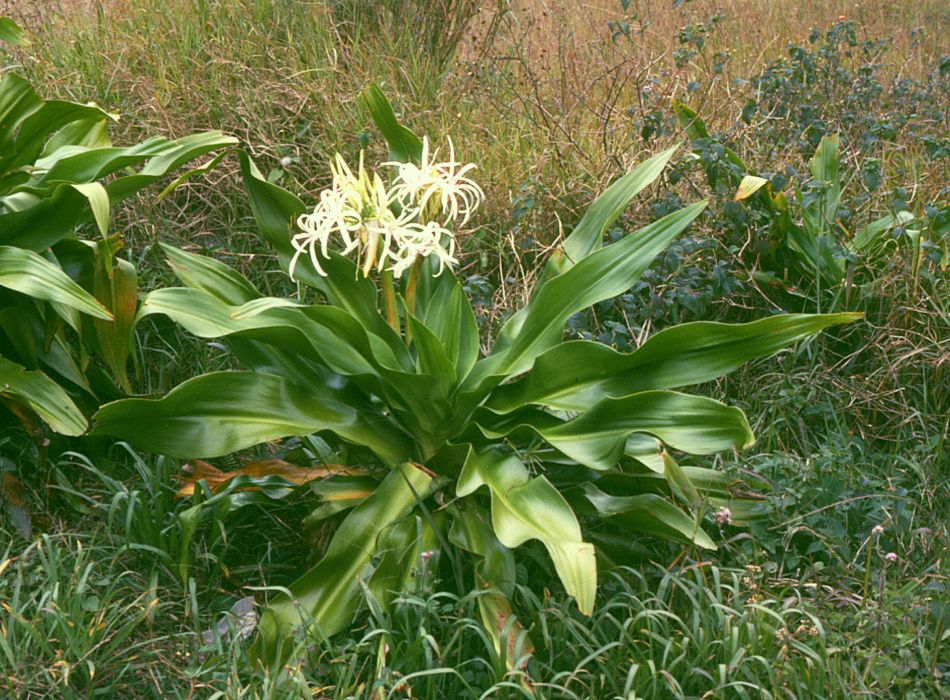
The Natal Lily grows from a bulb situated just below the soil surface, which can reach 20 cm in diameter. It has a projecting neck measuring 20–30 cm above the soil surface.[1][2][3]
The leaves form a rosette of long, flat, green foliage. The plant typically reaches a height of approximately 0.3–1.6 m, while its leaves measure approximately 0.65–1.5 m in length and 6–12 cm in width.[4][5][6][7]
The flowering stalk can reach 1.2 m in height and bear a cluster of 5–10 flowers. The flowers are funnel-shaped, strongly fragrant and range in colour from white to pale pink.[8][9][10][11]
The flower petals measure approximately 8–10 cm in length and 2.4–4 cm in width. Flower buds initially point vertically and droop as the flowers mature.[12][13][14]
The flower filament curves downwards before turning upwards at its tip. The upper part of the flower style is red.[15][16]
Habitat
The Natal Lily thrives in damp, marshy loam soil.[17]
The species is native to the Cape Provinces of South Africa and KwaZulu-Natal in South Africa. It has been introduced to Peru, Ecuador, Mexico and Korea, and is cultivated in the Nilgiris and Idukki regions of the Western Ghats in South India.[18][19][20][21][22][23][24]
Behaviour
The flowers reportedly produce a stronger scent in the evening. This stronger evening fragrance may help attract pollinators at that time.[25][26]
Reproduction and life cycle
The bulbs propagate through multiplication from their base.[27]
Conservation
The Natal Lily is classified as Vulnerable on the Red List of South African Plants. Its wild population has declined by 20% over the past 70 years.[28][29]
Harvesting the bulbs for traditional medicine contributes to the decline of wild populations. Pest infestations are also identified as a cause of the decline.[30][31]
Uses
The Natal Lily is used in traditional medicine to treat urinary tract infections and skin infections. It is also traditionally used for blood cleansing and in treatments for cattle.[32][33][34][35]
The species is sold in traditional medicine markets outside its native distribution range. The Faraday Street market in Johannesburg is one location where it is sold.[36][37]
Classification of the Natal Lily
| Kingdom | Plantae |
|---|---|
| Subkingdom | Pteridobiotina |
| Phylum | Tracheophyta |
| Class | Liliopsida |
| Order | Asparagales |
| Family | Amaryllidaceae (Amaryllids) |
| Genus | Crinum (Marshlilies) |
| Species | Crinum moorei Hook.f. |
Where the Natal Lily is found
Checklists and occurrence records place Crinum moorei in 11 countries across Africa, Europe, North America, Oceania and South America. GBIF holds 777 georeferenced records of it.
Countries where it is native or its origin is not stated
Countries where it has been introduced
Regions and cities with the most records
- Azores, Portugal 463
- KwaZulu-Natal, South Africa 60
- Western Cape, South Africa 36
- Ponta Delgada, Portugal 28
- Madeira, Portugal 17
- Câmara de Lobos, Portugal 16
- Funchal, Portugal 16
- Port Shepstone, South Africa 16
- Santo António, Portugal 16
- Pinetown, South Africa 15
- São Martinho, Portugal 15
- Eastern Cape, South Africa 14
- Ga-Malakhe, South Africa 14
- Ntuzuma, South Africa 14
- Caniço, Portugal 13
- George, South Africa 13
- Margate, South Africa 12
- Durban, South Africa 9
- Knysna, South Africa 9
- Benito Juarez, Mexico 8
- Coyoacán, Mexico 8
- Cuauhtémoc, Mexico 8
- Delegación Cuajimalpa de Morelos, Mexico 8
- Huixquilucan, Mexico 8
- Iztacalco, Mexico 8
- Iztapalapa, Mexico 8
- Jesús del Monte, Mexico 8
- Magdalena Contreras, Mexico 8
- Mexico City, Mexico 8
- Miguel Hidalgo, Mexico 8
- San Miguel Ajusco, Mexico 8
- San Miguel Topilejo, Mexico 8
- Tlalpan, Mexico 8
- Xochimilco, Mexico 8
- Azcapotzalco, Mexico 7
- Ciudad Nezahualcoyotl, Mexico 7
9 more countries have a few records outside this range
These countries hold a few records of Crinum moorei but lie outside the range the checklists give for it. Such records are often zoo or garden specimens, museum material or vagrants, so the species is not counted as occurring there.
A number beside a place is its count of GBIF occurrence records. A place without a number comes from a checklist alone. Records show where a species has been observed or collected, which can include escapes and vagrants.
Common names
English
- Natal Lily
- Inanda Lily
- Moores Swamplily
- Natal Swamplily
- Ngome Lily
Names in 12 other languages
- Afrikaans
- Natal-lelie, Ngomelelie, natallelie
- Chinese
- 穆尔香殊兰, 香殊兰
- Finnish
- kapmaankriinumi
- Japanese
- モモイロハマオモト
- Korean
- 아프리카문주란
- Lithuanian
- Švelnusis krinas
- Russian
- Кринум Мура
- Spanish
- Azucena rosa, lirio de Natal
- Swedish
- fönsterkrinum
- Thai
- ว่านมหาบัว
- Tswana
- ledutla
- Zulu
- Inanga lily, Undongenezibomvana
Synonyms
12 other scientific names have been used for this species and are now treated as synonyms of Crinum moorei.
- Amaryllis moorei (Hook.f.) Stapf
- Crinum colensoi Baker
- Crinum imbricatum Baker
- Crinum mackenii Baker
- Crinum makoyanum E.C.Hend.
- Crinum makoyanum Carrière
- Crinum makoyanum var. roseum Pynaert
- Crinum moorei var. variegatum André
- Crinum natalense Baker
- Crinum schmidtii Regel
- Crinum ugentii (Ochoa) Molinari
- Hippeastrum ugentii Ochoa
Related species
-
 PoisonbulbCrinum asiaticum
-
 Orange River SwamplilyCrinum bulbispermum
-
 Pink Striped Trumpet LilyCrinum latifolium
-
 Florida Swamp LilyCrinum americanum
-
 Crinum calamistratum
-
 Cape Coast LilyCrinum macowanii
-
 Water OnionCrinum thaianum
-
 Crinum mauritianum
Compare
Questions and answers
What is the scientific name of the Natal Lily?
The scientific name of the Natal Lily is Crinum moorei. Written with its author, the full name is Crinum moorei Hook.f..
Which family does the Natal Lily belong to?
Crinum moorei belongs to the family Amaryllidaceae, in the order Asparagales and the class Liliopsida.
Where is the Natal Lily found?
Checklists and occurrence records place Crinum moorei in 11 countries, including South Africa, Ghana, Liberia, Sierra Leone and Cameroon.
What other names does the Natal Lily have?
Crinum moorei is also known in English as Inanda Lily, Moores Swamplily, Natal Swamplily and Ngome Lily.
Do crinum lilies spread?
Yes. The Natal Lily's bulbs propagate through multiplication from their base.[27]
Sources
Passages the profile rests on
- The plant grows from a bulb situated just below the soil surface. Source passage: “It grows from a bulb up to 20 cm (7.9 in) diameter just under the surface of the soil.” — English Wikipedia
- The bulb can reach 20 cm in diameter. Source passage: “bulb up to 20 cm (7.9 in) diameter” — English Wikipedia
- The plant has a projecting neck measuring 20–30 cm above the soil surface. Source passage: “A long neck projects 20–30 cm (7.9–11.8 in) above the surface.” — English Wikipedia
- The leaves form a rosette of long, flat, green foliage. Source passage: “This is topped by a rosette of long, flat, green leaves” — English Wikipedia
- The plant typically reaches a height of approximately 0.3–1.6 m. Source passage: “about 0.3–1.6 m (0.98–5.25 ft)tall.” — English Wikipedia
- The leaves measure approximately 0.65–1.5 m in length. Source passage: “about 0.65–1.5 m (2.1–4.9 ft) long” — English Wikipedia
- The leaves measure approximately 6–12 cm in width. Source passage: “6–12 cm (2.4–4.7 in) wide.” — English Wikipedia
- The flowering stalk can bear a cluster of 5–10 flowers. Source passage: “A cluster of 5-10 white to pale pink flowers form” — English Wikipedia
- The flowers range in colour from white to pale pink. Source passage: “5-10 white to pale pink flowers” — English Wikipedia
- The flowering stalk can reach 1.2 m in height. Source passage: “on top of a stalk that is up to 1.2 m (3.9 ft) tall.” — English Wikipedia
- The flowers have a strong fragrance and a funnel-shaped form. Source passage: “The strongly-scented flowers are funnel shaped.” — English Wikipedia
- The flower petals measure approximately 8–10 cm in length. Source passage: “The petals are about 8–10 cm (3.1–3.9 in) long” — English Wikipedia
- The flower petals measure approximately 2.4–4 cm in width. Source passage: “2.4–4 cm (0.94–1.57 in) wide.” — English Wikipedia
- The flower buds initially point vertically and droop as the flowers mature. Source passage: “The buds are initially vertical and droop as the flower matures.” — English Wikipedia
- The flower filament curves downwards before turning upwards at its tip. Source passage: “The filament curves downwards, and then upwards at the tip.” — English Wikipedia
- The upper part of the flower style is red. Source passage: “The style is red towards the top end.” — English Wikipedia
- The species thrives in damp, marshy loam soil. Source passage: “Crinum moorei thrives in damp, marshy loam soil” — English Wikipedia
- The species is native to the Cape Provinces of South Africa. Source passage: “Crinum moorei is native to Cape Provinces and KwaZulu-Natal in South Africa.” — English Wikipedia
- The species is native to KwaZulu-Natal in South Africa. Source passage: “Crinum moorei is native to Cape Provinces and KwaZulu-Natal in South Africa.” — English Wikipedia
- The species has been introduced to Peru. Source passage: “It has been introduced in Peru, Ecuador, Mexico and Korea.” — English Wikipedia
- The species has been introduced to Ecuador. Source passage: “It has been introduced in Peru, Ecuador, Mexico and Korea.” — English Wikipedia
- The species has been introduced to Mexico. Source passage: “It has been introduced in Peru, Ecuador, Mexico and Korea.” — English Wikipedia
- The species has been introduced to Korea. Source passage: “It has been introduced in Peru, Ecuador, Mexico and Korea.” — English Wikipedia
- The species is cultivated in the Nilgiris and Idukki regions of the Western Ghats in South India. Source passage: “It is grown in the Nilgiris and Idukki in the Western Ghats of South India.” — English Wikipedia
- The flowers reportedly produce a stronger scent in the evening. Source passage: “The flower scent is reported to be stronger in the evening” — English Wikipedia
- The stronger evening fragrance may help attract pollinators at that time. Source passage: “perhaps to attract pollinators during that time.” — English Wikipedia
- The bulbs propagate through multiplication from their base. Source passage: “The bulbs propagate by multiplying from the base.” — English Wikipedia
- Crinum moorei is classified as Vulnerable on the Red List of South African Plants. Source passage: “Crinum moorei is Vulnerable” — English Wikipedia
- The wild population has declined by 20% over the past 70 years. Source passage: “the wild population having declined by 20% over the past 70 years.” — English Wikipedia
- Harvesting the bulbs for traditional medicine contributes to the decline of wild populations. Source passage: “This is due to harvesting of bulbs for traditional medicine” — English Wikipedia
- Pest infestations are identified as a cause of the species' wild population decline. Source passage: “and infestations by pests.” — English Wikipedia
- The species is used in traditional medicine to treat urinary tract infections. Source passage: “Crinum moorei is used in traditional medicine for urinary tract and skin infections” — English Wikipedia
- The species is used in traditional medicine to treat skin infections. Source passage: “for urinary tract and skin infections” — English Wikipedia
- The species is traditionally used for blood cleansing. Source passage: “and cleansing the blood.” — English Wikipedia
- The species is also used in treatments for cattle. Source passage: “It is also used for treating cattle.” — English Wikipedia
- The species is sold in traditional medicine markets outside its native distribution range. Source passage: “Crinum moorei is sold in traditional medicine markets outside of its distribution range” — redlist.sanbi.org
- The Faraday Street market in Johannesburg is one location where the species is sold in traditional medicine markets. Source passage: “e.g. the Faraday Street market in Johannesburg.” — redlist.sanbi.org
Data
- Catalogue of Life, 2026-10-16 XR cc by
- Global Biodiversity Information Facility CC BY 4.0
- Wikidata CC0
- GeoNames CC BY 4.0
- Wikimedia Commons per image; credit shown with each image
- Within the Catalogue of Life, this name comes from The World Checklist of Vascular Plants (WCVP) cc by
References
- Bot. Mag. 100: t. 6113 (1874) where the name was published
This species in other databases
- Catalogue of Life ZGR2
- Wikidata Q1017258
- iNaturalist 135361
- World Flora Online wfo-0000764603
- GRIN 12229
Page built on 27 November 2026. See how the catalog is made and all sources and licences.
Cite this page
ScientificNames.org. (2026). Crinum moorei (Natal Lily). Retrieved November 27, 2026, from https://scientificnames.org/species/crinum-moorei
“Crinum moorei (Natal Lily).” ScientificNames.org, 2026, scientificnames.org/species/crinum-moorei. Accessed 27 Nov. 2026.
ScientificNames.org. “Crinum moorei (Natal Lily).” Accessed November 27, 2026. https://scientificnames.org/species/crinum-moorei.
@misc{scientificnames_crinum_moorei_natal_lily,
  author = {{ScientificNames.org}},
  title = {Crinum moorei (Natal Lily)},
  year = {2026},
  url = {https://scientificnames.org/species/crinum-moorei},
  note = {Accessed 2026-11-27}
}