Species · Mammals
Sanetti Shrew Crocidura afeworkbekelei
The scientific name of the Sanetti Shrew is Crocidura afeworkbekelei. It is a species of mammal in the family Soricidae (shrew), order Eulipotyphla. The name dates from 2016.
- Scientific name
- Crocidura afeworkbekelei Lavrenchenko, Voyta & Hutterer, 2016
- Common name
- Sanetti Shrew
- Genus
- Crocidura
- Family
- Soricidae (Shrew)
- Order
- Eulipotyphla
- Class
- Mammalia
- Red List category
- DD Data Deficient
- Name status
- accepted in the Catalogue of Life
Overview
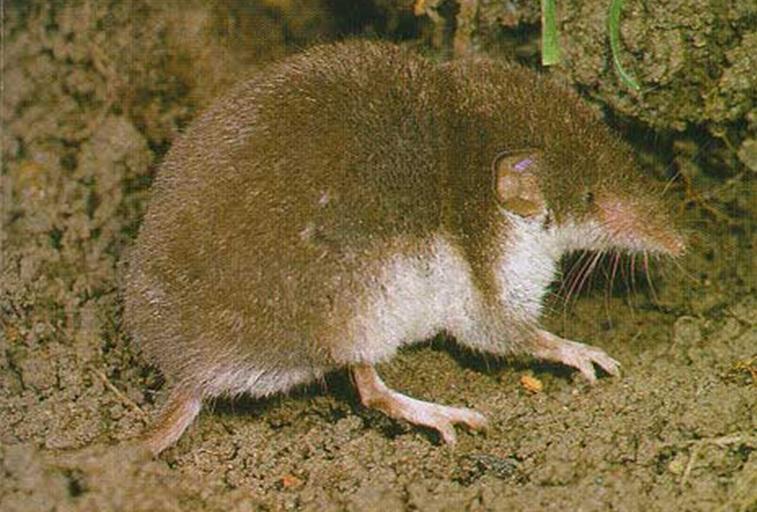
The species is thought to occur exclusively in the Bale Mountains of the Sanetti Plateau in southwestern Ethiopia. It has greyish-brown dorsal fur, gray ventral fur with light yellowish tips, and a brown tail with long bristles.
Written 27 November 2026 from the sources listed below. Each statement was checked against the passage it cites; statements that could not be supported were removed.
Appearance
The dorsal fur is greyish-brown with gray hair bases. The ventral fur is gray with light yellowish tips, and the backs of the legs are light gray.[1][2][3]
The Sanetti Shrew has slightly elongated feet. Its tail is brown above and brownish-gray below, with long bristles distributed throughout, and measures 50.6–61.5% of the head-body length.[4][5][6]
The head-body length is 78–85 millimetres, and the tail length is 43–48 millimetres. The feet measure 16.3–17 millimetres and the ears measure 8.5–10 millimetres in length.[7][8][9][10]
Habitat
The Sanetti Shrew inhabits the Afromontane zone, which is characterized by low and scattered vegetation. It occurs at approximately 4,000 metres above sea level.[11][12]
The species is endemic to Ethiopia and is thought to occur exclusively in the Bale Mountains of the Sanetti Plateau in southwestern Ethiopia.[13][14]
Conservation
No threats have presently been documented for the Sanetti Shrew. It is classified as Data Deficient on the IUCN Red List.[15][16]
Classification of the Sanetti Shrew
| Kingdom | Animalia |
|---|---|
| Phylum | Chordata |
| Subphylum | Vertebrata |
| Infraphylum | Gnathostomata |
| Parvphylum | Osteichthyes |
| Megaclass | Tetrapoda |
| Class | Mammalia (Mammal) |
| Subclass | Theria |
| Infraclass | Eutheria |
| Order | Eulipotyphla |
| Family | Soricidae (Shrew) |
| Subfamily | Crocidurinae (White-toothed Shrews) |
| Genus | Crocidura (White-toothed Shrews) |
| Species | Crocidura afeworkbekelei Lavrenchenko, Voyta & Hutterer, 2016 |
Where the Sanetti Shrew is found
Checklists place Crocidura afeworkbekelei in Africa.
Range as the checklists state it
Africa
A number beside a place is its count of GBIF occurrence records. A place without a number comes from a checklist alone. Records show where a species has been observed or collected, which can include escapes and vagrants.
Common names
English
- Sanetti Shrew
- Bekele's White-toothed Shrew
Related species
- Christmas Island ShrewCrocidura trichura
-
 Greater White-toothed ShrewCrocidura russula
-
 Lesser White-toothed ShrewCrocidura suaveolens
-
 Bicolored ShrewCrocidura leucodon
- Cretan ShrewCrocidura zimmermanni
- African Giant ShrewCrocidura olivieri
-
 Canarian ShrewCrocidura canariensis
-
 Güldenstädt's ShrewCrocidura gueldenstaedtii
Compare
Questions and answers
What is the scientific name of the Sanetti Shrew?
The scientific name of the Sanetti Shrew is Crocidura afeworkbekelei. Written with its author, the full name is Crocidura afeworkbekelei Lavrenchenko, Voyta & Hutterer, 2016.
Which family does the Sanetti Shrew belong to?
Crocidura afeworkbekelei belongs to the family Soricidae, in the order Eulipotyphla and the class Mammalia.
What is the conservation status of the Sanetti Shrew?
The IUCN Red List category recorded for Crocidura afeworkbekelei is Data Deficient (DD).
What other names does the Sanetti Shrew have?
Crocidura afeworkbekelei is also known in English as Bekele's White-toothed Shrew.
Sources
Passages the profile rests on
- The dorsal fur is greyish-brown with gray hair bases. Source passage: “The dorsal pelage is greyish-brown with the base of the hairs being gray” — English Wikipedia
- The ventral fur is gray with light yellowish tips. Source passage: “the ventral pelage is gray with light yellowish tips.” — English Wikipedia
- The backs of the legs are light gray. Source passage: “The back of the legs is light gray.” — English Wikipedia
- The species has slightly elongated feet. Source passage: “The feet are slightly elongated.” — English Wikipedia
- The tail measures 50.6–61.5% of the head-body length. Source passage: “The tail, between 50.6 and 61.5% of the head-body length” — English Wikipedia
- The tail is brown above and brownish-gray below, with long bristles distributed throughout. Source passage: “is brown above, brownish-gray below and interspersed with long bristles.” — English Wikipedia
- The species has a head-body length of 78–85 millimetres. Source passage: “the head-body length being between 78–85 millimetres (3.1–3.3 in)” — English Wikipedia
- The species has a tail length of 43–48 millimetres. Source passage: “the length of the tail being between 43–48 millimetres (1.7–1.9 in)” — English Wikipedia
- The species has feet measuring 16.3–17 millimetres in length. Source passage: “the length of the feet between 16.3–17 millimetres (0.64–0.67 in)” — English Wikipedia
- The species has ears measuring 8.5–10 millimetres in length. Source passage: “the length of the ears between 8.5–10 millimetres (0.33–0.39 in).” — English Wikipedia
- The species inhabits the Afromontane zone characterized by low and scattered vegetation. Source passage: “It inhabits the Afromontane zone with low and scattered vegetation” — English Wikipedia
- The species occurs at approximately 4,000 metres above sea level. Source passage: “at about 4,000 metres (13,120 ft) above sea level.” — English Wikipedia
- The species is endemic to Ethiopia. Source passage: “It is endemic to Ethiopia.” — English Wikipedia
- The species is thought to occur exclusively in the Bale Mountains of the Sanetti Plateau in southwestern Ethiopia. Source passage: “This species is thought to be endemic to the Bale Mountains of the Sanetti Plateau in southwestern Ethiopia.” — English Wikipedia
- No threats have presently been documented for the species. Source passage: “No threats have presently been documented for this species” — English Wikipedia
- The species is classified as Data Deficient on the IUCN Red List. Source passage: “it is classified as Data Deficient on the IUCN Red List.” — English Wikipedia
Data
- Catalogue of Life, 2026-10-16 XR cc by
- Wikidata CC0
- Within the Catalogue of Life, this name comes from The Integrated Taxonomic Information System cc0
References
- Lavrenchenko, Leonid A., Leonid L. Voyta & Rainer Hutterer. 2016. Diversity of shrews in Ethiopia, with the description of two new species of Crocidura (Mammalia: Lipotyphla: Soricidae). Zootaxa 4196(1): 38–60. Link where the name was published
- Burgin, Connor, Kai He, Rudolf Haslauer, et al. / Don E. Wilson and Russell A. Mittermeier, eds. (2018). Family Soricidae (Shrews). Handbook of the Mammals of the World. Vol. 8: Insectivores, Sloths and Colugos.
This species in other databases
Page built on 29 November 2026. See how the catalog is made and all sources and licences.
Cite this page
ScientificNames.org. (2026). Crocidura afeworkbekelei (Sanetti Shrew). Retrieved November 29, 2026, from https://scientificnames.org/species/crocidura-afeworkbekelei
“Crocidura afeworkbekelei (Sanetti Shrew).” ScientificNames.org, 2026, scientificnames.org/species/crocidura-afeworkbekelei. Accessed 29 Nov. 2026.
ScientificNames.org. “Crocidura afeworkbekelei (Sanetti Shrew).” Accessed November 29, 2026. https://scientificnames.org/species/crocidura-afeworkbekelei.
@misc{scientificnames_crocidura_afeworkbekelei_sanetti_shrew,
  author = {{ScientificNames.org}},
  title = {Crocidura afeworkbekelei (Sanetti Shrew)},
  year = {2026},
  url = {https://scientificnames.org/species/crocidura-afeworkbekelei},
  note = {Accessed 2026-11-29}
}