Species · Mammals
Dracula Shrew Crocidura dracula
The scientific name of the Dracula Shrew is Crocidura dracula. It is a species of mammal in the family Soricidae (shrew), order Eulipotyphla. The name dates from 1912.
- Scientific name
- Crocidura dracula Thomas, 1912
- Common name
- Dracula Shrew
- Genus
- Crocidura
- Family
- Soricidae (Shrew)
- Order
- Eulipotyphla
- Class
- Mammalia
- Recorded in
- 5 countries
- Name status
- accepted in the Catalogue of Life
Overview
The Dracula Shrew (Crocidura dracula Thomas, 1912) is a mammal in the family Soricidae, order Eulipotyphla, and class Mammalia. It occurs in Vietnam, Laos, and adjacent southern China, and may also occur in Cambodia east of the Mekong River. It has a large body, a long tail, and upperparts ranging from smoke brown to dark grey-black.
Written 27 November 2026 from the sources listed below. Each statement was checked against the passage it cites; statements that could not be supported were removed.
Appearance
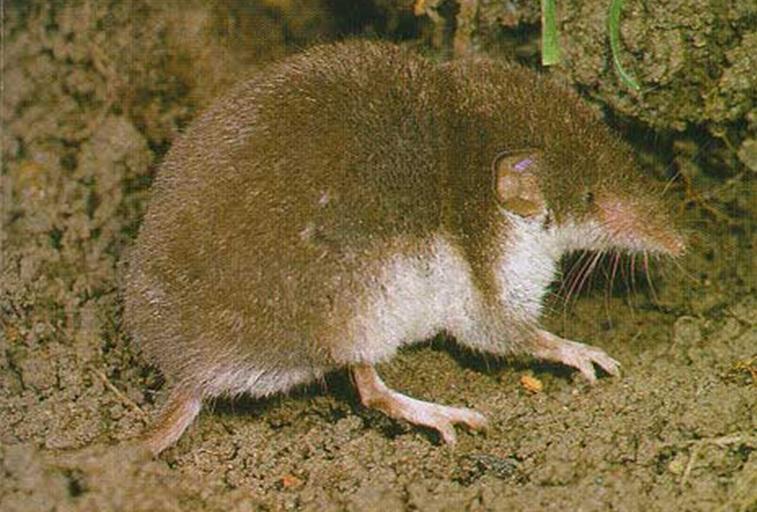
The Dracula Shrew has a large body and a long tail. Its upperparts range in color from smoke brown to dark grey-black, while its underparts are dark grey and its feet are dull white.[1][2][3][4]
Its head-and-body length ranges from 78 to 95 mm. Its tail typically measures 65–80 mm and is generally at least 80% of its head-and-body length.[5][6][7]
The tail is often darker on its upper surface than on its lower surface.[8]
Similar species
The Dracula Shrew is visually similar to the Southeast Asian shrew. It was historically considered part of the same species complex as that species.[9][10]
Recent genetic evidence strongly supports its recognition as a uniquely diverged species. The range boundary between the Dracula Shrew and the Southeast Asian shrew remains under resolution.[11][12]
Diet
The Dracula Shrew is an insectivore.[13]
Classification of the Dracula Shrew
| Kingdom | Animalia |
|---|---|
| Phylum | Chordata |
| Subphylum | Vertebrata |
| Infraphylum | Gnathostomata |
| Parvphylum | Osteichthyes |
| Megaclass | Tetrapoda |
| Class | Mammalia (Mammal) |
| Subclass | Theria |
| Infraclass | Eutheria |
| Order | Eulipotyphla |
| Family | Soricidae (Shrew) |
| Subfamily | Crocidurinae (White-toothed Shrews) |
| Genus | Crocidura (White-toothed Shrews) |
| Species | Crocidura dracula Thomas, 1912 |
Where the Dracula Shrew is found
Checklists and occurrence records place Crocidura dracula in 5 countries across Asia. GBIF holds 254 georeferenced records of it.
Countries
Regions and cities with the most records
- Lao Cai, Vietnam 20
- Yunnan, China 18
- Lào Cai, Vietnam 15
- Kyaikto, Myanmar 6
- Kyauktaga, Myanmar 6
- Mon, Myanmar 6
- Mengzi, China 4
- Meghalaya, India 3
- Shella, India 3
Range as the checklists state it
Southern Asia
A number beside a place is its count of GBIF occurrence records. A place without a number comes from a checklist alone. Records show where a species has been observed or collected, which can include escapes and vagrants.
Common names
English
- Dracula Shrew
- Large White-toothed Shrew
Synonyms
2 other scientific names have been used for this species and are now treated as synonyms of Crocidura dracula.
- Crocidura fuliginosa dracula Thomas, 1912
- Crocidura praedax Thomas, 1923
Related species
- Christmas Island ShrewCrocidura trichura
-
 Greater White-toothed ShrewCrocidura russula
-
 Lesser White-toothed ShrewCrocidura suaveolens
-
 Bicolored ShrewCrocidura leucodon
- Cretan ShrewCrocidura zimmermanni
- African Giant ShrewCrocidura olivieri
-
 Canarian ShrewCrocidura canariensis
-
 Güldenstädt's ShrewCrocidura gueldenstaedtii
Compare
Questions and answers
What is the scientific name of the Dracula Shrew?
The scientific name of the Dracula Shrew is Crocidura dracula. Written with its author, the full name is Crocidura dracula Thomas, 1912.
Which family does the Dracula Shrew belong to?
Crocidura dracula belongs to the family Soricidae, in the order Eulipotyphla and the class Mammalia.
Where is the Dracula Shrew found?
Checklists and occurrence records place Crocidura dracula in 5 countries: China, Vietnam, Myanmar, India and Malaysia.
What other names does the Dracula Shrew have?
Crocidura dracula is also known in English as Large White-toothed Shrew.
What is the diet of a shrew?
The Dracula Shrew is an insectivore.[13]
Are shrews omnivores or carnivores?
The Dracula Shrew is an insectivore.[13]
Sources
Passages the profile rests on
- The Dracula shrew has a large body and a long tail. Source passage: “The Dracula shrew is a large and long-tailed shrew” — English Wikipedia
- Its upperparts range in color from smoke brown to dark grey-black. Source passage: “The coloring is smoke brown to dark grey black above” — English Wikipedia
- Its underparts are dark grey. Source passage: “fading to dark grey below” — English Wikipedia
- Its feet are dull white. Source passage: “with dull white feet” — English Wikipedia
- Its head-and-body length ranges from 78 to 95 mm. Source passage: “a head-and-body length of between 78 and 95 mm (3.1 and 3.7 in)” — English Wikipedia
- Its tail is generally at least 80% of its head-and-body length. Source passage: “a tail generally at least 80% of that length” — English Wikipedia
- Its tail typically measures 65–80 mm. Source passage: “typically between 65 and 80 mm (2.6 and 3.1 in).” — English Wikipedia
- Its tail is often darker on the upper surface than on the lower surface. Source passage: “the tail is often dark above and lighter below” — English Wikipedia
- The Dracula shrew is visually similar to the Southeast Asian shrew. Source passage: “Because it is so visually similar to the Southeast Asian shrew” — English Wikipedia
- The Dracula shrew was historically considered part of the same species complex as the Southeast Asian shrew. Source passage: “it has historically been considered part of the same species complex” — English Wikipedia
- The range boundary between the Dracula shrew and the Southeast Asian shrew remains under resolution. Source passage: “the range delineation between the two species is still being resolved.” — English Wikipedia
- Recent genetic evidence strongly supports the Dracula shrew's recognition as a uniquely diverged species. Source passage: “Recent genetic evidence strongly supports that the Dracula shrew is in fact a uniquely diverged species.” — English Wikipedia
- The Dracula shrew is an insectivore. Source passage: “the Dracula shrew is an insectivore.” — English Wikipedia
Data
- Catalogue of Life, 2026-10-16 XR cc by
- Global Biodiversity Information Facility CC BY 4.0
- Wikidata CC0
- GeoNames CC BY 4.0
- Within the Catalogue of Life, this name comes from The Integrated Taxonomic Information System cc0
References
- Burgin, Connor, Kai He, Rudolf Haslauer, et al. / Don E. Wilson and Russell A. Mittermeier, eds. (2018). Family Soricidae (Shrews). Handbook of the Mammals of the World. Vol. 8: Insectivores, Sloths and Colugos.
This species in other databases
Page built on 29 November 2026. See how the catalog is made and all sources and licences.
Cite this page
ScientificNames.org. (2026). Crocidura dracula (Dracula Shrew). Retrieved November 29, 2026, from https://scientificnames.org/species/crocidura-dracula
“Crocidura dracula (Dracula Shrew).” ScientificNames.org, 2026, scientificnames.org/species/crocidura-dracula. Accessed 29 Nov. 2026.
ScientificNames.org. “Crocidura dracula (Dracula Shrew).” Accessed November 29, 2026. https://scientificnames.org/species/crocidura-dracula.
@misc{scientificnames_crocidura_dracula_dracula_shrew,
  author = {{ScientificNames.org}},
  title = {Crocidura dracula (Dracula Shrew)},
  year = {2026},
  url = {https://scientificnames.org/species/crocidura-dracula},
  note = {Accessed 2026-11-29}
}