Species · Mammals
Sulawesi Shrew Crocidura lea
The scientific name of the Sulawesi Shrew is Crocidura lea. It is a species of mammal in the family Soricidae (shrew), order Eulipotyphla. The name dates from 1921.
- Scientific name
- Crocidura lea G. S. Miller & Hollister, 1921
- Common name
- Sulawesi Shrew
- Genus
- Crocidura
- Family
- Soricidae (Shrew)
- Order
- Eulipotyphla
- Class
- Mammalia
- Red List category
- LC Least Concern
- Recorded in
- 1 country
- Name status
- accepted in the Catalogue of Life
Overview
The Sulawesi Shrew is a shrew endemic to the Indonesian island of Sulawesi. It occurs in the central and northern parts of Sulawesi. It is the smallest member of its endemic northern and central Sulawesi shrew assemblage.
Written 27 November 2026 from the sources listed below. Each statement was checked against the passage it cites; statements that could not be supported were removed.
Appearance
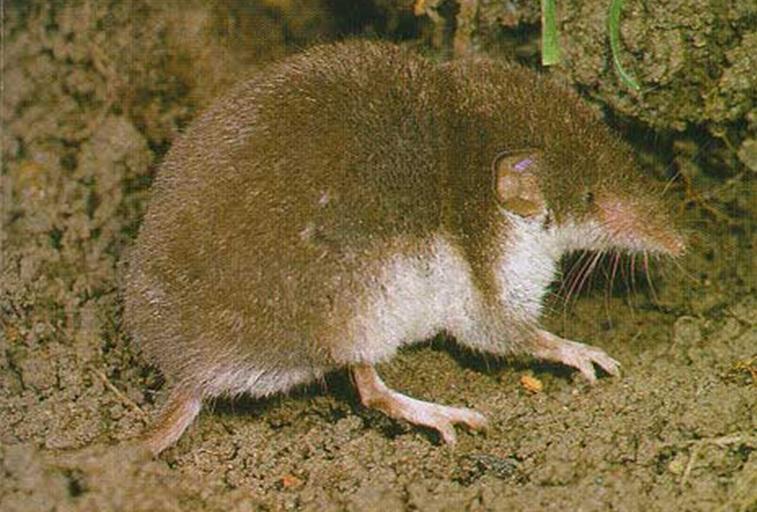
The dorsal fur is short and velvety, with greyish-brown or reddish-brown colouring. The underside is paler than the dorsal fur.[1][2][3]
The species lacks iron deposits in its tooth enamel.[4]
Habitat
The Sulawesi Shrew inhabits primary tropical forests and can also survive in secondary forests.[5][6]
It has been recorded at elevations of up to approximately 1,000 metres.[7]
Diet
The Sulawesi Shrew is insectivorous and is likely to eat insects and small arthropods.[8][9]
Behaviour
The species is thought to be nocturnal and lives among leaf litter.[10][11]
It is regularly captured in pitfall traps.[12]
Conservation
The Sulawesi Shrew is assessed as Least Concern by the International Union for Conservation of Nature. It is fairly common in some locations.[13][14]
Its population trend is unknown, and no particular threats have been recognised.[15][16]
Classification of the Sulawesi Shrew
| Kingdom | Animalia |
|---|---|
| Phylum | Chordata |
| Subphylum | Vertebrata |
| Infraphylum | Gnathostomata |
| Parvphylum | Osteichthyes |
| Megaclass | Tetrapoda |
| Class | Mammalia (Mammal) |
| Subclass | Theria |
| Infraclass | Eutheria |
| Order | Eulipotyphla |
| Family | Soricidae (Shrew) |
| Subfamily | Crocidurinae (White-toothed Shrews) |
| Genus | Crocidura (White-toothed Shrews) |
| Species | Crocidura lea G. S. Miller & Hollister, 1921 |
Where the Sulawesi Shrew is found
Checklists and occurrence records place Crocidura lea in 1 country across Asia. GBIF holds 59 georeferenced records of it.
Countries
Regions and cities with the most records
Range as the checklists state it
Southern Asia
A number beside a place is its count of GBIF occurrence records. A place without a number comes from a checklist alone. Records show where a species has been observed or collected, which can include escapes and vagrants.
Common names
English
- Sulawesi Shrew
- Lesser Black-footed White-toothed Shrew
Names in 5 other languages
- Czech
- bělozubka lea
- Finnish
- sulawesinmetsäsupiainen
- Japanese
- レアジネズミ
- Polish
- zębiełek sulaweski
- Russian
- Львиная белозубка
Related species
- Christmas Island ShrewCrocidura trichura
-
 Greater White-toothed ShrewCrocidura russula
-
 Lesser White-toothed ShrewCrocidura suaveolens
-
 Bicolored ShrewCrocidura leucodon
- Cretan ShrewCrocidura zimmermanni
- African Giant ShrewCrocidura olivieri
-
 Canarian ShrewCrocidura canariensis
-
 Güldenstädt's ShrewCrocidura gueldenstaedtii
Compare
Questions and answers
What is the scientific name of the Sulawesi Shrew?
The scientific name of the Sulawesi Shrew is Crocidura lea. Written with its author, the full name is Crocidura lea G. S. Miller & Hollister, 1921.
Which family does the Sulawesi Shrew belong to?
Crocidura lea belongs to the family Soricidae, in the order Eulipotyphla and the class Mammalia.
Where is the Sulawesi Shrew found?
Checklists and occurrence records place Crocidura lea in 1 country: Indonesia.
What is the conservation status of the Sulawesi Shrew?
The IUCN Red List category recorded for Crocidura lea is Least Concern (LC).
What other names does the Sulawesi Shrew have?
Crocidura lea is also known in English as Lesser Black-footed White-toothed Shrew.
What is the habitat of a shrew?
The Sulawesi Shrew inhabits primary tropical forests and can also survive in secondary forests. It has been recorded at elevations of up to approximately 1,000 metres.[5][6][7]
Is a shrew an herbivore, carnivore, or omnivore?
The Sulawesi Shrew is insectivorous.[8]
Sources
Passages the profile rests on
- The dorsal fur is short and velvety. Source passage: “The dorsal pelage is short and velvety” — English Wikipedia
- The dorsal fur is greyish-brown or reddish-brown. Source passage: “being greyish-brown or reddish-brown” — English Wikipedia
- The underside of the species is paler than its dorsal fur. Source passage: “and the underside is paler.” — English Wikipedia
- The species lacks iron deposits in its tooth enamel. Source passage: “it lacks the deposits of iron in the enamel of the teeth” — English Wikipedia
- The species inhabits primary tropical forests. Source passage: “Its typical habitat is primary tropical forests” — English Wikipedia
- The species can also survive in secondary forests. Source passage: “but it seems able to survive in secondary forests as well.” — English Wikipedia
- The species has been recorded at elevations of up to approximately 1,000 metres. Source passage: “at altitudes of up to about 1,000 m (3,300 ft).” — English Wikipedia
- The Sulawesi shrew is insectivorous. Source passage: “and is insectivorous” — English Wikipedia
- The species is likely to eat insects and small arthropods. Source passage: “and is likely to eat insects and small arthropods.” — English Wikipedia
- The species is thought to be nocturnal. Source passage: “The Sulawesi shrew is thought to be nocturnal” — English Wikipedia
- The species lives among leaf litter. Source passage: “Like other members of its family it lives among the leaf litter” — English Wikipedia
- The species is regularly captured in pitfall traps. Source passage: “and is regularly caught in pitfall traps.” — English Wikipedia
- The species is assessed as being of Least Concern by the International Union for Conservation of Nature. Source passage: “the International Union for Conservation of Nature has assessed its conservation status as being of "least concern".” — English Wikipedia
- The species is fairly common in some locations. Source passage: “The Sulawesi shrew is fairly common in some locations” — English Wikipedia
- The population trend of the species is unknown. Source passage: “The population trend is unknown” — English Wikipedia
- No particular threats to the species have been recognised. Source passage: “but no particular threats to this species have been recognised.” — English Wikipedia
Data
- Catalogue of Life, 2026-10-16 XR cc by
- Global Biodiversity Information Facility CC BY 4.0
- Wikidata CC0
- GeoNames CC BY 4.0
- Within the Catalogue of Life, this name comes from The Integrated Taxonomic Information System cc0
References
- Proc. Biol. Soc. Wash. vol.34 p.102 where the name was published
- Wilson, Don E., and DeeAnn M. Reeder, eds. (1993). Mammal Species of the World: A Taxonomic and Geographic Reference, 2nd Ed., 3rd Printing.
- Wilson, Don E., and F. Russell Cole. (2000). Common Names of Mammals of the World.
- Wilson, Don E., and DeeAnn M. Reeder, eds. (2005). Mammal Species of the World: A Taxonomic and Geographic Reference, 3rd Ed., Vols. 1 & 2.
- Burgin, Connor, Kai He, Rudolf Haslauer, et al. / Don E. Wilson and Russell A. Mittermeier, eds. (2018). Family Soricidae (Shrews). Handbook of the Mammals of the World. Vol. 8: Insectivores, Sloths and Colugos.
- Esselstyn, Jacob A., Anang S. Achmadi, Heru Handika, Mark T. Swanson, Thomas C. Giarla, et al. (2021). Fourteen New, Endemic Species of Shrew (Genus Crocidura) from Sulawesi Reveal a Spectacular Island Radiation. Bulletin of the American Museum of Natural History, Vol. 454, No. 1. Link
This species in other databases
Page built on 29 November 2026. See how the catalog is made and all sources and licences.
Cite this page
ScientificNames.org. (2026). Crocidura lea (Sulawesi Shrew). Retrieved November 29, 2026, from https://scientificnames.org/species/crocidura-lea
“Crocidura lea (Sulawesi Shrew).” ScientificNames.org, 2026, scientificnames.org/species/crocidura-lea. Accessed 29 Nov. 2026.
ScientificNames.org. “Crocidura lea (Sulawesi Shrew).” Accessed November 29, 2026. https://scientificnames.org/species/crocidura-lea.
@misc{scientificnames_crocidura_lea_sulawesi_shrew,
  author = {{ScientificNames.org}},
  title = {Crocidura lea (Sulawesi Shrew)},
  year = {2026},
  url = {https://scientificnames.org/species/crocidura-lea},
  note = {Accessed 2026-11-29}
}