Species · Other invertebrates
Crossota millsae
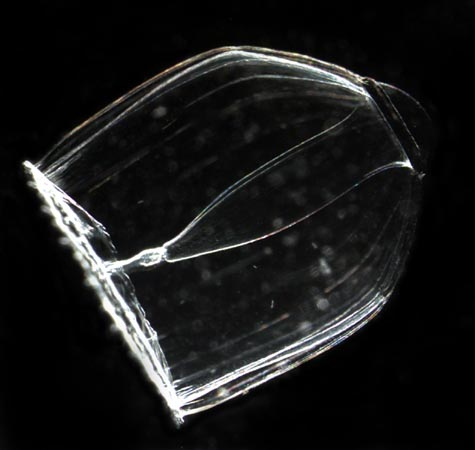
Crossota millsae has no English name on record in the checklists used here. It is a species of animal in the family Rhopalonematidae, order Trachymedusae. The name dates from 2003.
- Scientific name
- Crossota millsae Thuesen, 2003
- Genus
- Crossota
- Family
- Rhopalonematidae
- Order
- Trachymedusae
- Class
- Hydrozoa
- Environment
- marine
- Recorded in
- 2 countries
- Name status
- accepted in the Catalogue of Life

Overview
Crossota millsae occurs in the Pacific Ocean off Hawaii and California, the Arctic Ocean, and Guayanilla Canyon off Puerto Rico. It is bioluminescent and reproduces sexually, with females brooding baby medusae.
Written 26 November 2026 from the sources listed below. Each statement was checked against the passage it cites; statements that could not be supported were removed.
Appearance
Crossota millsae is bioluminescent and emits light that serves as a defense or warning to other creatures.[1]
Reproduction and life cycle
Crossota millsae reproduces sexually. Both males and females have been described.[2]
The species is viviparous. Females brood baby medusae attached to gastric canals inside the sub-umbrellar space.[3]
Habitat
Crossota millsae occurs at depths below 1,000 metres in the Pacific Ocean off Hawaii and California, the Arctic Ocean, and Guayanilla Canyon off Puerto Rico.[4][5][6]
The highest recorded abundance off California occurs at a depth of 2,500 metres. Off Hawaii, the highest recorded abundance occurs at a depth of 1,250 metres.[7][8]
Behaviour
Crossota millsae has been observed sitting on the seafloor in the Arctic Ocean.[9]
Classification of Crossota millsae
| Kingdom | Animalia |
|---|---|
| Phylum | Cnidaria |
| Class | Hydrozoa |
| Subclass | Trachylinae |
| Order | Trachymedusae |
| Family | Rhopalonematidae |
| Genus | Crossota |
| Species | Crossota millsae Thuesen, 2003 |
Where Crossota millsae is found
Checklists and occurrence records place Crossota millsae in 2 countries. GBIF holds 68 georeferenced records of it.
Countries
A number beside a place is its count of GBIF occurrence records. A place without a number comes from a checklist alone. Records show where a species has been observed or collected, which can include escapes and vagrants.
Related species
-
 Crossota norvegica
- Crossota alba
- Crossota rufobrunnea
- Crossota brunnea
-
 Pink HelmetAglantha digitale
-
 Benthocodon hyalinus
-
 American PipitAglaura hemistoma
-
 Silky MedusaColobonema sericeum
Compare
Sources
Passages the profile rests on
- Crossota millsae is bioluminescent and emits light that serves as a defense or warning to other creatures. Source passage: “These small ocean-dwelling creatures are bioluminescent; the light emitted by these jellyfish serves as a defense or warning to other creatures.” — English Wikipedia
- Crossota millsae reproduces sexually, and both males and females have been described. Source passage: “Males and females have both been described, and it reproduces sexually.” — English Wikipedia
- Crossota millsae is viviparous, with females brooding baby medusae attached to gastric canals inside the sub-umbrellar space. Source passage: “They are viviparous and females brood baby medusae attached to the gastric canals inside the sub-umbrellar space.” — English Wikipedia
- Crossota millsae was first described from the Pacific Ocean off Hawaii and California. Source passage: “Crossota millsae was first described from the Pacific Ocean off Hawaii and California.” — English Wikipedia
- Crossota millsae has also been recorded in the Arctic Ocean and Guayanilla Canyon off Puerto Rico. Source passage: “It was subsequently found in the Arctic Ocean and in Guayanilla Canyon off Puerto Rico.” — English Wikipedia
- Crossota millsae occurs at depths below 1,000 metres in the four reported regions. Source passage: “It lives below 1 km depth in all four regions.” — English Wikipedia
- The highest recorded abundance of Crossota millsae off California occurs at a depth of 2,500 metres. Source passage: “Its highest abundance is found at 2500 m off California and 1250 m off Hawaii.” — English Wikipedia
- The highest recorded abundance of Crossota millsae off Hawaii occurs at a depth of 1,250 metres. Source passage: “Its highest abundance is found at 2500 m off California and 1250 m off Hawaii.” — English Wikipedia
- Crossota millsae has been observed sitting on the seafloor in the Arctic Ocean. Source passage: “In the Arctic Ocean, it has been observed sitting on the seafloor.” — English Wikipedia
Data
- Catalogue of Life, 2026-10-16 XR cc by
- Global Biodiversity Information Facility CC BY 4.0
- Wikidata CC0
- GeoNames CC BY 4.0
- Wikimedia Commons per image; credit shown with each image
- Within the Catalogue of Life, this name comes from World Register of Marine Species cc by
References
- Thuesen, E. V. (2003). Crossota millsae (Cnidaria: Trachymedusae: Rhopalonematidae), a new species of viviparous hydromedusa from the deep sea off California and Hawaii. Zootaxa, 309. https://doi.org/10.11646/zootaxa.309.1.1 Link where the name was published
This species in other databases
- Catalogue of Life ZMQ9
- Wikidata Q2430039
- iNaturalist 1151367
- WoRMS urn:lsid:marinespecies.org:taxname:285347
Page built on 27 November 2026. See how the catalog is made and all sources and licences.
Cite this page
ScientificNames.org. (2026). Crossota millsae. Retrieved November 27, 2026, from https://scientificnames.org/species/crossota-millsae
“Crossota millsae.” ScientificNames.org, 2026, scientificnames.org/species/crossota-millsae. Accessed 27 Nov. 2026.
ScientificNames.org. “Crossota millsae.” Accessed November 27, 2026. https://scientificnames.org/species/crossota-millsae.
@misc{scientificnames_crossota_millsae,
  author = {{ScientificNames.org}},
  title = {Crossota millsae},
  year = {2026},
  url = {https://scientificnames.org/species/crossota-millsae},
  note = {Accessed 2026-11-27}
}