Species · Birds
Tataupa Tinamou Crypturellus tataupa
The scientific name of the Tataupa Tinamou is Crypturellus tataupa. It is a species of bird in the family Tinamidae (tinamou), order Tinamiformes. The name dates from 1815.
- Scientific name
- Crypturellus tataupa (Temminck, 1815)
- Common name
- Tataupa Tinamou
- Genus
- Crypturellus
- Family
- Tinamidae (Tinamou)
- Order
- Tinamiformes
- Class
- Aves
- Red List category
- LC Least Concern
- Recorded in
- 6 countries
- Name status
- accepted in the Catalogue of Life

Overview
Crypturellus tataupa inhabits dry forests, lowland moist forests, and degraded former forest habitats. It has dark brown upperparts and crown, darker grey sides of the head, neck, and breast, and purplish red legs and bill.
Written 26 November 2026 from the sources listed below. Each statement was checked against the passage it cites; statements that could not be supported were removed.
Appearance
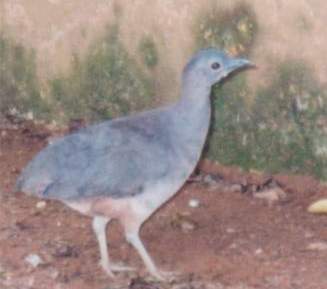
The Tataupa Tinamou has dark brown upperparts and a dark brown crown. The sides of its head, neck, and breast are darker grey.[1][2]
Its legs and bill are purplish red. It measures approximately 25 cm in length.[3][4]
Habitat
The Tataupa Tinamou commonly inhabits dry forests in subtropical and tropical regions of southeastern South America. It prefers dry forests at elevations up to 1,400 m.[5][6]
It also occurs in lowland moist forests and can inhabit degraded former forest habitats.[7][8]
The nominate subspecies occurs in eastern Bolivia, southern Brazil, northern Argentina, and Paraguay. Crypturellus tataupa inops occurs in the Marañón Valley of northwestern Peru and extreme southern Ecuador, while Crypturellus tataupa peruvianus occurs in the Chanchamayo Valley of Peru's Junín Region.[9][10][11]
Crypturellus tataupa lepidotus occurs in the northeastern Brazilian states of Bahia, Ceará, Piauí, Pernambuco, and Maranhão.[12]
Diet
The Tataupa Tinamou eats fruit from the ground and low-lying bushes. It also consumes small quantities of invertebrates.[13][14]
Behaviour
Male Tataupa Tinamous incubate the eggs. A male may incubate eggs laid by as many as four different females.[15][16]
The male raises the chicks until they can live independently.[17]
Reproduction and life cycle
The Tataupa Tinamou builds its nest on the ground in dense brush or between raised root buttresses.[18]
Male Tataupa Tinamous incubate eggs that may originate from as many as four females. They raise their young for approximately two to three weeks until they are independent.[19][20]
Conservation
The Tataupa Tinamou is classified as Least Concern by the IUCN. Its occurrence range is approximately 4,900,000 km².[21][22]
Classification of the Tataupa Tinamou
| Kingdom | Animalia |
|---|---|
| Phylum | Chordata |
| Subphylum | Vertebrata |
| Infraphylum | Gnathostomata |
| Parvphylum | Osteichthyes |
| Megaclass | Tetrapoda |
| Class | Aves (Bird) |
| Order | Tinamiformes (Tinamou) |
| Family | Tinamidae (Tinamou) |
| Genus | Crypturellus (Crypturellus Tinamous) |
| Species | Crypturellus tataupa (Temminck, 1815) |
Where the Tataupa Tinamou is found
Checklists and occurrence records place Crypturellus tataupa in 6 countries across South America. GBIF holds 32,026 georeferenced records of it.
Countries
Regions and cities with the most records
- São Paulo, Brazil 3,730
- Misiones, Argentina 2,696
- Cordoba, Argentina 1,701
- Mato Grosso, Brazil 1,608
- Salta, Argentina 1,542
- Paraná, Brazil 1,539
- Santa Catarina, Brazil 1,314
- Jujuy, Argentina 1,290
- Rio de Janeiro, Brazil 1,241
- Chapada dos Guimarães, Brazil 1,144
- Minas Gerais, Brazil 1,056
- Santa Cruz Department, Bolivia 1,022
- Bahia, Brazil 986
- Chaco, Argentina 941
- Formosa, Argentina 863
- San Martín Department, Peru 755
- Santiago del Estero, Argentina 720
- Rio Grande do Sul, Brazil 708
- Ceará, Brazil 592
- Cajamar, Brazil 551
- Puerto Iguazú, Argentina 544
- Salta, Argentina 530
- Pirapora do Bom Jesus, Brazil 518
- Unquillo, Argentina 511
- Santa Fe, Argentina 502
- San Vicente, Argentina 501
- San Pedro, Argentina 497
- Santana de Parnaíba, Brazil 494
- Cosquín, Argentina 478
- San Luis, Argentina 478
- Presidente Hayes, Paraguay 444
- Itapúa, Paraguay 441
- Paraguarí, Paraguay 430
- La Falda, Argentina 426
- Foz do Iguaçu, Brazil 424
- Caieiras, Brazil 398
Range as the checklists state it
South America
A number beside a place is its count of GBIF occurrence records. A place without a number comes from a checklist alone. Records show where a species has been observed or collected, which can include escapes and vagrants.
Common names
English
- Tataupa Tinamou
- Tataupá Tinamou
Names in 24 other languages
- Arabic
- تنام تاتوبي
- Catalan
- tinamú tatapua, tinamú tataupà
- Chinese
- 塔陶巴穴(共鳥), 塔陶穴䳍
- Croatian
- pjegavoboki tinamu
- Czech
- tinama tataupa
- Danish
- Tataupa Tinamu
- Dutch
- Tataupatinamoe
- Esperanto
- tataupa tinamo
- Estonian
- tataupa-metstinamu
- Finnish
- huittitinami
- French
- Tinamou tataupa
- Hungarian
- Tataupa-tinamu
- Italian
- Tinamo tataupa
- Japanese
- ヒメシギダチョウ
- Lithuanian
- tinamas tataupa
- Polish
- kusacz śniady
- Portuguese
- Lambu-do-Pé-Roxo, Nambu, inambu-chintã, inhambu-chintã, tinamu-tatáupá
- Russian
- Cкрытохвост татаупа, Скрытохвост татаупа, Татаупа
- Serbian
- Crvenokljuni tinamu
- Spanish
- Perdiz Tataupá, Tataupá, Tataupá común, Tataupá montaraz, Tinamú tataupá
- Turkish
- Tataupa Tinamusu
- Ukrainian
- татаупа сіроголовий
- Welsh
- tinamŵ tataupa
- grn
- Ynambu tataupa
Synonyms
One other scientific name has been used for this species and is now treated as a synonym of Crypturellus tataupa.
- Tinamus tataupa Temminck, CJ, 1815
Subspecies and varieties
- Crypturellus tataupa inops subspecies
- Crypturellus tataupa lepidotus subspecies
- Crypturellus tataupa peruvianus subspecies
- Crypturellus tataupa tataupa subspecies
Related species
-
 Little TinamouCrypturellus soui
-
 Brown TinamouCrypturellus obsoletus
-
 Cinereous TinamouCrypturellus cinereus
-
 Undulated TinamouCrypturellus undulatus
-
 Thicket TinamouCrypturellus cinnamomeus
-
 Small-billed TinamouCrypturellus parvirostris
-
 Slaty-breasted TinamouCrypturellus boucardi
- Rusty TinamouCrypturellus brevirostris
Compare
Questions and answers
What is the scientific name of the Tataupa Tinamou?
The scientific name of the Tataupa Tinamou is Crypturellus tataupa. Written with its author, the full name is Crypturellus tataupa (Temminck, 1815).
Which family does the Tataupa Tinamou belong to?
Crypturellus tataupa belongs to the family Tinamidae, in the order Tinamiformes and the class Aves.
Where is the Tataupa Tinamou found?
Checklists and occurrence records place Crypturellus tataupa in 6 countries: Brazil, Argentina, Paraguay, Peru, Bolivia and Ecuador.
What is the conservation status of the Tataupa Tinamou?
The IUCN Red List category recorded for Crypturellus tataupa is Least Concern (LC).
What other names does the Tataupa Tinamou have?
Crypturellus tataupa is also known in English as Tataupá Tinamou.
Sources
Passages the profile rests on
- The Tataupa Tinamou has dark brown upperparts and a dark brown crown. Source passage: “Its upper parts are dark brown, with a dark brown crown” — English Wikipedia
- The sides of the Tataupa Tinamou's head, neck, and breast are darker grey. Source passage: “It has darker grey on the sides of its head, neck, and breast” — English Wikipedia
- The Tataupa Tinamou has purplish red legs and bill. Source passage: “Its bill and legs are purplish red.” — English Wikipedia
- The Tataupa Tinamou measures approximately 25 cm in length. Source passage: “The tataupa tinamou is approximately 25 cm (9.8 in) in length.” — English Wikipedia
- The Tataupa Tinamou commonly inhabits dry forests in subtropical and tropical regions of southeastern South America. Source passage: “commonly found in dry forest in subtropical and tropical regions in southeastern South America.” — English Wikipedia
- The Tataupa Tinamou prefers dry forests at elevations up to 1,400 m. Source passage: “The tataupa tinamou prefers dry forest up to 1,400 m (4,600 ft) altitude.” — English Wikipedia
- The Tataupa Tinamou also occurs in lowland moist forests. Source passage: “It may also be found in lowland moist forest” — English Wikipedia
- The Tataupa Tinamou can inhabit degraded former forest habitats. Source passage: “and degraded former forest habitats.” — English Wikipedia
- The nominate subspecies occurs in eastern Bolivia, southern Brazil, northern Argentina, and Paraguay. Source passage: “C. t. tataupa Nominate race, occurs in eastern Bolivia, southern Brazil, northern Argentina, and Paraguay.” — English Wikipedia
- The subspecies Crypturellus tataupa inops occurs in the Marañón Valley of northwestern Peru and extreme southern Ecuador. Source passage: “C. t. inops occurs in northwestern Peru in the Marañón Valley,. and also extreme southern Ecuador” — English Wikipedia
- The subspecies Crypturellus tataupa peruvianus occurs in the Chanchamayo Valley of Peru's Junín Region. Source passage: “C. t. peruvianus occurs in west central Peru in the Chanchamayo Valley of Junín Region.” — English Wikipedia
- The subspecies Crypturellus tataupa lepidotus occurs in the northeastern Brazilian states of Bahia, Ceará, Piauí, Pernambuco, and Maranhão. Source passage: “C. t. lepidotus occurs in northeastern Brazil; Bahia, Ceará, Piauí, Pernambuco, and Maranhão States.” — English Wikipedia
- The Tataupa Tinamou eats fruit from the ground and low-lying bushes. Source passage: “the tataupa tinamou eats fruit off the ground or low-lying bushes.” — English Wikipedia
- The Tataupa Tinamou also consumes small quantities of invertebrates. Source passage: “They also eat small amounts of invertebrates” — English Wikipedia
- Male Tataupa Tinamous incubate the eggs. Source passage: “The male incubates the eggs” — English Wikipedia
- A male Tataupa Tinamou may incubate eggs laid by as many as four different females. Source passage: “which may come from as many as 4 different females” — English Wikipedia
- The male Tataupa Tinamou raises the chicks until they can live independently. Source passage: “and then will raise them until they are ready to be on their own” — English Wikipedia
- The Tataupa Tinamou builds its nest on the ground in dense brush or between raised root buttresses. Source passage: “The nest is located on the ground in dense brush or between raised root buttresses.” — English Wikipedia
- Male Tataupa Tinamous incubate eggs that may originate from as many as four females. Source passage: “The male incubates the eggs which may come from as many as 4 different females” — English Wikipedia
- Male Tataupa Tinamous raise their young for approximately two to three weeks until they are independent. Source passage: “until they are ready to be on their own, usually 2–3 weeks.” — English Wikipedia
- The Tataupa Tinamou is classified as Least Concern by the IUCN. Source passage: “The IUCN classifies this tinamou as Least Concern” — English Wikipedia
- The Tataupa Tinamou has an occurrence range of approximately 4,900,000 km². Source passage: “with an occurrence range of 4,900,000 km2 (1,900,000 sq mi).” — English Wikipedia
- The Tataupa Tinamou is native to northeastern Brazil, eastern Bolivia, northern Argentina, Paraguay, and western Peru. Source passage: “This species is native to northeastern Brazil, eastern Bolivia, northern Argentina, Paraguay and western Peru in South America.” — English Wikipedia
- The Tataupa Tinamou has also been sighted in extreme southern Ecuador. Source passage: “It also has been sighted in extreme southern Ecuador.” — English Wikipedia
Data
- Catalogue of Life, 2026-10-16 XR cc by
- Global Biodiversity Information Facility CC BY 4.0
- Wikidata CC0
- GeoNames CC BY 4.0
- Wikimedia Commons per image; credit shown with each image
- Within the Catalogue of Life, this name comes from The Integrated Taxonomic Information System cc0
References
- Dickinson, Edward C., ed. (2003). The Howard and Moore Complete Checklist of the Birds of the World, 3rd Edition.
- Gill, Frank, & and Minturn Wright. (2006). Birds of the World: Recommended English Names.
This species in other databases
Page built on 28 November 2026. See how the catalog is made and all sources and licences.
Cite this page
ScientificNames.org. (2026). Crypturellus tataupa (Tataupa Tinamou). Retrieved November 28, 2026, from https://scientificnames.org/species/crypturellus-tataupa
“Crypturellus tataupa (Tataupa Tinamou).” ScientificNames.org, 2026, scientificnames.org/species/crypturellus-tataupa. Accessed 28 Nov. 2026.
ScientificNames.org. “Crypturellus tataupa (Tataupa Tinamou).” Accessed November 28, 2026. https://scientificnames.org/species/crypturellus-tataupa.
@misc{scientificnames_crypturellus_tataupa_tataupa_tinamou,
  author = {{ScientificNames.org}},
  title = {Crypturellus tataupa (Tataupa Tinamou)},
  year = {2026},
  url = {https://scientificnames.org/species/crypturellus-tataupa},
  note = {Accessed 2026-11-28}
}