Species · Fishes
Cuban Killifish Cubanichthys cubensis
The scientific name of the Cuban Killifish is Cubanichthys cubensis. It is a species of fish in the family Cyprinodontidae (pupfish), order Cyprinodontiformes. The name dates from 1903.
- Scientific name
- Cubanichthys cubensis (Eigenmann, 1903)
- Common name
- Cuban Killifish
- Genus
- Cubanichthys
- Family
- Cyprinodontidae (Pupfish)
- Order
- Cyprinodontiformes
- Class
- Teleostei
- Red List category
- LC Least Concern
- Environment
- brackish, freshwater
- Recorded in
- 1 country
- Name status
- accepted in the Catalogue of Life

Overview
Cuban killifish is a fish and the type species of the genus Cubanichthys. The species is endemic to Cuba, occurring predominantly in western Cuba and more locally in central parts of the island.
Written 27 November 2026 from the sources listed below. Each statement was checked against the passage it cites; statements that could not be supported were removed.
Appearance
The Cuban killifish has a moderately deep, chubby, cylindrical body that is slightly broader and taller toward the front. It has a flattened head, a short, blunt snout, and a wide, oblique, protrusible mouth positioned at the front.[1][2][3]
The body is mottled, semi-transparent golden buff, with a creamy white patch extending from behind the gill covers toward the anal fin. Horizontal light blue lines extend from the gill covers to the caudal peduncle.[4][5]
Males have more prominent blue body lines and more elaborate dorsal and anal fins than females. They have a brown body stripe narrowly edged in blue-white, yellow dorsal and anal fins with black edges, and yellow pelvic fins.[6][7][8]
Females often have mottling or blotches along the body's centre line. They also have a black stripe extending from the chin to the eye and continuing toward the centre of the tail base.[9][10]
The dorsal fin has 11 rays, including two rudimentary rays, and originates around mid-body. The anal fin has 10–11 branched rays, while the pectoral fin has 18 rays and is positioned low on the side of the body.[11][12][13]
The pelvic fins are small and contain six to seven rays, and the tail fin is bluntly rounded. The body has 24–26 large, smooth scales in the lateral series.[14][15][16]
Adult males measure approximately 3.6 centimetres in length, while females are slightly smaller.[17]
Habitat
The Cuban killifish prefers freshwater but is occasionally found in brackish water. Recorded habitat substrates include mud, sand, gravel, beaches, estuaries, mangroves, and seagrass.[18][19]
The species strongly prefers waters with dense vegetation consisting of macrophytes or algae. It prefers open, sunny areas within vegetated waters.[20][21]
Diet
Mosquito larvae constitute a large part of the Cuban killifish's diet. It also feeds on mobile benthic worms, insects, detritus, and benthic microalgae.[22][23]
Behaviour
The Cuban killifish is described as larvivorous.[24]
Reproduction and life cycle
The spawning period lasts several days, during which females can lay up to ten eggs per day. Females deposit their eggs individually on plants.[25][26][27]
The eggs are approximately 1.4 millimetres in diameter, transparent, and adhesive. Females sometimes temporarily carry eggs attached to their urogenital papillae before rubbing them onto aquatic plants.[28][29][30]
The species has no pelagic larval stage or pelagic phase.[31]
Classification of the Cuban Killifish
| Kingdom | Animalia |
|---|---|
| Phylum | Chordata |
| Subphylum | Vertebrata |
| Infraphylum | Gnathostomata |
| Parvphylum | Osteichthyes |
| Gigaclass | Actinopterygii |
| Superclass | Actinopteri |
| Class | Teleostei (Teleost) |
| Order | Cyprinodontiformes |
| Family | Cyprinodontidae (Pupfish) |
| Subfamily | Cubanichthyinae |
| Genus | Cubanichthys |
| Species | Cubanichthys cubensis (Eigenmann, 1903) |
Where the Cuban Killifish is found
Checklists and occurrence records place Cubanichthys cubensis in 1 country. GBIF holds 77 georeferenced records of it.
Countries
Regions and cities with the most records
1 more country has a few records outside this range
These countries hold a few records of Cubanichthys cubensis but lie outside the range the checklists give for it. Such records are often zoo or garden specimens, museum material or vagrants, so the species is not counted as occurring there.
A number beside a place is its count of GBIF occurrence records. A place without a number comes from a checklist alone. Records show where a species has been observed or collected, which can include escapes and vagrants.
Common names
English
- Cuban Killifish
- Cuban Minnow
- Cuban Pupfish
Names in 2 other languages
- Russian
- Кубанихт
- Spanish
- guajacón cubano
Synonyms
2 other scientific names have been used for this species and are now treated as synonyms of Cubanichthys cubensis.
- Crenichthys cubensis (Eigenmann, 1903)
- Fundulus cubensis Eigenmann, 1903
Related species
- Jamaican KillifishCubanichthys pengelleyi
-
 Devils Hole PupfishCyprinodon diabolis
-
 Death Valley PupfishCyprinodon salinus
-
 Desert PupfishCyprinodon macularius
-
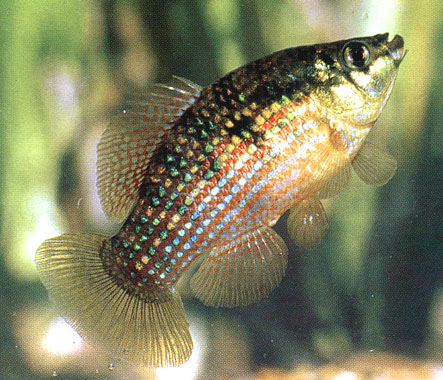 FlagfishJordanella floridae
-
 Amargosa PupfishCyprinodon nevadensis
-
 Catarina PupfishMegupsilon aporus
-
 Titicaca OrestiasOrestias cuvieri
Compare
Questions and answers
What is the scientific name of the Cuban Killifish?
The scientific name of the Cuban Killifish is Cubanichthys cubensis. Written with its author, the full name is Cubanichthys cubensis (Eigenmann, 1903).
Which family does the Cuban Killifish belong to?
Cubanichthys cubensis belongs to the family Cyprinodontidae, in the order Cyprinodontiformes and the class Teleostei.
Where is the Cuban Killifish found?
Checklists and occurrence records place Cubanichthys cubensis in 1 country: Cuba.
What is the conservation status of the Cuban Killifish?
The IUCN Red List category recorded for Cubanichthys cubensis is Least Concern (LC).
What other names does the Cuban Killifish have?
Cubanichthys cubensis is also known in English as Cuban Minnow and Cuban Pupfish.
What should I feed my killifish?
The Cuban killifish feeds on mosquito larvae, mobile benthic worms, insects, detritus, and benthic microalgae. Mosquito larvae constitute a large part of its diet.[22][23]
What animals are only found in Cuba?
The Cuban killifish is endemic to Cuba.[32]
Sources
Passages the profile rests on
- The species has a cylindrical body that is slightly broader and taller toward the front. Source passage: “Cubanichthys cubensis has a cylindrical body which is slightly broader and taller in the anterior portion.” — English Wikipedia
- The species has a moderately deep, chubby body, a flattened head, and a short, blunt snout. Source passage: “Body moderately deep and chubby; head flattened, but with an enlarged crest on back of skull; snout short and blunt;” — biogeodb.stri.si.edu
- The mouth is wide, oblique, positioned at the front, and protrusible. Source passage: “mouth wide, oblique, at front, protrusible;” — biogeodb.stri.si.edu
- The body is mottled, semi-transparent golden buff with a creamy white patch extending from behind the gill covers toward the anal fin. Source passage: “the body being a mottled semi-transparent golden buff with a creamy white patch which starts behind the gill covers” — English Wikipedia
- The body has horizontal light blue lines extending from the gill covers to the caudal peduncle. Source passage: “A series of horizontal light blue lines start at the gill covers and extend along the body to the caudal peduncle.” — English Wikipedia
- Males have more prominent blue body lines and more elaborate dorsal and anal fins than females. Source passage: “The males are brighter and the blue lines are more obvious” — English Wikipedia
- Males have a brown body stripe narrowly edged in blue-white. Source passage: “male with similar brown stripe, that on body narrowly edged in blue-white;” — biogeodb.stri.si.edu
- Males have yellow dorsal and anal fins with black edges and yellow pelvic fins. Source passage: “dorsal and anal fins yellow, with black edges, pelvics yellow;” — biogeodb.stri.si.edu
- Females often have mottling or blotches along the body's centre line. Source passage: “The females are plainer and often display mottling or splotching along the centre line of the body.” — English Wikipedia
- Females have a black stripe extending from the chin to the eye and continuing toward the centre of the tail base. Source passage: “female with black stripe from chin to eye; continuing to center of end of tail base” — biogeodb.stri.si.edu
- The dorsal fin has 11 rays, including two rudimentary rays, and originates around mid-body. Source passage: “dorsal fin short based, 11 rays (2 rudimentary), at mid-body” — biogeodb.stri.si.edu
- The anal fin has 10–11 rays, all of which are branched. Source passage: “anal fin 10-11, with all rays branched;” — biogeodb.stri.si.edu
- The pectoral fin has 18 rays and is positioned low on the side of the body. Source passage: “pectoral fin short, 18 rays, low on side;” — biogeodb.stri.si.edu
- The pelvic fins are small and contain six to seven rays. Source passage: “pelvics small, 6-7 rays, on belly well behind pectoral base;” — biogeodb.stri.si.edu
- The tail fin is bluntly rounded. Source passage: “tail fin bluntly rounded;” — biogeodb.stri.si.edu
- The body has 24–26 large, smooth scales in the lateral series. Source passage: “body with large, smooth scales, 24-26 scales in lateral series;” — biogeodb.stri.si.edu
- Adult males measure approximately 3.6 centimetres in length, while females are slightly smaller. Source passage: “the males are 3.6 centimetres (1.4 in) while the females are slightly smaller.” — English Wikipedia
- Recorded habitat substrates include mud, sand, gravel, beaches, estuaries, mangroves, and seagrass. Source passage: “Soft bottom (mud/sand/gravel/beach/estuary/mangrove/seagrass)” — biogeodb.stri.si.edu
- The species prefers freshwater but is occasionally found in brackish water. Source passage: “Cubanichthys cubensis prefers fresh water but can infrequently be found in brackish water.” — English Wikipedia
- The species strongly prefers waters with dense vegetation consisting of macrophytes or algae. Source passage: “They strongly prefer waters with thick vegetation consisting of macrophytes or algae plants” — English Wikipedia
- The species prefers open, sunny areas within vegetated waters. Source passage: “and where they show a preference for open sunny areas.” — English Wikipedia
- Mosquito larvae constitute a large part of the species' diet. Source passage: “a large part of this species' diet consists of the larvae of mosquitoes.” — English Wikipedia
- The species feeds on mobile benthic worms, insects, detritus, and benthic microalgae. Source passage: “Mobile benthic worms Insects Detritus Benthic microalgae” — biogeodb.stri.si.edu
- The species is described as larvivorous. Source passage: “It has been described as larvivorous” — English Wikipedia
- The spawning period lasts several days. Source passage: “The spawning period lasts for several days” — English Wikipedia
- Females can lay up to ten eggs per day during spawning. Source passage: “the females can lay up to 10 eggs a day” — English Wikipedia
- Females deposit their eggs individually on plants. Source passage: “laying each egg individually and placing them on a plant.” — English Wikipedia
- The eggs measure approximately 1.4 millimetres in diameter. Source passage: “measuring 1.4 mm in diameter” — English Wikipedia
- The eggs are transparent and adhesive. Source passage: “transparent and adhesive.” — English Wikipedia
- Females sometimes temporarily carry eggs attached to their urogenital papillae before rubbing them onto aquatic plants. Source passage: “Sometimes a female will be seen with some eggs hanging from her urogenital papillae but she soon rubs the eggs off onto water plants.” — English Wikipedia
- The species has no pelagic larval stage or pelagic phase. Source passage: “No pelagic larva Data Benthic No pelagic phase” — biogeodb.stri.si.edu
- The species is endemic to Cuba. Source passage: “which is endemic to Cuba.” — English Wikipedia
Data
- Catalogue of Life, 2026-10-16 XR cc by
- Global Biodiversity Information Facility CC BY 4.0
- Wikidata CC0
- GeoNames CC BY 4.0
- Wikimedia Commons per image; credit shown with each image
- Within the Catalogue of Life, this name comes from World Register of Marine Species cc by
This species in other databases
- Catalogue of Life 32879
- Wikidata Q951536
- iNaturalist 341428
- WoRMS urn:lsid:marinespecies.org:taxname:280458
- ITIS 646898
Page built on 29 November 2026. See how the catalog is made and all sources and licences.
Cite this page
ScientificNames.org. (2026). Cubanichthys cubensis (Cuban Killifish). Retrieved November 29, 2026, from https://scientificnames.org/species/cubanichthys-cubensis
“Cubanichthys cubensis (Cuban Killifish).” ScientificNames.org, 2026, scientificnames.org/species/cubanichthys-cubensis. Accessed 29 Nov. 2026.
ScientificNames.org. “Cubanichthys cubensis (Cuban Killifish).” Accessed November 29, 2026. https://scientificnames.org/species/cubanichthys-cubensis.
@misc{scientificnames_cubanichthys_cubensis_cuban_killifish,
  author = {{ScientificNames.org}},
  title = {Cubanichthys cubensis (Cuban Killifish)},
  year = {2026},
  url = {https://scientificnames.org/species/cubanichthys-cubensis},
  note = {Accessed 2026-11-29}
}