Species · Flowering plants
Tarweed Cuphea viscosissima
The scientific name of the Tarweed is Cuphea viscosissima. It is a species of flowering plant in the family Lythraceae (loosestrife family), order Myrtales.
- Scientific name
- Cuphea viscosissima Jacq.
- Common name
- Tarweed
- Genus
- Cuphea
- Family
- Lythraceae (Loosestrife Family)
- Order
- Myrtales
- Class
- Magnoliopsida
- Recorded in
- 6 countries
- Name status
- accepted in the Catalogue of Life

Overview
Cuphea viscosissima, also known as waxbush, blue waxweed, clammy cuphea or (ambiguously) as "tarweed", is an herbaceous plant in the loosestrife family. It native to the eastern United States, where it is most often found in open, rocky calcareous areas. It is the most common and widespread Cuphea in the U.S.
Classification of the Tarweed
| Kingdom | Plantae |
|---|---|
| Subkingdom | Pteridobiotina |
| Phylum | Tracheophyta |
| Class | Magnoliopsida |
| Order | Myrtales |
| Family | Lythraceae (Loosestrife Family) |
| Subfamily | Punicoideae |
| Genus | Cuphea (Waxweed) |
| Species | Cuphea viscosissima Jacq. |
Where the Tarweed is found
Checklists and occurrence records place Cuphea viscosissima in 6 countries across Asia and North America. GBIF holds 3,427 georeferenced records of it.
Countries where it is native or its origin is not stated
Countries where it has been introduced
Regions and cities with the most records
- Pennsylvania, United States 479
- Virginia, United States 265
- Missouri, United States 254
- Kansas, United States 115
- Maryland, United States 108
- Limerick, United States 94
- Lansdale, United States 93
- Illinois, United States 91
- Norristown, United States 79
- Phoenixville, United States 77
- Wayne, United States 75
- Arkansas, United States 73
- Radnor, United States 73
- King of Prussia, United States 71
- Tennessee, United States 71
- Ashburn, United States 69
- South Riding, United States 66
- Herndon, United States 63
- Sterling, United States 63
- Indiana, United States 60
- Oak Hill, United States 58
- Chantilly, United States 57
- Linton Hall, United States 54
- Leesburg, United States 53
- Reston, United States 53
- Kentucky, United States 52
- West Virginia, United States 48
- North Carolina, United States 36
- Sudley, United States 35
- Joplin, United States 34
- Pottstown, United States 34
- Wheaton, United States 34
- Adams Morgan, United States 33
- Arlington, United States 33
- Centreville, United States 33
- Fairfax, United States 33
3 more countries have a few records outside this range
These countries hold a few records of Cuphea viscosissima but lie outside the range the checklists give for it. Such records are often zoo or garden specimens, museum material or vagrants, so the species is not counted as occurring there.
Range as the checklists state it
Azerbaijan [I]; China [I]; Canada (Ontario); USA (Alabama, Arkansas, Connecticut, District of Columbia, Delaware, Florida, Georgia, Iowa, Illinois, Indiana, Kansas, Kentucky, Louisiana, Massachusetts, Maryland, Missouri, Mississippi, North Carolina, Nebraska, New Hampshire, New Jersey, New York, Ohio, Oklahoma, Pennsylvania, South Carolina, Tennessee, Virginia, Vermont, West Virginia); Mexico (Aguascalientes, Jalisco, Nuevo León, Sinaloa, Tamaulipas); Jamaica [I]
A number beside a place is its count of GBIF occurrence records. A place without a number comes from a checklist alone. Records show where a species has been observed or collected, which can include escapes and vagrants.
Common names
English
- Tarweed
- Clammy Cuphea
Names in 3 other languages
- Chinese
- 黏毛萼距花
- French
- cuphéa, cuphéa visqueux
- Swedish
- borstig bägarblomma, indianbloss
Synonyms
9 other scientific names have been used for this species and are now treated as synonyms of Cuphea viscosissima.
- Cuphea albida Raf.
- Cuphea brownei Jacq.
- Cuphea petiolaris (L.) Koehne
- Cuphea petiolata (L.) Koehne
- Lythrum cuphea L.fil.
- Lythrum petiolatum L.
- Melfona purpurea Raf.
- Parsonsia petiolata (L.) Rusby
- Cuphea parietarioides Koehne ambiguous synonym
Related species
-
 False HeatherCuphea hyssopifolia
-
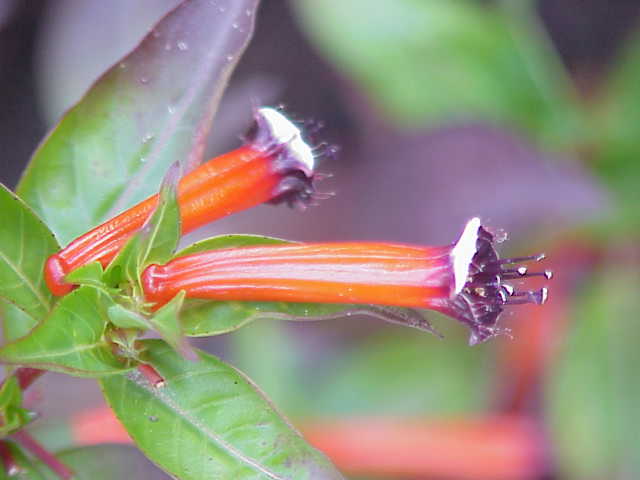 Cigar PlantCuphea ignea
-
 Cuphea lanceolata
- Tropical WaxweedCuphea aspera
- Cuphea gaumeri
-
 Cuphea melvilla
-
 TarweedCuphea carthagenensis
-
 CigarplantCuphea micropetala
Compare
Questions and answers
What is the scientific name of the Tarweed?
The scientific name of the Tarweed is Cuphea viscosissima. Written with its author, the full name is Cuphea viscosissima Jacq..
Which family does the Tarweed belong to?
Cuphea viscosissima belongs to the family Lythraceae, in the order Myrtales and the class Magnoliopsida.
Where is the Tarweed found?
Checklists and occurrence records place Cuphea viscosissima in 6 countries, including United States, Mexico and Canada.
What other names does the Tarweed have?
Cuphea viscosissima is also known in English as Clammy Cuphea.
Sources
Data
- Catalogue of Life, 2026-10-16 XR cc by
- Global Biodiversity Information Facility CC BY 4.0
- Wikidata CC0
- English Wikipedia CC BY-SA 4.0
- GeoNames CC BY 4.0
- Wikimedia Commons per image; credit shown with each image
- Within the Catalogue of Life, this name comes from Synonymic Checklists of the Vascular Plants of the World cc by
References
- Jacq. (1772). Hort. Bot. Vindob. 2: 83, t. 177 (1772). where the name was published
This species in other databases
Page built on 26 November 2026. See how the catalog is made and all sources and licences.
Cite this page
ScientificNames.org. (2026). Cuphea viscosissima (Tarweed). Retrieved November 26, 2026, from https://scientificnames.org/species/cuphea-viscosissima
“Cuphea viscosissima (Tarweed).” ScientificNames.org, 2026, scientificnames.org/species/cuphea-viscosissima. Accessed 26 Nov. 2026.
ScientificNames.org. “Cuphea viscosissima (Tarweed).” Accessed November 26, 2026. https://scientificnames.org/species/cuphea-viscosissima.
@misc{scientificnames_cuphea_viscosissima_tarweed,
  author = {{ScientificNames.org}},
  title = {Cuphea viscosissima (Tarweed)},
  year = {2026},
  url = {https://scientificnames.org/species/cuphea-viscosissima},
  note = {Accessed 2026-11-26}
}