Species · Birds
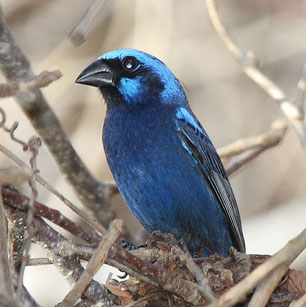
Blue-black Grosbeak Cyanocompsa cyanoides
The scientific name of the Blue-black Grosbeak is Cyanocompsa cyanoides. It is a species of bird in the family Cardinalidae (cardinals), order Passeriformes. The name dates from 1847.
- Scientific name
- Cyanocompsa cyanoides (Lafresnaye, 1847)
- Common name
- Blue-black Grosbeak
- Genus
- Cyanocompsa
- Family
- Cardinalidae (Cardinals)
- Order
- Passeriformes
- Class
- Aves
- Red List category
- LC Least Concern
- Environment
- terrestrial
- Recorded in
- 17 countries
- Name status
- accepted in the Catalogue of Life
Overview
Cyanocompsa cyanoides occurs across Central and South America and is recorded in Belize, Colombia, Costa Rica, Ecuador, Guatemala, Honduras, Mexico, Nicaragua, Panama, Peru, and Venezuela. The species exhibits sexual dimorphism, with dark blue plumage in males and dark brown plumage in females.
Written 27 November 2026 from the sources listed below. Each statement was checked against the passage it cites; statements that could not be supported were removed.
Appearance
Male Blue-black Grosbeaks have dark blue plumage with lighter blue eyebrows, wing shoulder patches, and foreheads. Females have dark brown plumage that may have a slight reddish hue.[1][2]
The species exhibits sexual dimorphism in plumage coloration.[3]
Among the three recognized subspecies, C. c. concreta is the largest and has the darkest plumage. C. c. cyanoides is the smallest and has the brightest plumage.[4][5][6][7]
Habitat
Blue-black Grosbeaks prefer habitats with dense tall trees and undergrowth that provide cover. They occur along the edges of broadleaf forests.[8][9]
The documented distribution of the Blue-black Grosbeak extends across Central and South America. The species is recorded in Belize, Colombia, Costa Rica, Ecuador, Guatemala, Honduras, Mexico, Nicaragua, Panama, Peru, and Venezuela.[10][11]
The subspecies C. c. caerulescens and C. c. concreta occur in Mexico and Central America. C. c. cyanoides occurs from Panama to northern South America.[12][13]
Diet
Blue-black Grosbeaks are omnivorous and consume seeds, fruits, ants, and caterpillars. They crush seeds before consuming them.[14][15]
Behaviour
Blue-black Grosbeaks frequently remain concealed among vegetation. Their presence is often detected through their vocalizations.[16][17]
The species' song consists of approximately six whistles that decrease in pitch. It ends with a sequence of whistles transcribed as 'seee seee sewee suwee sweet suuu.'[18][19]
The songs of the three recognized subspecies differ slightly. The Blue-black Grosbeak also gives sharp calls described as 'shek' or 'chit' and frequently repeats them.[20][21][22]
Reproduction and life cycle
Blue-black Grosbeaks construct small cup-shaped nests for laying eggs. The usual clutch size is two eggs.[23][24]
The breeding season occurs during spring and summer. The peak breeding period varies slightly among populations in different geographical areas.[25][26]
Classification of the Blue-black Grosbeak
| Kingdom | Animalia |
|---|---|
| Phylum | Chordata |
| Subphylum | Vertebrata |
| Infraphylum | Gnathostomata |
| Parvphylum | Osteichthyes |
| Megaclass | Tetrapoda |
| Class | Aves (Bird) |
| Order | Passeriformes (Passerine) |
| Family | Cardinalidae (Cardinals) |
| Genus | Cyanocompsa (Blue Buntings) |
| Species | Cyanocompsa cyanoides (Lafresnaye, 1847) |
Where the Blue-black Grosbeak is found
Checklists and occurrence records place Cyanocompsa cyanoides in 17 countries across North America and South America. GBIF holds 71,352 georeferenced records of it.
Countries
- Argentina 4
- Belize 16,227
- Bolivia 35
- Brazil 219
- Colombia 5,212
- Costa Rica 30,519
- Ecuador 1,487
- French Guiana 11
- Guatemala 2,191
- Guyana 57
- Honduras 1,557
- Mexico 2,295
- Nicaragua 266
- Panama 9,525
- Peru 186
- Suriname 11
- Venezuela 1,550
Regions and cities with the most records
- Puntarenas Province, Costa Rica 10,382
- Cayo District, Belize 9,381
- Alajuela Province, Costa Rica 6,450
- Heredia Province, Costa Rica 5,594
- San Ignacio, Belize 5,142
- Alcalde Díaz, Panama 4,185
- Chilibre, Panama 3,708
- Limón Province, Costa Rica 3,576
- Belmopan, Belize 2,966
- Panamá, Panama 2,876
- Orange Walk District, Belize 2,513
- San José, Costa Rica 2,442
- Colón, Panama 2,421
- Panama City, Panama 2,075
- Stann Creek, Belize 2,018
- Curundú, Panama 1,904
- San Miguelito, Panama 1,888
- Ancón, Panama 1,872
- Arraiján, Panama 1,872
- Toledo District, Belize 1,843
- Petén, Guatemala 1,478
- Bocas del Toro Province, Panama 1,474
- Veracruz, Panama 1,304
- Chiapas, Mexico 1,185
- Juan Díaz, Panama 1,152
- Antioquia, Colombia 1,075
- Guápiles, Costa Rica 1,068
- Guanacaste Province, Costa Rica 1,053
- San Isidro, Costa Rica 986
- Turrialba, Costa Rica 923
- San Rafael Abajo, Costa Rica 870
- Quesada, Costa Rica 852
- Siquirres, Costa Rica 829
- Magdalena Department, Colombia 768
- Cartago Province, Costa Rica 727
- Coclé, Panama 714
Range as the checklists state it
lowlands of southeastern Mexico (Veracruz) southward, west of the Andes, to far northwestern Peru (Tumbes and Piura), and eastward across northern Colombia (southward to Norte de Santander) and northwestern and northern Venezuela (to Miranda)
Middle America
South America
A number beside a place is its count of GBIF occurrence records. A place without a number comes from a checklist alone. Records show where a species has been observed or collected, which can include escapes and vagrants.
Common names
English
- Blue-black Grosbeak
Names in 25 other languages
- Catalan
- indi ultramarí
- Chinese
- 蓝黑彩鹀, 藍黑彩鵐
- Croatian
- šumski batač
- Czech
- biskoupek tmavomodrý
- Danish
- Cyankernebider
- Dutch
- Blauwrugbisschop
- Esperanto
- nigrablua kardinalo
- Finnish
- hohtokardinaali
- French
- Évêque bleu-noir
- German
- Stahlbischof, Stahlkardinal
- Hungarian
- kék püspökpinty
- Italian
- Beccogrosso neroblu
- Japanese
- クロルリノジコ
- Lithuanian
- dvispalvis startinis kardinolas
- Norwegian
- indigotykknebb
- Norwegian Bokmål
- indigotykknebb
- Polish
- indygówka stalowa
- Portuguese
- Bicudo-azulão, azulão-escuro
- Russian
- Синяя гуирака, Чёрно-синий овсянковый кардинал
- Serbian
- Srednjeamerički biskup
- Slovak
- pápežík tmavomodrý
- Spanish
- Picogordo negro, Picogordo Azulnegro, Picogrueso negriazul, picogrueso negro azulado
- Swedish
- blåsvart kardinal
- Turkish
- Meksika Çivit Kocabaşı
- Ukrainian
- лускар сизий
Synonyms
3 other scientific names have been used for this species and are now treated as synonyms of Cyanocompsa cyanoides.
- Coccoborus cyanoides Lafresnaye, 1847
- Cyanoloxia cyanoides (de Lafresnaye, 1847)
- Passerina cyanoides (Lafresnaye, 1847)
Subspecies and varieties
- Cyanocompsa cyanoides caerulescens subspecies
- Cyanocompsa cyanoides concreta subspecies
- Cyanocompsa cyanoides cyanoides subspecies
- Cyanoloxia cyanoides cyanoides subspecies
Related species
-
 Blue BuntingCyanocompsa parellina
-
 Ultramarine GrosbeakCyanocompsa brissonii
- Rothschild's GrosbeakCyanocompsa rothschildii
-
 Northern CardinalCardinalis cardinalis
-
 Rose-breasted GrosbeakPheucticus ludovicianus
-
 Painted BuntingPasserina ciris
-
 Indigo BuntingPasserina cyanea
-
 DickcisselSpiza americana
Compare
Questions and answers
What is the scientific name of the Blue-black Grosbeak?
The scientific name of the Blue-black Grosbeak is Cyanocompsa cyanoides. Written with its author, the full name is Cyanocompsa cyanoides (Lafresnaye, 1847).
Which family does the Blue-black Grosbeak belong to?
Cyanocompsa cyanoides belongs to the family Cardinalidae, in the order Passeriformes and the class Aves.
Where is the Blue-black Grosbeak found?
Checklists and occurrence records place Cyanocompsa cyanoides in 17 countries, including Costa Rica, Belize, Panama, Colombia, Mexico and Guatemala.
What is the conservation status of the Blue-black Grosbeak?
The IUCN Red List category recorded for Cyanocompsa cyanoides is Least Concern (LC).
Sources
Passages the profile rests on
- Male Blue-black Grosbeaks have dark blue plumage with lighter blue eyebrows, wing shoulder patches, and foreheads. Source passage: “Males are dark blue with lighter blue eyebrows and shoulder patches on their wings. The forehead, the area just above the beak, is also a lighter shade of blue.” — English Wikipedia
- Female Blue-black Grosbeaks have dark brown plumage that may have a slight reddish hue. Source passage: “Females have dark brown plumage which can have a slight reddish hue.” — English Wikipedia
- The species exhibits sexual dimorphism in plumage coloration. Source passage: “The blue-black grosbeak is sexually dimorphic.” — English Wikipedia
- Among the three recognized subspecies, C. c. concreta is the largest. Source passage: “C.c. concreta has the darkest of the three and is also the largest.” — English Wikipedia
- C. c. cyanoides is the smallest of the three recognized subspecies. Source passage: “followed by C.c. cyanoides, which has the smallest size and brightest plumage.” — English Wikipedia
- C. c. concreta has the darkest plumage among the three recognized subspecies. Source passage: “C.c. concreta has the darkest of the three” — English Wikipedia
- C. c. cyanoides has the brightest plumage among the three recognized subspecies. Source passage: “C.c. cyanoides, which has the smallest size and brightest plumage.” — English Wikipedia
- Blue-black Grosbeaks prefer habitats with dense tall trees and undergrowth that provide cover. Source passage: “They prefer habitats which are dense with tall trees and undergrowth because this provides sufficient cover.” — English Wikipedia
- Blue-black Grosbeaks occur along the edges of broadleaf forests. Source passage: “the blue-black grosbeak can be found at edges of broadleaf forests.” — English Wikipedia
- The documented distribution of the Blue-black Grosbeak extends across Central and South America. Source passage: “The distribution of the blue-black grosbeak is limited to the Central and South American.” — English Wikipedia
- The species is recorded in Belize, Colombia, Costa Rica, Ecuador, Guatemala, Honduras, Mexico, Nicaragua, Panama, Peru, and Venezuela. Source passage: “It is found in Belize, Colombia, Costa Rica, Ecuador, Guatemala, Honduras, Mexico, Nicaragua, Panama, Peru, and Venezuela.” — English Wikipedia
- The subspecies C. c. caerulescens and C. c. concreta occur in Mexico and Central America. Source passage: “Both C.c. caerulescens and C.c. concreta are found in Mexico and Central America” — English Wikipedia
- The subspecies C. c. cyanoides occurs from Panama to northern South America. Source passage: “C.c. cyanoides can be found from Panama to northern South America.” — English Wikipedia
- Blue-black Grosbeaks are omnivorous and consume seeds, fruits, ants, and caterpillars. Source passage: “Blue-black grosbeaks are omnivorous; they have been known to eat seeds and fruits, as well as insects like ants and caterpillars.” — English Wikipedia
- Blue-black Grosbeaks crush seeds before consuming them. Source passage: “They crush the seeds before they consume them.” — English Wikipedia
- Blue-black Grosbeaks frequently remain concealed among vegetation. Source passage: “Often blue-black grosbeaks will not be seen since they prefer to stay hidden among the vegetation” — English Wikipedia
- The presence of Blue-black Grosbeaks is often detected through their vocalizations. Source passage: “so most of the time their presence is known only when they vocalize.” — English Wikipedia
- The species' song consists of approximately six whistles that decrease in pitch. Source passage: “Their song is composed of about six whistles with decreasing pitch” — English Wikipedia
- The Blue-black Grosbeak's song ends with a sequence of whistles transcribed as 'seee seee sewee suwee sweet suuu.' Source passage: “ends with a "seee seee sewee suwee sweet suuu."” — English Wikipedia
- The songs of the three recognized subspecies differ slightly. Source passage: “There are slight differences in the songs between the three different subspecies.” — English Wikipedia
- The Blue-black Grosbeak gives sharp calls described as 'shek' or 'chit'. Source passage: “The call is a sharp "shek" or "chit"” — English Wikipedia
- The species frequently repeats its sharp calls. Source passage: “and will often be repeated many times.” — English Wikipedia
- Blue-black Grosbeaks construct small cup-shaped nests for laying eggs. Source passage: “The blue-black grosbeak construct little cup nests to lay their eggs in” — English Wikipedia
- The usual clutch size of the Blue-black Grosbeak is two eggs. Source passage: “normally have a clutch size of 2.” — English Wikipedia
- The Blue-black Grosbeak's breeding season occurs during spring and summer. Source passage: “The breeding season of the blue-black grosbeak takes place during the spring and summer months” — English Wikipedia
- The peak breeding period varies slightly among populations in different geographical areas. Source passage: “the peak period of the breeding season differs slightly between populations located in different areas.” — English Wikipedia
Data
- Catalogue of Life, 2026-10-16 XR cc by
- Global Biodiversity Information Facility CC BY 4.0
- Wikidata CC0
- GeoNames CC BY 4.0
- Within the Catalogue of Life, this name comes from The Integrated Taxonomic Information System cc0
References
- Rev. Zool. [Paris], 10: 74. 1847 where the name was published
- Gill, Frank, & and Minturn Wright. (2006). Birds of the World: Recommended English Names.
This species in other databases
Page built on 27 November 2026. See how the catalog is made and all sources and licences.
Cite this page
ScientificNames.org. (2026). Cyanocompsa cyanoides (Blue-black Grosbeak). Retrieved November 27, 2026, from https://scientificnames.org/species/cyanocompsa-cyanoides
“Cyanocompsa cyanoides (Blue-black Grosbeak).” ScientificNames.org, 2026, scientificnames.org/species/cyanocompsa-cyanoides. Accessed 27 Nov. 2026.
ScientificNames.org. “Cyanocompsa cyanoides (Blue-black Grosbeak).” Accessed November 27, 2026. https://scientificnames.org/species/cyanocompsa-cyanoides.
@misc{scientificnames_cyanocompsa_cyanoides_blue_black_grosbeak,
  author = {{ScientificNames.org}},
  title = {Cyanocompsa cyanoides (Blue-black Grosbeak)},
  year = {2026},
  url = {https://scientificnames.org/species/cyanocompsa-cyanoides},
  note = {Accessed 2026-11-27}
}