Species · Conifers and allies
Sago Palm Cycas revoluta
The scientific name of the Sago Palm is Cycas revoluta. It is a species of gymnosperm in the family Cycadaceae (cycads), order Cycadales.
- Scientific name
- Cycas revoluta Thunb.
- Common name
- Sago Palm
- Genus
- Cycas
- Family
- Cycadaceae (Cycads)
- Order
- Cycadales
- Class
- Cycadopsida
- Red List category
- LC Least Concern
- Recorded in
- 13 countries
- Name status
- accepted in the Catalogue of Life
Overview
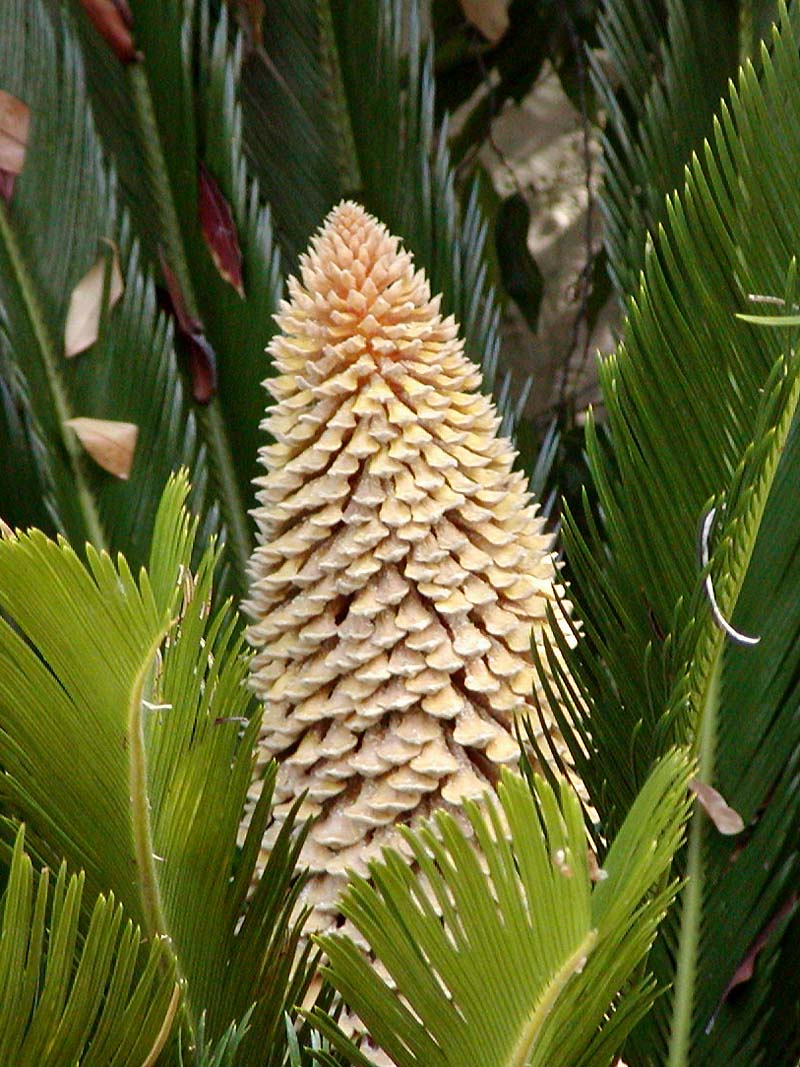
The species is native to southern Japan, including the Ryukyu Islands. It has a thick, shaggy trunk and a crown of deep green, feather-like leaves.
Written 24 November 2026 from the sources listed below. Each statement was checked against the passage it cites; statements that could not be supported were removed.
Appearance
Sago Palm has a symmetrical growth form, with a crown of shiny, dark green leaves atop a thick, shaggy trunk covered with fibers. The leaves form a feather-like rosette that can reach one metre in diameter.[1][2][3][4]
The leaflets are narrow, stiff, crowded and have strongly recurved edges. The basal leaflets are modified into spine-like structures, and the leaf stalks have small protective barbs.[5][6][7]
Mature reproductive leaves measure approximately 50–150 centimetres in length, while individual leaflets measure approximately 8–18 centimetres long. The petioles measure approximately 6–10 centimetres long.[8][9][10]
Habitat
Sago Palm grows outdoors in warm temperate and subtropical regions. In colder regions, it can be cultivated under glass.[11][12]
The species grows best in sandy, well-drained soil containing some organic matter. It tolerates full sun and outdoor shade.[13][14]
Uses
Sago Palm is cultivated as an ornamental plant and is widely grown as a landscape plant in many parts of the world. It is also cultivated as a bonsai plant.[15][16][17]
Starch extracted from the pith is used to produce sago. The leaves are widely used as ceremonial palms.[18][19]
Similar species
Sago Palm is sometimes mistaken for a palm because of its superficial visual similarity.[20]
Behaviour
Sago Palm is slow-growing and requires approximately 50–100 years to develop a trunk 6–7 metres long. The trunk can branch several times, producing multiple leaf crowns.[21][22]
In temperate climates, the species usually loses its leaves during winter and produces several new leaves by spring.[23]
Reproduction and life cycle
Sago Palm is dioecious, with male plants producing pollen cones and female plants producing groups of megasporophylls. Pollination can occur naturally through insects or through artificial methods.[24][25]
The species can be propagated using seeds or by removing basal offsets.[26]
Conservation
The scale insect Aulacaspis yasumatsui can destroy Sago Palm if its infestation is left uncontrolled.[27]
Classification of the Sago Palm
| Kingdom | Plantae |
|---|---|
| Subkingdom | Pteridobiotina |
| Phylum | Tracheophyta |
| Class | Cycadopsida |
| Order | Cycadales |
| Family | Cycadaceae (Cycads) |
| Genus | Cycas (Cycad) |
| Species | Cycas revoluta Thunb. |
Origin of the name. From the Latin revolutus (‘rolled’), referring to the revolute leaflet margins.
Where the Sago Palm is found
Checklists and occurrence records place Cycas revoluta in 13 countries across Asia. GBIF holds 1,265 georeferenced records of it.
Countries
- Bangladesh 3
- China 195
- India 92
- Indonesia 23
- Japan 520
- Malaysia 5
- Philippines 10
- South Korea 27
- Taiwan 64
- Thailand 5
- Turkey 3
- United States 313
- Vietnam 5
Regions and cities with the most records
- Okinawa, Japan 200
- Okinawa, Japan 56
- Guangxi, China 54
- Kagoshima, Japan 47
- Taiwan, Taiwan 45
- Urasoe, Japan 43
- Ginowan, Japan 41
- Gushikawa, Japan 41
- Uruma, Japan 41
- Naha, Japan 39
- Texas, United States 37
- Tomigusuku, Japan 37
- Nago, Japan 35
- Itoman, Japan 31
- Florida, United States 28
- Alabama, United States 24
- Sichuan, China 20
- Caotun, Taiwan 19
- Guangdong, China 19
- Nantou, Taiwan 19
- Wufeng, Taiwan 19
- Yuanlin, Taiwan 19
- Chang-hua, Taiwan 18
- Changhua, Taiwan 18
- California, United States 17
- Tokyo, Japan 16
- Ishigaki, Japan 15
- Chōfu, Japan 14
- Georgia, United States 14
- Komae, Japan 14
- Musashino, Japan 14
- Nishi-Tokyo-shi, Japan 14
- Asaka, Japan 13
- Fuchū, Japan 13
- Inagi, Japan 13
- Kodaira, Japan 13
38 more countries have a few records outside this range
These countries hold a few records of Cycas revoluta but lie outside the range the checklists give for it. Such records are often zoo or garden specimens, museum material or vagrants, so the species is not counted as occurring there.
- Argentina 9
- Australia 67
- Benin 4
- Bermuda 29
- Brazil 148
- Cameroon 8
- Colombia 56
- Cook Islands 6
- Costa Rica 6
- Cuba 10
- Cyprus 3
- Democratic Republic of the Congo 4
- Dominican Republic 7
- Ecuador 5
- Egypt 6
- El Salvador 5
- Fiji 18
- France 15
- French Guiana 6
- French Polynesia 13
- Germany 18
- Greece 4
- Guadeloupe 3
- Italy 18
- Jamaica 12
- Martinique 3
- Mexico 16
- Mozambique 3
- New Caledonia 4
- New Zealand 8
- Nicaragua 4
- Palau 3
- Panama 5
- Portugal 25
- Puerto Rico 7
- South Africa 13
- Spain 32
- United Kingdom 11
Range as the checklists state it
China (Fujian), Japan (Ryukyu Islands)
A number beside a place is its count of GBIF occurrence records. A place without a number comes from a checklist alone. Records show where a species has been observed or collected, which can include escapes and vagrants.
Common names
English
- Sago Palm
- Fern Palm
- Sago Cycas
- Sotesu-nut
Names in 3 other languages
- Chinese
- feng-wei-jiao-ye, su tie, tieshu, 苏铁, 苏铁叶, 苏铁果, 苏铁根, 苏铁花
- Japanese
- ban shou, hichichi, sotetsu, susitykuki
- Swedish
- japansk kottepalm
Synonyms
14 other scientific names have been used for this species and are now treated as synonyms of Cycas revoluta.
- Cycas aurea J.Verschaff.
- Cycas inermis Oudem.
- Cycas miquelii Warb.
- Cycas revoluta subsp. brevifrons Thunb.
- Cycas revoluta subsp. planifolia Thunb.
- Cycas revoluta subsp. prolifera Thunb.
- Cycas revoluta subsp. robusta Thunb.
- Cycas revoluta var. brevifrons Miq.
- Cycas revoluta var. planifolia Miq.
- Cycas revoluta var. prolifera Siebold & Zucc.
- Cycas revoluta var. revoluta
- Cycas revoluta var. robusta Messeri
- Epicycas miquelii (Warb.) de Laub.
- Cycas aurea Dyer ambiguous synonym
Related species
-
 Fern PalmCycas circinalis
-
 Queen SagoCycas rumphii
-
 CycadCycas micronesica
-
 Madagascar CycadCycas thouarsii
-
 Beddome’s CycasCycas beddomei
-
 Arayat PitogoCycas riuminiana
-
 Nut-palmCycas media
-
 CycadCycas seemannii
Compare
Questions and answers
What is the scientific name of the Sago Palm?
The scientific name of the Sago Palm is Cycas revoluta. Written with its author, the full name is Cycas revoluta Thunb..
Which family does the Sago Palm belong to?
Cycas revoluta belongs to the family Cycadaceae, in the order Cycadales and the class Cycadopsida.
Where is the Sago Palm found?
Checklists and occurrence records place Cycas revoluta in 13 countries, including Japan, United States, China, India, Taiwan and South Korea.
What is the conservation status of the Sago Palm?
The IUCN Red List category recorded for Cycas revoluta is Least Concern (LC).
What other names does the Sago Palm have?
Cycas revoluta is also known in English as Fern Palm, Sago Cycas and Sotesu-nut.
Sources
Passages the profile rests on
- The species has a symmetrical growth form with a crown of shiny, dark green leaves atop a thick, shaggy trunk. Source passage: “This very symmetrical plant supports a crown of shiny, dark green leaves on a thick shaggy trunk” — English Wikipedia
- The trunk is covered with a thick coat of fibers. Source passage: “The sago cycad can be distinguished by a thick coat of fibers on its trunk.” — English Wikipedia
- The leaves are deep green and semiglossy. Source passage: “The leaves are a deep semiglossy green” — English Wikipedia
- The leaves form a feather-like rosette that can reach one metre in diameter. Source passage: “They grow out into a feather-like rosette to 1 m (3.3 ft) in diameter.” — English Wikipedia
- The leaflets are narrow, stiff, crowded, and have strongly recurved edges. Source passage: “The crowded, stiff, narrow leaflets are 8–18 cm (3.1–7.1 in) long and have strongly recurved or revolute edges.” — English Wikipedia
- The basal leaflets are modified into spine-like structures. Source passage: “The basal leaflets become more like spines.” — English Wikipedia
- The leaf stalks have small protective barbs. Source passage: “The petiole or stems of the sago cycad are 6–10 cm (2.4–3.9 in) long and have small protective barbs.” — English Wikipedia
- Mature reproductive leaves measure approximately 50–150 centimetres in length. Source passage: “The leaves are a deep semiglossy green and about 50–150 cm (20–59 in) long when the plants are of a reproductive age.” — English Wikipedia
- Individual leaflets measure approximately 8–18 centimetres long. Source passage: “The crowded, stiff, narrow leaflets are 8–18 cm (3.1–7.1 in) long” — English Wikipedia
- The petioles measure approximately 6–10 centimetres long. Source passage: “The petiole or stems of the sago cycad are 6–10 cm (2.4–3.9 in) long” — English Wikipedia
- The species grows outdoors in warm temperate and subtropical regions. Source passage: “grown outdoors in warm temperate and subtropical regions” — English Wikipedia
- In colder regions, the species can be cultivated under glass. Source passage: “or under glass in colder areas.” — English Wikipedia
- The species grows best in sandy, well-drained soil containing some organic matter. Source passage: “It grows best in sandy, well-drained soil, preferably with some organic matter.” — English Wikipedia
- The species tolerates full sun and outdoor shade. Source passage: “grows well in full sun or outdoor shade” — English Wikipedia
- The species is cultivated as an ornamental plant. Source passage: “as well as an ornamental plant.” — English Wikipedia
- The species is widely cultivated as a landscape plant in many parts of the world. Source passage: “In many areas of the world, it is heavily promoted commercially as a landscape plant.” — English Wikipedia
- The species is cultivated as a bonsai plant. Source passage: “It is also quite popular as a bonsai plant.” — English Wikipedia
- Starch extracted from the pith is used to produce sago. Source passage: “The pith contains edible starch, and is used for making sago.” — English Wikipedia
- The leaves are widely used as ceremonial palms. Source passage: “its leaves are widely used as ceremonial “palms” in ...” — britannica.com
- The species is sometimes mistaken for a palm because of its superficial visual similarity. Source passage: “The sago cycad is sometimes mistakenly thought to be a palm, although the only similarity between the two is that they look similar and both produce seeds.” — English Wikipedia
- The species is slow-growing and requires approximately 50–100 years to develop a trunk 6–7 metres long. Source passage: “the plant is very slow-growing and requires about 50–100 years to achieve this height.” — English Wikipedia
- The trunk can branch several times, producing multiple leaf crowns. Source passage: “Trunks can branch several times, thus producing multiple heads of leaves.” — English Wikipedia
- In temperate climates, the species usually loses its leaves during winter and produces several new leaves by spring. Source passage: “C. revoluta usually defoliates in winter in this temperate climate, but will usually flush (grow) several new leaves by spring.” — English Wikipedia
- The species is dioecious, with male plants producing pollen cones and female plants producing groups of megasporophylls. Source passage: “As with other cycads, it is dioecious, with the males bearing pollen cones (strobilus) and the females bearing groups of megasporophylls.” — English Wikipedia
- Pollination can occur naturally through insects or through artificial methods. Source passage: “Pollination can be done naturally by insects or artificially.” — English Wikipedia
- The species can be propagated using seeds or by removing basal offsets. Source passage: “Propagation of Cycas revoluta is either by seed or clonally by removal of basal offsets.” — English Wikipedia
- The scale insect Aulacaspis yasumatsui can destroy the species if its infestation is left uncontrolled. Source passage: “Aulacaspis yasumatsui is a scale insect feeding on C. revoluta, and unchecked is able to destroy the plant.” — English Wikipedia
Data
- Catalogue of Life, 2026-10-16 XR cc by
- Global Biodiversity Information Facility CC BY 4.0
- Wikidata CC0
- GeoNames CC BY 4.0
- Wikimedia Commons per image; credit shown with each image
- Within the Catalogue of Life, this name comes from The World List of Cycads, online edition cc by
References
- Thunb. (1782). In: Verh. Holl. Maatsch Weetensch. Haarlem 20(2): 424, 426-427 where the name was published
This species in other databases
- Catalogue of Life 32S52
- Wikidata Q161517
- World Flora Online wfo-0000631639
- IPNI 328823-2
- Tropicos 9600006
- GRIN 12727
Page built on 24 November 2026. See how the catalog is made and all sources and licences.
Cite this page
ScientificNames.org. (2026). Cycas revoluta (Sago Palm). Retrieved November 24, 2026, from https://scientificnames.org/species/cycas-revoluta
“Cycas revoluta (Sago Palm).” ScientificNames.org, 2026, scientificnames.org/species/cycas-revoluta. Accessed 24 Nov. 2026.
ScientificNames.org. “Cycas revoluta (Sago Palm).” Accessed November 24, 2026. https://scientificnames.org/species/cycas-revoluta.
@misc{scientificnames_cycas_revoluta_sago_palm,
  author = {{ScientificNames.org}},
  title = {Cycas revoluta (Sago Palm)},
  year = {2026},
  url = {https://scientificnames.org/species/cycas-revoluta},
  note = {Accessed 2026-11-24}
}