Species · Flowering plants
Achocha Cyclanthera pedata
The scientific name of the Achocha is Cyclanthera pedata. It is a species of flowering plant in the family Cucurbitaceae (gourd family), order Cucurbitales.
- Scientific name
- Cyclanthera pedata (L.) Schrad.
- Common name
- Achocha
- Genus
- Cyclanthera
- Family
- Cucurbitaceae (Gourd Family)
- Order
- Cucurbitales
- Class
- Magnoliopsida
- Recorded in
- 18 countries
- Name status
- accepted in the Catalogue of Life
Overview
The species grows in mountainous agricultural areas of Mexico, Central America and South America.
Written 26 November 2026 from the sources listed below. Each statement was checked against the passage it cites; statements that could not be supported were removed.
Appearance
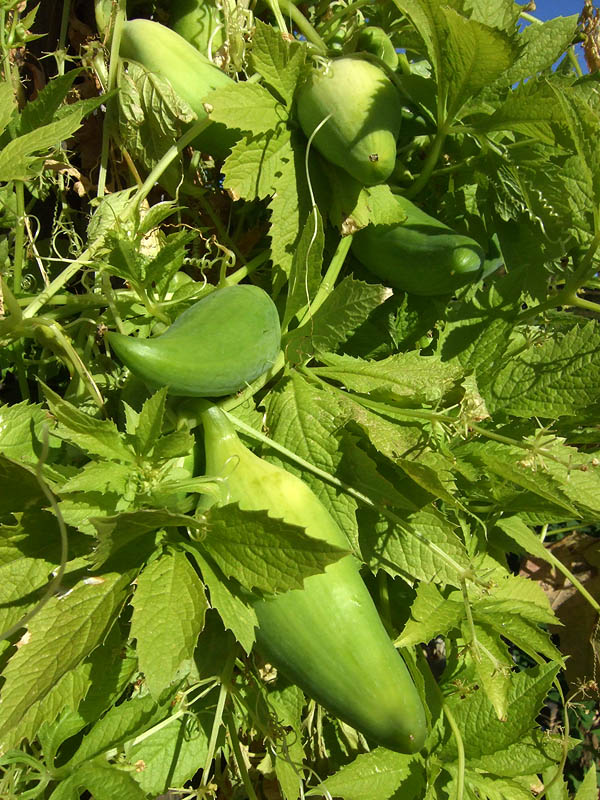
The climbing vines can reach 4.5 metres in height, and the leaves can reach 24 centimetres in length. The fruits can grow up to 15 centimetres long, with flesh approximately 0.5 centimetres thick.[1][2][3][4]
Habitat
Achocha grows in mountainous agricultural areas of Mexico, Central America and South America. It can grow at elevations of up to 2,000 metres above sea level.[5][6]
The plant grows best in deep, well-drained soils and temperatures between 12 and 27 degrees Celsius. It grows best with at least six to eight hours of direct sunlight daily and requires regular irrigation.[7][8][9][10]
Reproduction and life cycle
Immature fruits are harvested approximately 70–90 days after sowing. Mature fruits are harvested approximately 100–120 days after sowing.[11][12]
Behaviour
Achocha climbs and requires trellising for structural support during cultivation. Damaged leaves are reported to release an odor resembling cucumber.[13][14]
Diet
Young achocha fruits can be eaten fresh or incorporated into salads. Young shoots and leaves are also edible as greens.[15][16]
Mature fruits are commonly stuffed with meat, fish or cheese. The fruits are eaten after their seeds have been removed.[17][18]
Uses
Achocha fruits are primarily used as a vegetable. Mature fruits can be prepared by frying, breading or baking.[19][20]
The fruits provide potassium, magnesium and phosphorus. In Kashmir, they are traditionally deseeded and dried for consumption during winter.[21][22]
Achocha has traditionally been used in South American folk medicine for purported anti-inflammatory effects. Its fruits contain flavonoid glycosides, four of which exhibit antioxidant effects.[23][24]
Extracts of the species have demonstrated anticholesterolemic activity in a hepatic cell model.[25]
Classification of the Achocha
| Kingdom | Plantae |
|---|---|
| Subkingdom | Pteridobiotina |
| Phylum | Tracheophyta |
| Class | Magnoliopsida |
| Order | Cucurbitales |
| Family | Cucurbitaceae (Gourd Family) |
| Tribe | Sicyoeae |
| Genus | Cyclanthera |
| Species | Cyclanthera pedata (L.) Schrad. |
Where the Achocha is found
Checklists and occurrence records place Cyclanthera pedata in 18 countries across Asia, North America and South America. GBIF holds 661 georeferenced records of it.
Countries where it is native or its origin is not stated
- Argentina 17
- Brazil 72
- Colombia 109
- Costa Rica 23
- Ecuador 82
- Guatemala 21
- Honduras 1
- Mexico 12
- Nicaragua 3
- Panama 2
- Peru 92
- United States 52
Countries where it has been introduced
Regions and cities with the most records
- Cochabamba, Bolivia 29
- Pichincha, Ecuador 29
- Bogotá, Colombia 25
- Bogota D.C., Colombia 24
- Cota, Colombia 23
- Funza, Colombia 23
- Mosquera, Colombia 21
- Vinto, Bolivia 21
- Tiquipaya, Bolivia 19
- Cochabamba, Bolivia 18
- Colcapirhua, Bolivia 18
- Quillacollo, Bolivia 18
- Pomasqui, Ecuador 17
- Santa Cruz Department, Bolivia 17
- Soacha, Colombia 17
- Aserrí, Costa Rica 15
- Curridabat, Costa Rica 15
- Guadalupe, Costa Rica 15
- Heredia, Costa Rica 15
- Patarrá, Costa Rica 15
- Purral, Costa Rica 15
- San Diego, Costa Rica 15
- San Felipe, Costa Rica 15
- San José, Costa Rica 15
- San Juan, Costa Rica 15
- San Juan de Dios, Costa Rica 15
- San Miguel, Costa Rica 15
- San Pablo, Costa Rica 15
- San Pedro, Costa Rica 15
- San Rafael, Costa Rica 15
- San Rafael Arriba, Costa Rica 15
- San Vicente, Costa Rica 15
- San Vicente de Moravia, Costa Rica 15
- Cundinamarca, Colombia 13
- Sipe Sipe, Bolivia 13
- Yunnan, China 13
10 more countries have a few records outside this range
These countries hold a few records of Cyclanthera pedata but lie outside the range the checklists give for it. Such records are often zoo or garden specimens, museum material or vagrants, so the species is not counted as occurring there.
Range as the checklists state it
La Réunion [I]; China [I] (Yunnan [I]); Tibet [I]; Nepal [I]; Bhutan [I]; India [I] (Sikkim [I], Uttarakhand [I], West Bengal [I]); Mexico (Chiapas, Guerrero, Jalisco, Michoacán); Guatemala; Honduras; Nicaragua; Costa Rica; Panama; Colombia (Antioquia, Cundinamarca, Nariño); Venezuela [I]; Ecuador; Peru; Bolivia [I]; Argentina (Jujuy, Salta)
A number beside a place is its count of GBIF occurrence records. A place without a number comes from a checklist alone. Records show where a species has been observed or collected, which can include escapes and vagrants.
Common names
English
- Achocha
- Slipper Gourd
- Lady's-slipper
- Slipper Goard
- Stuffing Gourd
- Stuffing-cucumber
- Wild Cucumber
Names in 10 other languages
- Chinese
- xiao que gua
- Czech
- ačokča
- Finnish
- herkkuhyppykurkku
- French
- concombre grimpant
- German
- Korila
- Italian
- ciuenlai, milioncino, milione
- Portuguese
- Boga-boga, Cayo, Chuchu-de-bucha, Chuchu-de-vento, Chuchu-do-reino, Chuchu-paulista, Maxixe-do norte, Maxixe-do-reino
- Russian
- Циклантера съедобная
- Slovak
- cyklantéra odnožená
- Spanish
- Achojcha, Pepino de Guiso, Pepino de relleno, caiba, caifa, caigua, caihua, caygua
Synonyms
7 other scientific names have been used for this species and are now treated as synonyms of Cyclanthera pedata.
- Anguria pedatisecta Nees & Mart.
- Cyclanthera digitata Arn.
- Cyclanthera edulis Naudin ex C.Huber
- Cyclanthera pedata f. edulis (Naudin ex C.Huber) Voss
- Cyclanthera pedata var. edulis (Naudin ex C.Huber) Cogn.
- Cyclanthera pedata var. pedata
- Momordica pedata L.
Related species
-
 Exploding CucumberCyclanthera brachystachya
- Cyclanthera carthagenensis
- Cyclanthera dissecta
- Cyclanthera filiformis
- Cyclanthera langaei
- Cyclanthera ribiflora
- Cyclanthera hastata
- Cyclanthera multifoliola
Compare
Questions and answers
What is the scientific name of the Achocha?
The scientific name of the Achocha is Cyclanthera pedata. Written with its author, the full name is Cyclanthera pedata (L.) Schrad..
Which family does the Achocha belong to?
Cyclanthera pedata belongs to the family Cucurbitaceae, in the order Cucurbitales and the class Magnoliopsida.
Where is the Achocha found?
Checklists and occurrence records place Cyclanthera pedata in 18 countries, including Colombia, Peru, Ecuador, Brazil, United States and Costa Rica.
What other names does the Achocha have?
Cyclanthera pedata is also known in English as Slipper Gourd, Lady's-slipper, Slipper Goard, Stuffing Gourd, Stuffing-cucumber and Wild Cucumber.
Can you eat achocha raw?
Yes. Young achocha fruits can be eaten fresh or incorporated into salads.[15]
Sources
Passages the profile rests on
- The climbing vines can reach a height of 4.5 metres. Source passage: “C. pedata is an annual climbing plant with vines that can reach up to 4.5 meters in height.” — English Wikipedia
- The leaves can reach 24 centimetres in length. Source passage: “the leaves can be up to 24 cm long, palmate or pedate in shape.” — English Wikipedia
- The fruits can grow up to 15 centimetres long. Source passage: “The fruit is light green, ovoid, curved, up to 15 cm long,” — English Wikipedia
- The flesh of the fruit is approximately 0.5 centimetres thick. Source passage: “The fruit flesh is soft and spongy, not crunchy, with a thickness of only 0.5 cm,” — English Wikipedia
- The species grows in mountainous agricultural areas of Mexico, Central America and South America. Source passage: “Cyclanthera pedata is grown at small scale farming in mountain areas of Mexico, Central America and South America.” — English Wikipedia
- The species can grow at elevations of up to 2,000 metres above sea level. Source passage: “Though it can be grown at altitudes up to 2000 m.a.s.l., the plant is sensitive to frost.” — English Wikipedia
- The plant grows best in deep, well-drained soils. Source passage: “Additionally, the plant grows best in deep, well-drained soils and does not tolerate saline soils.” — English Wikipedia
- The plant flourishes in temperatures between 12 and 27 degrees Celsius. Source passage: “Cyclanthera pedata flourishes in cool to moderate temperatures ranging from 12–27 °C.” — English Wikipedia
- The species grows best with at least six to eight hours of direct sunlight daily. Source passage: “It thrives in direct sunlight (at least 6-8h/day)” — English Wikipedia
- The species requires regular irrigation. Source passage: “and similarly to other Cucurbitaceae requires regular irrigation.” — English Wikipedia
- Immature fruits are harvested approximately 70–90 days after sowing. Source passage: “Immature fruits are harvested 70–90 days after sowing (mid June/July),” — English Wikipedia
- Mature fruits are harvested approximately 100–120 days after sowing. Source passage: “and mature fruits at 100–120 days (August).” — English Wikipedia
- The plant climbs and requires trellising for structural support during cultivation. Source passage: “As Caigua is a climbing vine, trellising is crucial for support.” — English Wikipedia
- Damaged leaves are reported to release an odor resembling cucumber. Source passage: “When the leaves are injured, it is said to release a cucumber-like odor.” — English Wikipedia
- The young fruits can be eaten fresh or incorporated into salads. Source passage: “Young fruits can be eaten fresh, added to salads, sautéed, or served as a side dish.” — English Wikipedia
- The young shoots and leaves are edible as greens. Source passage: “Young shoots and leaves can also be eaten as greens.” — English Wikipedia
- Mature fruits are commonly stuffed with meat, fish or cheese. Source passage: “Mature fruits are typically stuffed with meats, fish, or cheese” — English Wikipedia
- The fruits are eaten after their seeds have been removed. Source passage: “The fruits are eaten after removing the seeds.” — English Wikipedia
- The fruits are primarily used as a vegetable. Source passage: “known as caigua, is a herbaceous vine grown for its edible fruit, which is predominantly used as a vegetable.” — English Wikipedia
- Mature fruits can be prepared by frying, breading or baking. Source passage: “Mature fruits are typically stuffed with meats, fish, or cheese and can be fried, breaded, or baked.” — English Wikipedia
- The fruits provide potassium, magnesium and phosphorus. Source passage: “The fruits are a source of potassium, magnesium and phosphorus.” — English Wikipedia
- In Kashmir, the fruits are traditionally deseeded and dried for consumption during winter. Source passage: “Traditionally the people of Kashmir remove its seeds and dry it, to be consumed in winters.” — English Wikipedia
- The species has traditionally been used in South American folk medicine for purported anti-inflammatory effects. Source passage: “Caigua (Cyclanthera pedata) has been traditionally used in South American folk medicine for its alleged anti-inflammatory, hypoglycemic, and hypocholesterolemic effects,” — English Wikipedia
- The fruits contain flavonoid glycosides, four of which exhibit antioxidant effects. Source passage: “The fruits contain flavonoid glycosides of which four show an antioxidant effect.” — English Wikipedia
- Extracts of the species have demonstrated anticholesterolemic activity in a hepatic cell model. Source passage: “The anticholesterolemic activity of caigua was confirmed, promoting cholesterol metabolism and bile acids synthesis in a hepatic cell model,” — English Wikipedia
Data
- Catalogue of Life, 2026-10-16 XR cc by
- Global Biodiversity Information Facility CC BY 4.0
- Wikidata CC0
- GeoNames CC BY 4.0
- Wikimedia Commons per image; credit shown with each image
- Within the Catalogue of Life, this name comes from Synonymic Checklists of the Vascular Plants of the World cc by
References
- Schrad. Index Sem. Hort. Acad. Götting. (1831). where the name was published
This species in other databases
- Catalogue of Life 32SRH
- Wikidata Q311101
- iNaturalist 157053
- World Flora Online wfo-0000632002
- GRIN 12773
Page built on 26 November 2026. See how the catalog is made and all sources and licences.
Cite this page
ScientificNames.org. (2026). Cyclanthera pedata (Achocha). Retrieved November 26, 2026, from https://scientificnames.org/species/cyclanthera-pedata
“Cyclanthera pedata (Achocha).” ScientificNames.org, 2026, scientificnames.org/species/cyclanthera-pedata. Accessed 26 Nov. 2026.
ScientificNames.org. “Cyclanthera pedata (Achocha).” Accessed November 26, 2026. https://scientificnames.org/species/cyclanthera-pedata.
@misc{scientificnames_cyclanthera_pedata_achocha,
  author = {{ScientificNames.org}},
  title = {Cyclanthera pedata (Achocha)},
  year = {2026},
  url = {https://scientificnames.org/species/cyclanthera-pedata},
  note = {Accessed 2026-11-26}
}