Species · Reptiles
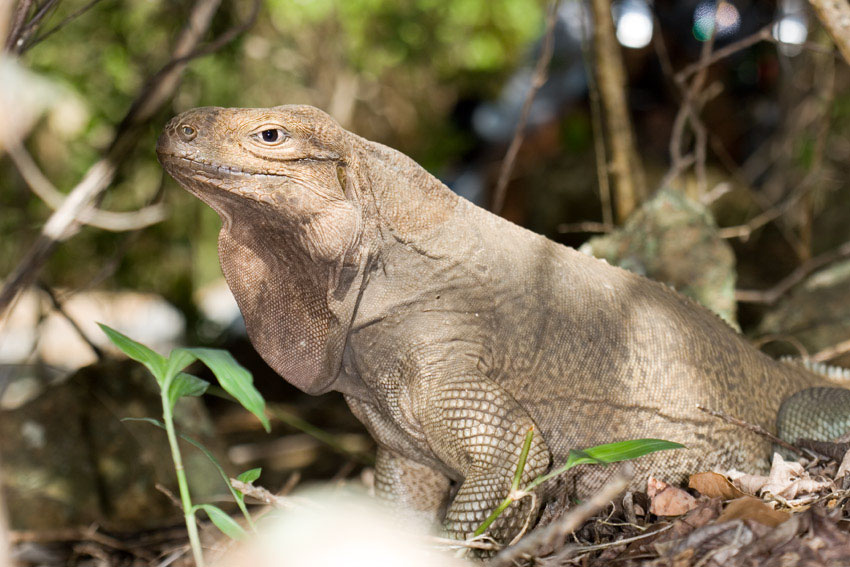
Rhinoceros Iguana Cyclura cornuta
The scientific name of the Rhinoceros Iguana is Cyclura cornuta. It is a species of reptile in the family Iguanidae (iguanas), order Squamata. The name dates from 1789.
- Scientific name
- Cyclura cornuta (Bonnaterre, 1789)
- Common name
- Rhinoceros Iguana
- Genus
- Cyclura
- Family
- Iguanidae (Iguanas)
- Order
- Squamata
- Class
- Reptilia
- Red List category
- EN Endangered
- Recorded in
- 4 countries
- Name status
- accepted in the Catalogue of Life

Overview
The rhinoceros iguana (Cyclura cornuta) is an endangered species of iguana that is (habituated) endemic to the Caribbean island of Hispaniola (shared by Haiti and the Dominican Republic) and its surrounding islands. A large lizard, they vary in length from 60 to 136 centimetres (24 to 54 in), and skin colours range from a steely grey to a dark green and even brown.
Classification of the Rhinoceros Iguana
| Kingdom | Animalia |
|---|---|
| Phylum | Chordata |
| Subphylum | Vertebrata |
| Infraphylum | Gnathostomata |
| Parvphylum | Osteichthyes |
| Megaclass | Tetrapoda |
| Class | Reptilia (Reptile) |
| Order | Squamata (Snakes) |
| Suborder | Iguania (Iguanas) |
| Family | Iguanidae (Iguanas) |
| Genus | Cyclura (Rock Iguanas) |
| Species | Cyclura cornuta (Bonnaterre, 1789) |
Where the Rhinoceros Iguana is found
Checklists and occurrence records place Cyclura cornuta in 4 countries across North America. GBIF holds 554 georeferenced records of it.
Countries
Regions and cities with the most records
- Independencia, Dominican Republic 87
- Baní, Dominican Republic 71
- Peravia, Dominican Republic 68
- Pedernales Province, Dominican Republic 43
- La Altagracia Province, Dominican Republic 30
- Azua Province, Dominican Republic 29
- Punta Cana, Dominican Republic 28
- La Romana, Dominican Republic 17
- Salvaleón de Higüey, Dominican Republic 15
- Ouest, Haiti 14
- Azua, Dominican Republic 11
- Mayagüez, Puerto Rico 10
- Santo Domingo, Dominican Republic 9
- Santo Domingo Este, Dominican Republic 8
- Santo Domingo Oeste, Dominican Republic 8
- Barahona Province, Dominican Republic 7
- La Romana, Dominican Republic 7
- Santo Domingo Province, Dominican Republic 7
- San Pedro de Macorís, Dominican Republic 6
- Baoruco Province, Dominican Republic 5
- San Cristóbal, Dominican Republic 5
- Bajos de Haina, Dominican Republic 4
- San Pedro de Macorís, Dominican Republic 4
Range as the checklists state it
Hispaniola (Dominican Republic, Haiti), Isla Beata, Ile de la Petite Gonave, Ile de la Tortue, Ile Grande Cayemite, Ile de la Petite Cayemite, Isla Saona, Isla Cabritos, Navassa, Isla Mona,
A number beside a place is its count of GBIF occurrence records. A place without a number comes from a checklist alone. Records show where a species has been observed or collected, which can include escapes and vagrants.
Common names
English
- Rhinoceros Iguana
- Hispaniola Rhinoceros Iguana
- Hispaniolan Rhinoceros Iguana
- Hispaniolan Rock Iguana
- Horned Ground Iguana
- Horned Iguana
- Rhinoceros Rock Iguana
Names in 23 other languages
- Arabic
- إغوانة مقرنة, إغوانة وحيد القرن
- Breton
- Igwan frikornek
- Chinese
- 犀牛鬣蜥
- Danish
- Næsehornsleguan
- Dutch
- Neushoornleguaan
- Finnish
- Sarvikuonoleguaani
- French
- Cyclure cornu, Iguane a cornes, Iguane cornu, Iguane rhinocéros, Iguane terrestre cornu
- German
- Nashornleguan
- Hebrew
- איגואנה קרנפית
- Hungarian
- Hispaniolai orrszarvú leguán, orrszarvú leguán
- Japanese
- サイイグアナ
- Polish
- Legwan nosorogi
- Portuguese
- Iguana-rinoceronte
- Russian
- Игуана-носорог
- Serbian
- Носорога игуана
- Slovak
- Leguán nosorohý
- Slovenian
- rogati vretenorepec
- Spanish
- Iguana Rinoceronte, Iguana Rinoceronte de La Española, Iguana cornuda
- Swedish
- Noshornsleguan
- Thai
- อิกัวนาแรด, ไรโน อีกัวนา
- Ukrainian
- Ігуана-носоріг
- nav
- Tsétah naʼashǫ́ʼiitsoh déélgédígíí
- pnb
- گینڈا ایگوانا
Synonyms
4 other scientific names have been used for this species and are now treated as synonyms of Cyclura cornuta.
- Aloponotus cornutus — Perrier, 1928
- Iguana cornuta — Latreille, 1801
- Lacerta cornuta Bonnaterre, 1789
- Metopoceros cornutus — Wagler, 1830
Subspecies and varieties
- Cyclura cornuta cornuta subspecies
- Cyclura cornuta stejnegeri (Mona Ground Iguana) subspecies
Related species
-
 Blue IguanaCyclura lewisi
-
 Jamaican IguanaCyclura collei
-
 Cuban Ground IguanaCyclura nubila
-
 Stout IguanaCyclura pinguis
-
 Northern Bahamian Rock IguanaCyclura cychlura
-
 Ricord's Rock IguanaCyclura ricordii
-
 White Cay Ground IguanaCyclura rileyi
-
 Turks and Caicos Rock IguanaCyclura carinata
Compare
Questions and answers
What is the scientific name of the Rhinoceros Iguana?
The scientific name of the Rhinoceros Iguana is Cyclura cornuta. Written with its author, the full name is Cyclura cornuta (Bonnaterre, 1789).
Which family does the Rhinoceros Iguana belong to?
Cyclura cornuta belongs to the family Iguanidae, in the order Squamata and the class Reptilia.
Where is the Rhinoceros Iguana found?
Checklists and occurrence records place Cyclura cornuta in 4 countries: Dominican Republic, Haiti, Puerto Rico and United States.
What is the conservation status of the Rhinoceros Iguana?
The IUCN Red List category recorded for Cyclura cornuta is Endangered (EN).
What other names does the Rhinoceros Iguana have?
Cyclura cornuta is also known in English as Hispaniola Rhinoceros Iguana, Hispaniolan Rhinoceros Iguana, Hispaniolan Rock Iguana, Horned Ground Iguana, Horned Iguana and Rhinoceros Rock Iguana.
Sources
Data
- Catalogue of Life, 2026-10-16 XR cc by
- Global Biodiversity Information Facility CC BY 4.0
- Wikidata CC0
- English Wikipedia CC BY-SA 4.0
- GeoNames CC BY 4.0
- Wikimedia Commons per image; credit shown with each image
- Within the Catalogue of Life, this name comes from The Reptile Database cc by
References
- Bonnaterre, P. J. (1789). Tableau encyclopédique et méthodique des trois règnes de la nature, . . . Erpétologie. Panckoucke, Paris, Xxviii+71 Pp. (+ Plates + Index).
- Cuvier, G. (1831). The Animal Kingdom arranged in conformity with its organization, by the Baron Cuvier, ... with additional descriptions of all the species hitherto named, and of many not before noticed, by Edward Griffith... and others. Vol. 9. Whittaker, Treacher and Co., London, 481 Pp.
- Duméril, A. M. C. and G. Bibron. (1837). Erpétologie Générale ou Histoire Naturelle Complete des Reptiles. Vol. 4. Libr. Encyclopédique Roret, Paris, 570 Pp.
- Tyler, R. E. (1850). On the iguana of Sta Lucia, Metopoceros cornutus of Wagler. Proc. Zool. Soc. London 1850: 106-110.
- Tyler, R. E. (1852). On the iguana of Sta Lucia, Metopoceros cornutus of Wagler. Ann. Mag. Nat. Hist. (2) 7: 494-494.
- Günther, & Albert. (1882). Observations on some rare Reptiles and a Batrachian now or lately living in the Society’s Menagerie. Transactions of the Zoological Society of London 11 (7): 215-222, 5 Plates (2 in Color).
- Cope, E. D. (1885). The large iguanas of the Greater Antilles. American Naturalist 19: 1005-1006.
- Boulenger, G. A. (1885). Catalogue of the lizards in the British Museum (Natural History). Vol. 2, Second edition. London, Xiii+497 Pp.
- Cope, E. D. (1886). On the species of Iguaninae. Proc. Amer. Philos. Soc. 23 (122): 261-271.
- Boulenger, G. A. (1890). On the distinctive cranial characters of the Iguanoid lizards allied to Iguana. Ann. Mag. Nat. Hist. (6) 6: 412-414.
- Stejneger, L. (1904). The herpetology of Porto Rico. Rept. United States Natl. Mus. 1902: 549-724.
- Barbour, T. and Noble, G.K. (1916). A revision of the lizards of the genus Cyclura. Bull. Mus. Comp. Zool. Harvard 60 (4): 139-164.
- Noble, G. K. (1923). Trailing the rhinoceros iguana. Nat. Hist. 23 (6):541-558.
- Mertens, R. (1938). Amphibien und Reptilien aus Santo Domingo, gesammelt von Prof. Dr. H. Böker. Senckenbergiana 20 (5): 332-342.
- Cochran, D. M. (1941). The herpetology of Hispaniola. Bull. US Natl. Mus. 177: Vii + 398 Pp.
- Grant, C. (1944). Cyclura stejnegeri: A Portrait. Herpetologica 2: 139-140.
- Avery, D. F., & Tanner, W. W. (1971). Evolution of the iguanine lizards (Sauria, Iguanidae) as determined by osteological and myological characters. Brigham Young University Science Bulletin 12 (3): 1-79.
- Schwartz, A., & Henderson, R. W. (1991). Amphibians and Reptiles of the West Indies. University of Florida Press, Gainesville, 720 Pp.
- Thomas, R., & Joglar, R. (1996). The herpetology of Puerto Rico: Past, present, and future. Ann New York Acad. Sci. 776: 181-200.
- Powell, R. (1999). Herpetology of Navassa Island, West Indies. Carib. J. Sci. 35: 1-13.
- Powell, R. and R.E. Glor. (2000). Cyclura stejnegeri Barbour and Noble Mona Island Rhinoceros Iguana. Catalogue of American Amphibians and Reptiles (711): 1-4.
- Boonman, & John. (2000). The Mona Island Iguana, Cyclura cornuta stejnegeri Barbour & Noble, 1916. Podarcis 1 (2): 33-35.
- Glor, R.E., R. Powell, and J.S. Parmerlee, Jr. (2000). Cyclura cornuta (Bonnaterre) Hispaniolan Rhinoceros Iguana. Catalogue of American Amphibians and Reptiles (709): 1-6.
- Powell, R. (2000). Cyclura onchiopsis Cope Navassa Island Rhinoceros Iguana. Catalogue of American Amphibians and Reptiles (710): 1-3.
- Malone,C.L.; Wheeler,T.; Taylor, J.F. & Davis,S.K. (2000). Phylogeography of the Caribbean Rock Iguana (Cyclura): implications for conservation and insights on the biogeographic history of the West Indies. Mol. Phylogen. Evol. 17 (2): 269.
This species in other databases
Page built on 25 November 2026. See how the catalog is made and all sources and licences.
Cite this page
ScientificNames.org. (2026). Cyclura cornuta (Rhinoceros Iguana). Retrieved November 25, 2026, from https://scientificnames.org/species/cyclura-cornuta
“Cyclura cornuta (Rhinoceros Iguana).” ScientificNames.org, 2026, scientificnames.org/species/cyclura-cornuta. Accessed 25 Nov. 2026.
ScientificNames.org. “Cyclura cornuta (Rhinoceros Iguana).” Accessed November 25, 2026. https://scientificnames.org/species/cyclura-cornuta.
@misc{scientificnames_cyclura_cornuta_rhinoceros_iguana,
  author = {{ScientificNames.org}},
  title = {Cyclura cornuta (Rhinoceros Iguana)},
  year = {2026},
  url = {https://scientificnames.org/species/cyclura-cornuta},
  note = {Accessed 2026-11-25}
}