Species · Flowering plants
Quince Cydonia oblonga
The scientific name of the Quince is Cydonia oblonga. It is a species of flowering plant in the family Rosaceae (rose family), order Rosales.
- Scientific name
- Cydonia oblonga Mill.
- Common name
- Quince
- Genus
- Cydonia
- Family
- Rosaceae (Rose Family)
- Order
- Rosales
- Class
- Magnoliopsida
- Red List category
- LC Least Concern
- Recorded in
- 88 countries
- Name status
- accepted in the Catalogue of Life
Overview
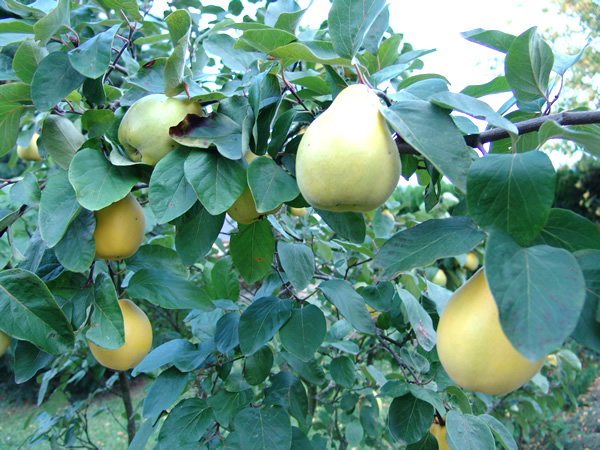
Quince (Cydonia oblonga Mill.) is a deciduous flowering plant in the Rosaceae family, order Rosales, class Magnoliopsida. It is native to the northern forests of Asia Minor and the Caucasus Mountains between Persia and Turkmenistan. It produces aromatic, golden-yellow, pear-shaped fruits that remain tough and hard even when fully ripe.
Written 24 November 2026 from the sources listed below. Each statement was checked against the passage it cites; statements that could not be supported were removed.
Similar species
The fruit resembles a pear or golden apple in appearance.[1][2]
Appearance
Quince is a deciduous shrub or small tree with crowded branches. Its leaves are broadly oval, mid-green, and have grey, downy undersides.[3][4][5]
Its solitary flowers are pale pink to white and appear in late spring. The flowers measure approximately 4–5 cm.[6][7]
Its aromatic fruits are golden-yellow and pear-shaped. The fruit is a pome resembling a pear or golden apple and remains tough and hard even when fully ripe.[8][1][9]
Ripening fruit changes from green through pale green to golden in late fall. The fruit flesh contains dispersed gritty stone cells.[10][11]
The shrub or small tree can reach 4–6 metres in height, with a canopy up to 3 metres in diameter. Its leaves measure 5–10 cm in length and approximately 5 cm in width.[12][13][14]
Its fruits can weigh approximately 300–500 g. Mature fruits measure approximately 3–5 inches, and individual fruits can weigh as much as 1 kilogram.[15][16][17]
Habitat
Quince grows in warm-temperate and temperate climates and can grow in most soil types. It tolerates both shaded and sunny growing conditions.[18][19][20]
It can grow in deep, fertile, moist but well-drained soil in a warm, sheltered, sunny location. It requires a cool period with temperatures below 7 °C to flower properly.[21][22]
Diet
The fruit is used in cooked preparations including jams, jellies, marmalade, and cakes. It can also be incorporated into applesauce and apple pie.[23][24]
The fruit can be eaten raw after sufficient ripening in warmer climates.[25]
Reproduction and life cycle
Quince flowers have five petals, five styles, and at least 20 stamens. Their lower ovary contains numerous ovules.[26][27]
Quince can be propagated using cuttings or layering. It can also be propagated by seed sown in autumn.[28][29]
Uses
Quince is grown as an ornamental plant for its attractive pink blossoms and is used as a rootstock for certain pear cultivars.[30][31]
The fruit is used to produce alcoholic beverages. In the Balkans, it is used to produce quince eau-de-vie known as rakija.[32][33]
The fruit is traditionally added to chicken or kibbeh in Levantine cooking.[34]
The leaves have been investigated for their potential use in therapeutic supplements. They contain calcium, magnesium, and iron as their most abundant minerals.[35][36]
Classification of the Quince
| Kingdom | Plantae |
|---|---|
| Subkingdom | Pteridobiotina |
| Phylum | Tracheophyta |
| Class | Magnoliopsida |
| Order | Rosales |
| Family | Rosaceae (Rose Family) |
| Subfamily | Amygdaloideae |
| Tribe | Maleae |
| Subtribe | Malinae |
| Genus | Cydonia (Quince) |
| Species | Cydonia oblonga Mill. |
Where the Quince is found
Checklists and occurrence records place Cydonia oblonga in 88 countries across Africa, Asia, Europe, North America, Oceania and South America. GBIF holds 52,611 georeferenced records of it.
Countries where it is native or its origin is not stated
- Afghanistan 358
- Albania 58
- Algeria 52
- Argentina 18
- Armenia 118
- Australia 239
- Austria 998
- Azerbaijan 189
- Belarus 5
- Belgium 260
- Bolivia 5
- Bosnia and Herzegovina 41
- Brazil 57
- Bulgaria 185
- Cabo Verde 2
- Canada 70
- Chile 24
- China 102
- Colombia 3
- Croatia 323
- Cyprus 12
- Czechia 1,379
- Denmark 57
- Ecuador 3
- El Salvador 3
- Estonia 6
- Ethiopia 19
- France 19,881
- Georgia 137
- Greece 770
- Guatemala 5
- Honduras 2
- Hungary 695
- India 8
- Iran 41
- Iraq 16
- Israel 16
- Italy 4,865
- Japan 28
- Jersey 3
- Kazakhstan 12
- Kosovo 4
- Kyrgyzstan 3
- Latvia 18
- Lebanon 21
- Libya 2
- Liechtenstein 3
- Luxembourg 41
- Mexico 50
- Moldova 26
- Monaco 2
- Montenegro 20
- Morocco 99
- Nepal 2
- New Caledonia 6
- New Zealand 124
- North Macedonia 17
- Pakistan 7
- Peru 6
- Poland 56
- Portugal 1,150
- Reunion 6
- Romania 306
- Russia 611
- San Marino 10
- Serbia 119
- Slovakia 239
- Slovenia 62
- South Africa 74
- Spain 5,160
- Sweden 204
- Switzerland 1,216
- Syria 8
- Taiwan
- Tajikistan 7
- The Netherlands 361
- Tunisia 14
- Turkey 552
- Turkmenistan 55
- Ukraine 421
- United States 693
- Uruguay 10
- Uzbekistan 110
- Vietnam
- Yemen
Countries where it has been introduced
Regions and cities with the most records
- Occitanie, France 4,724
- Provence-Alpes-Côte d'Azur, France 3,559
- Auvergne-Rhône-Alpes, France 3,275
- Île-de-France, France 1,567
- Baden-Wurttemberg, Germany 1,306
- Bavaria, Germany 1,288
- Catalonia, Spain 1,267
- North Rhine-Westphalia, Germany 1,104
- England, United Kingdom 989
- Paris 14 Observatoire, France 976
- Issy-les-Moulineaux, France 971
- Paris 07 Palais-Bourbon, France 967
- Paris 15 Vaugirard, France 966
- Clamart, France 964
- Boulogne-Billancourt, France 955
- Paris 16 Passy, France 954
- Meudon, France 952
- Paris 05 Panthéon, France 951
- Suresnes, France 951
- Paris, France 947
- Maison Blanche, France 943
- Paris 13 Gobelins, France 940
- Rueil-Malmaison, France 927
- Ivry-sur-Seine, France 920
- Gare, France 919
- Neuilly-sur-Seine, France 916
- Villejuif, France 916
- Courbevoie, France 914
- Nanterre, France 914
- Paris 09 Opéra, France 913
- Levallois-Perret, France 910
- Paris 17 Batignolles-Monceau, France 910
- Colombes, France 909
- Pays de la Loire, France 902
- Asnières-sur-Seine, France 897
- Clichy, France 896
Range as the checklists state it
England [I] (England [I], Wales [I], S-Scotland [I]); Ireland [I] (Ireland [I]); Germany [I]; Switzerland [c]; Austria [c]; Czech Republic [c]; Slovakia [c]; Hungary [c]; Portugal [c]; Spain [c]; France [c]; Monaco [c]; Channel Isl. [c] (Jersey [c]); Corsica [c]; Sardinia [c]; Italy [c]; Sicily [c]; San Marino [c]; Slovenia [c]; Croatia [c]; former Yugoslavia [c]; Albania [c]; Romania [c]; Bulgaria [c]; Greece [c]; Crete [c]; Crimea [c]; Morocco [c]; Algeria [c]; Tunisia [c]; Libya [c]; Canary Isl. [c] (Tenerife [c], Hierro [c]); Cape Verde Isl. [c] (Santo Antao Isl. [c], Ilha de Sao Tiago [c], Fogo Isl. [c]); South Africa [c] (Free State [c]); Kazakhstan [c]; Turkmenistan [c]; Uzbekistan [c]; Tajikistan [c]; Northern Caucasus; Georgia [Caucasus]; Armenia; Azerbaijan; East Aegaean Isl. [c]; Turkey (N-Anatolia, NE-Anatolia, NW-Anatolia: Bithynia, SSW-Anatolia, WN-Anatolia); Iraq (NE-Iraq); Iran (N-Iran, Iranian Aserbaijan, S-Iran, W-Iran); Afghanistan [c]; Yemen [c]; China [c] (Fujian [c], Guizhou [c], Jiangxi [c], S-Shaanxi [c], Shanxi [c], Xinjiang [c]); Taiwan [c]; Pakistan [c]; Nepal [c]; N-India [c]; Vietnam [c]; Australia [c] (South Australia [c]); New Zealand [c]; New Caledonia [c]; Canada [c] (Ontario [c]); USA [c] (California [c], Connecticut [c], Illinois [c], Massachusetts [c], Maryland [c], New York [c], Ohio [c], Oregon [c], Pennsylvania [c], Vermont [c]); Mexico [c]; Guatemala [c]; El Salvador [c]; Honduras [c]; Colombia [c]; Ecuador [c]; Bolivia [c]
A number beside a place is its count of GBIF occurrence records. A place without a number comes from a checklist alone. Records show where a species has been observed or collected, which can include escapes and vagrants.
Common names
English
- Quince
- Common Quince
- Quince Tree
Names in 37 other languages
- Afrikaans
- kweper
- Arabic
- Safarjal, سفرجل
- Basque
- Irasagar
- Bulgarian
- Обикновена дюля
- Catalan
- Codonyer
- Chinese
- Wen po, 木梨, 榲桲
- Czech
- kdouloň obecná
- Danish
- Almindelig kvæde, kvæde
- Dutch
- Kwee, Kweepeer
- Finnish
- kvitteni
- French
- Cognacier, Cognassier commun, Coing, cognassier
- German
- Echte Quitte, Quitte, Quittenbaum
- Greek
- Kydoni, Κυδωνιά
- Hebrew
- חבוש מוארך
- Hungarian
- Birs, Birsalma, közönséges birs
- Italian
- Cotogno
- Japanese
- Marumero, マルメロ
- Latvian
- Parastā cidonija
- Lithuanian
- Paprastoji cidonija
- Norwegian Bokmål
- kvede
- Polish
- Pigwa, Pigwa pospolita
- Portuguese
- Gamboa, Gamboeiro, Marmeleiro, marmelo
- Russian
- Aiva, Aiva obyknovennaia, ajva, Айва продолговатая
- Scottish Gaelic
- cuinnse
- Serbian
- Dunja
- Slovak
- dula podlhovastá
- Slovenian
- kutina, navadna kutina
- Spanish
- Membrillero, Membrillo
- Swedish
- kvitten
- Turkish
- Ayva
- Ukrainian
- Айва
- Urdu
- Behi
- Welsh
- Coeden Gwins Coed Cwins, Cwinswydden
- arg
- Codonyera
- frr
- Kwitenbuum
- mwl
- Burmelheiro
- san
- Amritaphala
Synonyms
108 other scientific names have been used for this species and are now treated as synonyms of Cydonia oblonga.
- Bollwilleria malifolia Zabel
- Crataegus serotina Salisb.
- Cydonia communis Loisel.
- Cydonia communis var. lusitanica (Mill.) Loisel.
- Cydonia communis var. maliformis (Mill.) Loisel.
- Cydonia communis var. oblonga (Mill.) Loisel.
- Cydonia cydonia (L.) J.F.Lehm.
- Cydonia cydonia (L.) Pers.
- Cydonia cydonia lusus pyramidalis (Dippel) Asch. & Graebn.
- Cydonia cydonia subsp. lusitanica (Mill.) Asch. & Graebn.
- Cydonia cydonia subvar. lusitanica (Mill.) Asch. & Graebn.
- Cydonia cydonia var. lusitanica (Mill.) Pers.
- Cydonia cydonia var. maliformis (Mill.) Asch. & Graebn.
- Cydonia cydonia var. oblonga (Mill.) Asch. & Graebn.
- Cydonia cydonia var. piriformis (G.Kirchn.) Asch. & Graebn.
- Cydonia europaea Savi
- Cydonia lusitanica Mill.
- Cydonia maliformis Mill.
- Cydonia maliformis Beck
- Cydonia media Poit. & Turpin
- Cydonia minor Poit. & Turpin
- Cydonia oblonga f. lusitanica (Mill.) Rehder
- Cydonia oblonga f. marmorata (Dippel) C.K.Schneid.
- Cydonia oblonga f. pyramidalis (Dippel) Rehder
- Cydonia oblonga f. pyriformis (Thell.) Rehder
- Cydonia oblonga subsp. integerrima Lobachev
- Cydonia oblonga subsp. lusitanica (Mill.) D.Rivera
- Cydonia oblonga subsp. maliformis (Mill.) Thell.
- Cydonia oblonga subsp. pyriformis (Medik.) Thell.
- Cydonia oblonga var. biserrulata Kakhadze
- Cydonia oblonga var. integerrimosepala Kakhadze
- Cydonia oblonga var. integerrimosepala Lobachev
- Cydonia oblonga var. lusitanica (Mill.) C.K.Schneid.
- Cydonia oblonga var. maliformis (Mill.) Hegi
- Cydonia oblonga var. maliformis (Mill.) C.K.Schneid.
- Cydonia oblonga var. obpyricarpa Lobachev
- Cydonia oblonga var. obpyriformis Lobachev
- Cydonia oblonga var. orbiculatocomplanata Lobachev
- Cydonia oblonga var. ovalicarpa Lobachev
- Cydonia oblonga var. ovalis Lobachev
Showing 40 of 108.
Related species
-
 LoquatEriobotrya japonica
-
 AlmondPrunus amygdalus
-
 SloePrunus spinosa
-
 Bradford PearPyrus calleryana
-
 BakeappleRubus chamaemorus
-
 Oriental Pear TreePyrus pyrifolia
-
 RowanSorbus aucuparia
-
 Chinese PlumPrunus mume
Compare
Questions and answers
What is the scientific name of the Quince?
The scientific name of the Quince is Cydonia oblonga. Written with its author, the full name is Cydonia oblonga Mill..
Which family does the Quince belong to?
Cydonia oblonga belongs to the family Rosaceae, in the order Rosales and the class Magnoliopsida.
Where is the Quince found?
Checklists and occurrence records place Cydonia oblonga in 88 countries, including France, Spain, Italy, Czechia, Switzerland and Portugal.
What is the conservation status of the Quince?
The IUCN Red List category recorded for Cydonia oblonga is Least Concern (LC).
What other names does the Quince have?
Cydonia oblonga is also known in English as Common Quince and Quince Tree.
What did quince used to be called?
The English name quince originated in the fourteenth century from the plural form of the Middle English word quoyn. The name ultimately derives from the Greek expression kydonion mēlon, meaning Kydonian apple.[37][38]
Why can't quince be eaten raw?
The fruit remains tough and hard even when fully ripe. It can be eaten raw after sufficient ripening in warmer climates.[9][25]
What are the medicinal uses of quince?
The leaves have been investigated for their potential use in therapeutic supplements. They contain calcium, magnesium, and iron as their most abundant minerals.[35][36]
Is quince a fruit or vegetable?
Quince produces a fruit classified as a pome.[1]
Sources
Passages the profile rests on
- The fruit is a pome with an appearance resembling a pear or golden apple. Source passage: “The quince fruit, called a pome, is somewhat similar in appearance to a pear or golden apple.” — extension.psu.edu
- The fruit resembles a pear in appearance. Source passage: “similar in appearance to a pear.” — English Wikipedia
- The quince is a deciduous shrub or small tree with crowded branches. Source passage: “A large shrub or small tree with crowded branches” — rhs.org.uk
- Its leaves are broadly oval, mid-green, and have grey, downy undersides. Source passage: “broadly oval, mid-green leaves with grey, downy undersides.” — rhs.org.uk
- The species is deciduous. Source passage: “It is a deciduous tree” — English Wikipedia
- Its solitary flowers are pale pink to white and appear in late spring. Source passage: “Solitary, pale pink to white flowers are produced in late spring” — rhs.org.uk
- Its flowers measure approximately 4–5 cm. Source passage: “The large and single flowers (4–5 cm)” — pmc.ncbi.nlm.nih.gov
- Its aromatic fruits are golden-yellow and pear-shaped. Source passage: “edible, aromatic, golden-yellow, pear-shaped fruit.” — rhs.org.uk
- The fruit remains tough and hard even when fully ripe. Source passage: “The fruit itself is tough and a bit hard, even when fully ripened.” — extension.psu.edu
- Ripening fruit changes from green through pale green to golden in late fall. Source passage: “The ripening fruit turns from green to pale green to a beautiful golden color in late fall” — extension.psu.edu
- The fruit flesh contains dispersed gritty stone cells. Source passage: “gritty stone cells are dispersed through the flesh.” — English Wikipedia
- The quince shrub or small tree can reach 4–6 metres in height. Source passage: “the quince plant grows as a shrub or small tree (4–6 m high)” — pmc.ncbi.nlm.nih.gov
- Its canopy can reach 3 metres in diameter. Source passage: “is rounded by a canopy up to 3 m in diameter.” — pmc.ncbi.nlm.nih.gov
- Its leaves measure 5–10 cm in length and approximately 5 cm in width. Source passage: “shape from oval to oblong (5–10 cm in length across, 5 cm width).” — pmc.ncbi.nlm.nih.gov
- Its fruits can weigh approximately 300–500 g. Source passage: “may reach a weight of about 300–500 g.” — pmc.ncbi.nlm.nih.gov
- Mature fruits measure approximately 3–5 inches. Source passage: “The mature fruit grows to approximately 3-5 inches” — extension.psu.edu
- Individual fruits can weigh as much as 1 kilogram. Source passage: “weighing as much as 1 kilogram (2.2 lb)” — English Wikipedia
- The species grows in warm-temperate and temperate climates. Source passage: “Quince is cultivated on all continents in warm-temperate and temperate climates.” — English Wikipedia
- The species can grow in most soil types. Source passage: “It is a very hardy tree that thrives in most soil” — extension.psu.edu
- The species tolerates both shaded and sunny growing conditions. Source passage: “It tolerates both shade and sun” — English Wikipedia
- The species can grow in deep, fertile, moist but well-drained soil in a warm, sheltered, sunny location. Source passage: “Grow in deep, fertile, moist but well-drained soil in a warm, sheltered spot in full sun.” — rhs.org.uk
- The species requires a cool period with temperatures below 7 °C to flower properly. Source passage: “It requires a cooler period of the year, with temperatures under 7 °C (45 °F), to flower properly.” — English Wikipedia
- The fruit is used as food in cooked preparations including jams, jellies, marmalade, and cakes. Source passage: “consumed processed as jams, jellies, marmalade, and cakes.” — pmc.ncbi.nlm.nih.gov
- The fruit can be incorporated into applesauce and apple pie. Source passage: “I have also been known to throw a few peeled pieces in when I am making homemade applesauce or apple pie.” — extension.psu.edu
- The fruit can be eaten raw after sufficient ripening in warmer climates. Source passage: “softens the fruit to the point where it can be eaten raw in warmer climates” — pmc.ncbi.nlm.nih.gov
- The species produces flowers with five petals, five styles, and at least 20 stamens. Source passage: “Each flower with five petals, five styles, 20 or more stamens” — pmc.ncbi.nlm.nih.gov
- The species has flowers with a lower ovary containing numerous ovules. Source passage: “and a lower ovary with many ovules” — pmc.ncbi.nlm.nih.gov
- The species can be propagated using cuttings or layering. Source passage: “Propagation is done by cuttings or layering” — English Wikipedia
- The species can also be propagated by seed sown in autumn. Source passage: “Propagate the species by seed sown in autumn.” — rhs.org.uk
- The species is grown as an ornamental plant for its attractive pink blossoms. Source passage: “This tree can be grown not only for its fruit but also for its attractive pink blossoms and ornamental qualities.” — extension.psu.edu
- The species is used as a rootstock for certain pear cultivars. Source passage: “Quince is used as rootstock for certain pear cultivars.” — English Wikipedia
- The fruit is used to produce alcoholic beverages. Source passage: “They are eaten raw or processed into jam, quince cheese, or alcoholic drinks.” — English Wikipedia
- The fruit is used in the Balkans to produce quince eau-de-vie known as rakija. Source passage: “In the Balkans, quince eau-de-vie (rakija) is made.” — English Wikipedia
- The fruit is traditionally added to chicken or kibbeh in Levantine cooking. Source passage: “It is added to either chicken or kibbeh to create an intense and unique taste such as with kibbeh safarjaliyeh.” — English Wikipedia
- The leaves have been investigated for their potential use in therapeutic supplements. Source passage: “Leaf extract of Cydonia Oblonga Mill. is interesting for further exploration of the potential of its substrates for therapeutic supplements.” — pmc.ncbi.nlm.nih.gov
- The leaves contain calcium, magnesium, and iron as their most abundant minerals. Source passage: “calcium, magnesium, and iron were the most abundant minerals.” — pmc.ncbi.nlm.nih.gov
- The English name quince originated in the fourteenth century from the plural form of the Middle English word quoyn. Source passage: “The modern English name originated in the 14th century as a plural, understood as a singular noun, of quoyn” — English Wikipedia
- The name ultimately derives from the Greek expression kydonion mēlon, meaning Kydonian apple. Source passage: “ultimately from Greek κυδώνιον μῆλον, kydonion mēlon "Kydonian apple".” — English Wikipedia
- The species is native to the northern forests of Asia Minor and the Caucasus Mountains between Persia and Turkmenistan. Source passage: “this plant is native to the northern forests of Asia Minor and the Caucasus Mountains between Persia and Turkmenistan” — pmc.ncbi.nlm.nih.gov
- Wild populations are reported in Dagestan, Azerbaijan, Turkmenia, and Iran. Source passage: “quince can still be found in the wild form in Dagestan, Azerbaijan, Turkmenia, and Iran” — pmc.ncbi.nlm.nih.gov
Data
- Catalogue of Life, 2026-10-16 XR cc by
- Global Biodiversity Information Facility CC BY 4.0
- Wikidata CC0
- GeoNames CC BY 4.0
- Wikimedia Commons per image; credit shown with each image
- Within the Catalogue of Life, this name comes from Synonymic Checklists of the Vascular Plants of the World cc by
References
- Mill. (1768). Gard. Dict., ed. 8: no. 1 (1768). where the name was published
This species in other databases
Page built on 24 November 2026. See how the catalog is made and all sources and licences.
Cite this page
ScientificNames.org. (2026). Cydonia oblonga (Quince). Retrieved November 24, 2026, from https://scientificnames.org/species/cydonia-oblonga
“Cydonia oblonga (Quince).” ScientificNames.org, 2026, scientificnames.org/species/cydonia-oblonga. Accessed 24 Nov. 2026.
ScientificNames.org. “Cydonia oblonga (Quince).” Accessed November 24, 2026. https://scientificnames.org/species/cydonia-oblonga.
@misc{scientificnames_cydonia_oblonga_quince,
  author = {{ScientificNames.org}},
  title = {Cydonia oblonga (Quince)},
  year = {2026},
  url = {https://scientificnames.org/species/cydonia-oblonga},
  note = {Accessed 2026-11-24}
}