Species · Flowering plants
Hill Blepharis Cynarospermum asperrimum
The scientific name of the Hill Blepharis is Cynarospermum asperrimum. It is a species of flowering plant in the family Acanthaceae (acanthus family), order Lamiales.
- Scientific name
- Cynarospermum asperrimum (Nees) Vollesen
- Common name
- Hill Blepharis
- Genus
- Cynarospermum
- Family
- Acanthaceae (Acanthus Family)
- Order
- Lamiales
- Class
- Magnoliopsida
- Red List category
- LC Least Concern
- Recorded in
- 1 country
- Name status
- accepted in the Catalogue of Life

Overview
Hill blepharis is a scrambling or trailing perennial herb with multiple branches. It grows in partly shaded and moist areas, including shrub savannas, forest edges, partly shaded roadsides, and bunds between fields. It is the only species in the genus Cynarospermum.
Written 27 November 2026 from the sources listed below. Each statement was checked against the passage it cites; statements that could not be supported were removed.
Appearance
Hill blepharis is a scrambling or trailing perennial herb with multiple branches. Its stems can grow up to 1 meter long.[1][2]
Habitat
Hill blepharis grows abundantly in partly shaded and moist areas. Its recorded habitats include shrub savannas, forest edges, partly shaded roadsides, and bunds between fields.[3][4]
The species is endemic to the Western Ghats of western India. It is locally common in the foothills and hill ranges of the Western Ghats across southern Gujarat, Maharashtra, Goa, and Karnataka.[5][6]
Behaviour
Hill blepharis can develop roots when its stems come into contact with soil.[7]
Reproduction and life cycle
Hill blepharis flowers during the monsoon and post-monsoon seasons. Several butterfly species are attracted to the plant for pollination.[8][9]
Uses
Hill blepharis can be cultivated in pots and gardens.[10]
Similar species
Cynarospermum asperrimum is the only species in the genus Cynarospermum.[11]
Classification of the Hill Blepharis
| Kingdom | Plantae |
|---|---|
| Subkingdom | Pteridobiotina |
| Phylum | Tracheophyta |
| Class | Magnoliopsida |
| Order | Lamiales |
| Family | Acanthaceae (Acanthus Family) |
| Subfamily | Acanthoideae |
| Tribe | Acantheae |
| Subtribe | Acanthinae |
| Genus | Cynarospermum |
| Species | Cynarospermum asperrimum (Nees) Vollesen |
Where the Hill Blepharis is found
Checklists and occurrence records place Cynarospermum asperrimum in 1 country across Asia. GBIF holds 198 georeferenced records of it.
Countries
Regions and cities with the most records
- Maharashtra, India 110
- Karnataka, India 20
- Bhayandar, India 9
- Airoli, India 8
- Kalher, India 8
- Khoni, India 8
- Khopoli, India 8
- Lonavla, India 8
- Maval, India 8
- Thāne, India 8
- Borivli, India 7
- Gorai, India 7
- Karjat, India 7
- Pen, India 7
- Satara, India 7
- Bhiwandi, India 6
- Powai, India 6
- Alībāg, India 5
- Bicholim, India 5
- Goa, India 5
- Godoli, India 5
- Kodoli, India 5
- Mumbai, India 5
- Panvel, India 5
- Wai, India 5
- Chanaje, India 4
- Dombivali, India 4
- Kharakvasla, India 4
- Koynanagar, India 4
- Kudāl, India 4
- Sakleshpur, India 4
- Sirsi, India 4
- Sopāra, India 4
- Uran, India 4
- Badlapur, India 3
- Kharghar, India 3
1 more country has a few records outside this range
These countries hold a few records of Cynarospermum asperrimum but lie outside the range the checklists give for it. Such records are often zoo or garden specimens, museum material or vagrants, so the species is not counted as occurring there.
Range as the checklists state it
S-India (Karnataka, Kerala, Maharashtra)
A number beside a place is its count of GBIF occurrence records. A place without a number comes from a checklist alone. Records show where a species has been observed or collected, which can include escapes and vagrants.
Common names
English
- Hill Blepharis
Names in 1 other language
- Marathi
- Akada, Dikna, डिकना
Synonyms
2 other scientific names have been used for this species and are now treated as synonyms of Cynarospermum asperrimum.
- Blepharis asperrima Nees
- Justicia aspera Perr. ex Nees ambiguous synonym
Related species
-
 Green ChirettaAndrographis paniculata
-
 Mexican PetuniaRuellia simplex
-
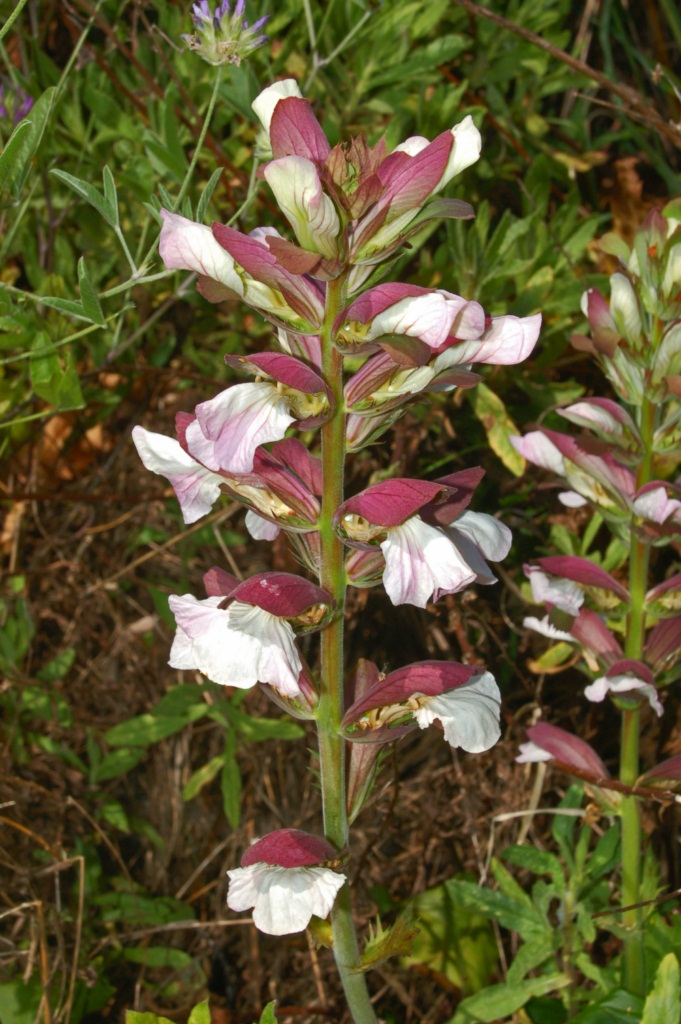 Bear's BreechAcanthus mollis
-
 Polka-dot-plantHypoestes phyllostachya
-
 Malabar NutJusticia adhatoda
-
 NerveplantFittonia albivenis
-
 Zebra-plantAphelandra squarrosa
-
 Firecracker-flowerCrossandra infundibuliformis
Compare
Questions and answers
What is the scientific name of the Hill Blepharis?
The scientific name of the Hill Blepharis is Cynarospermum asperrimum. Written with its author, the full name is Cynarospermum asperrimum (Nees) Vollesen.
Which family does the Hill Blepharis belong to?
Cynarospermum asperrimum belongs to the family Acanthaceae, in the order Lamiales and the class Magnoliopsida.
Where is the Hill Blepharis found?
Checklists and occurrence records place Cynarospermum asperrimum in 1 country: India.
What is the conservation status of the Hill Blepharis?
The IUCN Red List category recorded for Cynarospermum asperrimum is Least Concern (LC).
How long can the stems of hill blepharis grow?
Its stems can grow up to 1 meter long.[2]
Where is hill blepharis found?
It is endemic to the Western Ghats of western India and is locally common across southern Gujarat, Maharashtra, Goa, and Karnataka.[5][6]
When does hill blepharis flower?
It flowers during the monsoon and post-monsoon seasons.[8]
Which species pollinate hill blepharis?
Several butterfly species are attracted to the plant for pollination.[9]
Can hill blepharis be cultivated?
Yes. It can be cultivated in pots and gardens.[10]
Sources
Passages the profile rests on
- The species is a scrambling or trailing perennial herb with multiple branches. Source passage: “Cynarospermum asperrimum is a scrambling or trailing perennial herb, with multiple branches and stems up to 1 meter long.” — English Wikipedia
- Its stems can grow up to 1 meter long. Source passage: “stems up to 1 meter long.” — English Wikipedia
- The species grows abundantly in partly shaded and moist areas. Source passage: “It grows abundantly in partly-shaded and moist areas” — English Wikipedia
- Its recorded habitats include shrub savannas, forest edges, partly shaded roadsides, and bunds between fields. Source passage: “including shrub savannas, forest edges, partly-shaded roadsides, and bunds between fields.” — English Wikipedia
- The species is endemic to the Western Ghats of western India. Source passage: “It is a subshrub endemic to the Western Ghats of western India.” — English Wikipedia
- The species is locally common in the foothills and hill ranges of the Western Ghats across southern Gujarat, Maharashtra, Goa, and Karnataka. Source passage: “It is locally common in the foothills and hill ranges of the Western Ghats in southern Gujarat, Maharashtra, Goa, and Karnataka states.” — English Wikipedia
- The species can develop roots when its stems come into contact with soil. Source passage: “Stems can root in contact with soil.” — English Wikipedia
- The species flowers during the monsoon and post-monsoon seasons. Source passage: “It flowers during the monsoon and post-monsoon season” — English Wikipedia
- Several butterfly species are attracted to the plant for pollination. Source passage: “attracts several species of butterflies for pollination.” — English Wikipedia
- The species can be cultivated in pots and gardens. Source passage: “It is easily cultivated in pots and gardens.” — English Wikipedia
- Cynarospermum asperrimum is the only species in the genus Cynarospermum. Source passage: “It is the sole species in genus Cynarospermum.” — English Wikipedia
Data
- Catalogue of Life, 2026-10-16 XR cc by
- Global Biodiversity Information Facility CC BY 4.0
- Wikidata CC0
- GeoNames CC BY 4.0
- Wikimedia Commons per image; credit shown with each image
- Within the Catalogue of Life, this name comes from Synonymic Checklists of the Vascular Plants of the World cc by
References
- Vollesen. (1999). Kew Bull. 54(1): 172 (1999). where the name was published
This species in other databases
Page built on 28 November 2026. See how the catalog is made and all sources and licences.
Cite this page
ScientificNames.org. (2026). Cynarospermum asperrimum (Hill Blepharis). Retrieved November 28, 2026, from https://scientificnames.org/species/cynarospermum-asperrimum
“Cynarospermum asperrimum (Hill Blepharis).” ScientificNames.org, 2026, scientificnames.org/species/cynarospermum-asperrimum. Accessed 28 Nov. 2026.
ScientificNames.org. “Cynarospermum asperrimum (Hill Blepharis).” Accessed November 28, 2026. https://scientificnames.org/species/cynarospermum-asperrimum.
@misc{scientificnames_cynarospermum_asperrimum_hill_blepharis,
  author = {{ScientificNames.org}},
  title = {Cynarospermum asperrimum (Hill Blepharis)},
  year = {2026},
  url = {https://scientificnames.org/species/cynarospermum-asperrimum},
  note = {Accessed 2026-11-28}
}