Species · Fishes
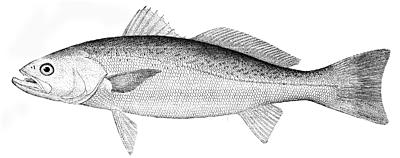
Weakfish Cynoscion regalis
The scientific name of the Weakfish is Cynoscion regalis. It is a species of fish in the family Sciaenidae (drums), order Perciformes. The name dates from 1801.
- Scientific name
- Cynoscion regalis (Bloch & Schneider, 1801)
- Common name
- Weakfish
- Genus
- Cynoscion
- Family
- Sciaenidae (Drums)
- Order
- Perciformes
- Class
- Teleostei
- Red List category
- EN Endangered
- Environment
- brackish, marine
- Recorded in
- 4 countries
- Name status
- accepted in the Catalogue of Life
Overview
Weakfish inhabit relatively shallow coastal waters with sandy mud bottoms and use brackish estuaries during summer.
Written 26 November 2026 from the sources listed below. Each statement was checked against the passage it cites; statements that could not be supported were removed.
Appearance
Weakfish can reach approximately 1 metre in length and 9 kilograms in weight. Mature fish commonly measure 12 to 18 inches, although some adults reach 3 feet in length.[1][2]
Habitat
Weakfish inhabit relatively shallow coastal waters with sandy mud bottoms. They use brackish river estuaries for reproduction and feeding during summer, and the brackish waters of Chesapeake Bay are an important spawning habitat.[3][4][5]
Diet
Weakfish consume anchovies, Atlantic menhaden, crabs, shrimp, mollusks, and large zooplankton. Their diet is dominated by anchovy-family fishes, other bony fishes, and mysids.[6][7]
Adult weakfish consume annelids, mollusks, crustaceans, and other fish. They also consume members of their own species and use vision to locate and pursue prey.[8][9][10]
Behaviour
Weakfish form schools and spend much of their time swimming together. They gather into tighter schools under stressful conditions.[11][12]
Reproduction and life cycle
During spawning season, male weakfish sonic muscles increase to three times their usual mass.[13]
Conservation
Weakfish stocks have remained depleted and have not recovered from declines that began in the late 1990s. Stock biomass reached an all-time low in 2003.[14][15]
Weakfish are assessed and managed as a single stock throughout their known range.[16]
Uses
Weakfish are commercially and recreationally fished. They are an important food and game fish for people along the Atlantic coast.[17][18]
Classification of the Weakfish
| Kingdom | Animalia |
|---|---|
| Phylum | Chordata |
| Subphylum | Vertebrata |
| Infraphylum | Gnathostomata |
| Parvphylum | Osteichthyes |
| Gigaclass | Actinopterygii |
| Superclass | Actinopteri |
| Class | Teleostei (Teleost) |
| Order | Perciformes |
| Suborder | Percoidei |
| Family | Sciaenidae (Drums) |
| Genus | Cynoscion (Sea Trout) |
| Species | Cynoscion regalis (Bloch & Schneider, 1801) |
Where the Weakfish is found
Checklists and occurrence records place Cynoscion regalis in 4 countries. GBIF holds 5,989 georeferenced records of it.
Countries
Regions and cities with the most records
- Virginia Beach, United States 158
- East Hampton, United States 133
- Long Beach, United States 129
- Freeport, United States 122
- Merrick, United States 122
- Bellmore, United States 114
- Seaford, United States 114
- Baldwin, United States 111
- East Massapequa, United States 110
- Massapequa, United States 110
- Wantagh, United States 107
- Hampton, United States 105
- Massapequa Park, United States 104
- Oceanside, United States 104
- Roosevelt, United States 102
- Atlantic City, United States 101
- Copiague, United States 99
- Rockville Centre, United States 96
- Lindenhurst, United States 95
- Long Branch, United States 95
- North Bellmore, United States 95
- Woodmere, United States 95
- Asbury Park, United States 89
- Florida, United States 87
- Lynbrook, United States 87
- North Massapequa, United States 85
- North Amityville, United States 84
- West Islip, United States 82
- South Carolina, United States 79
- Point Pleasant, United States 77
- Uniondale, United States 77
- Pleasantville, United States 76
- Tinton Falls, United States 76
- Valley Stream, United States 76
- North Babylon, United States 75
- West Babylon, United States 73
2 more countries have a few records outside this range
These countries hold a few records of Cynoscion regalis but lie outside the range the checklists give for it. Such records are often zoo or garden specimens, museum material or vagrants, so the species is not counted as occurring there.
A number beside a place is its count of GBIF occurrence records. A place without a number comes from a checklist alone. Records show where a species has been observed or collected, which can include escapes and vagrants.
Common names
English
- Weakfish
- Bastard Trout
- Bastard Weakfish
- Chickwick
- Common Weakfish
- Gray Sea Trout
- Gray Squwteague
- Gray Weakfish
- Grey Trout
- Grey Weakfish
- Saltwater Trout
- Sandtrout
- Shecutts
- Silver Seatrout
- Silver Squeteague
- Silver Weakfish
- Squit
- Croaker
- Drum
- Gray Trout
- Sea Trout
- Squeteague
Names in 13 other languages
- Arabic
- سمك ضعيف ملكي
- Chinese
- 斜紋犬牙石首魚, 犬牙石首魚
- Czech
- smuha západoatlantská
- Danish
- Kongetrommefisk
- Finnish
- Veltto
- French
- acoupa royal
- Norwegian Bokmål
- Havgjørs
- Polish
- Kulbiniec szary
- Portuguese
- Corvinata-real, Pescada-amarela
- Russian
- Королевский горбыль, Серый горбыль, окунь черный каменный
- Spanish
- Corvinata Real
- Swedish
- Havsgös, Vekfisk
- srn
- Wittiewittie
Synonyms
7 other scientific names have been used for this species and are now treated as synonyms of Cynoscion regalis.
- Cestreus carolinensis Gronow, 1854
- Cynoscion regalis regalis (Bloch & Schneider, 1801)
- Johnius regalis Bloch & Schneider, 1801
- Labrus squeteague Mitchill, 1815
- Otolithus obliquatus Cuvier & Valenciennes, 1879
- Otolithus thalassinus Holbrook, 1855
- Roccus comes Mitchill, 1814
Related species
-
 Spotted SeatroutCynoscion nebulosus
-
 Sand SeatroutCynoscion arenarius
-
 Acoupa WeakfishCynoscion acoupa
-
 Silver SeatroutCynoscion nothus
-
 Striped WeakfishCynoscion striatus
- Jamaica WeakfishCynoscion jamaicensis
- Smallscale WeakfishCynoscion microlepidotus
- SalmonCynoscion virescens
Compare
Questions and answers
What is the scientific name of the Weakfish?
The scientific name of the Weakfish is Cynoscion regalis. Written with its author, the full name is Cynoscion regalis (Bloch & Schneider, 1801).
Which family does the Weakfish belong to?
Cynoscion regalis belongs to the family Sciaenidae, in the order Perciformes and the class Teleostei.
Where is the Weakfish found?
Checklists and occurrence records place Cynoscion regalis in 4 countries: United States, Canada, Martinique and Mexico.
What is the conservation status of the Weakfish?
The IUCN Red List category recorded for Cynoscion regalis is Endangered (EN).
What other names does the Weakfish have?
Cynoscion regalis is also known in English as Bastard Trout, Bastard Weakfish, Chickwick, Common Weakfish, Gray Sea Trout and Gray Squwteague.
Why is it called a weakfish?
The common name weakfish refers to the weakness of its mouth muscles, which can allow hooks to tear free.[19]
What do weakfish eat?
Weakfish eat anchovies, Atlantic menhaden, other bony fishes, mysids, crabs, shrimp, mollusks, and large zooplankton. Their diet also includes annelids and members of their own species.[6][7][8][9]
Why are weakfish called weakfish?
Their name refers to the weakness of their mouth muscles, which can allow hooks to tear free.[19]
Sources
Passages the profile rests on
- Weakfish can reach approximately 1 metre in length and 9 kilograms in weight. Source passage: “The weakfish grows to 1 m (3.3 ft) in length and 9 kg (20 lb) in weight.” — English Wikipedia
- Mature weakfish commonly measure 12 to 18 inches, although some adults reach 3 feet in length. Source passage: “Ranging from 12-18 inches once fully matured, with some adults reaching well above this range at up to 3 feet and 18 lbs.” — English Wikipedia
- Weakfish inhabit relatively shallow coastal waters with sandy mud bottoms. Source passage: “They migrate seasonally in the relatively shallow coastal water of sandy mud bottoms” — animaldiversity.org
- Weakfish use brackish river estuaries for reproduction and feeding during summer. Source passage: “and then to the brackish water of river estuaries for reproduction and feeding in the summer” — animaldiversity.org
- The brackish waters of Chesapeake Bay are an important spawning habitat for weakfish. Source passage: “During the spawning season, the most important habitat for the weakfish is the brackish waters of the Chesapeake Bay” — animaldiversity.org
- Weakfish consume anchovies, Atlantic menhaden, crabs, shrimp, mollusks, and large zooplankton. Source passage: “small schooling fish like anchovies and Atlantic Menhaden, assorted crabs, shrimp, mollusks, and even large zooplankton.” — English Wikipedia
- The diet of weakfish is dominated by anchovy-family fishes, other bony fishes, and mysids. Source passage: “diet composition was mostly dominated by Engraulidae, Osteichthyes (bony fishes), and Mysidacea” — pmc.ncbi.nlm.nih.gov
- Weakfish also consume members of their own species. Source passage: “Highly opportunistic feeders, weakfish cannibalism also played an essential part of their diet.” — pmc.ncbi.nlm.nih.gov
- Adult weakfish consume annelids, mollusks, crustaceans, and other fish. Source passage: “An adult weakfish eats a variety of species, including annelids, mollusks, crustaceans, and other fish” — animaldiversity.org
- Weakfish are visually oriented when locating and pursuing prey. Source passage: “Weakfish are visually oriented animals when it comes to feeding and seeking after prey” — animaldiversity.org
- Weakfish form schools and spend much of their time swimming together. Source passage: “Cynoscion regalis are schooling fish, meaning that they spend a large majority of their time swimming together” — English Wikipedia
- Weakfish gather into tighter schools under stressful conditions. Source passage: “In times of stress, weakfish gather into tighter schools.” — animaldiversity.org
- Male weakfish sonic muscles increase to three times their usual mass during spawning season. Source passage: “the male's sonic muscles, which are used in producing 'drumming' and 'croaking' sounds, increases three times its usual mass during spawning season” — animaldiversity.org
- Weakfish stocks have remained depleted and have not recovered from declines that began in the late 1990s. Source passage: “Current stock biomass remains low and has not recovered from declines in the late 1990s” — pmc.ncbi.nlm.nih.gov
- Weakfish stock biomass reached an all-time low in 2003. Source passage: “reaching an all‐time low in 2003.” — pmc.ncbi.nlm.nih.gov
- Weakfish are assessed and managed as a single stock throughout their known range. Source passage: “weakfish are assessed and managed as a single stock across their known range” — pmc.ncbi.nlm.nih.gov
- Weakfish are commercially and recreationally fished. Source passage: “where it is fished both commercially and recreationally.” — English Wikipedia
- Weakfish are an important food and game fish for people along the Atlantic coast. Source passage: “Weakfish are important food and gamefish for people along the Atlantic coast.” — animaldiversity.org
- The common name weakfish refers to the weakness of the fish's mouth muscles, which can allow hooks to tear free. Source passage: “The origin of its name is based on the weakness of the mouth muscles, which often cause a hook to tear free” — English Wikipedia
Data
- Catalogue of Life, 2026-10-16 XR cc by
- Global Biodiversity Information Facility CC BY 4.0
- Wikidata CC0
- GeoNames CC BY 4.0
- Wikimedia Commons per image; credit shown with each image
- Within the Catalogue of Life, this name comes from World Register of Marine Species cc by
This species in other databases
- Catalogue of Life 6BVN8
- Wikidata Q136887
- iNaturalist 154500
- WoRMS urn:lsid:marinespecies.org:taxname:159313
- ITIS 169241
Page built on 27 November 2026. See how the catalog is made and all sources and licences.
Cite this page
ScientificNames.org. (2026). Cynoscion regalis (Weakfish). Retrieved November 27, 2026, from https://scientificnames.org/species/cynoscion-regalis
“Cynoscion regalis (Weakfish).” ScientificNames.org, 2026, scientificnames.org/species/cynoscion-regalis. Accessed 27 Nov. 2026.
ScientificNames.org. “Cynoscion regalis (Weakfish).” Accessed November 27, 2026. https://scientificnames.org/species/cynoscion-regalis.
@misc{scientificnames_cynoscion_regalis_weakfish,
  author = {{ScientificNames.org}},
  title = {Cynoscion regalis (Weakfish)},
  year = {2026},
  url = {https://scientificnames.org/species/cynoscion-regalis},
  note = {Accessed 2026-11-27}
}