Species · Reptiles
Marbled Bow-fingered Gecko Cyrtodactylus marmoratus
The scientific name of the Marbled Bow-fingered Gecko is Cyrtodactylus marmoratus. It is a species of reptile in the family Gekkonidae (geckos), order Squamata. The name dates from 1831.
- Scientific name
- Cyrtodactylus marmoratus Gray, 1831
- Common name
- Marbled Bow-fingered Gecko
- Genus
- Cyrtodactylus
- Family
- Gekkonidae (Geckos)
- Order
- Squamata
- Class
- Reptilia
- Red List category
- LC Least Concern
- Recorded in
- 2 countries
- Name status
- accepted in the Catalogue of Life
Overview
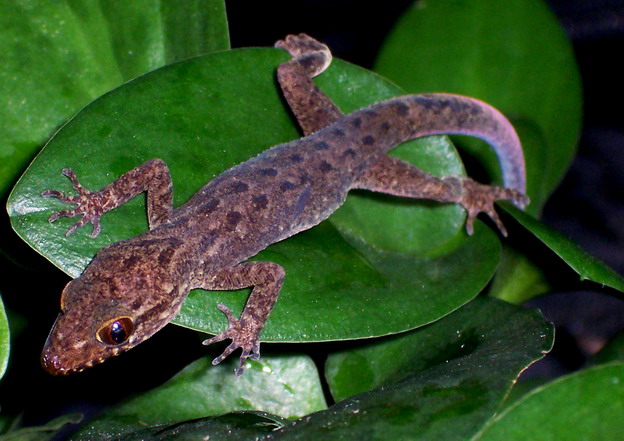
The Marbled Bow-fingered Gecko is a species in the genus Cyrtodactylus. It is recorded from Southeast Asia and occurs in Thailand, Indonesia, including Java, Sulawesi and Halmahera, and Papua New Guinea. It has a light brown upper body with dark brown spots, irregular dark head markings and dark brown annular markings on the tail.
Written 27 November 2026 from the sources listed below. Each statement was checked against the passage it cites; statements that could not be supported were removed.
Appearance
The species has a large, depressed head with a pointed snout. The head is covered with granular scales and has small tubercles on the occiput and temples.[1][2]
The body is elongated and covered with small granules and rounded, weakly keeled tubercles. The belly has small, smooth, overlapping, cycloid scales.[3][4]
The upper body is light brown with dark brown spots that sometimes form crossbands. The head has irregular dark markings and a dark temporal streak.[5][6]
The tail is rounded, tapering and covered with small, flat scales. It has dark brown annular markings.[7][8]
The underside is yellowish-white, with dark brown punctuations on each scale. There are 40 to 45 ventral scales across the middle of the belly.[9][10]
The limbs are elongated, and the digits are strong and slightly depressed at their bases. The head and body together measure 76 mm in length.[11][12]
The male has 12 or 13 preanal pores arranged in an inverted-V series. It also has four to six femoral pores on each thigh.[13][14]
Habitat
The species is recorded from Southeast Asia. It occurs in Thailand, Indonesia, including Java, Sulawesi and Halmahera, and Papua New Guinea.[15][16][17][18]
Classification of the Marbled Bow-fingered Gecko
| Kingdom | Animalia |
|---|---|
| Phylum | Chordata |
| Subphylum | Vertebrata |
| Infraphylum | Gnathostomata |
| Parvphylum | Osteichthyes |
| Megaclass | Tetrapoda |
| Class | Reptilia (Reptile) |
| Order | Squamata (Snakes) |
| Suborder | Gekkota |
| Family | Gekkonidae (Geckos) |
| Genus | Cyrtodactylus (Curve-toed Geckos) |
| Species | Cyrtodactylus marmoratus Gray, 1831 |
Where the Marbled Bow-fingered Gecko is found
Checklists and occurrence records place Cyrtodactylus marmoratus in 2 countries. GBIF holds 535 georeferenced records of it.
Countries
Regions and cities with the most records
- Bogor, Indonesia 147
- Ciampea, Indonesia 137
- Caringin, Indonesia 111
- Cibinong, Indonesia 105
- Citeureup, Indonesia 98
- Parung, Indonesia 83
- Sawangan, Indonesia 78
- Cicurug, Indonesia 54
- Depok, Indonesia 46
- Yogyakarta, Indonesia 44
- Sleman, Indonesia 31
- Candi Prambanan, Indonesia 30
- Jogonalan, Indonesia 30
- Melati, Indonesia 30
- Muntilan, Indonesia 30
- Depok, Indonesia 29
- Ambarawa, Indonesia 27
- Kebonarun, Indonesia 25
- Ungaran, Indonesia 25
- Boyolali, Indonesia 23
- Godean, Indonesia 19
- Cileungsir, Indonesia 18
- Bandung, Indonesia 17
- Tasikmalaya, Indonesia 16
- Rajapolah, Indonesia 15
- Baturaden, Indonesia 14
- Purwokerto, Indonesia 14
- Cileunyi, Indonesia 13
- Lembang, Indonesia 13
- Padalarang, Indonesia 13
- Sokaraja, Indonesia 13
- Cimahi, Indonesia 12
- Leuwiliang, Indonesia 12
- Margahayukencana, Indonesia 12
- Soreang, Indonesia 12
- Pameungpeuk, Indonesia 11
Range as the checklists state it
Indonesia (Java, Halmahera, Soah, Konorah) [Cyrtodactylus fumosus]
A number beside a place is its count of GBIF occurrence records. A place without a number comes from a checklist alone. Records show where a species has been observed or collected, which can include escapes and vagrants.
Common names
English
- Marbled Bow-fingered Gecko
- Clouded Bent-Toed Gecko
Synonyms
4 other scientific names have been used for this species and are now treated as synonyms of Cyrtodactylus marmoratus.
- Goniodactylus marmoratus Kuhl ex Schlegel, 1826
- Gonyodactylus marmoratus Gray ex Griffith & Pidgeon, 1831
- Gymnodactylus marmoratus var. quadrilineatus Werner, 1896
- Phyllurus marmoratus Boie ex Fitzinger, 1826
Related species
- Gunung Senyum Bent-toed GeckoCyrtodactylus gunungsenyumensis
- Jaipore Bent-toed GeckoCyrtodactylus jeyporensis
- Pecelmadiun’s Bent-toed GeckoCyrtodactylus pecelmadiun
- Gordon's Bow-fingered GeckoCyrtodactylus gordongekkoi
-
 Peters' Bow-fingered GeckoCyrtodactylus consobrinus
- Latpanchar Bent-toed GeckoCyrtodactylus nebulicola
-
 Giri's GeckoellaCyrtodactylus varadgirii
-
 Marbled Bent-toed GeckoCyrtodactylus quadrivirgatus
Compare
Questions and answers
What is the scientific name of the Marbled Bow-fingered Gecko?
The scientific name of the Marbled Bow-fingered Gecko is Cyrtodactylus marmoratus. Written with its author, the full name is Cyrtodactylus marmoratus Gray, 1831.
Which family does the Marbled Bow-fingered Gecko belong to?
Cyrtodactylus marmoratus belongs to the family Gekkonidae, in the order Squamata and the class Reptilia.
Where is the Marbled Bow-fingered Gecko found?
Checklists and occurrence records place Cyrtodactylus marmoratus in 2 countries: Indonesia and Malaysia.
What is the conservation status of the Marbled Bow-fingered Gecko?
The IUCN Red List category recorded for Cyrtodactylus marmoratus is Least Concern (LC).
What other names does the Marbled Bow-fingered Gecko have?
Cyrtodactylus marmoratus is also known in English as Clouded Bent-Toed Gecko.
Sources
Passages the profile rests on
- The species has a large, depressed head with a pointed snout. Source passage: “Head large, depressed; snout pointed” — English Wikipedia
- The head is covered with granular scales and has small tubercles on the occiput and temples. Source passage: “Head granular, with small tubercles on the occiput and temples” — English Wikipedia
- The body is elongated and covered with small granules and rounded, weakly keeled tubercles. Source passage: “Body elongate, covered above with small granules, intermixed with small, round, feebly keeled, subtrihedral tubercles.” — English Wikipedia
- The belly has small, smooth, overlapping, cycloid scales. Source passage: “Ventral scales small, smooth, cycloid, imbricate” — English Wikipedia
- The upper body is light brown with dark brown spots that sometimes form crossbands. Source passage: “Light brown above, with spots of dark brown along the back, sometimes forming cross bands.” — English Wikipedia
- The head has irregular dark markings and a dark temporal streak. Source passage: “Head with irregular dark markings; a dark temporal streak.” — English Wikipedia
- The tail is rounded, tapering and covered with small, flat scales. Source passage: “Tail round, tapering, covered with uniform small, flat scales” — English Wikipedia
- The tail has dark brown annular markings. Source passage: “Tail with dark brown annuli.” — English Wikipedia
- The underside is yellowish-white, with dark brown punctuations on each scale. Source passage: “Lower surface yellowish-white, each scale punctulated with dark brown.” — English Wikipedia
- There are 40 to 45 ventral scales across the middle of the belly. Source passage: “40—45 across the middle of the belly.” — English Wikipedia
- The limbs are elongated and the digits are strong and slightly depressed at their bases. Source passage: “Limbs elongate; digits strong, slightly depressed at the base” — English Wikipedia
- The head and body together measure 76 mm in length. Source passage: “Length of head and body 76 mm.” — English Wikipedia
- The male has 12 or 13 preanal pores arranged in an inverted-V series. Source passage: “Male with 12 or 13 preanal pores in an angular series, an inverted-V-shaped” — English Wikipedia
- The male has four to six femoral pores on each thigh. Source passage: “and 4—6 femoral pores, separated from the former, on each thigh.” — English Wikipedia
- The species is recorded from Southeast Asia. Source passage: “The marbled bow-fingered gecko (Cyrtodactylus marmoratus) is a species of gecko found in Southeast Asia.” — English Wikipedia
- The species occurs in Thailand. Source passage: “It is found in Thailand” — English Wikipedia
- The species occurs in Indonesia, including Java, Sulawesi and Halmahera. Source passage: “Indonesian (Java, Sulawesi, Halmahera)” — English Wikipedia
- The species occurs in Papua New Guinea. Source passage: “and Papua New Guinea.” — English Wikipedia
Data
- Catalogue of Life, 2026-10-16 XR cc by
- Global Biodiversity Information Facility CC BY 4.0
- Wikidata CC0
- GeoNames CC BY 4.0
- Wikimedia Commons per image; credit shown with each image
- Within the Catalogue of Life, this name comes from The Reptile Database cc by
References
- Schlegel, H. (1826). Notice sur l’Erpétologie de l’île de Java; Par M. Boïé. Bulletin Des Sciences Naturelles et de Géologie, 9: 233-240.
- Gray, J. E. (1831). A synopsis of the species of Class Reptilia. In: Griffith, E & E. Pidgeon: The animal kingdom arranged in conformity with its organisation by the Baron Cuvier with additional descriptions of all the species hither named, and of many before noticed [Vol. 9]. Whittaker, Treacher and Co., London: 481 + 110 Pp. [1830].
- Duméril, A.M. C. and G. Bibron. (1836). Erpetologie Générale ou Histoire Naturelle Complete des Reptiles. Vol. 3. Libr. Encyclopédique Roret, Paris, 528 Pp.
- Bleeker, P. (1860). Reptilien van Agam. Natuurkundig Tijdschrift Voor Nederlandsch Indie, Batavia, 20: 325-329.
- Boulenger, G. A. (1885). Catalogue of the lizards in the British Museum (Nat. Hist.) I. Geckonidae, Eublepharidae, Uroplatidae, Pygopodidae, Agamidae. London: 450 Pp.
- Boulenger, G. A. (1887). Note on some reptiles from Sumatra described by BLEEKER in 1860. Ann. Mag. Nat. Hist. (5) 20: 152.
- Strauch, A. A. (1887). Bemerkungen über die Geckoniden-Sammlung im zoologischen Museum der kaiserlichen Akademie der Wissenschaften zu St. Petersburg. Mém. Acad. Impér. Sci. St.-Pétersbourg, Ser. 7, 35 (2): 1-72.
- Müller, F. (1895). Reptilien und Amphibien aus Celebes. (II. Bericht). Verh. Naturf. Ges. Basel 10: 862-869.
- Werner, F. (1896). Zweiter Beitrag zur Herpetologie der indo-orientalischen Region. Verh. Zool. Bot. Ges. Wien 46: 6-24.
- de Rooij, & de, N. (1915). The Reptiles of the Indo-Australian Archipelago. I. Lacertilia, Chelonia, Emydosauria. Leiden (E. J. Brill), Xiv + 384 Pp.
- Mertens, R. (1930). Die Amphibien und Reptilien der Inseln Bali, Lombok, Sumbawa und Flores. Senck. Naturf. Gesell., Frankfurt Am Main, Abhandl. 42(3): 117-344.
- Kopstein, F. (1938). Ein Beitrag zur Eierkunde und zur Fortpflanzung der Malaiischen Reptilien. Bull. Raffles Mus. No 14: 81-167.
- Gibson-Hill, C. A. (1947). The terrestrial reptiles [of the Christmas Islands]. Bull. Raffles Mus. No 18: 81-86.
- Taylor, E. H. (1963). The lizards of Thailand. Univ. Kansas Sci. Bull. 44: 687-1077.
- Grandison, A. G. C. (1972). The Gunong Benom Expedition 1967. 5. Reptiles and amphibians of Gunong Benom with a description of a new species of Macrocalamus. Bull. Br. Mus. Nat. Hist. (Zool.), London, 23: 45-101.
- Dring J C M. (1979). Amphibians and reptiles from northern Trengganu, Malaysia, with descriptions of two new geckos: Cnemaspis and Cyrtodactylus. Bulletin of the British Museum (NATURAL HISTORY) ZOOLOGY 34 (5): 181-241.
- Kluge, A. G. (1985). Notes on the geckko nomenclature (Sauria: Gekkonidae). Zoologische Mededelingen 59 (10): 95-100.
- Manthey, U., & Grossmann, W. (1997). Amphibien & Reptilien Südostasiens. Natur Und Tier Verlag (Münster), 512 Pp. (ISBN 3-931587-12-6).
- Rösler, H. (2000). Die postanale Beschuppung bei Cyrtodactylus GRAY 1827 und Cyrtopodion FITZINGER 1843 - funktionelle und taxonomische Aspekte (Sauria: Gekkonidae). Gekkota 2: 154-207.
- Rösler, H. (2000). Kommentierte Liste der rezent, subrezent und fossil bekannten Geckotaxa (Reptilia: Gekkonomorpha). Gekkota 2: 28-153.
- Günther, R. & H. Rösler. (2002). Eine neue Art der Gattung Cyrtodactylus GRAY, 1827 aus dem Westen von Neuguinea (Reptilia: Sauria: Gekkonidae). Salamandra 38 (4): 195-212.
- Grismer L. Lee. (2005). New species of Bent-toed Gecko (Cyrtodactylus Gray 1827) from Pulau Aur, Johor, West Malaysia. Journal of Herpetology 39 (3):424-432.
- Grismer L. Lee & Leong, T.M. (2005). New Species of Cyrtodactylus (Squamata: Gekkonidae) from Southern Peninsular Malaysia. Journal of Herpetology 39 (4): 584-591.
- Youmans, Timothy M. & L. Lee Grismer. (2006). A new species of Cyrtodactylus (Reptilia: Squamata: Gekkonidae) from the Seribuat Archipelago, West Malaysia. Herpetological Natural History 10 (1): 61-70.
- Grismer, L.L.; Wood, P.L. & Youmans, T.M. (2007). Redescription of the gekkonid lizard Cyrtodactylus sworderi (SMITH 1925) from Southern Peninsular Malaysia. Hamadryad 31 (2): 250-257.
This species in other databases
Page built on 27 November 2026. See how the catalog is made and all sources and licences.
Cite this page
ScientificNames.org. (2026). Cyrtodactylus marmoratus (Marbled Bow-fingered Gecko). Retrieved November 27, 2026, from https://scientificnames.org/species/cyrtodactylus-marmoratus
“Cyrtodactylus marmoratus (Marbled Bow-fingered Gecko).” ScientificNames.org, 2026, scientificnames.org/species/cyrtodactylus-marmoratus. Accessed 27 Nov. 2026.
ScientificNames.org. “Cyrtodactylus marmoratus (Marbled Bow-fingered Gecko).” Accessed November 27, 2026. https://scientificnames.org/species/cyrtodactylus-marmoratus.
@misc{scientificnames_cyrtodactylus_marmoratus_marbled_bow_fingered_gecko,
  author = {{ScientificNames.org}},
  title = {Cyrtodactylus marmoratus (Marbled Bow-fingered Gecko)},
  year = {2026},
  url = {https://scientificnames.org/species/cyrtodactylus-marmoratus},
  note = {Accessed 2026-11-27}
}