Species · Fishes
Pearl Danio Danio albolineatus
The scientific name of the Pearl Danio is Danio albolineatus. It is a species of fish in the family Cyprinidae (carps), order Cypriniformes. The name dates from 1860.
- Scientific name
- Danio albolineatus (Blyth, 1860)
- Common name
- Pearl Danio
- Genus
- Danio
- Family
- Cyprinidae (Carps)
- Order
- Cypriniformes
- Class
- Teleostei
- Red List category
- LC Least Concern
- Environment
- freshwater
- Recorded in
- 7 countries
- Name status
- accepted in the Catalogue of Life

Overview
Danio albolineatus inhabits the surface waters of small, clear rivers and hill streams in tropical freshwater environments. It has an iridescent appearance and two light-coloured stripes that may be yellow, white, blue or red.
Written 26 November 2026 from the sources listed below. Each statement was checked against the passage it cites; statements that could not be supported were removed.
Appearance
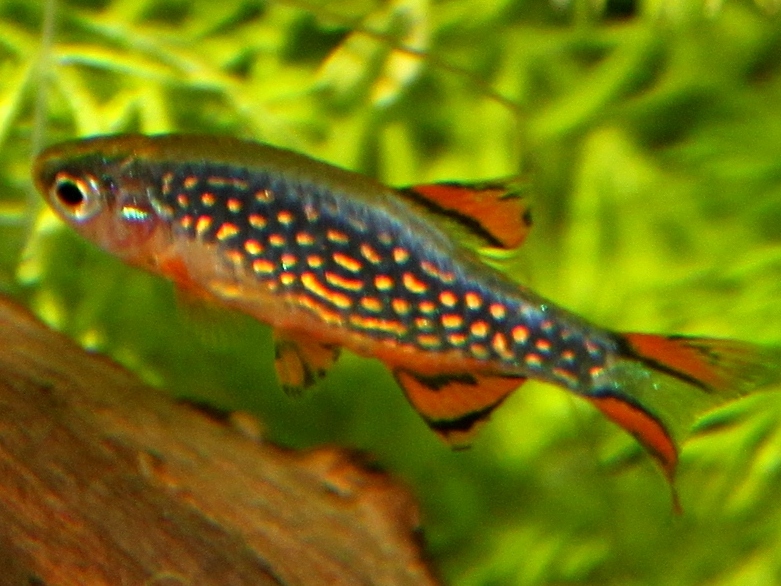
The Pearl Danio can have a brownish-yellow, pink or silver body. It has two light-coloured stripes that may be yellow, white, blue or red, giving it an iridescent appearance.[1][2][3]
Female Pearl Danios have two pairs of barbels. Golden varieties sold in shops are semi-albino Pearl Danios.[4][5]
The Pearl Danio reaches a maximum length of 6.6 cm.[6]
Habitat
The Pearl Danio inhabits the surface waters of small, clear rivers and hill streams in tropical freshwater environments. Its reported habitat temperature range is 20–25 °C, and its reported water hardness range is 5–19 dGH.[7][8][9][10]
The Pearl Danio is reported from Sumatra, Myanmar, Thailand and Phu Quoc Island in Vietnam.[11]
Diet
The Pearl Danio feeds mainly on insects and zooplankton.[12]
Similar species
The blue-redstripe danio was formerly considered synonymous with the Pearl Danio but is recognised as a distinct species. The Kedah danio was also formerly considered synonymous with the Pearl Danio but is recognised as a distinct species.[13][14]
Reproduction and life cycle
The Pearl Danio reproduces by laying eggs.[15]
Uses
The Pearl Danio is sometimes kept in aquariums by fish-keeping hobbyists.[16]
Classification of the Pearl Danio
| Kingdom | Animalia |
|---|---|
| Phylum | Chordata |
| Subphylum | Vertebrata |
| Infraphylum | Gnathostomata |
| Parvphylum | Osteichthyes |
| Gigaclass | Actinopterygii |
| Superclass | Actinopteri |
| Class | Teleostei (Teleost) |
| Order | Cypriniformes |
| Family | Cyprinidae (Carps) |
| Subfamily | Danioninae |
| Genus | Danio (Danios) |
| Species | Danio albolineatus (Blyth, 1860) |
Where the Pearl Danio is found
Checklists and occurrence records place Danio albolineatus in 7 countries. GBIF holds 343 georeferenced records of it.
Countries
Regions and cities with the most records
- Siem Reap, Cambodia 25
- Chin State, Myanmar 21
- Kalemyo, Myanmar 19
- Trat, Thailand 17
- Ang Mo Kio New Town, Singapore 15
- Eunos, Singapore 15
- MacPherson, Singapore 15
- Marine Parade, Singapore 15
- Novena, Singapore 15
- Ulu Bedok, Singapore 15
- Anak Bukit, Singapore 14
- Bandar Seri Alam, Malaysia 14
- Boon Lay, Singapore 14
- Bukit Panjang New Town, Singapore 14
- Bukit Timah, Singapore 14
- Choa Chu Kang New Town, Singapore 14
- Johor Bahru, Malaysia 14
- Jurong East, Singapore 14
- Jurong Town, Singapore 14
- Jurong West, Singapore 14
- Kampong Pasir Ris, Singapore 14
- Kampung Pasir Gudang Baru, Malaysia 14
- Keat Hong Village, Singapore 14
- Marsiling, Singapore 14
- Masai, Malaysia 14
- Matilda Estate, Singapore 14
- Pasir Gudang, Malaysia 14
- Punggol, Singapore 14
- Queenstown Estate, Singapore 14
- Sembawang Estate, Singapore 14
- Sengkang New Town, Singapore 14
- Singapore, Singapore 14
- Sungai Simpang, Singapore 14
- Taman Permas Jaya, Malaysia 14
- Teck Whye, Singapore 14
- Woodlands, Singapore 14
1 more country has a few records outside this range
These countries hold a few records of Danio albolineatus but lie outside the range the checklists give for it. Such records are often zoo or garden specimens, museum material or vagrants, so the species is not counted as occurring there.
A number beside a place is its count of GBIF occurrence records. A place without a number comes from a checklist alone. Records show where a species has been observed or collected, which can include escapes and vagrants.
Common names
English
- Pearl Danio
Names in 5 other languages
- Czech
- dánio duhové
- Japanese
- シロガネハヤモドキ, パールダニオ
- Portuguese
- Danio-pérola
- Russian
- Жемчужный Данио, Розовый данио
- Thai
- ปลาซิวใบไผ่เล็ก
Synonyms
10 other scientific names have been used for this species and are now treated as synonyms of Danio albolineatus.
- Brachydanio albolineata Herre, 1940
- Brachydanio albolineata (Blyth, 1860)
- Brachydanio albolineatus (Blyth, 1860)
- Branchydanio albolineatus (Blyth, 1860)
- Danio albolineata (Blyth, 1860)
- Danio pulcher Smith, 1931
- Danio stoliczkae Day, 1870
- Danio tweedei Brittan, 1956
- Danio tweediei Brittan, 1956
- Nuria albolineata Blyth, 1860
Related species
- ZebrafishDanio rerio
-
 Celestial Pearl DanioDanio margaritatus
-
 Glowlight DanioDanio choprae
- Emerald Dwarf DanioDanio erythromicron
-
 Gold Ring DanioDanio tinwini
-
 Redfin DanioDanio kyathit
-
 Blue DanioDanio kerri
-
 Moustached DanioDanio dangila
Compare
Questions and answers
What is the scientific name of the Pearl Danio?
The scientific name of the Pearl Danio is Danio albolineatus. Written with its author, the full name is Danio albolineatus (Blyth, 1860).
Which family does the Pearl Danio belong to?
Danio albolineatus belongs to the family Cyprinidae, in the order Cypriniformes and the class Teleostei.
Where is the Pearl Danio found?
Checklists and occurrence records place Danio albolineatus in 7 countries, including Thailand, Myanmar, Cambodia, Indonesia, Malaysia and Singapore.
What is the conservation status of the Pearl Danio?
The IUCN Red List category recorded for Danio albolineatus is Least Concern (LC).
How long do Pearl Danios live?
The Pearl Danio has a reported lifespan of approximately five years.[17]
What does pearl danio eat?
The Pearl Danio feeds mainly on insects and zooplankton.[12]
Sources
Passages the profile rests on
- The pearl danio can have a brownish-yellow, pink, or silver body. Source passage: “The fish could have a brownish-yellow, pink, or a silver body” — English Wikipedia
- The pearl danio has two light-coloured stripes that may be yellow, white, blue, or red. Source passage: “two light yellow/white or blue/red stripes” — English Wikipedia
- The pearl danio has an iridescent appearance. Source passage: “It has an iridescent look.” — English Wikipedia
- Female pearl danios have two pairs of barbels. Source passage: “The female fish has two pairs of barbels.” — English Wikipedia
- Golden varieties sold in shops are semi-albino pearl danios. Source passage: “Golden varieties are often seen in shops; these are in reality semi-albino fish.” — English Wikipedia
- The pearl danio reaches a maximum length of 6.6 cm. Source passage: “It grows to a maximum length of 2.6 inches (6.6 cm)” — English Wikipedia
- The pearl danio inhabits the surface waters of small, clear rivers and hill streams. Source passage: “In the wild, the pearl danio is found in along the surface of small, clear rivers and hill streams.” — English Wikipedia
- The pearl danio occurs in tropical freshwater environments. Source passage: “The pearl danio (Danio albolineatus) is a tropical, freshwater ray-finned fish” — English Wikipedia
- The reported water temperature range for the pearl danio is 20–25 °C. Source passage: “a temperature range of 68–77 °F (20–25 °C).” — English Wikipedia
- The reported water hardness range for pearl danio habitat is 5–19 dGH. Source passage: “a water hardness of up to 5 – 19 dGH” — English Wikipedia
- The pearl danio is reported from Sumatra, Myanmar, Thailand, and Phu Quoc Island in Vietnam. Source passage: “Originating in Sumatra, Myanmar, and Thailand and Vietnam (Phu Quoc Island)” — English Wikipedia
- The pearl danio feeds mainly on insects and zooplankton. Source passage: “Their diet consists mostly of exogenous insects and zooplankton.” — English Wikipedia
- The blue-redstripe danio was formerly considered synonymous with the pearl danio but is recognised as a distinct species. Source passage: “The blue-redstripe danio (D. pulcher) and the Kedah danio (D. tweediei) were considered synonymous with this species, but Eschmeyer's Catalog of Fishes recognises them as valid, distinct species.” — English Wikipedia
- The Kedah danio was formerly considered synonymous with the pearl danio but is recognised as a distinct species. Source passage: “The blue-redstripe danio (D. pulcher) and the Kedah danio (D. tweediei) were considered synonymous with this species, but Eschmeyer's Catalog of Fishes recognises them as valid, distinct species.” — English Wikipedia
- The pearl danio reproduces by laying eggs. Source passage: “The pearl danio is an egglayer.” — English Wikipedia
- The pearl danio is sometimes kept in aquariums by fish-keeping hobbyists. Source passage: “this fish is sometimes found in aquariums by fish-keeping hobbyists.” — English Wikipedia
- The pearl danio has a reported lifespan of approximately five years. Source passage: “lives for around five years.” — English Wikipedia
Data
- Catalogue of Life, 2026-10-16 XR cc by
- Global Biodiversity Information Facility CC BY 4.0
- Wikidata CC0
- GeoNames CC BY 4.0
- Wikimedia Commons per image; credit shown with each image
- Within the Catalogue of Life, this name comes from World Register of Marine Species cc by
This species in other databases
- Catalogue of Life 343ZF
- Wikidata Q924585
- iNaturalist 187319
- WoRMS urn:lsid:marinespecies.org:taxname:1013988
- ITIS 640161
Page built on 26 November 2026. See how the catalog is made and all sources and licences.
Cite this page
ScientificNames.org. (2026). Danio albolineatus (Pearl Danio). Retrieved November 26, 2026, from https://scientificnames.org/species/danio-albolineatus
“Danio albolineatus (Pearl Danio).” ScientificNames.org, 2026, scientificnames.org/species/danio-albolineatus. Accessed 26 Nov. 2026.
ScientificNames.org. “Danio albolineatus (Pearl Danio).” Accessed November 26, 2026. https://scientificnames.org/species/danio-albolineatus.
@misc{scientificnames_danio_albolineatus_pearl_danio,
  author = {{ScientificNames.org}},
  title = {Danio albolineatus (Pearl Danio)},
  year = {2026},
  url = {https://scientificnames.org/species/danio-albolineatus},
  note = {Accessed 2026-11-26}
}