Species · Molluscs
Darbya lira
Darbya lira has no English name on record in the checklists used here. It is a species of mollusc in the family Borsoniidae, order Neogastropoda. The name dates from 1934.
- Scientific name
- Darbya lira Bartsch, 1934
- Genus
- Darbya
- Family
- Borsoniidae
- Order
- Neogastropoda
- Class
- Gastropoda
- Environment
- marine
- Recorded in
- 2 countries
- Name status
- accepted in the Catalogue of Life

Overview
The species occurs in marine waters off Puerto Rico and the United States Virgin Islands. It is distinguished by an elongate-conic, pale yellow shell with a faint brown band, axial ribs, and rounded spiral cords.
Written 28 November 2026 from the sources listed below. Each statement was checked against the passage it cites; statements that could not be supported were removed.
Appearance
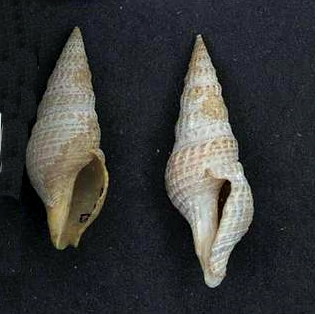
The shell is elongate-conic and pale yellow, with a faint brown band encircling the whorls near the summit. It reaches a length of 23 mm.[1][2]
The protoconch consists of 1.5 smooth, well-rounded whorls. The first three postnuclear whorls have a submedian row of widely spaced cusps, which develop into axial ribs on subsequent whorls, extending from the summit's sinal sulcus toward the suture.[3][4][5]
The first postnuclear whorl bears 10 axial ribs, the second and third bear 12 each, and the remaining whorls bear 14, except for the body whorl, which bears 16. Numerous fine growth lines slope retractively in the summit sulcus and protractively toward the anterior.[6][7]
The summit sulcus lacks spiral sculpture. Anterior to the summit sulcus, rounded spiral cords cross the ribs and the spaces between them.[8][9]
The fifth through seventh whorls have four spiral cords, the eighth has five, the ninth has seven, and the body whorl has eight between the summit and suture. The whorl suture is prominent because of the slightly sloping shoulder at the summit.[10][11]
The shell has a well-rounded periphery. Its short base bears seven spiral cords of unequal strength.[12][13]
The columella is short and stubby, with a strong, broad fold opposite the outer-lip varix. The shell has seven relatively broad spiral cords separated by narrow channels.[14][15]
The aperture is short and distinctly channeled at both its anterior and posterior ends, with a deeply notched posterior channel. A broad varix occurs half a whorl behind the aperture.[16][17]
The inner lip forms a heavy callus appressed to the columella and extending over the parietal wall.[18]
Classification of Darbya lira
| Kingdom | Animalia |
|---|---|
| Phylum | Mollusca |
| Class | Gastropoda (Gastropod) |
| Subclass | Caenogastropoda |
| Order | Neogastropoda |
| Superfamily | Conoidea |
| Family | Borsoniidae |
| Genus | Darbya |
| Species | Darbya lira Bartsch, 1934 |
Where Darbya lira is found
Checklists and occurrence records place Darbya lira in 2 countries. GBIF holds 67 georeferenced records of it.
Countries
Regions and cities with the most records
- Sainte-Anne, Guadeloupe 4
- Candelaria, Puerto Rico 3
- Levittown, Puerto Rico 3
- Vega Baja, Puerto Rico 3
A number beside a place is its count of GBIF occurrence records. A place without a number comes from a checklist alone. Records show where a species has been observed or collected, which can include escapes and vagrants.
Related species
-
 Typhlodaphne purissima
- Aphanitoma mariottinii
-
 Bathytoma atractoides
-
 Bathytoma prodicia
-
 Pink Tower ShellPhenatoma roseum
-
 Borsonia silicea
-
 Genota mitriformis
-
 Bathytoma visagei
Compare
Sources
Passages the profile rests on
- The shell is elongate-conic and pale yellow, with a faint brown band encircling the whorls near the summit. Source passage: “The shell has an elongate-conic shape. It is pale yellow, with a faint brown band encircling the whorls a little anterior to the sinal sulcus at the summit.” — English Wikipedia
- The shell reaches a length of 23 mm. Source passage: “The length of the shell attains 23 mm.” — English Wikipedia
- The protoconch consists of 1.5 smooth, well-rounded whorls. Source passage: “The protoconch contains 1.5, smooth, well rounded whorls.” — English Wikipedia
- The first three postnuclear whorls have a submedian row of widely spaced cusps. Source passage: “They are marked on the first three turns by a submedian row of distantly spaced cusps.” — English Wikipedia
- The cusps develop into axial ribs on subsequent whorls, extending from the summit's sinal sulcus toward the suture. Source passage: “On the succeeding whorls these cusps become elongated into ribs that extend from the sinal sulcus at the summit anteriorly to the suture” — English Wikipedia
- The first postnuclear whorl bears 10 axial ribs, the second and third bear 12 each, and the remaining whorls bear 14, except for the body whorl, which bears 16. Source passage: “Of these ribs, 10 occur upon the first whorl, 12 upon the second and third, and 14 upon the remaining whorls except the body whorl, which has 16.” — English Wikipedia
- The shell has numerous fine growth lines that slope retractively in the summit sulcus and protractively toward the anterior. Source passage: “In addition to this there are numerous fine lines of growth, which slope retractively in the sulcus at the summit and protractively anteriorly.” — English Wikipedia
- The summit sulcus lacks spiral sculpture. Source passage: “The sulcus at the summit is without spiral sculpture” — English Wikipedia
- The region anterior to the summit sulcus has rounded spiral cords crossing both the ribs and the spaces between them. Source passage: “in the region anterior to it both ribs and intercostal spaces are crossed by rather strong, low, rounded, spiral cords” — English Wikipedia
- The fifth through seventh whorls have four spiral cords, the eighth has five, the ninth has seven, and the body whorl has eight between the summit and suture. Source passage: “of which four occur upon the fifth to seventh, five upon the eighth, seven upon the ninth, and eight upon the body whorl between the summit and suture.” — English Wikipedia
- The whorl suture is prominent because of the slightly sloping shoulder at the summit. Source passage: “The suture is rendered conspicuous by the slightly sloping shoulder of the summit of the whorls.” — English Wikipedia
- The shell has a well-rounded periphery. Source passage: “The periphery is well rounded.” — English Wikipedia
- The shell base is short and bears seven spiral cords of unequal strength. Source passage: “The base of the shell is short, marked by the feeble continuation of the axial ribs and by seven spiral cords which are of unequal strength.” — English Wikipedia
- The columella is short and stubby, with a strong, broad fold opposite the outer-lip varix. Source passage: “The columella is short and stubby with a strong, broad fold opposite the varix on the outer lip” — English Wikipedia
- The shell has seven relatively broad spiral cords separated by narrow channels. Source passage: “The shell is marked by seven rather broad spiral cords, which are separated by narrow channels.” — English Wikipedia
- The aperture is short and distinctly channeled at both its anterior and posterior ends, with a deeply notched posterior channel. Source passage: “The aperture is short, decidedly channeled anteriorly and posteriorly, the posterior channel being deeply notched and at the summit of the shell.” — English Wikipedia
- A broad varix occurs half a whorl behind the aperture. Source passage: “There is a broad varix half a whorl behind the aperture.” — English Wikipedia
- The inner lip forms a heavy callus appressed to the columella and extending over the parietal wall. Source passage: “The inner lip is appressed to the columella as a heavy callus which extends over the parietal wall.” — English Wikipedia
Data
- Catalogue of Life, 2026-10-16 XR cc by
- Global Biodiversity Information Facility CC BY 4.0
- Wikidata CC0
- GeoNames CC BY 4.0
- Wikimedia Commons per image; credit shown with each image
- Within the Catalogue of Life, this name comes from World Register of Marine Species cc by
References
- Bartsch, P. (1934). Reports on the collections obtained by the first Johnson-Smithsonian deep-sea expedition to the Puerto Rican deep; new mollusks of the family Turritidae. Smithsonian Miscellaneous Collections, 91 (2): 1–29, 8 pls. where the name was published
This species in other databases
Page built on 28 November 2026. See how the catalog is made and all sources and licences.
Cite this page
ScientificNames.org. (2026). Darbya lira. Retrieved November 28, 2026, from https://scientificnames.org/species/darbya-lira
“Darbya lira.” ScientificNames.org, 2026, scientificnames.org/species/darbya-lira. Accessed 28 Nov. 2026.
ScientificNames.org. “Darbya lira.” Accessed November 28, 2026. https://scientificnames.org/species/darbya-lira.
@misc{scientificnames_darbya_lira,
  author = {{ScientificNames.org}},
  title = {Darbya lira},
  year = {2026},
  url = {https://scientificnames.org/species/darbya-lira},
  note = {Accessed 2026-11-28}
}