Species · Insects
Golden Jezebel Delias aruna
The scientific name of the Golden Jezebel is Delias aruna. It is a species of insect in the family Pieridae (whites), order Lepidoptera. The name dates from 1832.
- Scientific name
- Delias aruna (Boisduval, 1832)
- Common name
- Golden Jezebel
- Genus
- Delias
- Family
- Pieridae (Whites)
- Order
- Lepidoptera
- Class
- Insecta
- Recorded in
- 3 countries
- Name status
- accepted in the Catalogue of Life
Overview
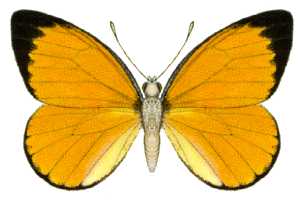
The Golden Jezebel (Delias aruna) is an insect in the family Pieridae, order Lepidoptera and class Insecta. It occurs in Queensland, Irian Jaya, Maluku and Papua New Guinea, as well as several surrounding islands. Males have yellow to orange upper wings, while females are black with orange basal wing areas; both sexes have dark brown undersides.
Written 27 November 2026 from the sources listed below. Each statement was checked against the passage it cites; statements that could not be supported were removed.
Appearance
Male Golden Jezebels have yellow to orange upper wing ground coloration, a black forewing apex and a narrow black marginal band on the hindwing. Females are black with an orange basal wing area and indistinct orange apical spots.[1][2][3]
The undersides of both sexes are dark brown. Males have a yellow patch on each forewing and a scarlet marking near the base of each hindwing, while females have arcs of yellow spots along the underside margins of all wings.[4][5][6]
Both males and females have wingspans of approximately 7 centimetres. The species exhibits considerable variation across its geographical range.[7][8]
The irma subspecies is described as the darkest known race. Male irma butterflies have an almost entirely black underside and broader upper wing margins than the inferna subspecies.[9][10][11]
Female inferna butterflies lack a yellow transverse spot at the forewing discocellular on the upper surface. This spot appears on the underside.[12][13]
The madala form has a narrow distal wing margin and orange upper ground coloration. Its underside has enlarged red costal and discal spots that reduce the black distal margin.[14][15]
The bajura form has a pale yellow basal area on the upper hindwing and a sharply defined, narrower white transverse spot before the forewing cell.[16][17]
Diet
Adult Golden Jezebel butterflies visit the flowers of Syzygium jambos.[18]
Behaviour
The Golden Jezebel is frequently encountered in July.[19]
Classification of the Golden Jezebel
| Kingdom | Animalia |
|---|---|
| Phylum | Arthropoda |
| Subphylum | Hexapoda |
| Class | Insecta (Insect) |
| Order | Lepidoptera |
| Superfamily | Papilionoidea |
| Family | Pieridae (Whites) |
| Genus | Delias (Jezebels) |
| Species | Delias aruna (Boisduval, 1832) |
Where the Golden Jezebel is found
Checklists and occurrence records place Delias aruna in 3 countries. GBIF holds 473 georeferenced records of it.
Countries
Regions and cities with the most records
- Queensland, Australia 102
- Papua, Indonesia 50
- Morobe Province, Papua New Guinea 24
- Maluku, Indonesia 14
- Wamena, Indonesia 9
- Abepura, Indonesia 7
- Jayapura, Indonesia 7
- Oro Province, Papua New Guinea 7
- Sentani, Indonesia 7
- Ambon, Indonesia 5
- Fakfak, Indonesia 5
- Eastern Highlands Province, Papua New Guinea 4
- Milne Bay Province, Papua New Guinea 4
- Sandaun Province, Papua New Guinea 4
- Southern Highlands Province, Papua New Guinea 4
- Tobelo, Indonesia 4
- Western Province, Papua New Guinea 4
- Central Province, Papua New Guinea 3
- East Sepik Province, Papua New Guinea 3
- Madang Province, Papua New Guinea 3
1 more country has a few records outside this range
These countries hold a few records of Delias aruna but lie outside the range the checklists give for it. Such records are often zoo or garden specimens, museum material or vagrants, so the species is not counted as occurring there.
A number beside a place is its count of GBIF occurrence records. A place without a number comes from a checklist alone. Records show where a species has been observed or collected, which can include escapes and vagrants.
Common names
English
- Golden Jezebel
Related species
-
 Common JezebelDelias eucharis
-
 Painted JezebelDelias hyparete
-
 Black JezebelDelias nigrina
-
 Red Base JezebelDelias pasithoe
-
 Red-spotted JezebelDelias aganippe
-
 Red-spot JezebelDelias descombesi
-
 Scarlet JezebelDelias argenthona
-
 Red-breast JezebelDelias acalis
Compare
Questions and answers
What is the scientific name of the Golden Jezebel?
The scientific name of the Golden Jezebel is Delias aruna. Written with its author, the full name is Delias aruna (Boisduval, 1832).
Which family does the Golden Jezebel belong to?
Delias aruna belongs to the family Pieridae, in the order Lepidoptera and the class Insecta.
Where is the Golden Jezebel found?
Checklists and occurrence records place Delias aruna in 3 countries: Indonesia, Papua New Guinea and Australia.
Sources
Passages the profile rests on
- Male Delias aruna butterflies have yellow to orange upper wing ground coloration. Source passage: “The male upper ground colour is yellow to orange.” — English Wikipedia
- Males have a black forewing apex and a narrow black marginal band on the hindwing. Source passage: “The forewing apex is black apex and there is a narrow black band marginal hindwing band.” — English Wikipedia
- Females are black with an orange basal wing area and indistinct orange apical spots. Source passage: “The female is black, with an orange basal area and obscure orange apical spots.” — English Wikipedia
- The undersides of both sexes are dark brown. Source passage: “The undersides of both sexes are dark brown.” — English Wikipedia
- Males have a yellow patch on each forewing and a scarlet marking near the base of each hindwing. Source passage: “The male has a yellow forewing patch and a scarlet mark near the base of each hindwing.” — English Wikipedia
- Females have arcs of yellow spots along the underside margins of all wings. Source passage: “The female has arcs of yellow spots around the margin of the undersides of all wings.” — English Wikipedia
- The species exhibits considerable variation across its geographical range. Source passage: “D aruna is very variable across its large range.” — English Wikipedia
- Both male and female Delias aruna have wingspans of approximately 7 centimetres. Source passage: “Both sexes have wingspans of c. 7 cms.” — English Wikipedia
- The irma subspecies is described as the darkest known race. Source passage: “the darkest known race” — English Wikipedia
- Male irma butterflies have an almost entirely black underside. Source passage: “male beneath almost entirely black” — English Wikipedia
- Male irma butterflies have broader upper wing margins than the inferna subspecies. Source passage: “also above with broader margins than inferna.” — English Wikipedia
- Female inferna butterflies lack a yellow transverse spot at the forewing discocellular on the upper surface. Source passage: “in the female above no yellow transverse spot at the discocellular of the forewing” — English Wikipedia
- The yellow transverse spot absent from the upper forewing of female inferna appears on its underside. Source passage: “which, however, appears again beneath.” — English Wikipedia
- The madala form has a narrow distal wing margin and orange upper ground coloration. Source passage: “Distal margin narrow, the ground-colour above orange” — English Wikipedia
- The madala form has enlarged red costal and discal spots on the underside, reducing the black distal margin. Source passage: “the red costal and discal spot are considerably larger and hence the black distal margin is reduced.” — English Wikipedia
- The bajura form has a pale yellow basal area on the upper hindwing. Source passage: “pale yellow basal part of the hindwing above” — English Wikipedia
- The bajura form has a sharply defined, narrower white transverse spot before the forewing cell. Source passage: “sharply defined and narrower white transverse spot before the cell of the forewing.” — English Wikipedia
- Adult Delias aruna butterflies visit the flowers of Syzygium jambos. Source passage: “The butter¬ flies are fond of visiting the flowers of Syzygium jambos” — English Wikipedia
- Delias aruna is frequently encountered in July. Source passage: “mostly met with in July” — English Wikipedia
- Delias aruna occurs in Queensland, Irian Jaya, Maluku and Papua New Guinea, as well as several surrounding islands. Source passage: “It is found in Queensland, Irian Jaya, Maluku, Papua New Guinea and several surrounding islands.” — English Wikipedia
- The species is classified in the butterfly family Pieridae. Source passage: “is a butterfly in the family Pieridae.” — English Wikipedia
Data
- Catalogue of Life, 2026-10-16 XR cc by
- Global Biodiversity Information Facility CC BY 4.0
- Wikidata CC0
- GeoNames CC BY 4.0
- Wikimedia Commons per image; credit shown with each image
- Within the Catalogue of Life, this name comes from Global Butterfly Information System cc by
This species in other databases
Page built on 28 November 2026. See how the catalog is made and all sources and licences.
Cite this page
ScientificNames.org. (2026). Delias aruna (Golden Jezebel). Retrieved November 28, 2026, from https://scientificnames.org/species/delias-aruna
“Delias aruna (Golden Jezebel).” ScientificNames.org, 2026, scientificnames.org/species/delias-aruna. Accessed 28 Nov. 2026.
ScientificNames.org. “Delias aruna (Golden Jezebel).” Accessed November 28, 2026. https://scientificnames.org/species/delias-aruna.
@misc{scientificnames_delias_aruna_golden_jezebel,
  author = {{ScientificNames.org}},
  title = {Delias aruna (Golden Jezebel)},
  year = {2026},
  url = {https://scientificnames.org/species/delias-aruna},
  note = {Accessed 2026-11-28}
}