Species · Insects
Dingy Flat-body Depressaria daucella
The scientific name of the Dingy Flat-body is Depressaria daucella. It is a species of insect in the family Depressariidae (depressariids), order Lepidoptera. The name dates from 1775.
- Scientific name
- Depressaria daucella ([Denis & Schiffermüller], 1775)
- Common name
- Dingy Flat-body
- Genus
- Depressaria
- Family
- Depressariidae (Depressariids)
- Order
- Lepidoptera
- Class
- Insecta
- Recorded in
- 19 countries
- Name status
- accepted in the Catalogue of Life

Overview
The species occurs across most of Europe, excluding parts of the Balkan Peninsula, and has been introduced to the west coast of North America. The adult moth has light brown, whitish-speckled forewings with numerous dark fuscous dashes and a wingspan of 21–24 mm.
Written 27 November 2026 from the sources listed below. Each statement was checked against the passage it cites; statements that could not be supported were removed.
Appearance
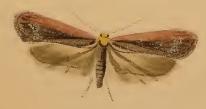
The adult moth has light brown forewings with whitish speckling, sometimes with a slight reddish tint, and numerous dark fuscous dashes. Its hindwings are fuscous-whitish and become more fuscous towards the posterior.[1][2]
The terminal joint of the palpi bears two blackish bands. The adult moth has a wingspan of 21–24 mm.[3][4]
Habitat
The species occurs across most of Europe, excluding parts of the Balkan Peninsula. It has been introduced to the west coast of North America.[5][6]
Diet
The larvae feed on Sison amomum and Oenanthe pimpinelloides.[7][8]
Behaviour
Adult moths are active from September and become active again through April after overwintering.[9]
The larvae mine leaves while feeding and can be found from June until the end of July.[10][11]
Classification of the Dingy Flat-body
| Kingdom | Animalia |
|---|---|
| Phylum | Arthropoda |
| Subphylum | Hexapoda |
| Class | Insecta (Insect) |
| Order | Lepidoptera |
| Superfamily | Gelechioidea |
| Family | Depressariidae (Depressariids) |
| Subfamily | Depressariinae |
| Genus | Depressaria |
| Species | Depressaria daucella ([Denis & Schiffermüller], 1775) |
Where the Dingy Flat-body is found
Checklists and occurrence records place Depressaria daucella in 19 countries. GBIF holds 5,441 georeferenced records of it.
Countries
- Aland Islands 30
- Austria 77
- Denmark 68
- Estonia 56
- Finland 3,127
- France 216
- Germany 22
- Guernsey 5
- Ireland 8
- Isle of Man 34
- Lithuania 3
- Norway 58
- Poland 5
- Portugal 182
- Russia 18
- Spain 109
- Sweden 270
- The Netherlands 41
- United Kingdom 1,112
Regions and cities with the most records
- England, United Kingdom 612
- Scotland, United Kingdom 325
- Kuopio, Finland 165
- Siilinjärvi, Finland 157
- Fylde, United Kingdom 144
- Poulton-le-Fylde, United Kingdom 137
- Lohja, Finland 136
- Preston, United Kingdom 134
- Pori, Finland 131
- Lytham St Annes, United Kingdom 128
- Wales, United Kingdom 123
- Hollola, Finland 121
- Leyland, United Kingdom 121
- Janakkala, Finland 118
- Espoo, Finland 117
- Hämeenlinna, Finland 117
- Kaarina, Finland 109
- Turku, Finland 109
- Väståboland, Finland 108
- Lieto, Finland 104
- Lahti, Finland 101
- Blackburn, United Kingdom 100
- Myyrmäki, Finland 99
- Chorley, United Kingdom 98
- Pieksämäki, Finland 97
- Helsinki, Finland 91
- Vantaa, Finland 91
- Galicia, Spain 86
- Tampere, Finland 80
- Vaasa, Finland 80
- Kirkkonummi, Finland 75
- Heysham, United Kingdom 72
- Korsholm, Finland 71
- Lancaster, United Kingdom 71
- Raisio, Finland 70
- Fleetwood, United Kingdom 69
4 more countries have a few records outside this range
These countries hold a few records of Depressaria daucella but lie outside the range the checklists give for it. Such records are often zoo or garden specimens, museum material or vagrants, so the species is not counted as occurring there.
A number beside a place is its count of GBIF occurrence records. A place without a number comes from a checklist alone. Records show where a species has been observed or collected, which can include escapes and vagrants.
Common names
English
- Dingy Flat-body
Names in 9 other languages
- Czech
- plochuška kmínová
- Danish
- Kommenmøl
- Dutch
- Karwijmot, Karwijplatlijfje
- Finnish
- keisolattakoi
- French
- Teigne de la carotte
- Japanese
- クロミャクマルハキバガ
- Lithuanian
- Morkinė deprezarija
- Slovak
- ploskáč rascový
- Swedish
- sprängörtplattmal, sprängörtsplattmal
Synonyms
6 other scientific names have been used for this species and are now treated as synonyms of Depressaria daucella.
- Depressaria rubricella (Denis & Schiffermüller, 1775)
- Phalaena daucella Denis & Schiffermüller, 1775
- Tinea apiella Hübner, 1796
- Tinea daucella [Denis & Schiffermüller], 1775
- Tinea rubricella [Denis & Schiffermüller], 1775
- Depressaria nervosa Stephens, 1834 ambiguous synonym
Related species
- Parsnip MothDepressaria radiella
-
 Streaked Flat-bodyDepressaria chaerophylli
-
 Purple Carrot-seed MothDepressaria depressana
-
 Brown Flat-bodyDepressaria badiella
-
 Chervil Flat-bodyDepressaria sordidatella
-
 Yarrow Flat-bodyDepressaria olerella
- Depressaria nemolella
-
 Depressaria ululana
Compare
Questions and answers
What is the scientific name of the Dingy Flat-body?
The scientific name of the Dingy Flat-body is Depressaria daucella. Written with its author, the full name is Depressaria daucella ([Denis & Schiffermüller], 1775).
Which family does the Dingy Flat-body belong to?
Depressaria daucella belongs to the family Depressariidae, in the order Lepidoptera and the class Insecta.
Where is the Dingy Flat-body found?
Checklists and occurrence records place Depressaria daucella in 19 countries, including Finland, United Kingdom, Sweden, France, Portugal and Spain.
Sources
Passages the profile rests on
- The adult moth has light brown forewings with whitish speckling, sometimes with a slight reddish tint, and numerous dark fuscous dashes. Source passage: “Forewings light brown, somewhat whitish-sprinkled, sometimes slightly reddish-tinged; numerous dark fuscous dashes” — English Wikipedia
- The adult moth has hindwings that are fuscous-whitish and become more fuscous towards the posterior. Source passage: “Hindwings fuscous-whitish, more fuscous posteriorly” — English Wikipedia
- The terminal joint of the moth's palpi bears two blackish bands. Source passage: “The terminal joint of palpi with two blackish bands.” — English Wikipedia
- The adult moth has a wingspan of 21–24 mm. Source passage: “The wingspan is 21–24 mm.” — English Wikipedia
- The species occurs across most of Europe, excluding parts of the Balkan Peninsula. Source passage: “It is found in most of Europe, except for parts of the Balkan Peninsula.” — English Wikipedia
- The species has been introduced to the west coast of North America. Source passage: “It is also found as an introduced species in the west coast of North America.” — English Wikipedia
- The larvae feed on Sison amomum. Source passage: “The larvae are leaf miners and feed on plants including, Sison amomum” — English Wikipedia
- The larvae feed on Oenanthe pimpinelloides. Source passage: “Oenanthe pimpinelloides.” — English Wikipedia
- Adult moths are active from September and become active again through April after overwintering. Source passage: “Adults are on wing from September and after overwintering, again to April.” — English Wikipedia
- The larvae mine leaves while feeding. Source passage: “The larvae are leaf miners” — English Wikipedia
- The larvae can be found from June until the end of July. Source passage: “Larvae can be found from June to the end of July.” — English Wikipedia
Data
- Catalogue of Life, 2026-10-16 XR cc by
- Global Biodiversity Information Facility CC BY 4.0
- Wikidata CC0
- GeoNames CC BY 4.0
- Wikimedia Commons per image; credit shown with each image
- Within the Catalogue of Life, this name comes from Global Lepidoptera Index cc by
This species in other databases
Page built on 28 November 2026. See how the catalog is made and all sources and licences.
Cite this page
ScientificNames.org. (2026). Depressaria daucella (Dingy Flat-body). Retrieved November 28, 2026, from https://scientificnames.org/species/depressaria-daucella
“Depressaria daucella (Dingy Flat-body).” ScientificNames.org, 2026, scientificnames.org/species/depressaria-daucella. Accessed 28 Nov. 2026.
ScientificNames.org. “Depressaria daucella (Dingy Flat-body).” Accessed November 28, 2026. https://scientificnames.org/species/depressaria-daucella.
@misc{scientificnames_depressaria_daucella_dingy_flat_body,
  author = {{ScientificNames.org}},
  title = {Depressaria daucella (Dingy Flat-body)},
  year = {2026},
  url = {https://scientificnames.org/species/depressaria-daucella},
  note = {Accessed 2026-11-28}
}