Species · Insects
Human Botfly Dermatobia hominis
The scientific name of the Human Botfly is Dermatobia hominis. It is a species of insect in the family Oestridae (botfly), order Diptera. The name dates from 1781.
- Scientific name
- Dermatobia hominis (Linnaeus, 1781)
- Common name
- Human Botfly
- Genus
- Dermatobia
- Family
- Oestridae (Botfly)
- Order
- Diptera
- Class
- Insecta
- Recorded in
- 14 countries
- Name status
- accepted in the Catalogue of Life
Overview
The species occurs in tropical and semi-tropical areas of the New World. Adult flies lack mouthparts and attach their eggs to blood-sucking arthropods.
Written 26 November 2026 from the sources listed below. Each statement was checked against the passage it cites; statements that could not be supported were removed.
Appearance
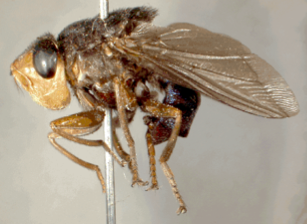
Adult flies are approximately 15 mm in length. They lack mouthparts.[1][2]
Habitat
The species occurs in tropical and semi-tropical areas of the New World. Its native range extends from southeastern Mexico to northern Argentina and Uruguay.[3][4]
The species is native to Central and South America.[5]
Diet
Larvae feed in a cavity beneath the host's skin.[6]
Behaviour
Mature larvae leave their hosts, fall to the ground and pupate in the environment. They generally leave their hosts during nighttime and early morning.[7][8]
The larvae parasitize humans and a wide range of other animals, including other primates. The species can infect a variety of mammals.[9][10]
Human infestations commonly produce painful swellings on the skin or scalp that may discharge fluid. They rarely result in death, and the species is not known to transmit disease-causing pathogens.[11][12][13]
Reproduction and life cycle
Female flies capture mosquitoes and attach their eggs to the mosquitoes' bodies.[14]
Adult flies emerge approximately one month after pupation and reproduce to continue the life cycle.[15]
Classification of the Human Botfly
| Kingdom | Animalia |
|---|---|
| Phylum | Arthropoda |
| Subphylum | Hexapoda |
| Class | Insecta (Insect) |
| Order | Diptera (Fly) |
| Family | Oestridae (Botfly) |
| Subfamily | Cuterebrinae |
| Genus | Dermatobia |
| Species | Dermatobia hominis (Linnaeus, 1781) |
Where the Human Botfly is found
Checklists and occurrence records place Dermatobia hominis in 14 countries. GBIF holds 283 georeferenced records of it.
Countries
- Argentina 14
- Belize 21
- Bolivia 13
- Brazil 89
- Canada 3
- Colombia 11
- Costa Rica 69
- Ecuador 6
- French Guiana 14
- Mexico 15
- Panama 4
- Paraguay 6
- Peru 13
- United States 5
Regions and cities with the most records
- Alajuela Province, Costa Rica 19
- Heredia Province, Costa Rica 16
- Santa Catarina, Brazil 16
- Puntarenas Province, Costa Rica 14
- Rio de Janeiro, Brazil 14
- Misiones, Argentina 13
- Seara, Brazil 13
- Chiapas, Mexico 10
- Itatiaia, Brazil 9
- Resende, Brazil 9
- Cayo District, Belize 8
- Guanacaste Province, Costa Rica 8
- Limón Province, Costa Rica 7
- Madre de Dios, Peru 7
- Santa Cruz Department, Bolivia 7
- São Paulo, Brazil 7
- Stann Creek, Belize 5
- Belize District, Belize 4
- Belmopan, Belize 4
- Cayenne, French Guiana 4
- Matoury, French Guiana 4
- Rémire-Montjoly, French Guiana 4
- Antioquia, Colombia 3
- Mato Grosso, Brazil 3
- Minas Gerais, Brazil 3
- Napo, Ecuador 3
- Paraná, Brazil 3
A number beside a place is its count of GBIF occurrence records. A place without a number comes from a checklist alone. Records show where a species has been observed or collected, which can include escapes and vagrants.
Common names
English
- Human Botfly
- Torsalo
Names in 4 other languages
- French
- Ver macaque, Ver macaque (larve)
- Portuguese
- Berne, Mosca-Berneira
- Russian
- Человеческий кожный овод
- Spanish
- Colmoyote, Rezno, Tornillo, Tórsalo, Ura, gusano de zancudo, nuche
Synonyms
5 other scientific names have been used for this species and are now treated as synonyms of Dermatobia hominis.
- Cuterebra cyaniventris Macquart, 1844
- Cuterebra noxialis Goudot, 1845
- Oestrus hominis Linnaeus, 1781
- Oestrus hominis Linnaeus Jr in Pallas, 1781
- Oestrus humanus Howship, 1833
Related species
- Dermatobia hydropica
-
 Sheep Nasal Bot FlyOestrus ovis
-
 Mouse Bot FlyCuterebra fontinella
-
 Horse Bot FlyGasterophilus intestinalis
-
 Tree Squirrel Bot FlyCuterebra emasculator
- Rhinoceros BotflyGyrostigma rhinocerontis
- Reindeer Nose BotflyCephenemyia trompe
-
 Horse Nasal Bot FlyGasterophilus nasalis
Compare
Questions and answers
What is the scientific name of the Human Botfly?
The scientific name of the Human Botfly is Dermatobia hominis. Written with its author, the full name is Dermatobia hominis (Linnaeus, 1781).
Which family does the Human Botfly belong to?
Dermatobia hominis belongs to the family Oestridae, in the order Diptera and the class Insecta.
Where is the Human Botfly found?
Checklists and occurrence records place Dermatobia hominis in 14 countries, including Brazil, Costa Rica, Belize, Mexico, Argentina and French Guiana.
What other names does the Human Botfly have?
Dermatobia hominis is also known in English as Torsalo.
How do you know if you have a human botfly?
Human infestations commonly produce painful swellings on the skin or scalp that may discharge fluid.[11]
How long can a botfly live in you?
The larval development period inside the host lasts approximately five to ten weeks.[16]
What does a bot fly eat?
Botfly larvae feed in a cavity beneath the host's skin.[6]
Sources
Passages the profile rests on
- Adult flies are approximately 15 mm in length. Source passage: “Adults are large, approximately 15 mm in length.” — cdc.gov
- Adult flies lack mouthparts. Source passage: “The adults are large flies lacking mouthparts” — English Wikipedia
- The species occurs in tropical and semi-tropical areas of the New World. Source passage: “are found in tropical and semi-tropical areas of the New World.” — animaldiversity.org
- Its native range extends from southeastern Mexico to northern Argentina and Uruguay. Source passage: “This species is native to the Americas from southeastern Mexico (beginning in central Veracruz) to northern Argentina, and Uruguay” — English Wikipedia
- The species is native to Central and South America. Source passage: “The human bot fly is native to Central and South America.” — ask.ifas.ufl.edu
- Larvae feed in a cavity beneath the host's skin. Source passage: “Larvae feed inside a subdermal cavity for 5-10 weeks.” — cdc.gov
- Mature larvae leave their hosts, fall to the ground and pupate in the environment. Source passage: “Mature larvae drop to the ground and pupate in the environment.” — cdc.gov
- Larvae generally leave their hosts during nighttime and early morning. Source passage: “Larvae tend to leave their host during the night and early morning, probably to avoid desiccation.” — cdc.gov
- The species' larvae parasitize humans and a wide range of other animals, including other primates. Source passage: “whose larvae parasitise humans (in addition to a wide range of other animals, including other primates).” — English Wikipedia
- The species can infect a variety of mammals. Source passage: “Dermatobia hominis occurs in Mexico and Central and South America and may infect a variety of mammals.” — cdc.gov
- Human infestations commonly produce painful swellings on the skin or scalp that may discharge fluid. Source passage: “Infestations with D. hominis are often characterized by cutaneous swellings on the body or scalp that may produce discharges and be painful.” — cdc.gov
- Human infestations rarely result in death. Source passage: “Death is rare, but there have been instances of cerebral myiasis in children where larvae enter the brain.” — cdc.gov
- The species is not known to transmit disease-causing pathogens. Source passage: “The fly is not known to transmit disease-causing pathogens” — ask.ifas.ufl.edu
- Female flies capture mosquitoes and attach their eggs to the mosquitoes' bodies. Source passage: “The female captures the mosquito and attaches its eggs to its body, then releases it.” — English Wikipedia
- Adult flies emerge approximately one month after pupation and reproduce to continue the life cycle. Source passage: “After approximately one month, the adults emerge to mate and repeat the cycle.” — cdc.gov
- The larval development period inside the host lasts approximately five to ten weeks. Source passage: “Larvae feed in a subdermal cavity for 5-10 weeks.” — cdc.gov
Data
- Catalogue of Life, 2026-10-16 XR cc by
- Global Biodiversity Information Facility CC BY 4.0
- Wikidata CC0
- GeoNames CC BY 4.0
- Wikimedia Commons per image; credit shown with each image
- Within the Catalogue of Life, this name comes from Systema Dipterorum cc by
References
- Pallas, P.S. (1781) Mittheilungen uber Oestrus hominis. Neue nordische Beytr. Phys. Geogr. Erde y. Volk, 1. where the name was published
This species in other databases
Page built on 27 November 2026. See how the catalog is made and all sources and licences.
Cite this page
ScientificNames.org. (2026). Dermatobia hominis (Human Botfly). Retrieved November 27, 2026, from https://scientificnames.org/species/dermatobia-hominis
“Dermatobia hominis (Human Botfly).” ScientificNames.org, 2026, scientificnames.org/species/dermatobia-hominis. Accessed 27 Nov. 2026.
ScientificNames.org. “Dermatobia hominis (Human Botfly).” Accessed November 27, 2026. https://scientificnames.org/species/dermatobia-hominis.
@misc{scientificnames_dermatobia_hominis_human_bot_y,
  author = {{ScientificNames.org}},
  title = {Dermatobia hominis (Human Botfly)},
  year = {2026},
  url = {https://scientificnames.org/species/dermatobia-hominis},
  note = {Accessed 2026-11-27}
}