Species · Fishes
Headlight Fish Diaphus effulgens
The scientific name of the Headlight Fish is Diaphus effulgens. It is a species of fish in the family Myctophidae (lanternfish), order Myctophiformes. The name dates from 1896.
- Scientific name
- Diaphus effulgens (Goode & Bean, 1896)
- Common name
- Headlight Fish
- Genus
- Diaphus
- Family
- Myctophidae (Lanternfish)
- Order
- Myctophiformes
- Class
- Teleostei
- Red List category
- LC Least Concern
- Environment
- marine
- Recorded in
- 26 countries
- Name status
- accepted in the Catalogue of Life

Overview
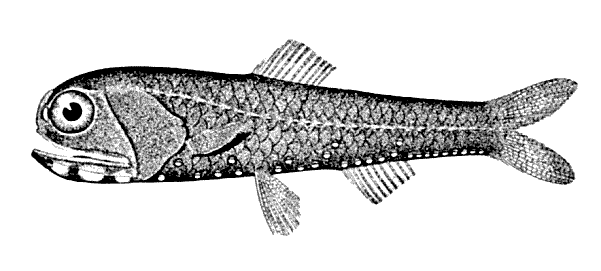
Diaphus effulgens occurs in the Atlantic, Pacific, and Indian Oceans. It is distinguished by a large luminescent patch covering the front of its head between the nares.
Written 26 November 2026 from the sources listed below. Each statement was checked against the passage it cites; statements that could not be supported were removed.
Appearance
The Headlight Fish has a large luminescent patch covering the front of its head between the nares. Its maximum reported length is 15 cm (5.9 inches).[1][2]
Similar species
The Headlight Fish can be distinguished from the lanternfish Myctophum affine and pearlsides of the genus Maurolicus by its large luminescent head patch.[3]
Habitat
The Headlight Fish is both high-oceanic and mesopelagic. During daylight, it inhabits depths of 501 to 700 metres.[4][5]
Behaviour
At night, the Headlight Fish moves closer to the surface and has been observed at depths of 40 to 175 metres. It exhibits size stratification according to depth.[6][7]
Reproduction and life cycle
Female individuals are believed to spawn in deep water.[8]
Classification of the Headlight Fish
| Kingdom | Animalia |
|---|---|
| Phylum | Chordata |
| Subphylum | Vertebrata |
| Infraphylum | Gnathostomata |
| Parvphylum | Osteichthyes |
| Gigaclass | Actinopterygii |
| Superclass | Actinopteri |
| Class | Teleostei (Teleost) |
| Order | Myctophiformes |
| Family | Myctophidae (Lanternfish) |
| Subfamily | Diaphinae |
| Genus | Diaphus |
| Species | Diaphus effulgens (Goode & Bean, 1896) |
Where the Headlight Fish is found
Checklists and occurrence records place Diaphus effulgens in 26 countries. GBIF holds 575 georeferenced records of it.
Countries
- Australia 42
- Bahamas 31
- Bermuda 130
- Cabo Verde 4
- Canada 48
- Cuba 3
- Dominican Republic 6
- India 3
- Indonesia 11
- Ireland 5
- Japan 8
- Mauritius 3
- Morocco 4
- New Caledonia 4
- Nicaragua 4
- Northern Mariana Islands 3
- Palau 8
- Panama 3
- Papua New Guinea 4
- Philippines 12
- Portugal 22
- Puerto Rico 4
- Saint Helena 4
- South Africa 16
- Spain 17
- United States 176
Regions and cities with the most records
2 more countries have a few records outside this range
These countries hold a few records of Diaphus effulgens but lie outside the range the checklists give for it. Such records are often zoo or garden specimens, museum material or vagrants, so the species is not counted as occurring there.
A number beside a place is its count of GBIF occurrence records. A place without a number comes from a checklist alone. Records show where a species has been observed or collected, which can include escapes and vagrants.
Common names
English
- Headlight Fish
- Headlight Lanternfish
Names in 4 other languages
- Czech
- lampař světlohlavý
- Finnish
- hohtovalottaja
- Japanese
- タマハダカ
- Russian
- Светоголовый диаф
Synonyms
6 other scientific names have been used for this species and are now treated as synonyms of Diaphus effulgens.
- Aethoprora effulgens Goode & Bean, 1896
- Diaphus antelucens Kulikova, 1961
- Diaphus efflugens (Goode & Bean, 1896)
- Diaphus macrophus Parr, 1928
- Myctophum aeolochrus Barnard, 1927
- Myctophum effulgens (Goode & Bean, 1896)
Related species
-
 White-spotted Lantern FishDiaphus rafinesquii
-
 Spothead Lantern FishDiaphus metopoclampus
-
 Blue LanternfishDiaphus coeruleus
-
 Lantern FishDiaphus dumerilii
-
 Small LanternfishDiaphus holti
-
 Sealed HeadlightfishDiaphus signatus
-
 California HeadlightfishDiaphus theta
-
 Watase's LanternfishDiaphus watasei
Compare
Questions and answers
What is the scientific name of the Headlight Fish?
The scientific name of the Headlight Fish is Diaphus effulgens. Written with its author, the full name is Diaphus effulgens (Goode & Bean, 1896).
Which family does the Headlight Fish belong to?
Diaphus effulgens belongs to the family Myctophidae, in the order Myctophiformes and the class Teleostei.
Where is the Headlight Fish found?
Checklists and occurrence records place Diaphus effulgens in 26 countries, including United States, Bermuda, Canada, Australia, Bahamas and Portugal.
What is the conservation status of the Headlight Fish?
The IUCN Red List category recorded for Diaphus effulgens is Least Concern (LC).
What other names does the Headlight Fish have?
Diaphus effulgens is also known in English as Headlight Lanternfish.
What kind of fish has a headlight?
The Headlight Fish (Diaphus effulgens) has a large luminescent patch covering the front of its head between the nares.[1]
Sources
Passages the profile rests on
- The species has a large luminescent patch covering the front of its head between the nares. Source passage: “by the large luminescent patch (from which the headlight fish gets its name) that covers the front of its head, between the nares.” — English Wikipedia
- The maximum reported length of this species is 15 cm (5.9 inches). Source passage: “The maximum reported length for this species is 15 cm (5.9 in).” — English Wikipedia
- The species can be distinguished from the lanternfish Myctophum affine and pearlsides of the genus Maurolicus by its large luminescent head patch. Source passage: “This species can be distinguished from other deepwater fishes such as the lanternfish Myctophum affine and from Pearlsides (in the genus Maurolicus) by the large luminescent patch” — English Wikipedia
- The species is both high-oceanic and mesopelagic. Source passage: “The species is both high-oceanic and mesopelagic.” — English Wikipedia
- During daylight, the species inhabits depths of 501 to 700 metres. Source passage: “During daylight, the fish are found in deep water, from depths of 501 to 700 metres (1,640 to 2,300 ft)” — English Wikipedia
- At night, the species moves closer to the surface and has been observed at depths of 40 to 175 metres. Source passage: “but at night they come up nearer the surface and have been observed from depths of 40 to 175 metres (130 to 570 ft).” — English Wikipedia
- The species exhibits size stratification according to depth. Source passage: “There is some size stratification with depth” — English Wikipedia
- Female individuals are believed to spawn in deep water. Source passage: “the female fish are believed to spawn in deep water.” — English Wikipedia
Data
- Catalogue of Life, 2026-10-16 XR cc by
- Global Biodiversity Information Facility CC BY 4.0
- Wikidata CC0
- GeoNames CC BY 4.0
- Wikimedia Commons per image; credit shown with each image
- Within the Catalogue of Life, this name comes from World Register of Marine Species cc by
This species in other databases
- Catalogue of Life 35CGT
- Wikidata Q930316
- iNaturalist 459365
- WoRMS urn:lsid:marinespecies.org:taxname:126591
- ITIS 162597
Page built on 27 November 2026. See how the catalog is made and all sources and licences.
Cite this page
ScientificNames.org. (2026). Diaphus effulgens (Headlight Fish). Retrieved November 27, 2026, from https://scientificnames.org/species/diaphus-effulgens
“Diaphus effulgens (Headlight Fish).” ScientificNames.org, 2026, scientificnames.org/species/diaphus-effulgens. Accessed 27 Nov. 2026.
ScientificNames.org. “Diaphus effulgens (Headlight Fish).” Accessed November 27, 2026. https://scientificnames.org/species/diaphus-effulgens.
@misc{scientificnames_diaphus_effulgens_headlight_fish,
  author = {{ScientificNames.org}},
  title = {Diaphus effulgens (Headlight Fish)},
  year = {2026},
  url = {https://scientificnames.org/species/diaphus-effulgens},
  note = {Accessed 2026-11-27}
}