Species · Insects
Ladybird Parasitoid Wasp Dinocampus coccinellae
The scientific name of the Ladybird Parasitoid Wasp is Dinocampus coccinellae. It is a species of insect in the family Braconidae (braconids), order Hymenoptera. The name dates from 1802.
- Scientific name
- Dinocampus coccinellae (Schrank, 1802)
- Common name
- Ladybird Parasitoid Wasp
- Genus
- Dinocampus
- Family
- Braconidae (Braconids)
- Order
- Hymenoptera
- Class
- Insecta
- Recorded in
- 23 countries
- Name status
- accepted in the Catalogue of Life

Overview
Dinocampus coccinellae develops inside ladybird beetle hosts, including the spotted lady beetle Coleomegilla maculata. It is the only known member of the genus Dinocampus.
Written 26 November 2026 from the sources listed below. Each statement was checked against the passage it cites; statements that could not be supported were removed.
Habitat
The species develops inside ladybird beetle hosts, including the spotted lady beetle Coleomegilla maculata.[1]
Diet
The larva feeds on the fat bodies and gonads of its ladybird host.[2]
Behaviour
Adult females primarily seek adult female ladybirds as hosts but sometimes lay eggs in adult males or larval stages. The infected ladybird continues foraging and feeding while the wasp larva develops inside it.[3][4]
After the wasp larva emerges, approximately one-quarter of parasitized ladybirds recover from paralysis. The parasitized ladybird protects the wasp cocoon by deterring approaching predators.[5][6]
Reproduction and life cycle
Nearly all individuals are female offspring produced from unfertilized eggs, although males occur occasionally. The female deposits a single egg beneath the soft underside of its ladybird host.[7][8]
The egg hatches into a first-instar larva after approximately five to seven days. The developing larva passes through four instars inside its ladybird host over 18–27 days.[9][10]
When ready to leave its host, the wasp larva paralyzes the ladybird before emerging. It pupates in a cocoon attached to the leg of its living ladybird host.[11][12]
Adult wasps emerge from their cocoons approximately six to nine days after pupation.[13]
The species can itself be parasitized by the hyperparasite Gelis agilis. Gelis agilis deposits eggs inside the cocoons of Dinocampus coccinellae, where its larvae consume the developing wasps.[14][15]
Appearance
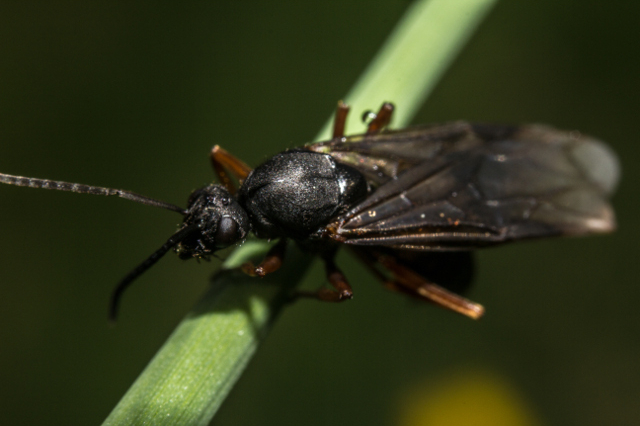
The female adult has a deep-black body, green eyes, and a mussel-brown head, front legs, and abdominal tip.[16]
Male individuals are slimmer and darker than females and lack an ovipositor.[17]
Classification of the Ladybird Parasitoid Wasp
| Kingdom | Animalia |
|---|---|
| Phylum | Arthropoda |
| Subphylum | Hexapoda |
| Class | Insecta (Insect) |
| Order | Hymenoptera (Ants) |
| Suborder | Apocrita (Ants) |
| Infraorder | Terebrantes |
| Superfamily | Ichneumonoidea |
| Family | Braconidae (Braconids) |
| Subfamily | Euphorinae |
| Tribe | Dinocampini |
| Genus | Dinocampus |
| Species | Dinocampus coccinellae (Schrank, 1802) |
Where the Ladybird Parasitoid Wasp is found
Checklists and occurrence records place Dinocampus coccinellae in 23 countries. GBIF holds 1,831 georeferenced records of it.
Countries
- Australia 22
- Austria 22
- Belgium 62
- Canada 169
- Czechia 7
- Denmark 119
- Finland 7
- France 51
- Germany 147
- Greenland 4
- Hungary 10
- Ireland 5
- Italy 22
- New Zealand 134
- Norway 56
- Poland 23
- Romania 3
- Serbia 4
- Spain 3
- Sweden 193
- The Netherlands 86
- United Kingdom 380
- United States 302
Regions and cities with the most records
- England, United Kingdom 355
- Skåne, Sweden 61
- California, United States 58
- Ontario, Canada 57
- Zealand, Denmark 47
- British Columbia, Canada 40
- Västra Götaland, Sweden 39
- Cambridge, United Kingdom 36
- Oregon, United States 36
- Malmö, Sweden 35
- Limhamn, Sweden 34
- Royston, United Kingdom 31
- Hazel Dell, United States 28
- Lake Oswego, United States 28
- North Rhine-Westphalia, Germany 28
- Orchards, United States 28
- Portland, United States 28
- Vancouver, United States 28
- Aloha, United States 27
- Beaverton, United States 27
- Bethany, United States 27
- Beverley, United Kingdom 27
- Happy Valley, United States 27
- Milwaukie, United States 27
- Oak Grove, United States 27
- Tigard, United States 27
- Tualatin, United States 27
- Brough, United Kingdom 26
- Canterbury, United Kingdom 26
- Colorado, United States 26
- Gotland, Sweden 26
- Otago, New Zealand 26
- West Linn, United States 26
- Dover, United Kingdom 25
- Five Corners, United States 25
- Gresham, United States 25
6 more countries have a few records outside this range
These countries hold a few records of Dinocampus coccinellae but lie outside the range the checklists give for it. Such records are often zoo or garden specimens, museum material or vagrants, so the species is not counted as occurring there.
A number beside a place is its count of GBIF occurrence records. A place without a number comes from a checklist alone. Records show where a species has been observed or collected, which can include escapes and vagrants.
Common names
English
- Ladybird Parasitoid Wasp
- Lady Beetle Parasitoid Wasp
Names in 5 other languages
- Chinese
- 瓢蟲繭蜂
- German
- Marienkäfer-Brackwespe
- Hungarian
- katica-gyilkosfürkész
- Japanese
- テントウハラボソコマユバチ
- Korean
- 무당벌레기생고치벌
Synonyms
6 other scientific names have been used for this species and are now treated as synonyms of Dinocampus coccinellae.
- Bracon terminalis (Nees, 1811, 1812)
- Bracon terminatus Nees von Esenbeck, 1811
- Dinocampus americanus (Riley, 1888)
- Dinocampus sculptus (Cresson, 1872)
- Dinocampus terminatus (Nees, 1811)
- Ichneumon coccinellae Schrank, 1802
Related species
-
 Tomato Hornworm Parasitoid WaspCotesia congregata
-
 Cabbage White Parasitoid WaspCotesia glomerata
-
 Habrobracon hebetor
-
 Aleiodes shakirae
- Aleiodes gaga
- Microgaster godzilla
- Diachasmimorpha longicaudata
-
 Aphidius ervi
Compare
Questions and answers
What is the scientific name of the Ladybird Parasitoid Wasp?
The scientific name of the Ladybird Parasitoid Wasp is Dinocampus coccinellae. Written with its author, the full name is Dinocampus coccinellae (Schrank, 1802).
Which family does the Ladybird Parasitoid Wasp belong to?
Dinocampus coccinellae belongs to the family Braconidae, in the order Hymenoptera and the class Insecta.
Where is the Ladybird Parasitoid Wasp found?
Checklists and occurrence records place Dinocampus coccinellae in 23 countries, including United Kingdom, United States, Sweden, Canada, Germany and New Zealand.
What other names does the Ladybird Parasitoid Wasp have?
Dinocampus coccinellae is also known in English as Lady Beetle Parasitoid Wasp.
What do parasitoid wasps eat?
The larva of Ladybird Parasitoid Wasp feeds on the fat bodies and gonads of its ladybird host.[2]
Where do parasitoid wasps live?
Ladybird Parasitoid Wasp develops inside ladybird beetle hosts, including the spotted lady beetle Coleomegilla maculata.[1]
Sources
Passages the profile rests on
- The species develops inside ladybird beetle hosts, including the spotted lady beetle Coleomegilla maculata. Source passage: “Dinocampus coccinellae is a braconid wasp parasite of coccinellid beetles, including the spotted lady beetle, Coleomegilla maculata.” — English Wikipedia
- The larva feeds on the fat bodies and gonads of its ladybird host. Source passage: “before beginning to feed on the ladybird's fat bodies and gonads.” — English Wikipedia
- Adult females primarily seek adult female ladybirds as hosts but sometimes lay eggs in adult males or larval stages. Source passage: “The mature female wasp seeks out adult female ladybirds, although they will sometimes oviposit into a male adult or larval instar.” — English Wikipedia
- The infected ladybird continues foraging and feeding while the wasp larva develops inside it. Source passage: “Meanwhile, the ladybird continues to forage and feed” — English Wikipedia
- The parasitized ladybird protects the wasp cocoon by deterring approaching predators. Source passage: “The ladybird becomes the parasite's bodyguard, by protecting it from predators.” — English Wikipedia
- Approximately one-quarter of parasitized ladybirds recover from paralysis after the wasp has emerged. Source passage: “some 25% of ladybirds revive and emerge from paralysis once the cocoon has been emptied.” — English Wikipedia
- Nearly all individuals of this species are female offspring produced from unfertilized eggs, although males occur occasionally. Source passage: “Nearly all D. coccinellae are female offspring of unfertilized eggs, although males are also occasionally found.” — English Wikipedia
- The female deposits a single egg beneath the soft underside of its ladybird host. Source passage: “One egg is planted in the host's soft underbelly.” — English Wikipedia
- The egg hatches into a first-instar larva after approximately five to seven days. Source passage: “The wasp larva hatches after 5–7 days into a first instar larva with large mandibles” — English Wikipedia
- The developing larva passes through four instars inside its ladybird host over 18–27 days. Source passage: “The wasp larva inside the ladybird goes through four larval instars in 18–27 days.” — English Wikipedia
- When ready to leave its host, the wasp larva paralyzes the ladybird before emerging. Source passage: “when it is ready to emerge, paralyzes the ladybird before tunneling out.” — English Wikipedia
- The wasp pupates in a cocoon attached to the leg of its living ladybird host. Source passage: “It pupates in a cocoon attached to the leg of the living ladybird” — English Wikipedia
- Adult wasps emerge from their cocoons approximately six to nine days after pupation. Source passage: “After 6–9 days, the wasp emerges from the cocoon.” — English Wikipedia
- The species can itself be parasitized by the hyperparasite Gelis agilis. Source passage: “Dinocampus coccinellae can itself be parasitised by Gelis agilis, a hyperparasite that is known for its mimicry of ants.” — English Wikipedia
- The hyperparasite Gelis agilis deposits eggs inside the cocoons of Dinocampus coccinellae, where its larvae consume the developing wasps. Source passage: “The wingless females of G. agilis oviposit into D. coccinellae cocoons; the egg immediately hatches and consumes the developing wasp.” — English Wikipedia
- The female adult was described as having a deep-black body, green eyes, and a mussel-brown head, front legs, and abdominal tip. Source passage: “Deep black, eyes green; head, front legs, and apex of the petiolate abdomen mussel-brown.” — English Wikipedia
- Male individuals are slimmer and darker than females and lack an ovipositor. Source passage: “The male, when observed, has no ovipositor and is slimmer and darker than females.” — English Wikipedia
Data
- Catalogue of Life, 2026-10-16 XR cc by
- Global Biodiversity Information Facility CC BY 4.0
- Wikidata CC0
- GeoNames CC BY 4.0
- Wikimedia Commons per image; credit shown with each image
- Within the Catalogue of Life, this name comes from Taxapad Ichneumonoidea cc by
References
- Schrank, & von Paula, F. (1802). Fauna Boica. 2(2). Ingolstadt. 412 Pp. (Ichneumon on Pp. 261-319.). where the name was published
This species in other databases
Page built on 27 November 2026. See how the catalog is made and all sources and licences.
Cite this page
ScientificNames.org. (2026). Dinocampus coccinellae (Ladybird Parasitoid Wasp). Retrieved November 27, 2026, from https://scientificnames.org/species/dinocampus-coccinellae
“Dinocampus coccinellae (Ladybird Parasitoid Wasp).” ScientificNames.org, 2026, scientificnames.org/species/dinocampus-coccinellae. Accessed 27 Nov. 2026.
ScientificNames.org. “Dinocampus coccinellae (Ladybird Parasitoid Wasp).” Accessed November 27, 2026. https://scientificnames.org/species/dinocampus-coccinellae.
@misc{scientificnames_dinocampus_coccinellae_ladybird_parasitoid_wasp,
  author = {{ScientificNames.org}},
  title = {Dinocampus coccinellae (Ladybird Parasitoid Wasp)},
  year = {2026},
  url = {https://scientificnames.org/species/dinocampus-coccinellae},
  note = {Accessed 2026-11-27}
}