Species · Other invertebrates
Dog Tapeworm Dipylidium caninum
The scientific name of the Dog Tapeworm is Dipylidium caninum. It is a species of animal in the family Dipylidiidae, order Cyclophyllidea. The name dates from 1758.
- Scientific name
- Dipylidium caninum (Linnaeus, 1758)
- Common name
- Dog Tapeworm
- Genus
- Dipylidium
- Family
- Dipylidiidae
- Order
- Cyclophyllidea
- Class
- Cestoda
- Environment
- terrestrial
- Recorded in
- 29 countries
- Name status
- accepted in the Catalogue of Life
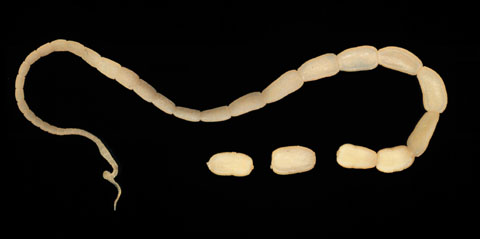
Overview
Adult worms inhabit the small intestine of their definitive vertebrate hosts. The species has a segmented body, a hooked scolex, and a life cycle involving an intermediate flea host and a definitive vertebrate host.
Written 26 November 2026 from the sources listed below. Each statement was checked against the passage it cites; statements that could not be supported were removed.
Appearance
Each proglottid has two genital pores, one along each lateral edge. Gravid proglottids have a barrel-like outline and contain numerous egg capsules.[1][2]
Adult worms can reach 60 cm in length and 3 mm in width. Other morphological descriptions report an average length of approximately 15 cm and a length of approximately 46 cm.[3][4][5]
The scolex has a transverse diameter of 250–500 micrometres. Individual egg packets typically contain five to fifteen or more eggs.[6][7]
Habitat
Adult worms inhabit the small intestine of their definitive vertebrate hosts. The cysticercoid larval stage develops within the body cavity of an infected flea.[8][9]
Behaviour
Adult worms attach to the intestinal lining of their definitive hosts using their hooked scolex. Freshly detached proglottids can crawl out of the host's anus and move around nearby surfaces.[10][11]
Most infections are asymptomatic, although infected pets may exhibit anal itching and scraping behaviour. The parasite can also cause mild gastrointestinal symptoms in infected animals.[12][13]
Reproduction and life cycle
Gravid proglottids detach from the adult worm and release egg packets through their genital pores. The life cycle requires an intermediate flea host and a definitive vertebrate host.[14][15]
Larval fleas ingest the parasite's eggs, which develop into cysticercoid larvae inside the insect. The most common intermediate hosts are larval stages of dog and cat fleas belonging to the genus Ctenocephalides.[16][17]
The dog chewing louse Trichodectes canis can occasionally act as an intermediate host. The infective cysticercoid reaches a definitive host when the infected adult flea is accidentally ingested.[18][19]
The cysticercoid develops into an adult tapeworm in the small intestine of the definitive host in approximately one month. Adult worms reach maturity approximately four to six weeks after ingestion of an infected flea.[20][21]
The normal definitive hosts are dogs and cats, while humans can occasionally serve as hosts. Human infections generally occur through accidental ingestion of an infected flea, and sexual maturity can develop approximately 20 days after ingestion.[22][23][24]
Classification of the Dog Tapeworm
| Kingdom | Animalia |
|---|---|
| Phylum | Platyhelminthes |
| Subphylum | Rhabditophora |
| Class | Cestoda |
| Subclass | Eucestoda |
| Order | Cyclophyllidea |
| Family | Dipylidiidae |
| Genus | Dipylidium |
| Species | Dipylidium caninum (Linnaeus, 1758) |
Where the Dog Tapeworm is found
Checklists and occurrence records place Dipylidium caninum in 29 countries. GBIF holds 529 georeferenced records of it.
Countries
- Canada 8
- China 4
- Croatia 4
- Democratic Republic of the Congo 4
- Egypt 24
- Finland 4
- France 7
- Germany 6
- Ghana 10
- India 5
- Iraq 30
- Israel 3
- Italy 5
- Japan 3
- Jordan 4
- Kazakhstan 13
- Malaysia 5
- Mexico 38
- Myanmar 3
- Pakistan 3
- Poland 7
- Portugal 21
- South Africa 8
- Spain 4
- Switzerland 11
- The Netherlands 7
- United Kingdom 20
- United States 259
- Yemen 9
Regions and cities with the most records
- Adams Morgan, United States 71
- Adelphi, United States 71
- Arlington, United States 71
- Beltsville, United States 71
- Bethesda, United States 71
- Brightwood, United States 71
- Capitol Riverfront, United States 71
- Central 14th Street / Spring Road, United States 71
- Chillum, United States 71
- College Park, United States 71
- Columbia Heights, United States 71
- Downtown DC, United States 71
- East Riverdale, United States 71
- Foggy Bottom, United States 71
- Golden Triangle, United States 71
- Greenbelt, United States 71
- H Street NE, United States 71
- Hyattsville, United States 71
- Kennedy Street, United States 71
- Landover, United States 71
- Langley Park, United States 71
- Mount Pleasant, United States 71
- Mount Vernon Triangle, United States 71
- NoMa, United States 71
- North Bethesda, United States 71
- Northwest One, United States 71
- Park View, United States 71
- Petworth, United States 71
- Pleasant Plains, United States 71
- Shaw, United States 71
- Silver Spring, United States 71
- Southwest Waterfront, United States 71
- Takoma Park, United States 71
- Washington, United States 71
- Wheaton, United States 71
- White Oak, United States 71
4 more countries have a few records outside this range
These countries hold a few records of Dipylidium caninum but lie outside the range the checklists give for it. Such records are often zoo or garden specimens, museum material or vagrants, so the species is not counted as occurring there.
A number beside a place is its count of GBIF occurrence records. A place without a number comes from a checklist alone. Records show where a species has been observed or collected, which can include escapes and vagrants.
Common names
English
- Dog Tapeworm
- Flea Tapeworm
Names in 8 other languages
- Czech
- tasemnice psí
- Danish
- Hundebændelorm
- Dutch
- Hondenlintworm
- French
- Taenia du chien
- Korean
- 개조충
- Polish
- Tasiemiec psi
- Russian
- Огуречный цепень
- Thai
- พยาธิตืดหมัด
Synonyms
3 other scientific names have been used for this species and are now treated as synonyms of Dipylidium caninum.
- Dipylidium carracidoi Lopez-Neyra, 1929
- Taenia canina Linnaeus, 1758
- Taenia cucumerina Bloch, 1782
Questions and answers
What is the scientific name of the Dog Tapeworm?
The scientific name of the Dog Tapeworm is Dipylidium caninum. Written with its author, the full name is Dipylidium caninum (Linnaeus, 1758).
Which family does the Dog Tapeworm belong to?
Dipylidium caninum belongs to the family Dipylidiidae, in the order Cyclophyllidea and the class Cestoda.
Where is the Dog Tapeworm found?
Checklists and occurrence records place Dipylidium caninum in 29 countries, including United States, Mexico, Iraq, Egypt, Portugal and United Kingdom.
What other names does the Dog Tapeworm have?
Dipylidium caninum is also known in English as Flea Tapeworm.
Do fleas have tapeworms?
Fleas can serve as intermediate hosts for the Dog Tapeworm. Its cysticercoid larval stage develops within the body cavity of an infected flea.[9][15][17]
Which tapeworm is transmitted by fleas?
The Dog Tapeworm (Dipylidium caninum) is transmitted through accidental ingestion of an infected adult flea containing an infective cysticercoid.[18][24]
Sources
Passages the profile rests on
- The adult worm has two genital pores on each proglottid, one along each lateral edge. Source passage: “Mature proglottids are longer than their width and contain 2 sets each of male and female reproductive organs with a genital atrium on each lateral edge” — pmc.ncbi.nlm.nih.gov
- Gravid proglottids have a barrel-like outline and contain numerous egg capsules. Source passage: “Gravid proglottids are barrel-like in outline and contain 2 genital pores and hundreds of egg capsules (packets) in the uterus.” — pmc.ncbi.nlm.nih.gov
- Adult worms can reach 60 cm in length and 3 mm in width. Source passage: “The adult tapeworms (measuring up to 60 cm in length and 3 mm in width)” — cdc.gov
- Adult worms average approximately 15 cm in length according to one reported morphological description. Source passage: “D. caninum adults are relative small, averaging about 15 cm in length.” — pmc.ncbi.nlm.nih.gov
- The adult worm is approximately 46 cm long according to another morphological description. Source passage: “The adult worm is about 18 inches (46 cm) long.” — English Wikipedia
- The scolex has a transverse diameter of 250–500 micrometres. Source passage: “Adult worm scolex is rhomboidal in shape with a transverse diameter of 250–500 um.” — English Wikipedia
- Individual egg packets typically contain five to fifteen or more eggs. Source passage: “Proglottids of D. caninum contain characteristic egg packets that are round to ovoid and contain 5 to 15 or more eggs each.” — cdc.gov
- Adult worms inhabit the small intestine of their definitive vertebrate hosts. Source passage: “The adult tapeworms (measuring up to 60 cm in length and 3 mm in width) reside in the small intestine of the host, where they each attach by their scolex .” — cdc.gov
- The cysticercoid larval stage develops within the body cavity of an infected flea. Source passage: “Then the metacestode stage, a cysticercoid, develops in the coelomic cavity (abdominal cavity; main body cavity) of the flea larvae and remains there as the flea matures into an adult.” — English Wikipedia
- Freshly detached proglottids can crawl out of the host's anus and move around nearby surfaces. Source passage: “The motile proglottids can actively crawl out of the anus of the infected animal/person and migrate small distances” — English Wikipedia
- Adult worms attach to the intestinal lining of their definitive hosts using their hooked scolex. Source passage: “Its hooked scolex is specialized to hold it in place in the intestine.” — animaldiversity.org
- Most infections are asymptomatic, although infected pets may exhibit anal itching and scraping behaviour. Source passage: “Most infections with Dipylidium caninum are asymptomatic. Pets may exhibit behavior to relieve anal pruritis (such as scraping anal region across grass or carpeting).” — cdc.gov
- The parasite can cause mild gastrointestinal symptoms in infected animals. Source passage: “Mild gastrointestinal disturbances may occur.” — cdc.gov
- Gravid proglottids detach from the adult worm and release egg packets through their genital pores. Source passage: “Then, the proglottids expel typical egg packets through their bilateral genital pores” — pmc.ncbi.nlm.nih.gov
- The parasite's life cycle requires an intermediate flea host and a definitive vertebrate host. Source passage: “Its life cycle requires the use of two hosts, a flea and a vertebrate.” — animaldiversity.org
- Larval fleas ingest the parasite's eggs, which develop into cysticercoid larvae inside the insect. Source passage: “The intermediate host (most often larval stages of the dog or cat flea Ctenocephalides spp.) ingests egg packets, and the oncosphere within is released into the larval flea’s intestine.” — cdc.gov
- The most common intermediate hosts are larval stages of dog and cat fleas belonging to the genus Ctenocephalides. Source passage: “The intermediate host is usually the larval stages of the dog or cat flea (Ctenocephalides spp.)” — cdc.gov
- The infective cysticercoid reaches a definitive host when the infected adult flea is accidentally ingested. Source passage: “The vertebrate host becomes infected by ingesting the adult flea containing the cysticercoid .” — cdc.gov
- The dog chewing louse Trichodectes canis can occasionally act as an intermediate host. Source passage: “and occasionally Trichodectes canis (the dog louse).” — cdc.gov
- The cysticercoid develops into an adult tapeworm in the small intestine of the definitive host in approximately one month. Source passage: “In the small intestine of the vertebrate host, the cysticercoid develops into the adult tapeworm after about one month.” — cdc.gov
- Adult worms reach maturity approximately four to six weeks after ingestion of an infected flea. Source passage: “In the small intestine of the definitive host, the metacestode develops into an adult tapeworm, which reaches maturity 4–6 weeks after ingestion.” — English Wikipedia
- Human infections can develop to sexual maturity approximately 20 days after ingestion of an infected flea. Source passage: “Humans get infection by accidental ingestion of the infected dog or cat fleas; the cysticercoid is liberated in the intestine and develops its sexual maturity within about 20 days.” — pmc.ncbi.nlm.nih.gov
- The normal definitive hosts are dogs and cats, while humans can occasionally serve as hosts. Source passage: “Canids and felids are the normal hosts for Dipylidium caninum.” — cdc.gov
- Human infection generally occurs through accidental ingestion of an infected flea. Source passage: “Humans also acquire infection by ingesting the cysticercoid contaminated flea.” — cdc.gov
- The species occurs worldwide in domestic dogs and cats. Source passage: “Worldwide; this tapeworm is ubiquitous and common among pet dogs and cats.” — cdc.gov
- Human infections have been reported on every inhabited continent. Source passage: “Human infection is rare, but has been reported from every inhabited continent.” — cdc.gov
Data
- Catalogue of Life, 2026-10-16 XR cc by
- Global Biodiversity Information Facility CC BY 4.0
- Wikidata CC0
- GeoNames CC BY 4.0
- Wikimedia Commons per image; credit shown with each image
- Within the Catalogue of Life, this name comes from World List of Cestoda cc by
References
- Systema Naturae per Regna Tria Naturae, Secundum Classes, Ordines, Genera, Species, cum Characteribus, Differentiis, Synonymis, Locis. Tomus I. Editio Decima, Reformata. Impensis Direct. 824 pp. 1758 where the name was published
This species in other databases
- Catalogue of Life 8GN7C
- Wikidata Q81125
- iNaturalist 513998
- WoRMS urn:lsid:marinespecies.org:taxname:1507503
Page built on 28 November 2026. See how the catalog is made and all sources and licences.
Cite this page
ScientificNames.org. (2026). Dipylidium caninum (Dog Tapeworm). Retrieved November 28, 2026, from https://scientificnames.org/species/dipylidium-caninum
“Dipylidium caninum (Dog Tapeworm).” ScientificNames.org, 2026, scientificnames.org/species/dipylidium-caninum. Accessed 28 Nov. 2026.
ScientificNames.org. “Dipylidium caninum (Dog Tapeworm).” Accessed November 28, 2026. https://scientificnames.org/species/dipylidium-caninum.
@misc{scientificnames_dipylidium_caninum_dog_tapeworm,
  author = {{ScientificNames.org}},
  title = {Dipylidium caninum (Dog Tapeworm)},
  year = {2026},
  url = {https://scientificnames.org/species/dipylidium-caninum},
  note = {Accessed 2026-11-28}
}