Species · Spiders and other arachnids
Dark Fishing Spider Dolomedes tenebrosus
The scientific name of the Dark Fishing Spider is Dolomedes tenebrosus. It is a species of arachnid in the family Dolomedidae, order Araneae. The name dates from 1844.
- Scientific name
- Dolomedes tenebrosus Hentz, 1844
- Common name
- Dark Fishing Spider
- Genus
- Dolomedes
- Family
- Dolomedidae
- Order
- Araneae
- Class
- Arachnida
- Recorded in
- 2 countries
- Name status
- accepted in the Catalogue of Life

Overview
The Dark Fishing Spider is more adapted to terrestrial life than some other members of its genus. It commonly inhabits wooded areas, trees, and the margins of swamps, ponds, and lakes. Its abdomen has three conspicuous black W-shaped marks, each ending in a light brown mark.
Written 24 November 2026 from the sources listed below. Each statement was checked against the passage it cites; statements that could not be supported were removed.
Appearance
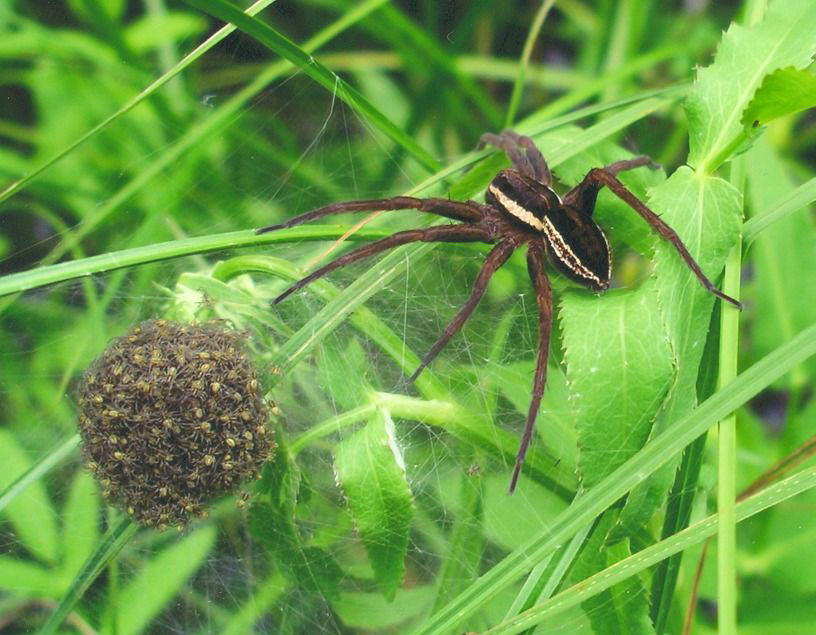
The Dark Fishing Spider has a pale to dark brown body with chevron markings and lighter stripes around its legs. Its abdomen has three conspicuous black W-shaped marks, each ending in a light brown mark.[1][2]
Its femora have brown and black bands, while its tibiae have reddish-brown and black bands. Its legs have dark rings and long spines.[3][4]
Adult females have a body length of 15–26 mm, excluding the legs, while adult males have a body length of 7–13 mm. Its legs measure approximately 50–90 mm long.[5][6][7]
A large female can have a body approximately one inch long and measure over three inches when her legs are extended.[8][9]
Habitat
The Dark Fishing Spider commonly inhabits wooded areas and lives on trees. Its usual habitats include the margins of swamps, ponds, and lakes.[10][11]
Individuals may shelter beneath bridges and culverts in dark, damp locations. The species can also occur in dry wooded areas far from water.[12][13]
Diet
The Dark Fishing Spider feeds on small fish and aquatic insects. It is an opportunistic generalist feeder that also consumes slugs.[14][15]
Behaviour
The Dark Fishing Spider actively hunts after dark. During the day, individuals tend to hide in corners and crevices.[16][17]
The species stalks prey rather than catching it in webs. It can run across the surface of water and may dive beneath the water when frightened.[18][19][20]
The species typically flees when it detects movement.[21]
Reproduction and life cycle
Female Dark Fishing Spiders have been observed killing males during copulation. The female may terminate mating by killing the male.[22][23]
The egg sac can reach 14 mm in diameter and contain nearly 1,400 eggs. Shortly before hatching, the female attaches the egg sac to vegetation and constructs a nursery web around it.[24][25][26]
The female guards the nursery web after attaching the egg sac. The young remain in the nursery web for some time after hatching.[27][28]
Egg casings form in June. The female attaches the egg casing to plant material before the young hatch.[29][30]
Similar species
Dolomedes scriptus resembles the Dark Fishing Spider but has more pronounced white W-shaped abdominal markings.[31]
Classification of the Dark Fishing Spider
| Kingdom | Animalia |
|---|---|
| Phylum | Arthropoda |
| Subphylum | Chelicerata |
| Class | Arachnida (Arachnid) |
| Order | Araneae (Spider) |
| Family | Dolomedidae |
| Genus | Dolomedes (Fishing Spiders) |
| Species | Dolomedes tenebrosus Hentz, 1844 |
Origin of the name. Etymology. Latin, darkness
Where the Dark Fishing Spider is found
Checklists and occurrence records place Dolomedes tenebrosus in 2 countries across North America. GBIF holds 29,716 georeferenced records of it.
Countries
Regions and cities with the most records
- Ontario, Canada 4,470
- Ohio, United States 2,189
- Virginia, United States 1,975
- Pennsylvania, United States 1,587
- Maryland, United States 1,516
- New York, United States 1,488
- North Carolina, United States 1,347
- Minnesota, United States 1,077
- Potomac, United States 998
- Michigan, United States 994
- McLean, United States 975
- Quebec, Canada 946
- Tennessee, United States 805
- Bethesda, United States 803
- Vermont, United States 762
- Texas, United States 752
- Rockville, United States 725
- Nova Scotia, Canada 697
- Reston, United States 686
- Arlington, United States 684
- Illinois, United States 666
- Wheaton, United States 642
- Aspen Hill, United States 641
- Kentucky, United States 629
- Indiana, United States 622
- Silver Spring, United States 600
- Wisconsin, United States 539
- Washington, United States 521
- Downtown DC, United States 518
- Missouri, United States 506
- New Jersey, United States 504
- Massachusetts, United States 486
- Connecticut, United States 485
- Gaithersburg, United States 479
- Centreville, United States 436
- West Virginia, United States 413
Range as the checklists state it
Canada, USA
A number beside a place is its count of GBIF occurrence records. A place without a number comes from a checklist alone. Records show where a species has been observed or collected, which can include escapes and vagrants.
Common names
English
- Dark Fishing Spider
Names in 3 other languages
- Czech
- lovčík tmavý
- French
- Araignée d'eau vagabonde
- Spanish
- Araña pescadora oscura
Related species
-
 Great Raft SpiderDolomedes plantarius
-
 Raft SpiderDolomedes fimbriatus
-
 White-banded Fishing SpiderDolomedes albineus
-
 Six-spotted Fishing SpiderDolomedes triton
-
 New Zealand Nursery Web SpiderDolomedes minor
-
 Striped Fishing SpiderDolomedes scriptus
-
 Water SpiderDolomedes aquaticus
-
 Banded Fishing SpiderDolomedes vittatus
Compare
Questions and answers
What is the scientific name of the Dark Fishing Spider?
The scientific name of the Dark Fishing Spider is Dolomedes tenebrosus. Written with its author, the full name is Dolomedes tenebrosus Hentz, 1844.
Which family does the Dark Fishing Spider belong to?
Dolomedes tenebrosus belongs to the family Dolomedidae, in the order Araneae and the class Arachnida.
Where is the Dark Fishing Spider found?
Checklists and occurrence records place Dolomedes tenebrosus in 2 countries: United States and Canada.
Sources
Passages the profile rests on
- The spider has a pale to dark brown body with chevron markings and lighter stripes around its legs. Source passage: “The spider is a pale to dark brown colour with several chevron markers and lighter stripes around its legs” — English Wikipedia
- The abdomen has three conspicuous black W-shaped marks, each ending in a light brown mark. Source passage: “The abdomen has 3 conspicuous black W-shaped marks, each of which ends in a light brown mark.” — arthropod.uark.edu
- Its femora have brown and black bands, while its tibiae have reddish-brown and black bands. Source passage: “The legs are banded with brown/black annulations on the femora and reddish-brown/black annulations on the tibia.” — English Wikipedia
- Its legs have dark rings and long spines. Source passage: “The legs have dark rings and long spines.” — arthropod.uark.edu
- Adult females have a body length of 15–26 mm, excluding the legs. Source passage: “Females are 15–26 millimetres (0.59–1.02 in) (excluding legs);” — English Wikipedia
- Adult males have a body length of 7–13 mm. Source passage: “and males are 7–13 millimetres (0.28–0.51 in).” — English Wikipedia
- Its legs measure approximately 50–90 mm long. Source passage: “Leg lengths range from 50–90 millimetres (2.0–3.5 in).” — English Wikipedia
- A large female can have a body approximately one inch long. Source passage: “The large female has a body (cephalothorax and abdomen) that reaches about 1” long.” — arthropod.uark.edu
- A female can measure over three inches when her legs are extended. Source passage: “If you add her legs, she can be over 3 inches long” — sercblog.si.edu
- The species commonly inhabits wooded areas and lives on trees. Source passage: “They are found in wooded areas and dwell on trees.” — English Wikipedia
- Its usual habitats include the margins of swamps, ponds, and lakes. Source passage: “Usual habitats for D. tenebrosus are swamp, pond, and lake margins” — arthropod.uark.edu
- Individuals may shelter beneath bridges and culverts in dark, damp locations. Source passage: “Individuals are also found in dark and damp situations beneath bridges or culverts” — arthropod.uark.edu
- The species can also occur in dry wooded areas far from water. Source passage: “Individuals sometimes stray quite far from water and may even be found in dry wooded areas.” — arthropod.uark.edu
- The species feeds on small fish and aquatic insects. Source passage: “They run freely over water in pursuit of prey, including small fish (Barbour 1921) and aquatic insects.” — arthropod.uark.edu
- The species is an opportunistic generalist feeder that also consumes slugs. Source passage: “Dark fishing spiders are, however, opportunistic, generalist feeders, and they have even been known to consume slugs” — arthropod.uark.edu
- The species actively hunts after dark. Source passage: “and they hunt actively after dark.” — arthropod.uark.edu
- During the day, individuals tend to hide in corners and crevices. Source passage: “The spiders tend to lurk in corners and crevices during the day” — arthropod.uark.edu
- The species stalks prey rather than catching it in webs. Source passage: “North American pisaurids are all wandering spiders, stalking their prey rather than snaring it in webs.” — arthropod.uark.edu
- Individuals may dive beneath the water when frightened. Source passage: “When frightened, they may dive beneath the surface.” — arthropod.uark.edu
- The species can run across the surface of water. Source passage: “They will even run on the water’s surface, using surface tension to maintain balance and buyancy.” — macalester.edu
- The species typically flees when it detects movement. Source passage: “but typically flees "at the slightest movement".” — English Wikipedia
- Female dark fishing spiders have been observed killing males during copulation. Source passage: “During copulation, females of the species practice sexual cannibalism on their male counterparts.” — English Wikipedia
- The female may terminate mating by killing the male. Source passage: “Mating behavior has been recorded only once, and in that case the female terminated copulation by killing the male” — arthropod.uark.edu
- The egg sac can reach 14 mm in diameter. Source passage: “The large egg sac of D. tenebrosus, measuring up to 14 mm in diameter” — arthropod.uark.edu
- An individual egg sac can contain nearly 1,400 eggs. Source passage: “Individual sacs have been known to contain nearly 1400 eggs” — arthropod.uark.edu
- Shortly before hatching, the female attaches the egg sac to vegetation and constructs a nursery web around it. Source passage: “Shortly before the eggs hatch, the mother attaches the sac to vegetation, builds a nursery web around it” — arthropod.uark.edu
- The female guards the nursery web after attaching the egg sac. Source passage: “and stands guard nearby.” — arthropod.uark.edu
- The young remain in the nursery web for some time after hatching. Source passage: “The young live in the nursery web for some time after hatching” — arthropod.uark.edu
- Egg casings form in June. Source passage: “Egg casings form in June” — macalester.edu
- The female attaches the egg casing to plant material before the young hatch. Source passage: “Days before the eggs hatch, the female attaches the sac to some plant matter” — macalester.edu
- Dolomedes scriptus resembles D. tenebrosus but has more pronounced white W-shaped abdominal markings. Source passage: “Dolomedes scriptus Hentz is similar to D. tenebrosus, but it has more pronounced W-shaped white marks associated with the black marks on the abdomen.” — arthropod.uark.edu
Data
- Catalogue of Life, 2026-10-16 XR cc by
- Global Biodiversity Information Facility CC BY 4.0
- Wikidata CC0
- GeoNames CC BY 4.0
- Wikimedia Commons per image; credit shown with each image
- Within the Catalogue of Life, this name comes from The World Spider Catalog cc by
References
- Hentz, N. M. (1844). Descriptions and figures of the araneides of the United States. Boston Journal of Natural History 4(4): 386-396, pl. 17-19. doi: <a href="https://doi.org/10.5962/bhl.part.16998" target="_blank">10.5962/bhl.part.16998 Link where the name was published
This species in other databases
Page built on 24 November 2026. See how the catalog is made and all sources and licences.
Cite this page
ScientificNames.org. (2026). Dolomedes tenebrosus (Dark Fishing Spider). Retrieved November 24, 2026, from https://scientificnames.org/species/dolomedes-tenebrosus
“Dolomedes tenebrosus (Dark Fishing Spider).” ScientificNames.org, 2026, scientificnames.org/species/dolomedes-tenebrosus. Accessed 24 Nov. 2026.
ScientificNames.org. “Dolomedes tenebrosus (Dark Fishing Spider).” Accessed November 24, 2026. https://scientificnames.org/species/dolomedes-tenebrosus.
@misc{scientificnames_dolomedes_tenebrosus_dark_fishing_spider,
  author = {{ScientificNames.org}},
  title = {Dolomedes tenebrosus (Dark Fishing Spider)},
  year = {2026},
  url = {https://scientificnames.org/species/dolomedes-tenebrosus},
  note = {Accessed 2026-11-24}
}