Species · Insects
Four-spotted Cup Moth Doratifera quadriguttata
The scientific name of the Four-spotted Cup Moth is Doratifera quadriguttata. It is a species of insect in the family Limacodidae (saddleback caterpillars), order Lepidoptera. The name dates from 1855.
- Scientific name
- Doratifera quadriguttata (Walker, 1855)
- Common name
- Four-spotted Cup Moth
- Genus
- Doratifera
- Family
- Limacodidae (Saddleback Caterpillars)
- Order
- Lepidoptera
- Class
- Insecta
- Recorded in
- 1 country
- Name status
- accepted in the Catalogue of Life

Overview
The Four-spotted Cup Moth is a moth first described by Francis Walker in 1855. It occurs in Australia, with a wide distribution spanning subtropical and temperate zones. Its red larvae have four pairs of black spots at each end of their bodies.
Written 27 November 2026 from the sources listed below. Each statement was checked against the passage it cites; statements that could not be supported were removed.
Appearance
Adult moths are brown and heavily built, with marbled forewings and a line of black spots on their forewings.[1][2]
Adult moths have a wingspan of 2–5 cm.[3]
The larvae are red and have four pairs of black spots at each end of their bodies. Mature larvae measure 20–35 mm in length.[4][5]
Habitat
The Four-spotted Cup Moth occurs in Australia, with a wide distribution spanning subtropical and temperate zones.[6][7]
Diet
The larvae feed on Tristaniopsis laurina, Lophostemon confertus and Rhizophora stylosa.[8][9][10]
The larvae also feed on Acacia and Eucalyptus species.[11]
Behaviour
Young caterpillars cluster together. Older larvae feed individually or in small groups.[12][13]
Older larvae consume entire leaves and feed alone or in groups of fewer than five individuals per leaf.[14][15]
The larvae possess raised stinging spines that can cause painful, sharp stings when disturbed.[16]
Reproduction and life cycle
After feeding on host-tree leaves, a caterpillar constructs an egg-shaped cocoon in which it pupates. The emerging adult moth exits its cocoon through a circular lid.[17][18]
The species usually produces two generations annually.[19]
Classification of the Four-spotted Cup Moth
| Kingdom | Animalia |
|---|---|
| Phylum | Arthropoda |
| Subphylum | Hexapoda |
| Class | Insecta (Insect) |
| Order | Lepidoptera |
| Superfamily | Zygaenoidea |
| Family | Limacodidae (Saddleback Caterpillars) |
| Genus | Doratifera |
| Species | Doratifera quadriguttata (Walker, 1855) |
Where the Four-spotted Cup Moth is found
Checklists and occurrence records place Doratifera quadriguttata in 1 country. GBIF holds 1,922 georeferenced records of it.
Countries
Regions and cities with the most records
- New South Wales, Australia 568
- Queensland, Australia 483
- Victoria, Australia 422
- South Australia, Australia 213
- Brisbane, Australia 118
- Balwyn North, Australia 98
- Canberra, Australia 95
- Burwood, Australia 90
- Australian Capital Territory, Australia 89
- Adelaide Hills, Australia 84
- Adelaide, Australia 80
- Tuggeranong, Australia 73
- Logan City, Australia 60
- Western Australia, Australia 60
- Capalaba, Australia 52
- Frankston East, Australia 52
- Narangba, Australia 50
- Armidale, Australia 46
- Melbourne, Australia 43
- Mount Barker, Australia 43
- Northern Territory, Australia 25
- Gympie, Australia 24
- Taree, Australia 23
- Bacchus Marsh, Australia 22
- St Albans, Australia 21
- Bairnsdale, Australia 16
- Liverpool, Australia 15
- Bathurst, Australia 13
- Goulburn, Australia 12
- Batemans Bay, Australia 11
- Gold Coast, Australia 10
- Wollongong, Australia 10
- Gawler, Australia 9
- Townsville, Australia 9
- Caloundra, Australia 8
- Central Coast, Australia 7
A number beside a place is its count of GBIF occurrence records. A place without a number comes from a checklist alone. Records show where a species has been observed or collected, which can include escapes and vagrants.
Common names
English
- Four-spotted Cup Moth
Synonyms
3 other scientific names have been used for this species and are now treated as synonyms of Doratifera quadriguttata.
- Anapaea quadriguttata Walker, 1855
- Doratifera unicolora Swinhoe, 1902
- Doratiophora lewini Scott, 1864
Related species
-
 Mottled Cup MothDoratifera vulnerans
-
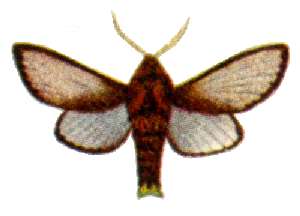 Painted Cup MothDoratifera oxleyi
-
 Doratifera pinguis
- Black Slug Cup MothDoratifera casta
- Doratifera corallina
- Doratifera nagodina
- Doratifera ochroptila
- Doratifera rufa
Compare
Questions and answers
What is the scientific name of the Four-spotted Cup Moth?
The scientific name of the Four-spotted Cup Moth is Doratifera quadriguttata. Written with its author, the full name is Doratifera quadriguttata (Walker, 1855).
Which family does the Four-spotted Cup Moth belong to?
Doratifera quadriguttata belongs to the family Limacodidae, in the order Lepidoptera and the class Insecta.
Where is the Four-spotted Cup Moth found?
Checklists and occurrence records place Doratifera quadriguttata in 1 country: Australia.
Sources
Passages the profile rests on
- Adult moths are brown and heavily built, with marbled forewings. Source passage: “Adult moths are brown and heavily built, with marbled forewings” — business.qld.gov.au
- Adult moths have a line of black spots on their forewings. Source passage: “Adult moths are brown and heavily built, with marbled forewings, a line of black spots on the forewings and a 2–5cm wingspan.” — business.qld.gov.au
- Adult moths have a wingspan of 2–5 cm. Source passage: “Adult moths are brown and heavily built, with marbled forewings, a line of black spots on the forewings and a 2–5cm wingspan.” — business.qld.gov.au
- The larvae are red and have four pairs of black spots at each end of their bodies. Source passage: “Larvae (caterpillars) are similar to those of D. vulnerans but are red with 4 pairs of black spots at each end of the body.” — business.qld.gov.au
- Mature larvae measure 20–35 mm in length. Source passage: “Mature larvae (caterpillars): are 20–35mm long” — business.qld.gov.au
- Doratifera quadriguttata occurs in Australia. Source passage: “It is found in Australia.” — English Wikipedia
- The species has a wide Australian distribution spanning subtropical and temperate zones. Source passage: “Wide distribution in Australia, ranging from subtropical to temperate zones” — business.qld.gov.au
- The larvae feed on Tristaniopsis laurina. Source passage: “The larvae feed on Tristaniopsis laurina, Lophostemon confertus, Rhizophora stylosa and Acacia and Eucalyptus species.” — English Wikipedia
- The larvae feed on Lophostemon confertus. Source passage: “The larvae feed on Tristaniopsis laurina, Lophostemon confertus, Rhizophora stylosa and Acacia and Eucalyptus species.” — English Wikipedia
- The larvae feed on Rhizophora stylosa. Source passage: “The larvae feed on Tristaniopsis laurina, Lophostemon confertus, Rhizophora stylosa and Acacia and Eucalyptus species.” — English Wikipedia
- The larvae feed on Acacia and Eucalyptus species. Source passage: “The larvae feed on Tristaniopsis laurina, Lophostemon confertus, Rhizophora stylosa and Acacia and Eucalyptus species.” — English Wikipedia
- Young caterpillars cluster together. Source passage: “Young caterpillars cluster together; older larvae feed singly or in small groups.” — business.qld.gov.au
- Older larvae feed individually or in small groups. Source passage: “Young caterpillars cluster together; older larvae feed singly or in small groups.” — business.qld.gov.au
- Older larvae consume entire leaves. Source passage: “Older larvae feed alone or in groups of less than 5 per leaf and consume the whole leaf.” — business.qld.gov.au
- Older larvae feed alone or in groups of fewer than five individuals per leaf. Source passage: “Older larvae feed alone or in groups of less than 5 per leaf and consume the whole leaf.” — business.qld.gov.au
- The larvae possess raised stinging spines that can cause painful, sharp stings when disturbed. Source passage: “have 4 bunches of spines at each end, which are raised when the insect is disturbed and cause painful, sharp stings” — business.qld.gov.au
- After feeding on host-tree leaves, a caterpillar constructs an egg-shaped cocoon in which it pupates. Source passage: “A caterpillar feeds on host tree leaves before building an egg-shaped cocoon, where it pupates.” — business.qld.gov.au
- The emerging adult moth exits its cocoon through a circular lid. Source passage: “A circular lid is cut in the cocoon and the adult moth emerges to recommence the life cycle.” — business.qld.gov.au
- The species usually produces two generations annually. Source passage: “Usually 2 generations are produced annually.” — business.qld.gov.au
Data
- Catalogue of Life, 2026-10-16 XR cc by
- Global Biodiversity Information Facility CC BY 4.0
- Wikidata CC0
- GeoNames CC BY 4.0
- Wikimedia Commons per image; credit shown with each image
- Within the Catalogue of Life, this name comes from Global Lepidoptera Index cc by
This species in other databases
Page built on 27 November 2026. See how the catalog is made and all sources and licences.
Cite this page
ScientificNames.org. (2026). Doratifera quadriguttata (Four-spotted Cup Moth). Retrieved November 27, 2026, from https://scientificnames.org/species/doratifera-quadriguttata
“Doratifera quadriguttata (Four-spotted Cup Moth).” ScientificNames.org, 2026, scientificnames.org/species/doratifera-quadriguttata. Accessed 27 Nov. 2026.
ScientificNames.org. “Doratifera quadriguttata (Four-spotted Cup Moth).” Accessed November 27, 2026. https://scientificnames.org/species/doratifera-quadriguttata.
@misc{scientificnames_doratifera_quadriguttata_four_spotted_cup_moth,
  author = {{ScientificNames.org}},
  title = {Doratifera quadriguttata (Four-spotted Cup Moth)},
  year = {2026},
  url = {https://scientificnames.org/species/doratifera-quadriguttata},
  note = {Accessed 2026-11-27}
}