Species · Flowering plants
Clawless Draba Draba exunguiculata
The scientific name of the Clawless Draba is Draba exunguiculata. It is a species of flowering plant in the family Brassicaceae (crucifer), order Capparales.
- Scientific name
- Draba exunguiculata (O.E.Schulz) C.L.Hitchc.
- Common name
- Clawless Draba
- Genus
- Draba
- Family
- Brassicaceae (Crucifer)
- Order
- Capparales
- Class
- Magnoliopsida
- Recorded in
- 1 country
- Name status
- accepted in the Catalogue of Life
Overview
Draba exunguiculata is endemic to Colorado in the United States, where it grows in alpine and open subalpine habitats. It is distinguished from Draba grayana by its erect, clawless petals.
Written 27 November 2026 from the sources listed below. Each statement was checked against the passage it cites; statements that could not be supported were removed.
Appearance
The stems bear between one and four sessile stem leaves. Its elongated flowering racemes contain four to twenty flowers, with four to thirteen being typical.[1][2][3]
Its ovate sepals measure 2–2.5 millimeters long, and its yellow petals can reach 3 millimeters long. Its fruits are flattened and range from lanceolate to oblong-lanceolate.[4][5][6]
Habitat
Clawless Draba grows on rocky and gravelly slopes and talus in alpine environments, typically over granitic bedrock. Its habitats include alpine tundra, rocky meadows, gravelly slopes, and fellfields, as well as open subalpine knolls and talus slopes.[7][8][9][10]
Reproduction and life cycle
Clawless Draba flowers from late June through August and produces fruit in August. Each ovary has between 20 and 24 ovules.[11][12][13]
The species is an apomict.[14]
Similar species
Draba grayana is a closely related species that sometimes occurs alongside Clawless Draba. Clawless Draba has erect, clawless petals, whereas Draba grayana has clawed, flared petals measuring 3–4.5 millimeters long.[15][16][17]
The stems and fruiting pedicels of Clawless Draba are hairless or sparsely covered with simple hairs. Those of Draba grayana are moderately to densely hairy and have simple and branched hairs.[18][19]
Conservation
Clawless Draba is listed by the United States federal government or a state. Recreational activities, including hiking and skiing, as well as non-motorized recreation, mining, grazing, and climate change, are identified as threats.[20][21][22]
Trampling by hikers may affect occurrences in popular hiking areas. Mountain goats also trample individual plants and may negatively affect habitat conditions in parts of the species' range.[23][24]
Over-collection for rock gardens is a conservation concern. The species has moderate adaptive capacity and moderate vulnerability to climate change.[25][26]
Classification of the Clawless Draba
| Kingdom | Plantae |
|---|---|
| Subkingdom | Pteridobiotina |
| Phylum | Tracheophyta |
| Class | Magnoliopsida |
| Order | Capparales |
| Family | Brassicaceae (Crucifer) |
| Subfamily | Brassicoideae |
| Tribe | Arabideae |
| Genus | Draba (Whitlow-grass) |
| Species | Draba exunguiculata (O.E.Schulz) C.L.Hitchc. |
Where the Clawless Draba is found
Checklists and occurrence records place Draba exunguiculata in 1 country across North America. GBIF holds 131 georeferenced records of it.
Countries
Regions and cities with the most records
Range as the checklists state it
USA (NC-Colorado: Clear Creek, El Paso, Grand, Summit Co.)
A number beside a place is its count of GBIF occurrence records. A place without a number comes from a checklist alone. Records show where a species has been observed or collected, which can include escapes and vagrants.
Common names
English
- Clawless Draba
Synonyms
4 other scientific names have been used for this species and are now treated as synonyms of Draba exunguiculata.
- Draba chrysantha S.Watson
- Draba chrysantha f. perhumilis O.E.Schulz
- Draba chrysantha var. exuguiculata O.E.Schulz
- Draba chrysantha var. exunguiculata O.E.Schulz
Related species
-
 Common Whitlow-grassDraba verna
-
 Yellow WhitlowgrassDraba aizoides
-
 Alpine Whitlow-grassDraba alpina
-
 Woods DrabaDraba nemorosa
-
 Slender DrabaDraba albertina
-
 Hoary WhitlowgrassDraba incana
-
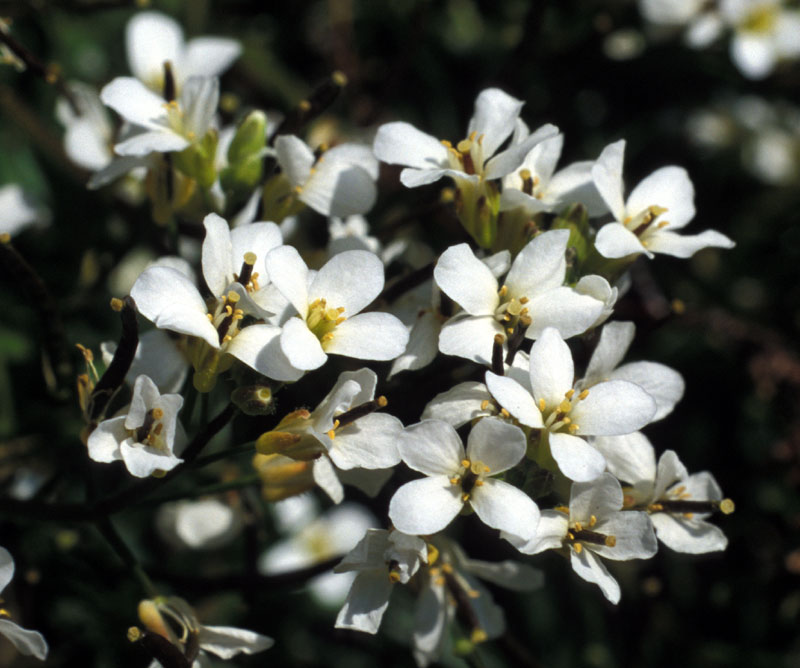 Milky DrabaDraba lactea
-
 Austrian DrabaDraba fladnizensis
Compare
Questions and answers
What is the scientific name of the Clawless Draba?
The scientific name of the Clawless Draba is Draba exunguiculata. Written with its author, the full name is Draba exunguiculata (O.E.Schulz) C.L.Hitchc..
Which family does the Clawless Draba belong to?
Draba exunguiculata belongs to the family Brassicaceae, in the order Capparales and the class Magnoliopsida.
Where is the Clawless Draba found?
Checklists and occurrence records place Draba exunguiculata in 1 country: United States.
Where is Clawless Draba found?
Clawless Draba is endemic to Colorado in the United States. It is recorded from Boulder, Clear Creek, El Paso, Gilpin, Grand, Lake, Park, San Juan, and Summit counties.[27][28]
At what elevations does Clawless Draba grow?
Its documented elevational range extends from 3,251 to 4,299 meters. It generally occurs between 3,600 and 4,000 meters.[29][30]
When does Clawless Draba flower and produce fruit?
It flowers from late June through August and produces fruit in August.[11][12]
How does Clawless Draba differ from Draba grayana?
Clawless Draba has erect, clawless petals, while Draba grayana has clawed, flared petals measuring 3–4.5 millimeters long. Clawless Draba also has hairless or sparsely simply hairy stems and fruiting pedicels, unlike the moderately to densely hairy stems and fruiting pedicels of Draba grayana.[15][16][17][18][19]
What does the name exunguiculata mean?
The scientific epithet exunguiculata means without claws in Botanical Latin.[31]
Sources
Passages the profile rests on
- Its stems bear between one and four sessile stem leaves. Source passage: “Cauline leaves 1-4; sessile” — cnhp.colostate.edu
- Its flowering structures are elongated racemes containing four to twenty flowers. Source passage: “Racemes 4-13(-20)-flowered” — cnhp.colostate.edu
- Its flowering racemes generally contain 4–13 flowers but can contain as many as 20. Source passage: “Racemes 4-13(-20)-flowered” — cnhp.colostate.edu
- Its sepals are ovate and measure 2–2.5 millimeters long. Source passage: “sepals ovate, 2-2.5 mm” — cnhp.colostate.edu
- Its fruits are flattened and range from lanceolate to oblong-lanceolate in shape. Source passage: “Fruits lanceolate to oblong-lanceolate, plane, flattened” — cnhp.colostate.edu
- Its yellow petals can reach 3 millimeters in length. Source passage: “yellow petals each up to 3 millimeters long.” — English Wikipedia
- The species grows on rocky and gravelly slopes and talus in alpine environments. Source passage: “Rocky, gravelly slopes and talus, in alpine areas” — cnhp.colostate.edu
- Its alpine habitat typically has granitic bedrock. Source passage: “in alpine areas typically with granitic bedrock” — cnhp.colostate.edu
- The species occurs in alpine tundra, including rocky meadows, gravelly slopes, and fellfields. Source passage: “It grows in the alpine tundra in rocky meadows, on gravelly slopes, and fellfields” — English Wikipedia
- The species also inhabits open subalpine locations such as knolls and talus slopes. Source passage: “rocky open subalpine habitats, such as open knolls and talus slopes.” — English Wikipedia
- The species flowers from late June through August. Source passage: “Flowers in late June through August” — cnhp.colostate.edu
- The species produces fruit in August. Source passage: “and fruits in August.” — cnhp.colostate.edu
- The species has between 20 and 24 ovules per ovary. Source passage: “ovules 20-24 per ovary” — cnhp.colostate.edu
- The species is an apomict. Source passage: “both species are apomicts that occasionally grow sympatrically.” — cnhp.colostate.edu
- Draba grayana is a closely related species that sometimes occurs alongside Draba exunguiculata. Source passage: “Draba exunguiculata is closely related to D. grayana, and they are occasionally found together” — cnhp.colostate.edu
- Draba exunguiculata differs from Draba grayana by having erect, clawless petals. Source passage: “by having erect, non-clawed petals, 2-3 mm” — cnhp.colostate.edu
- Draba grayana has clawed petals that are flared and measure 3–4.5 millimeters long. Source passage: “versus flared, clawed petals 3-4.5 mm” — cnhp.colostate.edu
- Draba exunguiculata has stems and fruiting pedicels that are hairless or sparsely covered with simple hairs. Source passage: “stems and fruiting pedicels glabrous or sparsely pubescent with simple trichomes” — cnhp.colostate.edu
- Draba grayana has moderately to densely hairy stems and fruiting pedicels with simple and branched hairs. Source passage: “moderately to densely pubescent with simple and 2- or 3-rayed trichomes” — cnhp.colostate.edu
- Recreational activities such as hiking and skiing are identified as threats to the species. Source passage: “The main threat to the species is recreational activity, such as hiking and skiing, in the habitat.” — English Wikipedia
- Non-motorized recreation, mining, grazing, and climate change are identified as threats to the species. Source passage: “Threats to Draba exunguiculata include non-motorized recreation, especially along the Continental Divide Trail, mining, grazing, and climate change” — cnhp.colostate.edu
- The species is listed by the United States federal government or a state. Source passage: “This plant is listed by the U.S. federal government or a state.” — plants.sc.egov.usda.gov
- Trampling by hikers may affect occurrences located in popular hiking areas. Source passage: “At least six occurrences are within popular hiking areas, and may be subjected to trampling by foot traffic” — cnhp.colostate.edu
- Mountain goats trample individual plants and may negatively affect habitat conditions in parts of the species' range. Source passage: “Mountain goats (Oreamnos americanus) trample individuals and are also likely to have a negative influence on habitat condition in some parts of its range.” — cnhp.colostate.edu
- Over-collection of the species for rock gardens is identified as a conservation concern. Source passage: “Over-collection as a desirable rock garden species is also a concern” — cnhp.colostate.edu
- The species is assessed as having moderate adaptive capacity and moderate vulnerability to climate change. Source passage: “This species is considered to have moderate adaptive capacity and is expected to be moderately vulnerable to climate change” — cnhp.colostate.edu
- The species is endemic to Colorado in the United States. Source passage: “It is endemic to Colorado in the United States.” — English Wikipedia
- The species is recorded from Boulder, Clear Creek, El Paso, Gilpin, Grand, Lake, Park, San Juan, and Summit counties in Colorado. Source passage: “known from Boulder, Clear Creek, El Paso, Gilpin, Grand, Lake, Park, San Juan and Summit counties.” — cnhp.colostate.edu
- Its documented elevational range extends from 3,251 to 4,299 meters. Source passage: “10,665 - 14,105 feet (3,251 - 4,299 meters)” — cnhp.colostate.edu
- The species generally occurs at elevations between 3,600 and 4,000 meters. Source passage: “but is more usually found at 3,600–4,000 m (11,800–13,100 ft).” — English Wikipedia
- The scientific epithet exunguiculata means without claws in Botanical Latin. Source passage: “exunguiculata, means without claws in Botanical Latin.” — English Wikipedia
Data
- Catalogue of Life, 2026-10-16 XR cc by
- Global Biodiversity Information Facility CC BY 4.0
- Wikidata CC0
- GeoNames CC BY 4.0
- Within the Catalogue of Life, this name comes from Synonymic Checklists of the Vascular Plants of the World cc by
References
- C.L.Hitchc. (1941). Univ. Wash. Publ. Biol. 11: 46 (1941). where the name was published
This species in other databases
Page built on 28 November 2026. See how the catalog is made and all sources and licences.
Cite this page
ScientificNames.org. (2026). Draba exunguiculata (Clawless Draba). Retrieved November 28, 2026, from https://scientificnames.org/species/draba-exunguiculata
“Draba exunguiculata (Clawless Draba).” ScientificNames.org, 2026, scientificnames.org/species/draba-exunguiculata. Accessed 28 Nov. 2026.
ScientificNames.org. “Draba exunguiculata (Clawless Draba).” Accessed November 28, 2026. https://scientificnames.org/species/draba-exunguiculata.
@misc{scientificnames_draba_exunguiculata_clawless_draba,
  author = {{ScientificNames.org}},
  title = {Draba exunguiculata (Clawless Draba)},
  year = {2026},
  url = {https://scientificnames.org/species/draba-exunguiculata},
  note = {Accessed 2026-11-28}
}