Species · Flowering plants
Norway Draba Draba norvegica
The scientific name of the Norway Draba is Draba norvegica. It is a species of flowering plant in the family Brassicaceae (crucifer), order Capparales.
- Scientific name
- Draba norvegica Gunnerus
- Common name
- Norway Draba
- Genus
- Draba
- Family
- Brassicaceae (Crucifer)
- Order
- Capparales
- Class
- Magnoliopsida
- Recorded in
- 15 countries
- Name status
- accepted in the Catalogue of Life

Overview
Norway draba is a small, herbaceous perennial flowering plant in the family Brassicaceae. It occurs along the Atlantic coast of eastern North America and in northwestern Europe, with separated inland populations. It is distinguished by dense clumps or tufts, white flowers and hairless or nearly hairless siliques.
Written 27 November 2026 from the sources listed below. Each statement was checked against the passage it cites; statements that could not be supported were removed.
Appearance
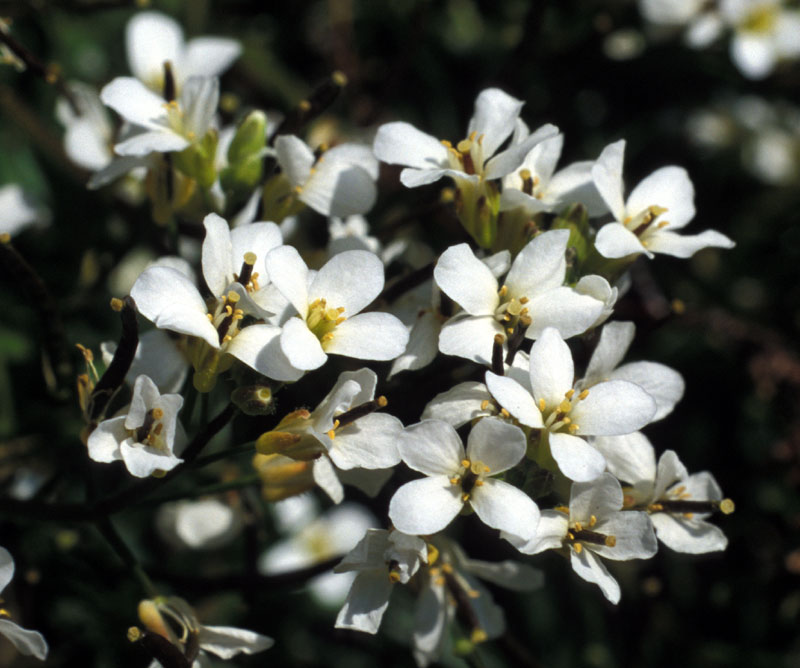
Norway draba is a small, herbaceous perennial plant that forms dense clumps or tufts. It produces a rosette of leaves from which its flowering stem emerges, and the stem may be unbranched or branched.[1][2][3]
The flowering stem typically measures 0.4–1.4 dm in height, with a documented range extending from 0.2 to 2 dm. The basal leaves are simple and narrowly oblanceolate, with hispid hairs, and the stem leaves are also covered with hispid hairs.[4][5][6]
The flowers grow in raceme inflorescences containing 5–23 flowers. They are white and have between two and four rays.[7][8]
The fruits are called siliques and are hairless or nearly hairless.[9]
Habitat
In Canada, Norway draba grows in arctic and subarctic environments. Canadian populations grow on gravelly shorelines.[10][11]
A Minnesota population grows on the rocky shores of Susie Island in Lake Superior. It occupies an environment described as arctic-like.[12][13]
The lower Coppermine River valley vegetation described in the 2017 study includes scattered white spruce and shrub tundra.[14]
Conservation
Norway draba is listed as an endangered species in Minnesota. Approximately 50 plants were counted in the Minnesota population in 1998.[15][16]
Classification of the Norway Draba
| Kingdom | Plantae |
|---|---|
| Subkingdom | Pteridobiotina |
| Phylum | Tracheophyta |
| Class | Magnoliopsida |
| Order | Capparales |
| Family | Brassicaceae (Crucifer) |
| Subfamily | Brassicoideae |
| Tribe | Arabideae |
| Genus | Draba (Whitlow-grass) |
| Species | Draba norvegica Gunnerus |
Where the Norway Draba is found
Checklists and occurrence records place Draba norvegica in 15 countries across Europe and North America. GBIF holds 10,551 georeferenced records of it.
Countries
- Austria 13
- Belgium 4
- Canada 507
- Denmark 12
- Estonia 66
- Faroe Islands 11
- Finland 259
- Greenland 658
- Iceland 1,635
- Norway 4,439
- Russia 96
- Svalbard and Jan Mayen 485
- Sweden 1,549
- United Kingdom 792
- United States 25
Regions and cities with the most records
- Nordland, Norway 1,026
- Scotland, United Kingdom 708
- Troms, Norway 554
- Norrbotten, Sweden 446
- Svalbard, Svalbard and Jan Mayen 317
- Västerbotten, Sweden 283
- Finnmark, Norway 282
- South, Iceland 268
- Jämtland, Sweden 231
- Quebec, Canada 165
- Lapland, Finland 147
- Akureyri, Iceland 117
- Tromsdalen, Norway 114
- Longyearbyen, Svalbard and Jan Mayen 102
- Tromsø, Norway 100
- Rogaland, Norway 92
- Møre og Romsdal, Norway 84
- Buskerud, Norway 69
- West, Iceland 66
- Fort William, United Kingdom 57
- Jan Mayen, Svalbard and Jan Mayen 52
- Newfoundland and Labrador, Canada 35
- Telemark, Norway 30
- Capital Region, Iceland 24
- Maardu, Estonia 19
- Alta, Norway 18
- Kiruna, Sweden 18
- Nenets, Russia 18
- Kujalleq, Greenland 16
- Reykjavík, Iceland 16
- Sermersooq, Greenland 16
- Tallinn, Estonia 15
- Kópavogur, Iceland 14
- Harjumaa, Estonia 12
- Hafnarfjörður, Iceland 11
- Nunavut, Canada 11
3 more countries have a few records outside this range
These countries hold a few records of Draba norvegica but lie outside the range the checklists give for it. Such records are often zoo or garden specimens, museum material or vagrants, so the species is not counted as occurring there.
Range as the checklists state it
Iceland; Jan Mayen; Svalbard; Faeroe Isl.; England (Scotland); Norway; Sweden; Finland; N-European Russia; Greenland; Canada (Newfoundland, Labrador, N. W. T., Nova Scotia, Quebec)
A number beside a place is its count of GBIF occurrence records. A place without a number comes from a checklist alone. Records show where a species has been observed or collected, which can include escapes and vagrants.
Common names
English
- Norway Draba
- Norway Whitlow-grass
- Norwegian Whitlow-grass
- Rock Whitlowgrass
Names in 9 other languages
- Faroese
- fjallavárperla
- Finnish
- kalliokynsimö
- French
- drave de Norvège
- German
- Norwegisches Felsenblümchen
- Norwegian Bokmål
- bergrublom
- Polish
- głodek norweski
- Russian
- Крупка норвежская
- Swedish
- bergdraba
- Welsh
- Bystwn y Graig, Llysiau'r Bystwn y Graig
Synonyms
42 other scientific names have been used for this species and are now treated as synonyms of Draba norvegica.
- Draba clivicola Fernald
- Draba furcata E.Ekman
- Draba hirta f. rupestris (R.Br.) Ostenf.
- Draba hirta var. distigmatica Hartm.
- Draba hirta var. norvegica (Gunnerus) Lilj.
- Draba hirta var. rupestris (W.T.Aiton) Wahlenb.
- Draba inferalpina E.Ekman
- Draba laxa Lindblom
- Draba laxa var. glabrata Lindblom
- Draba laxa var. gracilis Lindblom
- Draba laxa var. hebecarpa Lindblom
- Draba laxa var. legitima Lindblom
- Draba lindblomii E.Ekman
- Draba nemoralis var. hebecarpa (Lindblom) E.Lehm.
- Draba nemorosa var. hebecarpa Lindblom
- Draba norvegica var. berlinii O.E.Schulz
- Draba norvegica var. clivicola (Fernald) B.Boivin
- Draba norvegica var. glabrata (Lindblom) O.E.Schulz
- Draba norvegica var. hebecarpa (Lindblom) O.E.Schulz
- Draba norvegica var. intermedia (Lindblom) O.E.Schulz
- Draba norvegica var. laxa (Lindblom) O.E.Schulz
- Draba norvegica var. norvegica
- Draba proxima E.Ekman
- Draba rupestris R.Br.
- Draba rupestris f. glabriuscula Pohle
- Draba rupestris f. stellatopilosa Pohle
- Draba rupestris var. brachycarpa Sommerf.
- Draba rupestris var. distigmatica (Hartm.) Lindblom
- Draba rupestris var. glabrata (Lindblom) Lindblom
- Draba rupestris var. gracilis (Lindblom) Lindblom
- Draba rupestris var. hebecarpa (Lindblom) Lindblom
- Draba rupestris var. laxa (Lindblom) Lindblom
- Draba rupestris var. legitima (Lindblom) Lindblom
- Draba rupestris var. leiocarpa Regel
- Draba rupestris var. stricta Lindblom
- Draba scandinavica Lindblom
- Draba scandinavica var. distigmatica (Hartm.) Lindblom
- Draba scandinavica var. hebecarpa Lindblom
- Draba scandinavica var. legitima Lindblom
- Draba trichella Fr.
Showing 40 of 42.
Related species
-
 Common Whitlow-grassDraba verna
-
 Yellow WhitlowgrassDraba aizoides
-
 Alpine Whitlow-grassDraba alpina
-
 Woods DrabaDraba nemorosa
-
 Slender DrabaDraba albertina
-
 Hoary WhitlowgrassDraba incana
-
 Milky DrabaDraba lactea
-
 Austrian DrabaDraba fladnizensis
Compare
Questions and answers
What is the scientific name of the Norway Draba?
The scientific name of the Norway Draba is Draba norvegica. Written with its author, the full name is Draba norvegica Gunnerus.
Which family does the Norway Draba belong to?
Draba norvegica belongs to the family Brassicaceae, in the order Capparales and the class Magnoliopsida.
Where is the Norway Draba found?
Checklists and occurrence records place Draba norvegica in 15 countries, including Norway, Iceland, Sweden, United Kingdom, Greenland and Canada.
What other names does the Norway Draba have?
Draba norvegica is also known in English as Norway Whitlow-grass, Norwegian Whitlow-grass and Rock Whitlowgrass.
Where does Norway draba occur?
It occurs along the Atlantic coast of eastern North America and in northwestern Europe, with separated inland populations. It is recorded in Canada, and a small population occurs in Minnesota, United States, on Susie Island in Lake Superior.[17][18][19][20]
What is the conservation status of Norway draba in Minnesota?
Norway draba is listed as an endangered species in Minnesota.[15]
How many plants were counted in the Minnesota population?
Approximately 50 plants were counted in 1998.[16]
Sources
Passages the profile rests on
- Draba norvegica is a small, herbaceous perennial plant that forms dense clumps or tufts. Source passage: “Draba norvegica is a small cespitose (forming dense clumps or tufts), herbaceous perennial plant” — English Wikipedia
- The plant produces a rosette of leaves from which its flowering stem emerges. Source passage: “with a rosette of leaves from which a simple unbranched or branched” — English Wikipedia
- Its flowering stem may be either unbranched or branched. Source passage: “a simple unbranched or branched” — English Wikipedia
- The flowering stem typically measures 0.4–1.4 dm in height, with a documented range extending from 0.2 to 2 dm. Source passage: “(0.2-)0.4-1.4(-2) dm tall” — English Wikipedia
- The basal leaves are simple and narrowly oblanceolate, with hispid hairs. Source passage: “The basal leaves are simple, with hispid hairs, and narrowly oblanceolate in shape.” — English Wikipedia
- The stem leaves are covered with hispid hairs. Source passage: “The stem leaves are also covered in hispid hairs.” — English Wikipedia
- The flowers grow in raceme inflorescences containing 5–23 flowers. Source passage: “The flowers are arranged into a raceme inflorescence with 5-23-flowers.” — English Wikipedia
- The flowers are white and have between two and four rays. Source passage: “The flowers have 2 to 4 rays and are white in color.” — English Wikipedia
- The fruits are called siliques and are hairless or nearly hairless. Source passage: “The fruits (siliques) in contrast to the foliage are hairless or nearly so.” — English Wikipedia
- In Canada, the species grows in arctic and subarctic environments. Source passage: “In Canada it is found in arctic and subarctic areas” — English Wikipedia
- Canadian populations grow on gravelly shorelines. Source passage: “growing on gravelly shorelines, ledges, cliffs, and stone barrens.” — English Wikipedia
- A Minnesota population grows on the rocky shores of Susie Island in Lake Superior. Source passage: “found growing on the rocky shores of Susie island in lake superior” — English Wikipedia
- The Minnesota population occupies an environment described as arctic-like. Source passage: “which has an arctic-like environment.” — English Wikipedia
- The lower Coppermine River valley vegetation described in the 2017 study includes scattered white spruce and shrub tundra. Source passage: “Habitat comprises scattered white spruce (Picea glauca) and shrub tundra.” — pmc.ncbi.nlm.nih.gov
- Draba norvegica is listed as an endangered species in Minnesota. Source passage: “In Minnesota it is listed as an endangered species” — English Wikipedia
- Approximately 50 plants were counted in the Minnesota population in 1998. Source passage: “with around 50 plants counted in 1998.” — English Wikipedia
- The species occurs along the Atlantic coast of eastern North America and in northwestern Europe, with separated inland populations. Source passage: “Draba norvegica occurs along the Atlantic coast of eastern North America and northwestern Europe with disjunct inland populations.” — English Wikipedia
- The species is recorded in Canada. Source passage: “In Canada it is found in arctic and subarctic areas” — English Wikipedia
- A small population of the species occurs in Minnesota, United States. Source passage: “There is one small population in the USA state of Minnesota” — English Wikipedia
- The documented Minnesota population is located on Susie Island in Lake Superior. Source passage: “rocky shores of Susie island in lake superior” — English Wikipedia
Data
- Catalogue of Life, 2026-10-16 XR cc by
- Global Biodiversity Information Facility CC BY 4.0
- Wikidata CC0
- GeoNames CC BY 4.0
- Wikimedia Commons per image; credit shown with each image
- Within the Catalogue of Life, this name comes from Synonymic Checklists of the Vascular Plants of the World cc by
References
- Gunnerus. (1772). Fl. Norveg. 2: 106 (1772). where the name was published
This species in other databases
Page built on 29 November 2026. See how the catalog is made and all sources and licences.
Cite this page
ScientificNames.org. (2026). Draba norvegica (Norway Draba). Retrieved November 29, 2026, from https://scientificnames.org/species/draba-norvegica
“Draba norvegica (Norway Draba).” ScientificNames.org, 2026, scientificnames.org/species/draba-norvegica. Accessed 29 Nov. 2026.
ScientificNames.org. “Draba norvegica (Norway Draba).” Accessed November 29, 2026. https://scientificnames.org/species/draba-norvegica.
@misc{scientificnames_draba_norvegica_norway_draba,
  author = {{ScientificNames.org}},
  title = {Draba norvegica (Norway Draba)},
  year = {2026},
  url = {https://scientificnames.org/species/draba-norvegica},
  note = {Accessed 2026-11-29}
}