Species · Other invertebrates
Guinea Worm Dracunculus medinensis
The scientific name of the Guinea Worm is Dracunculus medinensis. It is a species of animal in the family Dracunculidae, order Rhabditida. The name dates from 1758.
- Scientific name
- Dracunculus medinensis (Linnaeus, 1758)
- Common name
- Guinea Worm
- Genus
- Dracunculus
- Family
- Dracunculidae
- Order
- Rhabditida
- Class
- Chromadorea
- Environment
- freshwater, terrestrial
- Recorded in
- 9 countries
- Name status
- accepted in the Catalogue of Life
Overview
Guinea Worm is a parasitic species that causes the disease known as dracunculiasis. The species favors freshwater habitats, particularly stagnant ponds, cisterns, pools in dried riverbeds, and temporary hand-dug wells.
Written 26 November 2026 from the sources listed below. Each statement was checked against the passage it cites; statements that could not be supported were removed.
Appearance
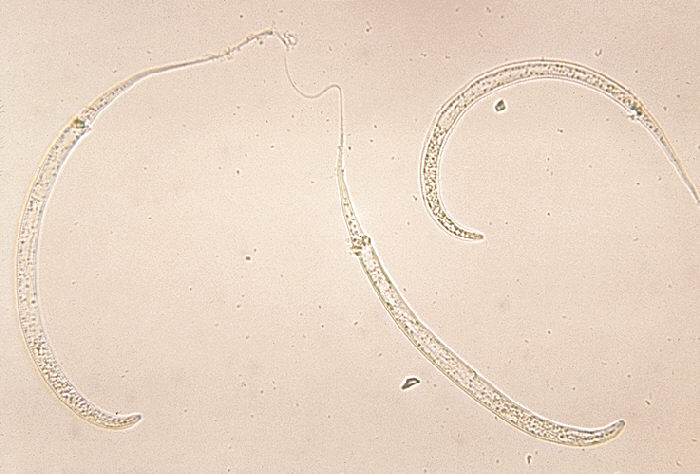
Adult females are long, white worms. Their bodies have three layers of epicuticle and one thick layer of cuticle, and the body cavity is occupied predominantly by the uterus.[1][2][3]
Mature females can reach 100 cm in length and measure 1–2 mm in thickness. Adult males recovered from experimental animals measure 15–40 mm in length and 0.4 mm in width.[4][5]
Habitat
The species favors freshwater habitats, particularly stagnant ponds, cisterns, pools in dried riverbeds, and temporary hand-dug wells. Its larvae develop inside freshwater copepods and can survive for a few days in freshwater.[6][7][8]
The mature female lives in subcutaneous connective tissues of the host before moving toward the skin surface.[9]
Diet
Adult female worms have intestines that are considered nonfunctional. Larval worms can store food in the anterior portion of their intestines.[10][11]
Behaviour
Mature females migrate toward the host's skin surface approximately one year after mating. They generally emerge through the host's lower extremities, particularly the feet and lower legs.[12][13]
The larvae require ingestion by suitable predatory copepods to continue their development.[14]
Reproduction and life cycle
A female can carry approximately three million embryos. Fertilized embryos develop inside the female until they reach the first larval stage.[15][16]
A mature female releases hundreds of thousands of first-stage larvae into water. The larvae develop into the infective third stage inside copepods in approximately fourteen days.[17][18]
Male worms become encapsulated and die after mating. The male worm dies approximately two months after mating according to observations reported in the species account.[19][20]
Conservation
As of 2023, the species remained endemic in Chad, Mali, South Sudan, Angola, and Ethiopia.[21]
In 2023, fourteen human infections were reported across Chad, South Sudan, Mali, Cameroon, and the Central African Republic. In the same year, 714 animal infections were reported.[22][23]
In 2020, infections were recorded in 1,507 domestic dogs in Chad.[24]
Uses
The traditional removal method involves winding the emerging worm around a stick.[25]
Classification of the Guinea Worm
| Kingdom | Animalia |
|---|---|
| Phylum | Nematoda |
| Class | Chromadorea |
| Subclass | Chromadoria |
| Order | Rhabditida |
| Suborder | Spirurina |
| Family | Dracunculidae |
| Genus | Dracunculus |
| Species | Dracunculus medinensis (Linnaeus, 1758) |
Where the Guinea Worm is found
Checklists and occurrence records place Dracunculus medinensis in 9 countries. GBIF holds 271 georeferenced records of it.
Countries
Regions and cities with the most records
- Klouékanmè, Benin 10
- Kouffo, Benin 10
- Toviklin, Benin 10
- Ganvié, Benin 4
- Zinvié, Benin 4
- Missérété, Benin 3
- Ouémé, Benin 3
2 more countries have a few records outside this range
These countries hold a few records of Dracunculus medinensis but lie outside the range the checklists give for it. Such records are often zoo or garden specimens, museum material or vagrants, so the species is not counted as occurring there.
A number beside a place is its count of GBIF occurrence records. A place without a number comes from a checklist alone. Records show where a species has been observed or collected, which can include escapes and vagrants.
Common names
English
- Guinea Worm
Names in 24 other languages
- Arabic
- تنينة مدينية
- Armenian
- Ռիշտա
- Azerbaijani
- Rişta
- Catalan
- Filària de Medina
- Chinese
- 麦地那龙线虫
- Czech
- Vlasovec medinský
- French
- Filaire de Médine
- Georgian
- რიშტა
- German
- Medinawurm
- Hebrew
- תולעת גינאה
- Indonesian
- cacing Guinea
- Italian
- filaria di Medina o verme di Guinea
- Korean
- 메디나충
- Lithuanian
- Rišta
- Polish
- Riszta
- Romanian
- vierme de Guineea sau filarie de Medina
- Russian
- Ришта
- Serbian
- Gvinejski crv
- Slovenian
- mali zmaj iz Medine
- Spanish
- gusano de Guinea
- Swedish
- Guineamask
- Vietnamese
- giun Guinea
- dag
- Nyili
- frr
- Guineawirem
Synonyms
2 other scientific names have been used for this species and are now treated as synonyms of Dracunculus medinensis.
- Filaria medinensis (Linnaeus, 1758)
- Gordius medinensis Linnaeus, 1758
Questions and answers
What is the scientific name of the Guinea Worm?
The scientific name of the Guinea Worm is Dracunculus medinensis. Written with its author, the full name is Dracunculus medinensis (Linnaeus, 1758).
Which family does the Guinea Worm belong to?
Dracunculus medinensis belongs to the family Dracunculidae, in the order Rhabditida and the class Chromadorea.
Where is the Guinea Worm found?
Checklists and occurrence records place Dracunculus medinensis in 9 countries, including Chad, Ethiopia, Benin, Sudan, Cameroon and Senegal.
Why is it called Dracunculus medinensis?
The scientific name Dracunculus medinensis has been translated as little dragon from Medina. The common name Guinea worm derives from the Guinea region of Western Africa.[26][27]
Do guinea worms still exist?
Yes. As of 2023, the species remained endemic in Chad, Mali, South Sudan, Angola, and Ethiopia. Fourteen human infections and 714 animal infections were reported in 2023.[21][22][23]
Where does the Guinea worm live?
The species favors freshwater habitats, particularly stagnant ponds, cisterns, pools in dried riverbeds, and temporary hand-dug wells. Larvae develop inside freshwater copepods, while mature females live in the host's subcutaneous connective tissues.[6][7][9]
Does dracunculiasis still exist?
Yes. In 2023, fourteen human infections were reported across Chad, South Sudan, Mali, Cameroon, and the Central African Republic, along with 714 animal infections.[22][23][28]
What type of parasite is Dracunculus medinensis?
Dracunculus medinensis is a parasitic species that causes the disease known as dracunculiasis.[28]
Sources
Passages the profile rests on
- Adult females are long, white worms. Source passage: “The female D. medinensis worm is a long white worm” — animaldiversity.org
- The female worm has three layers of epicuticle and one thick layer of cuticle. Source passage: “The female worm is covered in three layers of epicuticle and one thick layer of cuticle.” — animaldiversity.org
- The adult female's body cavity is occupied predominantly by her uterus. Source passage: “In adult females, the majority of the body cavity is occupied by the uterus.” — animaldiversity.org
- Mature females can reach 100 cm in length and measure 1–2 mm in thickness. Source passage: “A mature female D. medinensis is one of the longest nematodes, measuring up to 100 cm, but is only 1 to 2 mm wide” — pmc.ncbi.nlm.nih.gov
- Adult males recovered from experimental animals measure 15–40 mm in length and 0.4 mm in width. Source passage: “those from experimental animals measure 15 to 40 by 0.4 mm” — pmc.ncbi.nlm.nih.gov
- The species favors freshwater habitats, particularly stagnant ponds, cisterns, pools in dried riverbeds, and temporary hand-dug wells. Source passage: “Dracunculus medinensis favors freshwater habitats, mainly stagnant waters such as ponds, cisterns, pools in dried up riverbeds, and temporary hand-dug wells.” — animaldiversity.org
- The larvae develop inside freshwater copepods. Source passage: “D. medinensis L1 larvae are found in fresh water, where they are ingested by copepods (small crustaceans) of the genus Cyclops.” — English Wikipedia
- The larvae can survive for a few days in freshwater. Source passage: “They move actively in the water, resembling a free-living nematode, and can live for a few days in water.” — pmc.ncbi.nlm.nih.gov
- The mature female lives in subcutaneous connective tissues before moving toward the skin surface. Source passage: “The mature female worm lives in the subcutaneous connective tissues, moves to the surface of the skin” — pmc.ncbi.nlm.nih.gov
- Adult female worms have intestines that are considered nonfunctional. Source passage: “Adult female worms have intestines but the organs are thought to be nonfunctional.” — animaldiversity.org
- Larval worms can store food in the anterior portion of their intestines. Source passage: “In the larval worm, the anterior portion of the intestines can store food.” — animaldiversity.org
- Mature females migrate toward the host's skin surface approximately one year after mating. Source passage: “Approximately a year after mating, mature females with fertilized eggs move toward the surface of its host’s skin.” — animaldiversity.org
- Female worms generally emerge through the host's lower extremities, particularly the feet and lower legs. Source passage: “Once the adult female worm is ready to emerge she usually chooses the lower extremities such as the feet or lower legs to exit” — animaldiversity.org
- The larvae require ingestion by suitable predatory copepods to continue their development. Source passage: “For further development, the larvae need to be ingested by suitable predatory species of copepods” — pmc.ncbi.nlm.nih.gov
- A female can carry approximately three million embryos. Source passage: “The female carries 3 million embryos” — animaldiversity.org
- Fertilized embryos develop inside the female until they reach the first larval stage. Source passage: “Once fertilized, the embryos of D. medinensis develop inside the mother until they have matured into stage one larvae.” — animaldiversity.org
- A mature female releases hundreds of thousands of first-stage larvae into water. Source passage: “releases only hundreds of thousands of stage one larva into the water.” — animaldiversity.org
- Larvae develop into the infective third stage inside copepods in approximately fourteen days. Source passage: “Within the copepod, the D. medinensis larvae develop to an infective L3 stage within 14 days.” — English Wikipedia
- Male worms become encapsulated and die after mating. Source passage: “The males remain in the tissues and in a few months become encapsulated and die.” — pmc.ncbi.nlm.nih.gov
- The male worm dies approximately two months after mating according to observations reported in the species account. Source passage: “Two months after mating with the female, the male is encapsulated and dies.” — animaldiversity.org
- As of 2023, the species remained endemic in Chad, Mali, South Sudan, Angola, and Ethiopia. Source passage: “as of 2023, it remains endemic in five countries: Chad, Mali, South Sudan, Angola and Ethiopia” — English Wikipedia
- In 2023, fourteen human infections were reported across Chad, South Sudan, Mali, Cameroon, and the Central African Republic. Source passage: “There were 14 human GWD cases reported in 2023 in Chad, South Sudan, Mali, Cameroon, and Central African Republic.” — cdc.gov
- In 2023, 714 animal infections were reported. Source passage: “There were 714 animal GWD infections reported in 2023” — cdc.gov
- In 2020, infections were recorded in 1,507 domestic dogs in Chad. Source passage: “In 2020, Guinea worm was found in 1,507 domestic dogs in Chad” — English Wikipedia
- The traditional removal method involves winding the emerging worm around a stick. Source passage: “The only way to get rid of the guinea worms was to wind them onto sticks” — nationalgeographic.com
- The scientific name Dracunculus medinensis has been translated as little dragon from Medina. Source passage: “Dracunculus medinensis ("little dragon from Medina")” — English Wikipedia
- The common name Guinea worm derives from the Guinea region of Western Africa. Source passage: “The common name "Guinea worm" is derived from the Guinea region of Western Africa.” — English Wikipedia
- The species causes the parasitic disease known as dracunculiasis. Source passage: “Dracunculiasis, also known as Guinea worm disease (GWD), is an infection caused by the parasite Dracunculus medinensis.” — cdc.gov
Data
- Catalogue of Life, 2026-10-16 XR cc by
- Global Biodiversity Information Facility CC BY 4.0
- Wikidata CC0
- GeoNames CC BY 4.0
- Wikimedia Commons per image; credit shown with each image
- iNaturalist per image; credit shown with each image
- Within the Catalogue of Life, this name comes from Nemys, World Database of Nematodes cc by
This species in other databases
- Catalogue of Life BYBYQ
- Wikidata Q1502531
- iNaturalist 1460483
- WoRMS urn:lsid:marinespecies.org:taxname:1727908
Page built on 27 November 2026. See how the catalog is made and all sources and licences.
Cite this page
ScientificNames.org. (2026). Dracunculus medinensis (Guinea Worm). Retrieved November 27, 2026, from https://scientificnames.org/species/dracunculus-medinensis
“Dracunculus medinensis (Guinea Worm).” ScientificNames.org, 2026, scientificnames.org/species/dracunculus-medinensis. Accessed 27 Nov. 2026.
ScientificNames.org. “Dracunculus medinensis (Guinea Worm).” Accessed November 27, 2026. https://scientificnames.org/species/dracunculus-medinensis.
@misc{scientificnames_dracunculus_medinensis_guinea_worm,
  author = {{ScientificNames.org}},
  title = {Dracunculus medinensis (Guinea Worm)},
  year = {2026},
  url = {https://scientificnames.org/species/dracunculus-medinensis},
  note = {Accessed 2026-11-27}
}