Species · Flowering plants
Hill Jelutong Dyera costulata
The scientific name of the Hill Jelutong is Dyera costulata. It is a species of flowering plant in the family Apocynaceae (dogbane family), order Gentianales.
- Scientific name
- Dyera costulata (Miq.) Hook.fil.
- Common name
- Hill Jelutong
- Genus
- Dyera
- Family
- Apocynaceae (Dogbane Family)
- Order
- Gentianales
- Class
- Magnoliopsida
- Red List category
- LC Least Concern
- Recorded in
- 6 countries
- Name status
- accepted in the Catalogue of Life
Overview
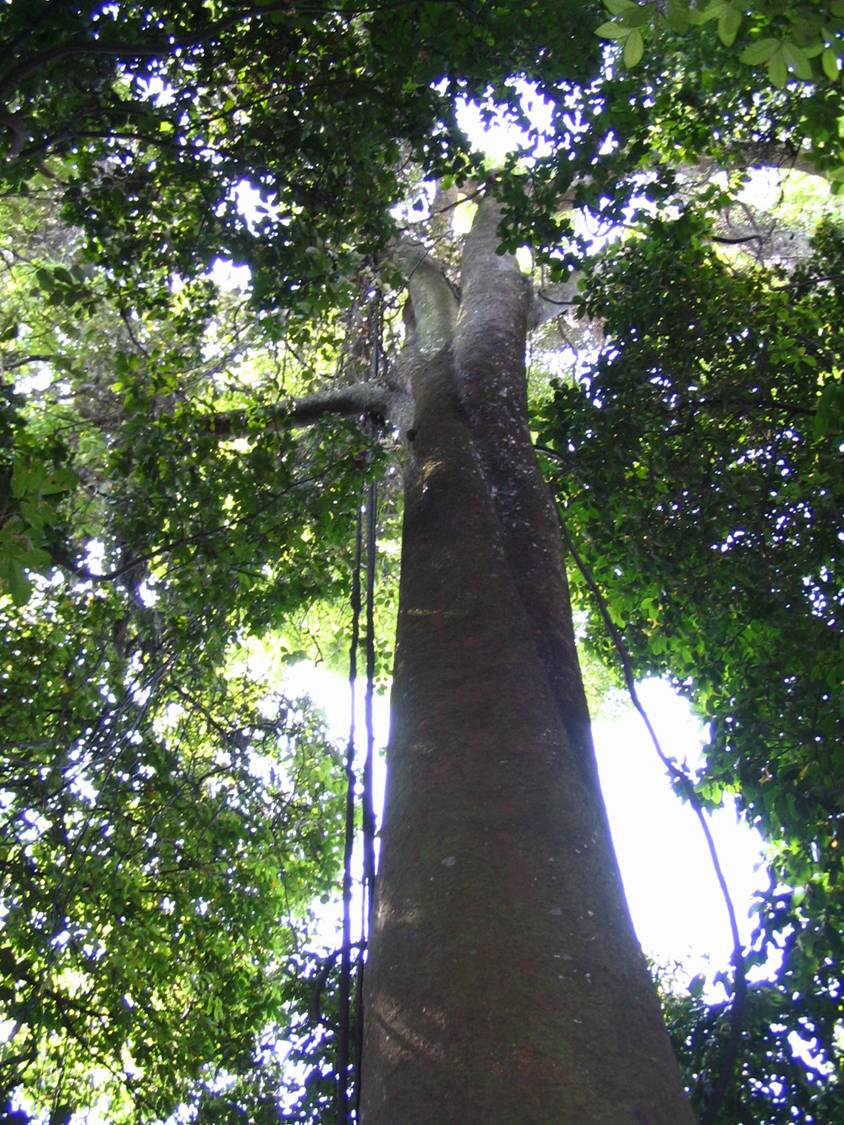
Dyera costulata occurs in scattered locations within low-elevation tropical evergreen forests. Some individuals reach 80 metres in height and 3 metres in diameter.
Written 26 November 2026 from the sources listed below. Each statement was checked against the passage it cites; statements that could not be supported were removed.
Appearance
Hill jelutong has a straight, clear trunk extending up to 30 metres. It typically reaches approximately 60 metres in height and 2 metres in diameter.[1][2]
Some individuals reach 80 metres in height and 3 metres in diameter.[3]
Habitat
Hill jelutong occurs in scattered locations within low-elevation tropical evergreen forests.[4]
Conservation
Hill jelutong has been threatened by traditional overharvesting in many areas. It is protected in certain parts of Malaysia and Thailand.[5][6]
Uses
Hill jelutong is cultivated commercially for its timber. Its latex can be harvested by tapping.[7][8]
The latex was an important source of chewing gum from the 1920s through the 1960s.[9]
The wood is used in model making and patternmaking because of its low density, straight grain and fine texture.[10]
The roots are used as a substitute for cork.[11]
Classification of the Hill Jelutong
| Kingdom | Plantae |
|---|---|
| Subkingdom | Pteridobiotina |
| Phylum | Tracheophyta |
| Class | Magnoliopsida |
| Order | Gentianales |
| Family | Apocynaceae (Dogbane Family) |
| Subfamily | Rauvolfioideae |
| Tribe | Alstonieae |
| Genus | Dyera |
| Species | Dyera costulata (Miq.) Hook.fil. |
Where the Hill Jelutong is found
Checklists and occurrence records place Dyera costulata in 6 countries across Asia. GBIF holds 472 georeferenced records of it.
Countries
Regions and cities with the most records
- Negeri Sembilan, Malaysia 63
- Ang Mo Kio New Town, Singapore 24
- Eunos, Singapore 24
- MacPherson, Singapore 24
- Novena, Singapore 24
- Singapore, Singapore 24
- Yio Chu Kang, Singapore 24
- Anak Bukit, Singapore 23
- Bukit Panjang New Town, Singapore 23
- Bukit Timah, Singapore 23
- Choa Chu Kang New Town, Singapore 23
- Jurong East, Singapore 23
- Jurong Town, Singapore 23
- Jurong West, Singapore 23
- Kampong Pasir Ris, Singapore 23
- Keat Hong Village, Singapore 23
- Marine Parade, Singapore 23
- Matilda Estate, Singapore 23
- Punggol, Singapore 23
- Queenstown Estate, Singapore 23
- Sengkang New Town, Singapore 23
- Teck Whye, Singapore 23
- Sembawang Estate, Singapore 22
- Sungai Simpang, Singapore 22
- Ulu Bedok, Singapore 22
- Yew Tee, Singapore 22
- Yishun New Town, Singapore 22
- Bedok New Town, Singapore 21
- Boon Lay, Singapore 21
- Kampung Pasir Gudang Baru, Malaysia 21
- Marsiling, Singapore 21
- Woodlands, Singapore 21
- Johor Bahru, Malaysia 20
- Pasir Gudang, Malaysia 20
- Kampong Loyang, Singapore 19
- Bangsar, Malaysia 17
1 more country has a few records outside this range
These countries hold a few records of Dyera costulata but lie outside the range the checklists give for it. Such records are often zoo or garden specimens, museum material or vagrants, so the species is not counted as occurring there.
Range as the checklists state it
India [c]; peninsular Thailand; peninsular Malaysia (widespread); Singapore; Sumatera; Borneo; Brunei; Jawa
A number beside a place is its count of GBIF occurrence records. A place without a number comes from a checklist alone. Records show where a species has been observed or collected, which can include escapes and vagrants.
Common names
English
- Hill Jelutong
Names in 6 other languages
- Chinese
- 大糖膠樹, 小脈夾竹桃
- Finnish
- kangasjelutoni
- Indonesian
- Jelutong, Jelutung
- Slovak
- dyera rebierkatá
- Swedish
- jelutongträd
- Thai
- Teen Pet Daeng
Synonyms
4 other scientific names have been used for this species and are now treated as synonyms of Dyera costulata.
- Alstonia costulata Miq.
- Alstonia eximia Miq.
- Alstonia grandifolia Miq.
- Dyera laxiflora Hook.fil.
Related species
- Swamp JelutongDyera polyphylla
-
 OleanderNerium oleander
-
 Blackboard TreeAlstonia scholaris
-
 Madagascar PeriwinkleCatharanthus roseus
-
 Desert RoseAdenium obesum
-
 Pong PongCerbera odollam
-
 GymnemaGymnema sylvestre
-
 IbogaTabernanthe iboga
Compare
Questions and answers
What is the scientific name of the Hill Jelutong?
The scientific name of the Hill Jelutong is Dyera costulata. Written with its author, the full name is Dyera costulata (Miq.) Hook.fil..
Which family does the Hill Jelutong belong to?
Dyera costulata belongs to the family Apocynaceae, in the order Gentianales and the class Magnoliopsida.
Where is the Hill Jelutong found?
Checklists and occurrence records place Dyera costulata in 6 countries: Indonesia, Malaysia, Singapore, Thailand, Brunei and India.
What is the conservation status of the Hill Jelutong?
The IUCN Red List category recorded for Dyera costulata is Least Concern (LC).
What is jelutong wood used for?
Jelutong wood is used in model making and patternmaking.[10]
What are the properties of jelutong wood?
Jelutong wood has low density, straight grain and fine texture.[10]
Sources
Passages the profile rests on
- Dyera costulata has a straight, clear trunk extending up to 30 metres. Source passage: “boles clear and straight for 30 m (90 ft).” — English Wikipedia
- Dyera costulata typically reaches approximately 60 metres in height and 2 metres in diameter. Source passage: “It grows to approximately 60 metres (200 ft) tall with diameters of 2 metres (5 to 6 ft)” — English Wikipedia
- Some individuals of Dyera costulata reach 80 metres in height and 3 metres in diameter. Source passage: “or even to 80 m (260 ft) tall with diameters to 3 m (10 ft)” — English Wikipedia
- Dyera costulata occurs in scattered locations within low-elevation tropical evergreen forests. Source passage: “Its natural distribution is scattered locales in low-elevation tropical evergreen forest.” — English Wikipedia
- Dyera costulata has been threatened by traditional overharvesting in many areas. Source passage: “Jelutong has been traditionally overharvested, and is a threatened species in many areas.” — English Wikipedia
- Dyera costulata is protected in certain parts of Malaysia and Thailand. Source passage: “It is a protected species in parts of Malaysia and Thailand.” — English Wikipedia
- Dyera costulata is cultivated commercially for its timber. Source passage: “The tree is grown commercially for timber.” — English Wikipedia
- The latex of Dyera costulata can be harvested by tapping. Source passage: “jelutong can be tapped for latex” — English Wikipedia
- Dyera costulata latex was an important chewing gum source from the 1920s through the 1960s. Source passage: “from the 1920s through the 1960s, jelutong latex was an important source of chewing gum.” — English Wikipedia
- The wood of Dyera costulata is used in model making and patternmaking because it has low density, straight grain and fine texture. Source passage: “These properties such as the low density, straight grain and fine texture mean it is easy to work with and hence popular with model makers and within the patternmaking trade.” — English Wikipedia
- The roots of Dyera costulata are used as a substitute for cork. Source passage: “The roots are used as a cork substitute.” — English Wikipedia
Data
- Catalogue of Life, 2026-10-16 XR cc by
- Global Biodiversity Information Facility CC BY 4.0
- Wikidata CC0
- GeoNames CC BY 4.0
- Wikimedia Commons per image; credit shown with each image
- Within the Catalogue of Life, this name comes from Synonymic Checklists of the Vascular Plants of the World cc by
References
- Hook.fil. (1882). J. Linn. Soc., Bot. 19: 293 (1882). where the name was published
This species in other databases
- Catalogue of Life 385V2
- Wikidata Q2714937
- iNaturalist 191771
- World Flora Online wfo-0000946993
- GRIN 14761
Page built on 28 November 2026. See how the catalog is made and all sources and licences.
Cite this page
ScientificNames.org. (2026). Dyera costulata (Hill Jelutong). Retrieved November 28, 2026, from https://scientificnames.org/species/dyera-costulata
“Dyera costulata (Hill Jelutong).” ScientificNames.org, 2026, scientificnames.org/species/dyera-costulata. Accessed 28 Nov. 2026.
ScientificNames.org. “Dyera costulata (Hill Jelutong).” Accessed November 28, 2026. https://scientificnames.org/species/dyera-costulata.
@misc{scientificnames_dyera_costulata_hill_jelutong,
  author = {{ScientificNames.org}},
  title = {Dyera costulata (Hill Jelutong)},
  year = {2026},
  url = {https://scientificnames.org/species/dyera-costulata},
  note = {Accessed 2026-11-28}
}