Species · Reptiles
Chinese Leopard Snake Elaphe bimaculata
The scientific name of the Chinese Leopard Snake is Elaphe bimaculata. It is a species of reptile in the family Colubridae (colubrid), order Squamata. The name dates from 1925.
- Scientific name
- Elaphe bimaculata Schmidt, 1925
- Common name
- Chinese Leopard Snake
- Genus
- Elaphe
- Family
- Colubridae (Colubrid)
- Order
- Squamata
- Class
- Reptilia
- Red List category
- NT Near Threatened
- Recorded in
- 1 country
- Name status
- accepted in the Catalogue of Life
Overview
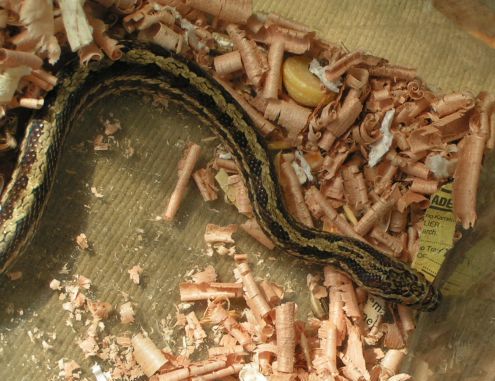
The Chinese Leopard Snake inhabits environments ranging from forest edges to cultivated areas. The species occurs in blotched and striped color-pattern phases, with the blotched phase being more common.
Written 26 November 2026 from the sources listed below. Each statement was checked against the passage it cites; statements that could not be supported were removed.
Appearance
The Chinese Leopard Snake occurs in both blotched and striped color-pattern phases. The blotched pattern is more common, and some individuals display a combination of a blotched anterior half and a striped posterior half.[1][2][3]
Adults typically measure between 60 and 80 cm in length. Females are generally larger and heavier than males.[4][5]
Habitat
The Chinese Leopard Snake inhabits environments ranging from forest edges to cultivated areas. It appears to prefer cooler temperatures and higher humidity.[6][7]
Diet
The Chinese Leopard Snake prefers relatively small prey, including young and half-grown mice.[8]
Behaviour
The Chinese Leopard Snake is described as secretive. It typically undergoes a hibernation period lasting 2–3 months.[9][10]
Reproduction and life cycle
The Chinese Leopard Snake has been recorded breeding at different times of the year. Females typically lay between 3 and 10 eggs in late spring.[11][12]
Egg incubation typically lasts between 35 and 48 days.[13]
Classification of the Chinese Leopard Snake
| Kingdom | Animalia |
|---|---|
| Phylum | Chordata |
| Subphylum | Vertebrata |
| Infraphylum | Gnathostomata |
| Parvphylum | Osteichthyes |
| Megaclass | Tetrapoda |
| Class | Reptilia (Reptile) |
| Order | Squamata (Snakes) |
| Suborder | Serpentes (Snakes) |
| Infraorder | Alethinophidia |
| Family | Colubridae (Colubrid) |
| Subfamily | Colubrinae |
| Genus | Elaphe (Fox Snakes) |
| Species | Elaphe bimaculata Schmidt, 1925 |
Where the Chinese Leopard Snake is found
Checklists and occurrence records place Elaphe bimaculata in 1 country across Asia. GBIF holds 89 georeferenced records of it.
Countries
Regions and cities with the most records
- Anhui, China 17
- Jiangsu, China 13
- Xiaolingwei, China 7
- Hubei, China 5
- Nanjing, China 5
- Zhejiang, China 5
- Hefei, China 3
- Jiangxi, China 3
- Jiujiang, China 3
- Inner Mongolia, China
Range as the checklists state it
C China (from E Sichuan to Jiangsu, north to Hebei; Chekiang, Anhwei, Jiangxi), Inner Mongolia
A number beside a place is its count of GBIF occurrence records. A place without a number comes from a checklist alone. Records show where a species has been observed or collected, which can include escapes and vagrants.
Common names
English
- Chinese Leopard Snake
- Twin-spotted Ratsnake
Names in 5 other languages
- Chinese
- 双斑锦蛇, 雙斑錦蛇
- Czech
- užovka dvojskvrnná
- German
- Chinesische Leopardnatter od. Zweifleckennatter, Zweifleckennatter
- Portuguese
- Cobra-leopardo-chinesa
- Russian
- Двухпятнистый лазающий полоз
Related species
-
 Japanese Rat SnakeElaphe climacophora
-
 King RatsnakeElaphe carinata
-
 Japanese Striped SnakeElaphe quadrivirgata
-
 Four-lined SnakeElaphe quatuorlineata
-
 Amur RatsnakeElaphe schrenckii
- Flower SnakeElaphe moellendorffi
- Steppe Rat SnakeElaphe dione
-
 Blotched SnakeElaphe sauromates
Compare
Questions and answers
What is the scientific name of the Chinese Leopard Snake?
The scientific name of the Chinese Leopard Snake is Elaphe bimaculata. Written with its author, the full name is Elaphe bimaculata Schmidt, 1925.
Which family does the Chinese Leopard Snake belong to?
Elaphe bimaculata belongs to the family Colubridae, in the order Squamata and the class Reptilia.
Where is the Chinese Leopard Snake found?
Checklists and occurrence records place Elaphe bimaculata in 1 country: China.
What is the conservation status of the Chinese Leopard Snake?
The IUCN Red List category recorded for Elaphe bimaculata is Near Threatened (NT).
What other names does the Chinese Leopard Snake have?
Elaphe bimaculata is also known in English as Twin-spotted Ratsnake.
Sources
Passages the profile rests on
- The species occurs in both blotched and striped color-pattern phases. Source passage: “It occurs as both blotched and striped phase” — English Wikipedia
- The blotched pattern is the more common phase in this species. Source passage: “with the blotched type being the more common or "typical" phase.” — English Wikipedia
- Some individuals display a combination pattern with a blotched anterior half and a striped posterior half. Source passage: “Some specimens even exhibit a pattern of half blotched, half striped where the anterior half is usually blotched and the posterior half striped.” — English Wikipedia
- Adults typically measure between 60 and 80 cm in length. Source passage: “is a small ratsnake (60–80 cm)” — English Wikipedia
- Females are generally larger and heavier than males. Source passage: “Females are known to grow larger and heavier than males.” — English Wikipedia
- The species inhabits environments ranging from forest edges to cultivated areas. Source passage: “They are found in many habitats ranging from the edge of forest to cultivated areas” — English Wikipedia
- The species appears to prefer cooler temperatures and higher humidity. Source passage: “seem to like cooler temperatures and higher humidity.” — English Wikipedia
- The species prefers relatively small prey, including young and half-grown mice. Source passage: “This secretive snake prefers smaller food items such as young to half grown mice.” — English Wikipedia
- The species is described as secretive. Source passage: “This secretive snake” — English Wikipedia
- The species typically undergoes a hibernation period lasting 2–3 months. Source passage: “A period of 2–3 months hibernation is typical.” — English Wikipedia
- The species has been recorded breeding at different times of the year. Source passage: “E. bimaculata has been known to breed at different times of the year” — English Wikipedia
- Females typically lay between 3 and 10 eggs in late spring. Source passage: “usually with 3-10 eggs being laid in late spring” — English Wikipedia
- Egg incubation typically lasts between 35 and 48 days. Source passage: “eggs require 35–48 days of incubation.” — English Wikipedia
Data
- Catalogue of Life, 2026-10-16 XR cc by
- Global Biodiversity Information Facility CC BY 4.0
- Wikidata CC0
- GeoNames CC BY 4.0
- Wikimedia Commons per image; credit shown with each image
- Within the Catalogue of Life, this name comes from The Reptile Database cc by
References
- Schmidt, KARL P. (1925). New Chinese amphibians and reptiles. American Museum Novitates (175): 1-3.
- Glass, Bryan P. (1946). A collection of reptiles from Hunan and Anhwei provinces, China. Copeia 1946 (4): 249-252.
- Schulz, K.-D. (1986). Die hinterasiatischen Kletternattern der Gattung Elaphe, Teil 5 Elaphe bimaculata (SCHMIDT, 1925). Sauria 8 (2): 23-26.
- Bartz, H. (1989). Keeping and breeding Elaphe bimaculata. Litteratura Serpentium 9 (6): 277-280.
- Schulz, & Klaus Dieter. (1989). Die hinterasiatischen Kletternattern der Gattung Elaphe. Teil 5: Elaphe bimaculata (Schmidt, 1925). Litteratura Serpentium 9 (3): 137.
- Zhao, E., & Adler, K. (1993). Herpetology of China. SSAR, Oxford/Ohio, 1-522.
- Langeveld, C.M. (Koert). (1995). The Chinese leopard snake, Elaphe bimaculata (K.P. Schmidt, 1925) an easy snake to keep. Litteratura Serpentium 15 (4): 82-88.
- Gillissen, F. (1996). Breeding results: Elaphe bimaculata. Litteratura Serpentium 16 (2): 53.
- Schulz, & Klaus-Dieter. (1996). A monograph of the colubrid snakes of the genus Elaphe Fitzinger. Koeltz Scientific Books, 439 Pp.
- Schulz, K. D. (1996). Eine Monographie der Schlangengattung Elaphe Fitzinger. Bushmaster, Berg (CH): 1-460.
- Mattison, & Chris. (1997). Four small Eurasian rat snakes. Reptiles 5 (3): 24-29.
- Wang, Y. Q., Zhou, K. Y., Xu, L. S., Yang, G., & Xu, G. J. (1999). The Evolutionary Relationships of Several Colubrid Snakes Suggested by Sequence Analysis of Cyt b Gene Fragment. Acta Zoologica Sinica 45:332-338.
- Meer, & Jan van het. (1999). Elaphe bimaculata. Litteratura Serpentium 19 (4): 119-121.
- Helfenberger, & Notker. (2001). Phylogenetic relationship of Old World Ratsnakes based on visceral organ topography, osteology, and allozyme variation. Russ. J. Herpetol. (Suppl.): 1-56.
- Utiger, Urs, Notker Helfenberger, Beat Schätti, Catherine Schmidt, & Markus Ruf and Vincent Ziswiler. (2002). Molecular systematics and phylogeny of Old World and New World ratsnakes, Elaphe Auct., and related genera (Reptilia, Squamata, Colubridae). Russ. J. Herpetol. 9 (2): 105-124.
- Diekmann, M., & Weyers, A. (2006). Haltung und Nachzucht der chinesischen Dione-Natter (Elaphe dione). Reptilia (Münster) 11 (58): 64-71.
- Zhao, E. M. (2006). The snakes of China [in Chinese]. Hefei, China, Anhui Sience & Technology Publ. House, Vol. I, 372 Pp., Vol. II (Color Plates), 280 Pp.
- Mattison, & Chris. (2007). The New Encyclopedia of Snakes. Princeton University Press.
- Treu, & Bruno. (2008). Amurnattern Elaphe schrenckii & Elaphe anomala. Natur Und Tier Verlag, Münster, 64 Pp.
- ZHANG Li-Jia BAO Wei-Dong. (2010). A New Record of Snake in Inner Mongolia: Elaphe bimaculata Nasendelger. Chinese Journal of Zoology 2010 - 3.
- Velden, & Robby van der. (2010). (Breeding)experience with the Chinese twin-spotted ratsnake (Elaphe bimaculata). Litteratura Serpentium 30 (1): 6-10.
- Wallach, Van; Kenneth L. Williams, Jeff Boundy. (2014). Snakes of the World: A Catalogue of Living and Extinct Species. [type catalogue]. Taylor and Francis, CRC Press, 1237 Pp.
- Augstenová, B., & Sofia Mazzoleni, L. K. O. a. M. R. (2017). Evolutionary Dynamics of the W Chromosome in Caenophidian Snakes. Genes 2018, 9(1), 5; Doi:10.3390/Genes9010005.
- Rovatsos M.; Augstenová B.; Altmanová M.; Sloboda M.; Kodym P. & Kratochvíl L. (2018). Triploid Colubrid Snake Provides Insight into the Mechanism of Sex Determination in Advanced Snakes. Sexual Development.
- Simonov, Evgeniy; Artem Lisachov, Natalia Oreshkova, Konstantin Krutovsky. (2018). The mitogenome of Elaphe bimaculata (Reptilia: Colubridae) has never been published: a case with the complete mitochondrial genome of E. dione. Acta Herpetologica 13 (2): 185-189.
This species in other databases
Page built on 27 November 2026. See how the catalog is made and all sources and licences.
Cite this page
ScientificNames.org. (2026). Elaphe bimaculata (Chinese Leopard Snake). Retrieved November 27, 2026, from https://scientificnames.org/species/elaphe-bimaculata
“Elaphe bimaculata (Chinese Leopard Snake).” ScientificNames.org, 2026, scientificnames.org/species/elaphe-bimaculata. Accessed 27 Nov. 2026.
ScientificNames.org. “Elaphe bimaculata (Chinese Leopard Snake).” Accessed November 27, 2026. https://scientificnames.org/species/elaphe-bimaculata.
@misc{scientificnames_elaphe_bimaculata_chinese_leopard_snake,
  author = {{ScientificNames.org}},
  title = {Elaphe bimaculata (Chinese Leopard Snake)},
  year = {2026},
  url = {https://scientificnames.org/species/elaphe-bimaculata},
  note = {Accessed 2026-11-27}
}