Species · Mammals
Tufted Deer Elaphodus cephalophus
The scientific name of the Tufted Deer is Elaphodus cephalophus. It is a species of mammal in the family Cervidae (deer), order Artiodactyla. The name dates from 1872.
- Scientific name
- Elaphodus cephalophus Milne-Edwards, 1872
- Common name
- Tufted Deer
- Genus
- Elaphodus
- Family
- Cervidae (Deer)
- Order
- Artiodactyla
- Class
- Mammalia
- Red List category
- NT Near Threatened
- Recorded in
- 2 countries
- Name status
- accepted in the Catalogue of Life
Overview
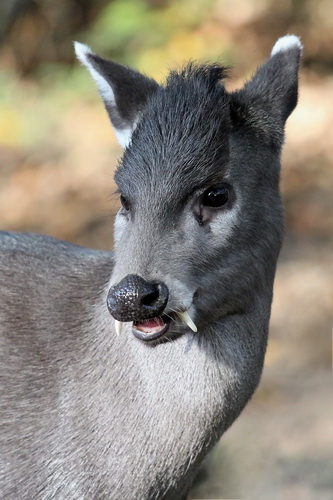
Elaphodus cephalophus is distinguished by a prominent black forehead tuft, very short antlers, and elongated canine teeth in males.
Written 26 November 2026 from the sources listed below. Each statement was checked against the passage it cites; statements that could not be supported were removed.
Appearance
The Tufted Deer has a prominent tuft of black hair on its forehead and upper neck. The tuft is horseshoe-shaped and can reach 17 centimetres in length.[1][2]
Its coarse coat changes from almost black in winter to chocolate brown in summer. The underside of the tail, lips, and ear tips are white.[3][4]
The species has very short antlers that are almost concealed by its forehead tuft. It has no upper incisors and possesses long, tusk-like upper canines.[5][6]
Adult Tufted Deer stand between 50 and 70 centimetres tall at the shoulder. Their reported body mass ranges from 17 to 30 kilograms, and their tail measures approximately 10 centimetres in length.[7][8][9]
The Animal Diversity Web reports a body mass range of 17 to 50 kilograms and a body length of 110 to 160 centimetres. The reported tail length is 7 to 16 centimetres.[10][11][12]
Habitat
The Tufted Deer inhabits high-altitude forests between approximately 500 and 4,500 metres above sea level. It occurs in evergreen and deciduous forests with dense understory and nearby freshwater.[13][14]
The species also inhabits forested areas and high-altitude valley rainforests between approximately 300 and 4,600 metres above sea level. Its habitat is consistently located near water, and it can occasionally occur in cultivated lands.[15][16][17]
Behaviour
Tufted Deer are generally solitary but sometimes occur in pairs. They are crepuscular and follow fixed routes within their territories.[18][19]
The species is territorial and generally remains near its home territory. Males vigorously defend their territories.[20][21]
Males use their elongated canine teeth when fighting over mates and territory. When alarmed, Tufted Deer bark before fleeing with cat-like leaps.[22][23]
While running, Tufted Deer raise their tails to expose their white undersides.[24]
Reproduction and life cycle
The mating season occurs between September and December. The gestation period is approximately six months, and the Animal Diversity Web reports a gestation period of 180 days.[25][26][27]
A female at Twycross Zoo had an average gestation period of 240 days over five years. Females typically give birth to one or two offspring in late spring or early summer.[28][29]
Tufted Deer become sexually mature between one and two years of age. Newborns can stand soon after birth, and young depend on their mothers until approximately six months of age.[30][31][32]
Conservation
The Tufted Deer is considered near-threatened because of overhunting and habitat loss. A 1998 survey estimated the population at approximately 300,000 to 500,000 individuals.[33][34]
Overharvesting of large animals in China is identified as a serious threat to the species. Habitat loss associated with development, deforestation for agriculture, and logging also threaten Tufted Deer in China.[35][36][37]
The species is provincially protected in many parts of China but lacks national legal protection.[38]
Uses
Tufted Deer are hunted for their meat and fur. Their hide is used as a high-end textile material.[39][40]
Classification of the Tufted Deer
| Kingdom | Animalia |
|---|---|
| Phylum | Chordata |
| Subphylum | Vertebrata |
| Infraphylum | Gnathostomata |
| Parvphylum | Osteichthyes |
| Megaclass | Tetrapoda |
| Class | Mammalia (Mammal) |
| Subclass | Theria |
| Infraclass | Eutheria |
| Order | Artiodactyla (Artiodactyls) |
| Family | Cervidae (Deer) |
| Subfamily | Cervinae |
| Tribe | Muntiacini (Muntjacs) |
| Genus | Elaphodus (Tufted Deer) |
| Species | Elaphodus cephalophus Milne-Edwards, 1872 |
Where the Tufted Deer is found
Checklists and occurrence records place Elaphodus cephalophus in 2 countries across Asia. GBIF holds 232 georeferenced records of it.
Countries
Regions and cities with the most records
- Sichuan, China 124
- Pingwu County, China 34
- Gansu, China 13
- Bikou, China 8
- Yunnan, China 5
- Zhejiang, China 5
- Ningbo, China 4
- Zhaobaoshan, China 4
- Hubei, China 3
- Tibet, China 3
1 more country has a few records outside this range
These countries hold a few records of Elaphodus cephalophus but lie outside the range the checklists give for it. Such records are often zoo or garden specimens, museum material or vagrants, so the species is not counted as occurring there.
Range as the checklists state it
Southern Asia
A number beside a place is its count of GBIF occurrence records. A place without a number comes from a checklist alone. Records show where a species has been observed or collected, which can include escapes and vagrants.
Common names
English
- Tufted Deer
Names in 19 other languages
- Arabic
- أيل مقنزع
- Chinese
- 毛冠鹿
- Czech
- muntžak chocholatý
- Dutch
- Kuifhert
- Estonian
- Tukkhirv
- Finnish
- Tupsuhirvi, tupsumuntjakki
- French
- Élaphode
- German
- Schopfhirsch, Schopfmuntjak
- Hungarian
- Bóbitás szarvas
- Italian
- Cervo dal ciuffo
- Japanese
- マエガミジカ
- Korean
- 솔기머리사슴
- Norwegian Bokmål
- Duskhjort, Topphjort
- Polish
- jelonek czubaty
- Portuguese
- Cervo-de-topete
- Russian
- Хохлатый олень
- Spanish
- Ciervo asiático de copete, Eláfodo, Eláfodo o ciervo de copete
- Swedish
- Tofshjort
- Thai
- กวางทัฟต์
Subspecies and varieties
- Elaphodus cephalophus cephalophus subspecies
- Elaphodus cephalophus ichangensis subspecies
- Elaphodus cephalophus michianus subspecies
Related species
-
 MooseAlces alces
-
 ElkCervus canadensis
-
 ReindeerRangifer tarandus
-
 White-tailed DeerOdocoileus virginianus
-
 Red DeerCervus elaphus
-
 Roe DeerCapreolus capreolus
-
 Mule DeerOdocoileus hemionus
-
 Irish ElkMegaloceros giganteus
Compare
Questions and answers
What is the scientific name of the Tufted Deer?
The scientific name of the Tufted Deer is Elaphodus cephalophus. Written with its author, the full name is Elaphodus cephalophus Milne-Edwards, 1872.
Which family does the Tufted Deer belong to?
Elaphodus cephalophus belongs to the family Cervidae, in the order Artiodactyla and the class Mammalia.
Where is the Tufted Deer found?
Checklists and occurrence records place Elaphodus cephalophus in 2 countries: China and Myanmar.
What is the conservation status of the Tufted Deer?
The IUCN Red List category recorded for Elaphodus cephalophus is Near Threatened (NT).
Why do tufted deer have fangs?
Male Tufted Deer use their elongated canine teeth when fighting over mates and territory.[23]
Sources
Passages the profile rests on
- The tufted deer has a prominent tuft of black hair on its forehead and elongated canine teeth in males. Source passage: “characterized by a prominent tuft of black hair on its forehead and fang-like canines for the males.” — English Wikipedia
- Its forehead and upper-neck hair tuft is horseshoe-shaped and can reach 17 centimetres in length. Source passage: “A tuft of horseshoe-shaped hair is present on the forehead and upper neck, being brown to black, and can be up to 17 centimetres” — English Wikipedia
- The species has a coarse coat that changes from almost black in winter to chocolate brown in summer. Source passage: “The coat is coarse with short and stiff hairs, being almost black in the winter and chocolate brown in the summer.” — English Wikipedia
- The underside of the tail, lips, and ear tips are white. Source passage: “The lips, tip of the ears, and the underside of the tails are white.” — English Wikipedia
- The species has very short antlers that are almost concealed by its forehead tuft. Source passage: “The antler is only present in males and is extremely short, almost hidden by its long tuft of hair.” — English Wikipedia
- The species has no upper incisors and possesses long, tusk-like upper canines. Source passage: “Tufted deer have no upper incisors, but their upper canines are long and tusklike, similar to those of the muntjac.” — animaldiversity.org
- Adult tufted deer stand between 50 and 70 centimetres tall at the shoulder. Source passage: “It stands at 50–70 centimetres (20–28 in) at the shoulder” — English Wikipedia
- The reported body mass of tufted deer ranges from 17 to 30 kilograms. Source passage: “the weight varies from 17 to 30 kilograms (37 to 66 lb).” — English Wikipedia
- The tail measures approximately 10 centimetres in length. Source passage: “The tail is short at around 10 cm (3.9 in).” — English Wikipedia
- The Animal Diversity Web reports a body mass range of 17 to 50 kilograms. Source passage: “They weigh from 17 to 50 kg (37-110 lbs)” — animaldiversity.org
- The Animal Diversity Web reports a body length of 110 to 160 centimetres. Source passage: “and are 110 to 160 cm long (3.6 to 5.3 ft)” — animaldiversity.org
- The tail length is reported as 7 to 16 centimetres. Source passage: “The tail is 7 to 16 cm (2.8-6.4 inches) long.” — animaldiversity.org
- The species inhabits high-altitude forests between approximately 500 and 4,500 metres above sea level. Source passage: “It inhabits high, damp forests at 500–4,500 metres (1,600–14,800 ft) above sea level” — English Wikipedia
- Tufted deer occur in evergreen and deciduous forests with dense understory and nearby freshwater. Source passage: “It is found in both evergreen and deciduous forests with extensive understory and nearby freshwater supply.” — English Wikipedia
- The species can occur occasionally in cultivated lands. Source passage: “and is occasionally found in cultivated lands.” — English Wikipedia
- Tufted deer inhabit forested areas and high-altitude valley rainforests between approximately 300 and 4,600 metres above sea level. Source passage: “Tufted deer live in forested regions at high altitudes (between about 300 and 4600 meters above sea level), and in rain forests in high-altitude valleys.” — animaldiversity.org
- The species' habitat is consistently located near water. Source passage: “Their habitat is always near water.” — animaldiversity.org
- Tufted deer are generally solitary but sometimes occur in pairs. Source passage: “The tufted deer is mainly solitary or found in pairs.” — English Wikipedia
- The species is crepuscular and follows fixed routes within its territory. Source passage: “It is crepuscular and travels in fixed routes about its territory” — English Wikipedia
- Males vigorously defend their territories. Source passage: “which is vigorously defended by the males.” — English Wikipedia
- Tufted deer are territorial and generally remain near their home territories. Source passage: “They are territorial and do not tend to move far from their home territory.” — animaldiversity.org
- When alarmed, tufted deer bark before fleeing with cat-like leaps. Source passage: “when alarmed, it will let out a bark before fleeing, moving in cat-like jumps.” — English Wikipedia
- Males use their elongated canine teeth when fighting over mates and territory. Source passage: “When fighting their main weapon is their elongated canines” — English Wikipedia
- The species raises its tail to expose its white underside while running. Source passage: “When the deer runs, it lifts its tail, exposing the underside in a similar manner to that of the white-tailed deer.” — animaldiversity.org
- The mating season occurs between September and December. Source passage: “The mating season occurs between September and December” — English Wikipedia
- The gestation period is approximately six months. Source passage: “The gestation period lasts about 6 months” — English Wikipedia
- The reported gestation period in the Animal Diversity Web is 180 days. Source passage: “the young are born in the early summer after a gestation of 180 days.” — animaldiversity.org
- Females typically give birth to one or two offspring in late spring or early summer. Source passage: “a litter of 1–2 is born in late spring and early summer.” — English Wikipedia
- A female at Twycross Zoo had an average gestation period of 240 days over five years. Source passage: “a female tufted deer at the Twycross Zoo in the United Kingdom gave birth after an average gestation period of 240 days over the course of 5 years.” — animaldiversity.org
- Tufted deer become sexually mature between one and two years of age. Source passage: “The young becomes sexually mature at the age of 1–2 years” — English Wikipedia
- Young tufted deer depend on their mothers until approximately six months of age. Source passage: “Until the age of six months, a young deer is dependent on its mother.” — animaldiversity.org
- Newborn tufted deer can stand soon after birth. Source passage: “They are capable of standing soon after birth.” — animaldiversity.org
- The species is considered near-threatened because of overhunting and habitat loss. Source passage: “Suffering from overhunting and habitat loss, this deer is considered near-threatened.” — English Wikipedia
- A 1998 survey estimated the population at approximately 300,000 to 500,000 individuals. Source passage: “Surveys from 1998 put the estimated population around 300,000–500,000 individuals” — English Wikipedia
- Overharvesting of large animals in China is identified as a serious threat to the species. Source passage: “Overharvesting of large animals in China is a serious threat to not only this species.” — English Wikipedia
- Habitat loss associated with development is a threat to tufted deer in China. Source passage: “Habitat loss is also an issue in this rapidly developing country.” — English Wikipedia
- The species is reported to be threatened by deforestation for agriculture and logging. Source passage: “although deforestation for agriculture and logging threaten their habitat.” — animaldiversity.org
- The species is provincially protected in many parts of China but lacks national legal protection. Source passage: “In China, this species is listed as provincially protected species in many places, but it is not protected by the national law.” — English Wikipedia
- Tufted deer are hunted for their meat and fur. Source passage: “Tufted deer may be hunted for meat and fur throughout their range.” — animaldiversity.org
- The species' hide is used as a high-end textile material. Source passage: “The hide of this deer is a fairly high-end textile material” — English Wikipedia
Data
- Catalogue of Life, 2026-10-16 XR cc by
- Global Biodiversity Information Facility CC BY 4.0
- Wikidata CC0
- GeoNames CC BY 4.0
- Wikimedia Commons per image; credit shown with each image
- Within the Catalogue of Life, this name comes from The Integrated Taxonomic Information System cc0
References
- Nouv. Arch. Mus. Hist. Nat. Paris, Bull. vol.7 p.93 where the name was published
- Wilson, Don E., and DeeAnn M. Reeder, eds. (1993). Mammal Species of the World: A Taxonomic and Geographic Reference, 2nd Ed., 3rd Printing.
- Wilson, Don E., and F. Russell Cole. (2000). Common Names of Mammals of the World.
- Wilson, Don E., and DeeAnn M. Reeder, eds. (2005). Mammal Species of the World: A Taxonomic and Geographic Reference, 3rd Ed., Vols. 1 & 2.
- Wilson, D. E., and R. A. Mittermeier, eds. (2011). Handbook of the Mammals of the World, Vol. 2: Hoofed Mammals.
- Leslie, David M., Dana N. Lee, and Richard W. Dolman. (2013). Elaphodus cephalophus (Artiodactyla: Cervidae). Mammalian Species, Vol. 45, No. 904.
- Burgin, Connor J., Don E. Wilson, Russell A. Mittermeier, Anthony B. Rylands, et al. (2020). Illustrated Checklist of the Mammals of the World. Vol. 2. Eulipotyphla to Carnivora.
This species in other databases
Page built on 29 November 2026. See how the catalog is made and all sources and licences.
Cite this page
ScientificNames.org. (2026). Elaphodus cephalophus (Tufted Deer). Retrieved November 29, 2026, from https://scientificnames.org/species/elaphodus-cephalophus
“Elaphodus cephalophus (Tufted Deer).” ScientificNames.org, 2026, scientificnames.org/species/elaphodus-cephalophus. Accessed 29 Nov. 2026.
ScientificNames.org. “Elaphodus cephalophus (Tufted Deer).” Accessed November 29, 2026. https://scientificnames.org/species/elaphodus-cephalophus.
@misc{scientificnames_elaphodus_cephalophus_tufted_deer,
  author = {{ScientificNames.org}},
  title = {Elaphodus cephalophus (Tufted Deer)},
  year = {2026},
  url = {https://scientificnames.org/species/elaphodus-cephalophus},
  note = {Accessed 2026-11-29}
}