Species · Amphibians
Common Coquí Eleutherodactylus coqui
The scientific name of the Common Coquí is Eleutherodactylus coqui. It is a species of amphibian in the family Eleutherodactylidae (rain frogs), order Anura. The name dates from 1966.
- Scientific name
- Eleutherodactylus coqui Thomas, 1966
- Common name
- Common Coquí
- Genus
- Eleutherodactylus
- Family
- Eleutherodactylidae (Rain Frogs)
- Order
- Anura
- Class
- Amphibia
- Red List category
- LC Least Concern
- Recorded in
- 4 countries
- Name status
- accepted in the Catalogue of Life

Overview
Eleutherodactylus coqui is native to Puerto Rico, including the islands of Vieques and Culebra, and inhabits humid mountain forests, dry forests, and urban areas. It lays terrestrial eggs that develop directly into froglets without passing through a free-swimming tadpole stage.
Written 24 November 2026 from the sources listed below. Each statement was checked against the passage it cites; statements that could not be supported were removed.
Appearance
Adults are gray-brown, with natural variation in coloration and striping among populations. The upper body is muddy brown and mottled, the flanks are rust-tan, and the belly is light gray.[1][2]
Habitat
The species inhabits humid mountain forests below 1,200 m elevation and also occurs in dry forests. It occurs in forests, mountains, and urban areas in tropical regions of the Americas.[3][4]
Individuals use protected cavities such as tree holes and rolled palm petioles as nesting sites. The species can inhabit areas without standing water because its eggs develop on land.[5][6]
The species is native to Puerto Rico, including the islands of Vieques and Culebra, and occurs naturally in Puerto Rico up to elevations of 1,200 m. It is especially abundant in Puerto Rico, except in the island's driest regions.[7][8][9]
Introduced populations have been recorded in southern Florida, Hawaii, and the U.S. Virgin Islands. The species has also been introduced to Colombia.[10][11]
Diet
The species feeds primarily on arthropods. Juveniles consume small prey such as ants, while adults consume spiders, moths, crickets, snails, and small frogs.[12][13][14]
Males sometimes eat eggs from their own clutches while guarding their nests.[15]
Behaviour
The species is nocturnal and climbs toward the forest canopy when nighttime humidity increases. Individuals descend toward lower forest levels as morning humidity decreases.[16][17]
Juveniles tend to remain in understory leaf litter during particularly dry periods. Horizontal movement within the forest home range generally does not exceed 6 m per night.[18][19]
Males produce a two-part call in which the first note repels rival males and the second attracts females. Females produce low rasping calls when defending feeding territories.[20][21]
Males and females defend established nesting territories by chasing, jumping at, and sometimes biting intruders. The species can accurately localize sounds despite having a very small head.[22][23]
Reproduction and life cycle
Fertilization occurs internally, and eggs are laid in terrestrial clutches. Typical clutches contain 10–40 eggs, and embryos develop directly into froglets without passing through a free-swimming tadpole stage.[24][25][26]
Reproduction occurs throughout the year, with higher reproductive rates during the rainy season. Reproductive maturity is reached at approximately one year of age.[27][28]
Conservation
The species was included on the IUCN list of 100 of the world's worst invasive species in 2000. Hawaii considers the introduced species a pest.[29][30]
Uses
The species is an important cultural symbol of Puerto Rico. Researchers use it to investigate developmental biology, vocal communication, auditory processing, and invasive-species biology.[31][32]
Similar species
The Common Coqui is closely related to Eleutherodactylus jasperi and Eleutherodactylus portoricensis.[33]
Classification of the Common Coquí
| Kingdom | Animalia |
|---|---|
| Phylum | Chordata |
| Subphylum | Vertebrata |
| Infraphylum | Gnathostomata |
| Parvphylum | Osteichthyes |
| Megaclass | Tetrapoda |
| Class | Amphibia (Amphibians) |
| Order | Anura (Frogs) |
| Superfamily | Brachycephaloidea |
| Family | Eleutherodactylidae (Rain Frogs) |
| Subfamily | Eleutherodactylinae |
| Genus | Eleutherodactylus (Coquis) |
| Species | Eleutherodactylus coqui Thomas, 1966 |
Where the Common Coquí is found
Checklists and occurrence records place Eleutherodactylus coqui in 4 countries across North America and Oceania. GBIF holds 7,923 georeferenced records of it.
Countries
Regions and cities with the most records
- Hawaii, United States 2,487
- Caguas, Puerto Rico 1,450
- Carolina, Puerto Rico 1,317
- Río Grande, Puerto Rico 1,222
- Trujillo Alto, Puerto Rico 708
- Cayey, Puerto Rico 577
- Guaynabo, Puerto Rico 557
- Cidra, Puerto Rico 513
- Bayamón, Puerto Rico 337
- San Juan, Puerto Rico 246
- Mayagüez, Puerto Rico 188
- San Juan, Puerto Rico 146
- Utuado, Puerto Rico 132
- Arecibo, Puerto Rico 126
- Luquillo, Puerto Rico 122
- Caguas, Puerto Rico 107
- Barranquitas, Puerto Rico 90
- Ciales, Puerto Rico 81
- Naguabo, Puerto Rico 80
- Aibonito, Puerto Rico 77
- Maricao, Puerto Rico 77
- Ponce, Puerto Rico 71
- Honolulu, United States 67
- East Honolulu, United States 62
- Aguas Buenas, Puerto Rico 55
- Jayuya, Puerto Rico 48
- Humacao, Puerto Rico 46
- Canóvanas, Puerto Rico 43
- Pearl City, United States 43
- Arecibo, Puerto Rico 42
- Isabela, Puerto Rico 36
- Mayagüez, Puerto Rico 36
- Gurabo, Puerto Rico 33
- Yabucoa, Puerto Rico 32
- Peñuelas, Puerto Rico 31
- San Lorenzo, Puerto Rico 31
Range as the checklists state it
North America
Caribbean
Oceania
A number beside a place is its count of GBIF occurrence records. A place without a number comes from a checklist alone. Records show where a species has been observed or collected, which can include escapes and vagrants.
Common names
English
- Common Coqui
- Coqui
- Puerto Rican Coqui
Names in 10 other languages
- Czech
- bezblanka koki
- German
- Höhlen-Pfeiffrosch
- Hungarian
- kokibéka
- Italian
- Coquí comune
- Japanese
- コキーコヤスガエル
- Korean
- 코키개구리
- Polish
- Szczekunka kokwi
- Portuguese
- Coquí-comum
- Russian
- Коки
- Spanish
- Coquí, Coquí Común
Related species
-
 Greenhouse FrogEleutherodactylus planirostris
-
 Antilles CoquíEleutherodactylus johnstonei
-
 Puerto Rican Rock FrogEleutherodactylus cooki
-
 Rio Grande Chirping FrogEleutherodactylus cystignathoides
-
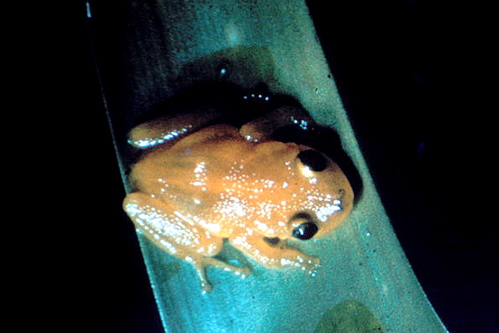 Golden CoquíEleutherodactylus jasperi
-
 Puerto Rican Wetland FrogEleutherodactylus juanariveroi
-
 Whistling CoquíEleutherodactylus cochranae
-
 Monte Iberia EleuthEleutherodactylus iberia
Compare
Questions and answers
What is the scientific name of the Common Coquí?
The scientific name of the Common Coquí is Eleutherodactylus coqui. Written with its author, the full name is Eleutherodactylus coqui Thomas, 1966.
Which family does the Common Coquí belong to?
Eleutherodactylus coqui belongs to the family Eleutherodactylidae, in the order Anura and the class Amphibia.
Where is the Common Coquí found?
Checklists and occurrence records place Eleutherodactylus coqui in 4 countries: Puerto Rico, United States, U.S. Virgin Islands and Costa Rica.
What is the conservation status of the Common Coquí?
The IUCN Red List category recorded for Eleutherodactylus coqui is Least Concern (LC).
What other names does the Common Coquí have?
Eleutherodactylus coqui is also known in English as Common Coqui, Coqui and Puerto Rican Coqui.
Sources
Passages the profile rests on
- Adults are gray-brown in coloration, with natural variation in color and striping among populations. Source passage: “Coquí are gray brown, with natural variation in color and striping among populations” — pmc.ncbi.nlm.nih.gov
- The upper body is muddy brown and mottled, the flanks are rust-tan, and the belly is light gray. Source passage: “Coquís are muddy-brown in mottled coloration on the top with rust-tan flanks and a light-gray belly.” — English Wikipedia
- The species inhabits humid mountain forests below 1,200 m elevation and also occurs in dry forests. Source passage: “Commonly used natural habitats include humid mountain forest at elevations less than 1,200 m and dry forest.” — animaldiversity.org
- The species occurs in forests, mountains, and urban areas in tropical regions of the Americas. Source passage: “Coquí are generalists occurring in a wide range of habitats, including forests, mountains, and urban areas in tropical regions of the Americas.” — pmc.ncbi.nlm.nih.gov
- Individuals use protected cavities such as tree holes and rolled palm petioles as nesting sites. Source passage: “Nesting sites occur in protected cavities such as tree holes and the petioles of rolled palms.” — animaldiversity.org
- The species can inhabit areas without standing water because its eggs develop on land. Source passage: “Since E. coqui are terrestrial and lay eggs on land, they are not constrained by needing bodies of water for reproduction, provided sufficient humidity” — pmc.ncbi.nlm.nih.gov
- The species is native to Puerto Rico, including the islands of Vieques and Culebra. Source passage: “Common coquís are native to the islands of Puerto Rico, Vieques and Culebra” — English Wikipedia
- The species occurs naturally in Puerto Rico up to elevations of 1,200 m. Source passage: “Puerto Rican coquis, Eleutherodactylus coqui , are found naturally in Puerto Rico up to elevations of 1,200m.” — animaldiversity.org
- The species is especially abundant in Puerto Rico, except in the island's driest regions. Source passage: “Puerto Rican coquis occur in abundance throughout Puerto Rico in terrestrial areas except for the driest regions of the island.” — animaldiversity.org
- Introduced populations have been recorded in southern Florida, Hawaii, and the U.S. Virgin Islands. Source passage: “They have been introduced to southern Florida, Hawaii, and the U.S. Virgin Islands.” — animaldiversity.org
- The species has also been introduced to Colombia. Source passage: “The species has been introduced to Colombia, Hawaii in the United States, and the Virgin Islands.” — English Wikipedia
- The species feeds primarily on arthropods. Source passage: “Puerto Rican coquis feed primarily on arthropods.” — animaldiversity.org
- Juveniles consume small prey such as ants. Source passage: “Juveniles consume smaller prey, such as ants,” — English Wikipedia
- Adults consume spiders, moths, crickets, snails, and small frogs. Source passage: “adults consume more varied diets that include spiders, moths, crickets, snails, and small frogs.” — English Wikipedia
- Males sometimes eat eggs from their own clutches while guarding their nests. Source passage: “Males will occasionally consume eggs from their own clutch, likely to provide supplemental nourishment while guarding their nests.” — English Wikipedia
- The species is nocturnal and climbs toward the forest canopy when nighttime humidity increases. Source passage: “Puerto Rican coquis emerge at night when the humidity level increases and climb to the canopy to forage.” — animaldiversity.org
- Individuals descend toward lower forest levels as morning humidity decreases. Source passage: “As the humidity level drops in morning, they descend to the lower levels of the forest, where humidity is higher.” — animaldiversity.org
- Juveniles tend to remain in understory leaf litter during particularly dry periods. Source passage: “the juvenile population, which is likely to remain in the leaf litter of the understory during particularly dry periods.” — animaldiversity.org
- Horizontal movement within the forest home range generally does not exceed 6 m per night. Source passage: “Horizontal movement does not often exceed 6 m a night.” — animaldiversity.org
- Males produce a two-part call in which the first note repels rival males and the second attracts females. Source passage: “the "co" serves to repel other males and establish territory while the "quí" serves to attract females” — English Wikipedia
- Females produce low rasping calls when defending feeding territories. Source passage: “Females are known to make a low rasping call in defense of feeding territories.” — animaldiversity.org
- Males and females defend established nesting territories by chasing, jumping at, and sometimes biting intruders. Source passage: “Once a nesting territory is established, males and females fight off intruders by chasing, jump attacks, and sometimes biting.” — animaldiversity.org
- The species can accurately localize sounds despite having a very small head. Source passage: “even species with very tiny heads, including E. coqui, are capable of accurate sound localization.” — pmc.ncbi.nlm.nih.gov
- Fertilization occurs internally, and eggs are laid in terrestrial clutches. Source passage: “Coquí have clutches of 10–40 eggs that are fertilized internally and brooded on land” — pmc.ncbi.nlm.nih.gov
- Typical clutches contain 10–40 eggs. Source passage: “Coquí have clutches of 10–40 eggs” — pmc.ncbi.nlm.nih.gov
- Embryos develop directly into froglets without passing through a free-swimming tadpole stage. Source passage: “Males guard eggs as they develop directly from egg to froglet, skipping the free-swimming tadpole stage observed in most frogs” — pmc.ncbi.nlm.nih.gov
- Reproduction occurs throughout the year, with higher reproductive rates during the rainy season. Source passage: “Eleutherodactylus coqui reproduce year round, but reproduction rates increase during the rainy season.” — animaldiversity.org
- Reproductive maturity is reached at approximately one year of age. Source passage: “reproductive maturity is reached within approximately one year.” — animaldiversity.org
- The species was included on the IUCN list of 100 of the world's worst invasive species in 2000. Source passage: “in the year 2000 it was put on IUCN's list of 100 of the world's worst invasive species.” — English Wikipedia
- Hawaii considers the introduced species a pest. Source passage: “It is now considered a pest species by the State of Hawaii,” — English Wikipedia
- The species is an important cultural symbol of Puerto Rico. Source passage: “This small but boisterous frog is a national symbol of Puerto Rico” — pmc.ncbi.nlm.nih.gov
- Researchers use the species to investigate developmental biology, vocal communication, auditory processing, and invasive-species biology. Source passage: “This combination of traits has made the coquí frog an excellent model for the study of developmental biology, neuroethology (notably in the areas of mate attraction, communication, and auditory processing) and invasion biology.” — pmc.ncbi.nlm.nih.gov
- The common coquí is closely related to Eleutherodactylus jasperi and Eleutherodactylus portoricensis. Source passage: “The common coquí is closely related to other members of the Eleutherodactylidae family, including the Eleutherodactylus jasperi and the Eleutherodactylus portoricensis.” — English Wikipedia
Data
- Catalogue of Life, 2026-10-16 XR cc by
- Global Biodiversity Information Facility CC BY 4.0
- Wikidata CC0
- GeoNames CC BY 4.0
- Wikimedia Commons per image; credit shown with each image
- Within the Catalogue of Life, this name comes from The Integrated Taxonomic Information System cc0
References
- Frost, Darrel R. (1997). Amphibian Species of the World, A Taxonomic and Geographic Reference. Second Edition.
- Crother, Brian I., Jeff Boundy, Jonathan A. Campbell, et al. / Moriarty, John J., ed. (2000). Scientific and Standard English Names of Amphibians and Reptiles of North America North of Mexico, with Comments Regarding Confidence in Our Understanding. Herpetological Circular, No. 29.
- Crother, Brian I., Jeff Boundy, Frank T. Burbrink, et al. / Moriarty, John J., ed. (2008). Scientific and Standard English Names of Amphibians and Reptiles of North America North of Mexico, With Comments Regarding Confidence in Our Understanding, Sixth Ed. Herpetological Circular No. 37.
This species in other databases
Page built on 24 November 2026. See how the catalog is made and all sources and licences.
Cite this page
ScientificNames.org. (2026). Eleutherodactylus coqui (Common Coquí). Retrieved November 24, 2026, from https://scientificnames.org/species/eleutherodactylus-coqui
“Eleutherodactylus coqui (Common Coquí).” ScientificNames.org, 2026, scientificnames.org/species/eleutherodactylus-coqui. Accessed 24 Nov. 2026.
ScientificNames.org. “Eleutherodactylus coqui (Common Coquí).” Accessed November 24, 2026. https://scientificnames.org/species/eleutherodactylus-coqui.
@misc{scientificnames_eleutherodactylus_coqui_common_coqui,
  author = {{ScientificNames.org}},
  title = {Eleutherodactylus coqui (Common Coquí)},
  year = {2026},
  url = {https://scientificnames.org/species/eleutherodactylus-coqui},
  note = {Accessed 2026-11-24}
}