Species · Fishes
Pacific Lamprey Entosphenus tridentatus
The scientific name of the Pacific Lamprey is Entosphenus tridentatus. It is a species of fish in the family Petromyzontidae (lamprey), order Petromyzontiformes. The name dates from 1836.
- Scientific name
- Entosphenus tridentatus (Richardson, 1836)
- Common name
- Pacific Lamprey
- Genus
- Entosphenus
- Family
- Petromyzontidae (Lamprey)
- Order
- Petromyzontiformes
- Class
- Petromyzonti
- Red List category
- LC Least Concern
- Environment
- brackish, freshwater, marine
- Recorded in
- 3 countries
- Name status
- accepted in the Catalogue of Life
Overview
Entosphenus tridentatus is native to the Pacific Rim regions of North America and Asia, with a North American coastal distribution extending from Alaska to Baja California, Mexico.
Written 26 November 2026 from the sources listed below. Each statement was checked against the passage it cites; statements that could not be supported were removed.
Similar species
Pacific Lamprey is distinct from the sea lamprey (Petromyzon marinus), which invaded the Great Lakes through the Erie Canal.[1]
Appearance
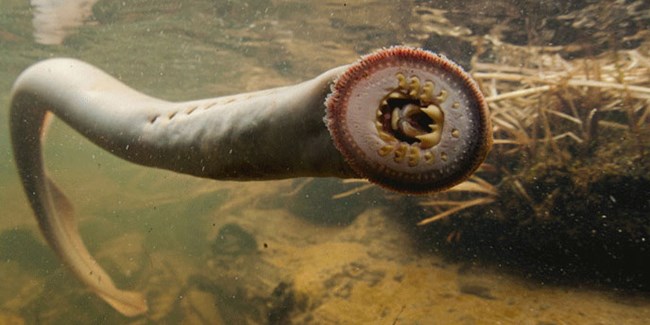
Adults have slender, elongated bodies with two dorsal fins positioned far back on the body. They have three sharp teeth on the supraoral bar, although some individuals have two, and three sharp points on each lateral plate.[2][3]
Adults living in the sea are bluish-black or greenish above and pale below, whereas freshwater adults are brown. Spawning adults can appear reddish-brown.[4][5]
Adults can grow to approximately 80 cm in length.[6]
Habitat
Adults are frequently found offshore, at depths ranging from near the surface to 1,508 metres. They construct spawning nests in stream riffles.[7][8]
In North America, the species inhabits the Fraser, Columbia, Klamath-Trinity, Eel and Sacramento-San Joaquin river systems. In Alaska, documented freshwater distribution extends north to the Kuskokwim River.[9][10]
Diet
Larvae feed primarily on detritus through filter feeding. Their diet also includes algae and microorganisms.[11][12]
Adults do not feed while migrating upstream in freshwater to spawn.[13]
Behaviour
The species is anadromous, spending part of its life in the ocean and part in freshwater. Pacific lampreys are semelparous.[14][15]
Juveniles migrate downstream to the ocean after completing metamorphosis. They can spend approximately 18 months in the ocean before returning to freshwater.[16][17]
Upstream migrants travel in large groups. Pacific lampreys can climb smooth vertical surfaces and waterfalls using their disc-shaped mouths.[18][19]
Larvae may move downstream at night to locate better feeding habitat.[20]
Reproduction and life cycle
Both sexes participate in constructing spawning nests. Males and females intertwine while depositing sperm and eggs into the nest.[21][22]
Females can release up to 100,000 eggs, depending on their size. Spawning nests are commonly circular depressions measuring approximately 1–2 feet in diameter.[23][24]
Eggs hatch in freshwater after approximately 2–4 weeks, depending on water temperature. In Washington, spawning generally occurs between April and July.[25][26]
After spawning, adults usually die within four days.[27]
Conservation
River dams, channelization and declining water quality have negatively affected the species' habitat and survival.[28]
Potential overharvesting by commercial, personal-use and subsistence fisheries is identified as a threat in Alaska. Invasive northern pike predation is identified as a potential threat to populations in the Susitna River drainage.[29][30]
Uses
Pacific lampreys are an important ceremonial food for several Indigenous communities in the Columbia, Klamath and Eel River regions. Indigenous communities traditionally smoke them over open fires.[31][32]
Some Indigenous communities have historically fed Pacific lampreys to babies and young children.[33]
Classification of the Pacific Lamprey
| Kingdom | Animalia |
|---|---|
| Phylum | Chordata |
| Subphylum | Vertebrata |
| Infraphylum | Agnatha |
| Superclass | Cyclostomi |
| Class | Petromyzonti |
| Order | Petromyzontiformes (Lamprey) |
| Family | Petromyzontidae (Lamprey) |
| Subfamily | Lampetrinae |
| Genus | Entosphenus (Pacific Lampreys) |
| Species | Entosphenus tridentatus (Richardson, 1836) |
Where the Pacific Lamprey is found
Checklists and occurrence records place Entosphenus tridentatus in 3 countries. GBIF holds 2,064 georeferenced records of it.
Countries
Regions and cities with the most records
- Oregon, United States 499
- California, United States 411
- British Columbia, Canada 138
- Washington, United States 120
- Abbotsford, Canada 56
- Chilliwack, Canada 53
- Mission, Canada 53
- Richmond, Canada 46
- Corvallis, United States 37
- Vancouver, Canada 35
- Riley Park, Canada 34
- West Vancouver, Canada 33
- Happy Valley, United States 32
- Milwaukie, United States 28
- Oregon City, United States 28
- Santa Paula, United States 28
- West Linn, United States 28
- Victoria-Fraserview, Canada 27
- Fillmore, United States 26
- Moorpark, United States 26
- Live Oak, United States 25
- Oak Grove, United States 25
- Alaska, United States 24
- Canby, United States 24
- Lake Oswego, United States 24
- Tualatin, United States 24
- Wilsonville, United States 24
- Portland, United States 23
- Santa Cruz, United States 23
- Albany, United States 22
- Sherwood, United States 22
- Tigard, United States 22
- Bayside, United States 20
- Klamath Falls, United States 20
- North Vancouver, Canada 20
- Arcata, United States 19
3 more countries have a few records outside this range
These countries hold a few records of Entosphenus tridentatus but lie outside the range the checklists give for it. Such records are often zoo or garden specimens, museum material or vagrants, so the species is not counted as occurring there.
A number beside a place is its count of GBIF occurrence records. A place without a number comes from a checklist alone. Records show where a species has been observed or collected, which can include escapes and vagrants.
Common names
English
- Pacific Lamprey
- Goose Lake Lamprey
- Sea Lamprey
- Three-toothed Lamprey
Names in 8 other languages
- Czech
- mihule trojzubá
- Finnish
- beringinnahkiainen
- French
- lamproie du Pacifique
- German
- Pazifisches Neunauge
- Japanese
- ミツバヤツメ
- Polish
- Minóg trójzębny
- Russian
- Трехзубая минога, Трёхзубая минога
- Spanish
- lamprea del Pacífico
Synonyms
9 other scientific names have been used for this species and are now treated as synonyms of Entosphenus tridentatus.
- Entosphenus epihexodon Gill, 1862
- Entosphenus tridentatus tridentatus (Richardson, 1836)
- Lampetra tridentata (Richardson, 1836)
- Lampetra tridentatus (Richardson, 1836)
- Petromyzon astori Girard, 1858
- Petromyzon ciliatus Ayres, 1855
- Petromyzon epihexodon (Gill, 1862)
- Petromyzon lividus Girard, 1858
- Petromyzon tridentatus Richardson, 1836
Related species
- Miller Lake LampreyEntosphenus minimus
-
 Klamath LampreyEntosphenus similis
- Pit-Klamath Brook LampreyEntosphenus lethophagus
- Northern California Brook LampreyEntosphenus folletti
- Lake LampreyEntosphenus macrostoma
-
 Sea LampreyPetromyzon marinus
-
 European River LampreyLampetra fluviatilis
-
 Brook LampreyLampetra planeri
Compare
Questions and answers
What is the scientific name of the Pacific Lamprey?
The scientific name of the Pacific Lamprey is Entosphenus tridentatus. Written with its author, the full name is Entosphenus tridentatus (Richardson, 1836).
Which family does the Pacific Lamprey belong to?
Entosphenus tridentatus belongs to the family Petromyzontidae, in the order Petromyzontiformes and the class Petromyzonti.
Where is the Pacific Lamprey found?
Checklists and occurrence records place Entosphenus tridentatus in 3 countries: United States, Canada and Mexico.
What is the conservation status of the Pacific Lamprey?
The IUCN Red List category recorded for Entosphenus tridentatus is Least Concern (LC).
What other names does the Pacific Lamprey have?
Entosphenus tridentatus is also known in English as Goose Lake Lamprey, Sea Lamprey and Three-toothed Lamprey.
Sources
Passages the profile rests on
- Pacific lamprey is distinct from the sea lamprey (Petromyzon marinus), which invaded the Great Lakes through the Erie Canal. Source passage: “The Pacific lamprey is not the same fish as the sea lamprey (Petromyzon marinus) that has invaded the Great Lakes via the Erie Canal.” — English Wikipedia
- Adults have slender, elongated bodies with two dorsal fins positioned far back on the body. Source passage: “They have slender, elongated bodies with two dorsal fins arising far back on the body.” — English Wikipedia
- Adults have three sharp teeth on the supraoral bar, although some individuals have two, and three sharp points on each lateral plate. Source passage: “This species is distinguished by having three (or occasionally two) sharp teeth on the supraoral bar above the mouth and three sharp points on each lateral plate.” — English Wikipedia
- Adults living in the sea are bluish-black or greenish above and pale below, whereas freshwater adults are brown. Source passage: “Adults living in the sea are a bluish-black or greenish colour above and pale below, but those in fresh water are brown.” — English Wikipedia
- Spawning adults can appear reddish-brown. Source passage: “During spawning, adult Pacific lamprey can appear to be reddish-brown in color.” — adfg.alaska.gov
- Adults can grow to approximately 80 cm in length. Source passage: “Pacific lampreys grow to about 80 cm (31 in) as adults.” — English Wikipedia
- Adults are frequently found offshore, at depths ranging from near the surface to 1,508 metres. Source passage: “At sea, depth: near surface to 1,508 m (4,946 ft)” — English Wikipedia
- Adults construct spawning nests in stream riffles. Source passage: “Both males and females participate in nest building in stream riffles by removing small rocks with their mouths and fanning smaller particles with their tails.” — adfg.alaska.gov
- In North America, the species inhabits the Fraser, Columbia, Klamath-Trinity, Eel and Sacramento-San Joaquin river systems. Source passage: “In North America, they occupy streams and rivers across some major river systems such as the Fraser, Columbia, Klamath-Trinity, Eel and Sacramento-San Joaquin rivers.” — English Wikipedia
- In Alaska, documented freshwater distribution extends north to the Kuskokwim River. Source passage: “In Alaska, Pacific lampreys are found from southeast Alaska north to the Bering Sea and Bristol Bay area drainages where currently the farthest north documentation of this species using freshwater in western Alaska is the Kuskokwim River.” — adfg.alaska.gov
- Larvae feed primarily on detritus through filter feeding. Source passage: “Larvae are filter feeders of primarily detritus (but also occasionally diatoms and algae).” — adfg.alaska.gov
- Larvae consume algae, detritus and microorganisms. Source passage: “During the larval stage, they spend most of their time feeding on algae, detritus and microorganisms.” — English Wikipedia
- Adults do not feed while migrating upstream in freshwater to spawn. Source passage: “Once back in freshwater to migrate upstream and spawn, adults do not feed.” — adfg.alaska.gov
- The species is anadromous, spending part of its life in the ocean and part in freshwater. Source passage: “Pacific lampreys are anadromous which means it spends part of its life in the ocean and part of its life in fresh water.” — adfg.alaska.gov
- Pacific lampreys are semelparous. Source passage: “They are anadromous and semelparous.” — English Wikipedia
- Juveniles migrate downstream to the ocean after completing metamorphosis. Source passage: “After the transformation is complete, juvenile lamprey migrate downstream to the ocean and latch on to a host species to begin feeding.” — wdfw.wa.gov
- Juveniles can spend approximately 18 months in the ocean before returning to freshwater. Source passage: “Parasitic juvenile Pacific lampreys migrate to the sea after metamorphosing from larvae and tend to spend about 18 months in the ocean before returning to freshwater to eventually spawn.” — adfg.alaska.gov
- Upstream migrants travel in large groups. Source passage: “Lampreys tend to migrate upstream in large groups and once upstream migration commences, lampreys do not feed.” — adfg.alaska.gov
- Pacific lampreys can climb smooth vertical surfaces and waterfalls using their disc-shaped mouths. Source passage: “The Pacific lamprey can climb smooth, vertical surfaces — even waterfalls! — using their strong, disc-shaped mouth.” — wdfw.wa.gov
- Larvae may move downstream at night to locate better feeding habitat. Source passage: “During this freshwater stage, larval lamprey may move downstream volitionally at night to find better feeding habitat, or they may be washed downstream during high flow events.” — wdfw.wa.gov
- Both sexes participate in constructing spawning nests. Source passage: “Both males and females participate in nest building in stream riffles by removing small rocks with their mouths and fanning smaller particles with their tails.” — adfg.alaska.gov
- Males and females intertwine while depositing sperm and eggs into the nest. Source passage: “Males and females intertwine while simultaneously depositing sperm and eggs into the nest.” — adfg.alaska.gov
- Females can release up to 100,000 eggs, depending on their size. Source passage: “Depending on her size, a single female can release up to 100,000 eggs.” — adfg.alaska.gov
- Spawning nests are commonly circular depressions measuring approximately 1–2 feet in diameter. Source passage: “Most commonly they create roughly a circle shaped depression 1–2 ft in diameter in the substrate.” — wdfw.wa.gov
- Eggs hatch in freshwater after approximately 2–4 weeks, depending on water temperature. Source passage: “The eggs hatch in freshwater in 2 to 4 weeks depending on the water temperature.” — adfg.alaska.gov
- In Washington, spawning generally occurs between April and July. Source passage: “Most Spawning in Washington occurs from April–July.” — wdfw.wa.gov
- After spawning, adults usually die within four days. Source passage: “After spawning, the adults usually die within four days.” — English Wikipedia
- River dams, channelization and declining water quality have negatively affected the species' habitat and survival. Source passage: “Damming rivers, channelization, and declines in water quality have impacted Pacific lamprey habitat and their ability to live.” — English Wikipedia
- Potential overharvesting by commercial, personal-use and subsistence fisheries is identified as a threat in Alaska. Source passage: “Potential overharvest from commercial, personal use or subsistence fisheries could also occur.” — adfg.alaska.gov
- Invasive northern pike predation is identified as a potential threat to populations in the Susitna River drainage. Source passage: “Predation by invasive Northern Pike in the Susitna River drainage is a potential threat to populations of Pacific Lamprey in Southcentral Alaska.” — adfg.alaska.gov
- Pacific lampreys are an important ceremonial food for several Indigenous communities in the Columbia, Klamath and Eel River regions. Source passage: “Pacific lampreys are an important ceremonial food for Native American tribes in the Columbia River basin and the Yurok people and Karuk of the Klamath River Wiyot people of the Eel River in northern California.” — English Wikipedia
- Pacific lampreys are traditionally smoked over open fires by Indigenous communities. Source passage: “In terms of tribal cuisine, the lamprey is often smoked over open fires, a method that enhances the flavor and aids in preservation, allowing them to be stored and consumed over extended periods.” — English Wikipedia
- Pacific lampreys have historically been fed to babies and young children by some Indigenous communities. Source passage: “Because lampreys are fatty and have a very high caloric count, tribes like the Wiyot and Yurok have traditionally fed them to babies and young children.” — English Wikipedia
Data
- Catalogue of Life, 2026-10-16 XR cc by
- Global Biodiversity Information Facility CC BY 4.0
- Wikidata CC0
- GeoNames CC BY 4.0
- Wikimedia Commons per image; credit shown with each image
- Within the Catalogue of Life, this name comes from World Register of Marine Species cc by
This species in other databases
- Catalogue of Life 6FFWG
- Wikidata Q25703311
- iNaturalist 219216
- WoRMS urn:lsid:marinespecies.org:taxname:314348
- ITIS 159699
Page built on 28 November 2026. See how the catalog is made and all sources and licences.
Cite this page
ScientificNames.org. (2026). Entosphenus tridentatus (Pacific Lamprey). Retrieved November 28, 2026, from https://scientificnames.org/species/entosphenus-tridentatus
“Entosphenus tridentatus (Pacific Lamprey).” ScientificNames.org, 2026, scientificnames.org/species/entosphenus-tridentatus. Accessed 28 Nov. 2026.
ScientificNames.org. “Entosphenus tridentatus (Pacific Lamprey).” Accessed November 28, 2026. https://scientificnames.org/species/entosphenus-tridentatus.
@misc{scientificnames_entosphenus_tridentatus_pacific_lamprey,
  author = {{ScientificNames.org}},
  title = {Entosphenus tridentatus (Pacific Lamprey)},
  year = {2026},
  url = {https://scientificnames.org/species/entosphenus-tridentatus},
  note = {Accessed 2026-11-28}
}