Species · Fishes
Petrale Sole Eopsetta jordani
The scientific name of the Petrale Sole is Eopsetta jordani. It is a species of fish in the family Pleuronectidae (dabs), order Pleuronectiformes. The name dates from 1879.
- Scientific name
- Eopsetta jordani (Lockington, 1879)
- Common name
- Petrale Sole
- Genus
- Eopsetta
- Family
- Pleuronectidae (Dabs)
- Order
- Pleuronectiformes
- Class
- Teleostei
- Red List category
- LC Least Concern
- Environment
- marine
- Recorded in
- 3 countries
- Name status
- accepted in the Catalogue of Life

Overview
Petrale Sole (Eopsetta jordani) is a right-eyed flatfish belonging to the family Pleuronectidae and the order Pleuronectiformes. It inhabits sandy seabeds in the Eastern Pacific, generally in deep water reaching approximately 550 metres. It has a brown upper surface, a white underside and a large mouth with rows of small, arrow-shaped teeth.
Written 26 November 2026 from the sources listed below. Each statement was checked against the passage it cites; statements that could not be supported were removed.
Appearance
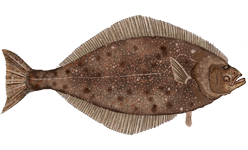
Petrale Sole is a right-eyed flounder with an oval-shaped body. Its upper surface ranges uniformly from light brown to dark brown, while its underside is white and may have pink traces.[1][2][3]
It has a large mouth with two rows of small, arrow-shaped teeth on the upper jaw and one row on the lower jaw. It is also depicted with a brown mottled pattern of dark spots.[4][5]
Male Petrale Sole can reach 53 centimetres in length, while females can reach 70 centimetres. The species can weigh up to 3.7 kilograms.[6][7][8]
Habitat
Petrale Sole inhabits sandy seabeds and generally occurs in deep water, reaching depths of approximately 550 metres.[9][10]
Its native range extends through the Eastern Pacific from Baja California to the Aleutian Islands in the Bering Sea.[11]
Diet
Juvenile Petrale Sole feed on cumaceans, carideans and amphipods.[12]
Adult Petrale Sole consume shrimps, crabs, epibenthic organisms and other fish. Their fish prey includes herring, hake, anchovy, pollock and other flatfish.[13][14]
Behaviour
Petrale Sole is a demersal fish.[15]
Uses
Petrale Sole is harvested as an edible commercial fish. Commercial fishing occurs along the United States and Canadian West Coast and extends into the Bering Sea.[16][17]
Commercial catches are made almost exclusively using trawlers. Bottom trawling targeting Petrale Sole is reported to cause minimal habitat damage.[18][19]
Petrale Sole has been commercially fished off Oregon since at least 1884. Its designated fishery is located off the western coast of the United States, although the species is also caught in Alaska and other fisheries.[20][21][22]
Conservation
Petrale Sole was declared overfished in 2009 and subsequently rebuilt in 2015 following a period of reduced catches. Its estimated minimum population doubling time is more than 14 years.[23][24]
The estimated biomass in the northern fishery segment increased from 1,267 tonnes in 1992 to 4,960 tonnes in 2005. In the southern fishery segment, biomass increased to 4,667 tonnes by 2005 after reaching a historical low of 1,012 tonnes in 1986.[25][26]
The coastwide annual catch ranged from 1,616 to 2,377 tonnes between 1995 and 2004. The annual coastwide catch did not exceed the established catch limit from 1995 through 2000.[27][28]
Beginning in 2001, catches in the Northern assessment area exceeded the portion of the catch limit allocated to that area. Petrale Sole has a reported vulnerability score of 52 out of 100, classified as moderate to high.[29][30]
Classification of the Petrale Sole
| Kingdom | Animalia |
|---|---|
| Phylum | Chordata |
| Subphylum | Vertebrata |
| Infraphylum | Gnathostomata |
| Parvphylum | Osteichthyes |
| Gigaclass | Actinopterygii |
| Superclass | Actinopteri |
| Class | Teleostei (Teleost) |
| Order | Pleuronectiformes |
| Suborder | Pleuronectoidei |
| Family | Pleuronectidae (Dabs) |
| Subfamily | Pleuronectinae |
| Genus | Eopsetta |
| Species | Eopsetta jordani (Lockington, 1879) |
Where the Petrale Sole is found
Checklists and occurrence records place Eopsetta jordani in 3 countries. GBIF holds 28,150 georeferenced records of it.
Countries
Regions and cities with the most records
- Encinitas, United States 25
- California, United States 23
- Richmond, Canada 16
- Santa Cruz, United States 14
- Courtenay, Canada 13
- San Diego, United States 13
- Delta, Canada 12
- Daly City, United States 11
- South San Francisco, United States 11
- Bayview-Hunters Point, United States 10
- Live Oak, United States 10
- Pacifica, United States 10
- San Francisco, United States 10
- San Bruno, United States 9
- British Columbia, Canada 8
- Marina, United States 8
- Alameda, United States 7
- Millbrae, United States 5
- Watsonville, United States 5
- Costa Mesa, United States 4
- Hermosa Beach, United States 4
- Huntington Beach, United States 4
- Newport Beach, United States 4
- Oregon, United States 4
- Ventura, United States 4
- Washington, United States 4
- Anacortes, United States 3
- Arroyo Grande, United States 3
- Coos Bay, United States 3
- Lake Elsinore, United States 3
- Manhattan Beach, United States 3
- Murrieta, United States 3
- Oxnard, United States 3
- Port Angeles, United States 3
- Port Hueneme, United States 3
- Santa Monica, United States 3
A number beside a place is its count of GBIF occurrence records. A place without a number comes from a checklist alone. Records show where a species has been observed or collected, which can include escapes and vagrants.
Common names
English
- Petrale Sole
- Brill
Names in 7 other languages
- Chinese
- 喬氏蟲鰈
- Danish
- Californisk flynder
- French
- Carlottin Pétrale, Charlottin Pétrale, plie de Californie
- German
- Kalifornische Scholle, Pazifische Scharbe
- Polish
- Petralka
- Russian
- Камбала Джордана, калифорнийская эопсетта
- Spanish
- Limanda Petrale, platija petrale
Synonyms
2 other scientific names have been used for this species and are now treated as synonyms of Eopsetta jordani.
- Eopsetia jordani (Lockington, 1879)
- Hippoglossoides jordani Lockington, 1879
Related species
-
 Shotted HalibutEopsetta grigorjewi
-
 European PlaicePleuronectes platessa
-
 Atlantic HalibutHippoglossus hippoglossus
-
 Pacific HalibutHippoglossus stenolepis
-
 Greenland HalibutReinhardtius hippoglossoides
-
 Lemon SoleMicrostomus kitt
-
 European FlounderPlatichthys flesus
-
 Common DabLimanda limanda
Compare
Questions and answers
What is the scientific name of the Petrale Sole?
The scientific name of the Petrale Sole is Eopsetta jordani. Written with its author, the full name is Eopsetta jordani (Lockington, 1879).
Which family does the Petrale Sole belong to?
Eopsetta jordani belongs to the family Pleuronectidae, in the order Pleuronectiformes and the class Teleostei.
Where is the Petrale Sole found?
Checklists and occurrence records place Eopsetta jordani in 3 countries: Canada, United States and Mexico.
What is the conservation status of the Petrale Sole?
The IUCN Red List category recorded for Eopsetta jordani is Least Concern (LC).
What other names does the Petrale Sole have?
Eopsetta jordani is also known in English as Brill.
Where does petrale sole come from?
Petrale Sole is native to the Eastern Pacific, with a range extending from Baja California to the Aleutian Islands in the Bering Sea. Commercial fishing occurs along the United States and Canadian West Coast and extends into the Bering Sea.[11][17]
What is the nutritional value of Petrale Sole fish?
Per 100 grams of wet weight, Petrale Sole contains approximately 0.378 grams of omega-3, 30.7 milligrams of calcium, 0.276 milligrams of iron, 19.1 micrograms of selenium, 14.9 micrograms of vitamin A and 0.349 milligrams of zinc.[31][32][33][34][35][36]
Sources
Passages the profile rests on
- The petrale sole is a right-eyed flounder with an oval-shaped body. Source passage: “Petrale sole is a right-eyed flounder with an oval body.” — English Wikipedia
- Its upper body surface ranges uniformly from light brown to dark brown. Source passage: “Its upper surface is uniformly light to dark brown” — English Wikipedia
- Its underside is white and may have pink traces. Source passage: “its lower surface is white, sometimes with pink traces.” — English Wikipedia
- It has a large mouth with two rows of small, arrow-shaped teeth on the upper jaw and one row on the lower jaw. Source passage: “It has a large mouth with two rows of small, arrow-shaped teeth on the upper jaw and one row of teeth on the lower jaw.” — English Wikipedia
- Petrale sole is depicted as a dark-colored flatfish with a brown mottled pattern of dark spots. Source passage: “Dark colored petrale sole with brown mottled pattern of dark spots” — wdfw.wa.gov
- Male petrale sole can reach 53 centimetres in length. Source passage: “Males can grow to 53 centimetres (21 in) in length” — English Wikipedia
- Female petrale sole can reach 70 centimetres in length. Source passage: “females to 70 centimetres (28 in)” — English Wikipedia
- Petrale sole can weigh up to 3.7 kilograms. Source passage: “they can weigh up to 3.7 kilograms (8.2 lb).” — English Wikipedia
- Petrale sole inhabits sandy seabeds. Source passage: “It is a demersal fish that lives on sandy bottoms” — English Wikipedia
- Petrale sole generally inhabits deep water, reaching depths of approximately 550 metres. Source passage: “usually in deep water, down to depths of about 550 metres (1,800 ft).” — English Wikipedia
- The native range of petrale sole extends through the Eastern Pacific from Baja California to the Aleutian Islands in the Bering Sea. Source passage: “Its native habitat is the Eastern Pacific, stretching from the coast of Baja California in the south to the Aleutian Islands in the Bering Sea in the north.” — English Wikipedia
- Juvenile petrale sole feed on cumaceans, carideans and amphipods. Source passage: “Juvenile petrale sole feed on cumaceans, carideans and amphipods” — English Wikipedia
- Adult petrale sole consume shrimps, crabs, epibenthic organisms and other fish. Source passage: “adults will eat shrimps, crabs, epibenthos organisms and other fish” — English Wikipedia
- Fish consumed by adult petrale sole include herring, hake, anchovy, pollock and other flatfish. Source passage: “such as herring, hake, anchovy, pollock and other flatfish.” — English Wikipedia
- Petrale sole is a demersal fish. Source passage: “It is a demersal fish” — English Wikipedia
- Petrale sole is harvested as an edible commercial fish. Source passage: “The Petrale sole is an important commercial fish” — English Wikipedia
- Commercial petrale sole fishing occurs along the United States and Canadian West Coast and extends into the Bering Sea. Source passage: “caught all along the West Coast of the United States and Canada and into the Bering Sea” — English Wikipedia
- Commercial petrale sole catches are made almost exclusively using trawlers. Source passage: “almost exclusively by trawler.” — English Wikipedia
- Bottom trawling targeting petrale sole is reported to cause minimal habitat damage. Source passage: “Bottom trawls cause minimal damage to habitat when targeting petrale sole” — fisheries.noaa.gov
- Petrale sole has been commercially fished off Oregon since at least 1884. Source passage: “has been fished off Oregon since at least 1884.” — English Wikipedia
- The designated petrale sole fishery is located off the western coast of the United States. Source passage: “One fishery exists, off the west coast of the United States.” — English Wikipedia
- Petrale sole is also caught in Alaska and other fisheries despite having only one designated fishery. Source passage: “Although Petrale sole are native to Alaska and are caught there and in other fisheries, no other designated Petrale sole fishery exists.” — English Wikipedia
- Petrale sole was declared overfished in 2009 and subsequently rebuilt in 2015 following a period of reduced catches. Source passage: “Petrale sole was declared overfished in 2009 and then rebuilt in 2015 after a period of reduced catches.” — English Wikipedia
- The minimum population doubling time estimated for petrale sole is more than 14 years. Source passage: “Very Low, minimum population doubling time more than 14 years” — fishbase.se
- The estimated biomass of petrale sole in the northern fishery segment increased from 1,267 tonnes in 1992 to 4,960 tonnes in 2005. Source passage: “reached a historical low of 1,267 tonnes in 1992, but has increased steadily since then to 4,960 tonnes in 2005.” — English Wikipedia
- The estimated biomass of petrale sole in the southern fishery segment increased to 4,667 tonnes by 2005 after reaching a historical low of 1,012 tonnes in 1986. Source passage: “The southern segment reached a historical low of 1,012 tonnes in 1986, and, after remaining stable for ten years, by 2005 it had increased to 4,667 tonnes.” — English Wikipedia
- The coastwide annual catch of petrale sole ranged from 1,616 to 2,377 tonnes between 1995 and 2004. Source passage: “Between 1995 and 2004 the coastwide catch of Petrale sole ranged from 1,616 to 2,377 tonnes.” — English Wikipedia
- The annual coastwide catch did not exceed the established catch limit from 1995 through 2000. Source passage: “from 1995 to 2000 the coastwide total annual catch did not exceed the catch limit” — English Wikipedia
- Beginning in 2001, catches in the Northern assessment area exceeded the portion of the catch limit allocated to that area. Source passage: “from 2001 the catch in the Northern assessment area has exceeded the portion of the catch limit attributed to that area.” — English Wikipedia
- Petrale sole has a reported vulnerability score of 52 out of 100, classified as moderate to high. Source passage: “Moderate to high vulnerability (52 of 100).” — fishbase.se
- Petrale sole contains approximately 0.378 grams of omega-3 per 100 grams of wet weight. Source passage: “Omega3 = 0.378 [0.181, 0.780] g/100g” — fishbase.se
- Petrale sole contains approximately 30.7 milligrams of calcium per 100 grams of wet weight. Source passage: “Calcium = 30.7 [12.2, 52.1] mg/100g” — fishbase.se
- Petrale sole contains approximately 0.276 milligrams of iron per 100 grams of wet weight. Source passage: “Iron = 0.276 [0.140, 0.534] mg/100g” — fishbase.se
- Petrale sole contains approximately 19.1 micrograms of selenium per 100 grams of wet weight. Source passage: “Selenium = 19.1 [9.5, 42.3] μg/100g” — fishbase.se
- Petrale sole contains approximately 14.9 micrograms of vitamin A per 100 grams of wet weight. Source passage: “VitaminA = 14.9 [3.5, 66.2] μg/100g” — fishbase.se
- Petrale sole contains approximately 0.349 milligrams of zinc per 100 grams of wet weight. Source passage: “Zinc = 0.349 [0.232, 0.525] mg/100g (wet weight);” — fishbase.se
Data
- Catalogue of Life, 2026-10-16 XR cc by
- Global Biodiversity Information Facility CC BY 4.0
- Wikidata CC0
- GeoNames CC BY 4.0
- Wikimedia Commons per image; credit shown with each image
- Within the Catalogue of Life, this name comes from World Register of Marine Species cc by
This species in other databases
- Catalogue of Life 6FKWW
- Wikidata Q2232931
- iNaturalist 83172
- WoRMS urn:lsid:marinespecies.org:taxname:280690
- ITIS 172868
Page built on 26 November 2026. See how the catalog is made and all sources and licences.
Cite this page
ScientificNames.org. (2026). Eopsetta jordani (Petrale Sole). Retrieved November 26, 2026, from https://scientificnames.org/species/eopsetta-jordani
“Eopsetta jordani (Petrale Sole).” ScientificNames.org, 2026, scientificnames.org/species/eopsetta-jordani. Accessed 26 Nov. 2026.
ScientificNames.org. “Eopsetta jordani (Petrale Sole).” Accessed November 26, 2026. https://scientificnames.org/species/eopsetta-jordani.
@misc{scientificnames_eopsetta_jordani_petrale_sole,
  author = {{ScientificNames.org}},
  title = {Eopsetta jordani (Petrale Sole)},
  year = {2026},
  url = {https://scientificnames.org/species/eopsetta-jordani},
  note = {Accessed 2026-11-26}
}