Species · Birds
Rio Madeira Stipplethroat Epinecrophylla amazonica
The scientific name of the Rio Madeira Stipplethroat is Epinecrophylla amazonica. It is a species of bird in the family Thamnophilidae (antbird), order Passeriformes. The name dates from 1905.
- Scientific name
- Epinecrophylla amazonica (H. F. A. Ihering, 1905)
- Common name
- Rio Madeira Stipplethroat
- Genus
- Epinecrophylla
- Family
- Thamnophilidae (Antbird)
- Order
- Passeriformes
- Class
- Aves
- Red List category
- LC Least Concern
- Recorded in
- 4 countries
- Name status
- accepted in the Catalogue of Life

Overview
The Rio Madeira Stipplethroat is a bird in the family Thamnophilidae, order Passeriformes, and class Aves. It occurs in Bolivia, Brazil, and Peru. Adult males of the nominate subspecies have dark red upperparts, gray underparts, and white throats marked with black streaks.
Written 27 November 2026 from the sources listed below. Each statement was checked against the passage it cites; statements that could not be supported were removed.
Appearance
The species measures between 10 and 11 cm in length and weighs between 8.7 and 9 g.[1][2]
Adult males of the nominate subspecies have mottled yellowish-brown faces, white throats marked with black streaks, dark yellowish-brown crowns, and slightly redder napes. Their mantles, backs, rumps, and uppertail coverts are dark red, while their tails are olive-gray.[3][4][5][6]
The primary wing coverts of nominate males are blackish with reddish tips. Their remaining wing coverts are dark brown with yellowish-buff tips, and their flight feathers are dark red.[7][8]
The underparts of nominate males are gray, and their irises are brownish red.[9][10]
Adult females have duller red upperparts than males, dull yellow-brown throats with indistinct dark markings, and pale yellowish-brown underparts. Their irises are grayish or pale beige.[11][12][13][14]
Both sexes have dark gray bills, legs, and feet.[15]
Males of E. a. dentei have buff-colored throats with black streaks and tails almost as red as their backs. Females have paler and grayer bellies than females of the nominate subspecies.[16][17][18]
Habitat
The species primarily inhabits lowland terra firme evergreen forest. In Bolivia, it also occurs in more upland forest.[19][20]
It occurs at elevations up to 400 m.[21]
Diet
The Rio Madeira Stipplethroat feeds on arthropods, particularly insects and spiders.[22]
Behaviour
The species is believed to remain in its range throughout the year.[23]
It typically forages alone, in pairs, or in small family groups, usually as part of mixed-species feeding flocks.[24][25]
It mostly forages in the forest understory up to approximately 3 m above the ground. It obtains almost all its prey by gleaning dead leaves on trees and also gleans prey from dead leaves caught in vine tangles and small palms.[26][27][28]
Reproduction and life cycle
The breeding biology of the species has not been documented.[29]
Conservation
The IUCN classifies the Rio Madeira Stipplethroat as Least Concern. It was most recently assessed for the IUCN Red List in 2024.[30][31]
The species has a large geographic range, and its population is believed to be stable, although its population size is unknown. It appears to be fairly common throughout its range.[32][33][34]
No immediate threats to the species have been identified. Its range contains extensive connected areas of intact habitat that appear to face minimal near-term development risk despite lacking formal protection.[35][36]
Classification of the Rio Madeira Stipplethroat
| Kingdom | Animalia |
|---|---|
| Phylum | Chordata |
| Subphylum | Vertebrata |
| Infraphylum | Gnathostomata |
| Parvphylum | Osteichthyes |
| Megaclass | Tetrapoda |
| Class | Aves (Bird) |
| Order | Passeriformes (Passerine) |
| Family | Thamnophilidae (Antbird) |
| Genus | Epinecrophylla (Stipplethroat) |
| Species | Epinecrophylla amazonica (H. F. A. Ihering, 1905) |
Where the Rio Madeira Stipplethroat is found
Checklists and occurrence records place Epinecrophylla amazonica in 4 countries across South America. GBIF holds 1,222 georeferenced records of it.
Countries
Regions and cities with the most records
- Madre de Dios, Peru 534
- Amazonas, Brazil 283
- Rondônia, Brazil 160
- Puerto Maldonado, Peru 78
- Pando, Bolivia 64
- Cobija, Bolivia 36
- Acre, Brazil 24
- Careiro, Brazil 21
- Porto Velho, Brazil 15
- Brasiléia, Brazil 13
- Epitaciolândia, Brazil 13
- Tambopata, Peru 13
- Lábrea, Brazil 10
- Tefé, Brazil 9
- Cuzco Department, Peru 4
- Mato Grosso, Brazil 3
Range as the checklists state it
South America
A number beside a place is its count of GBIF occurrence records. A place without a number comes from a checklist alone. Records show where a species has been observed or collected, which can include escapes and vagrants.
Common names
English
- Rio Madeira Stipplethroat
- Eastern Stipple-throated Antwren
- Madeira Antwren
- Madeira Stipple-throated Antwren
- Madeira Stipplethroat
- Rio Madeira Antwren
- Rio Madeira Stipple-throated Antwren
Names in 20 other languages
- Chinese
- 馬迪拉點喉蟻鷯, 马德拉斑喉蚁鹩
- Croatian
- biserastogrla mravarica
- Danish
- Madeiramyresmutte
- Dutch
- Madeiramiersluiper, Rio-Madeiramiersluiper
- Esperanto
- madejra formikulo
- Finnish
- Riomadeiranmuuranen
- French
- Alapi du Madeira, Myrmidon du Madeira
- German
- Amazonasameisenschlüpfer
- Japanese
- マデイラヒメアリサザイ
- Lithuanian
- Madeirinė karietaitinė skruzdlesė
- Norwegian
- madeiramaursmett
- Polish
- gardlinek amazoński
- Portuguese
- choquinha-do-madeira, formigueirinho-do-rio-madeira
- Russian
- Амазонская крапивниковая муравьеловка, Амазонский алапи
- Serbian
- Mravlji carić sa Rio Madere
- Slovak
- pralesníček džungľový
- Spanish
- Hormiguerito del Madeira, Hormiguerito dorsirrojo oriental
- Swedish
- madeiramyrsmyg, madeirastrimhake
- Turkish
- Rio Madeira Karıncaçıvgını
- Ukrainian
- кадук джунглевий
Synonyms
2 other scientific names have been used for this species and are now treated as synonyms of Epinecrophylla amazonica.
- Myrmotherula haematonota amazonica Ihering, HFA, 1905
- Myrmotherula pyrrhonota amazonica H. F. A. Ihering, 1905
Subspecies and varieties
- Epinecrophylla amazonica amazonica subspecies
- Epinecrophylla amazonica dentei (Roosevelt Antwren) subspecies
Related species
-
 Checker-throated StipplethroatEpinecrophylla fulviventris
-
 Ornate StipplethroatEpinecrophylla ornata
-
 Brown-bellied StipplethroatEpinecrophylla gutturalis
-
 Rufous-backed StipplethroatEpinecrophylla haematonota
-
 Foothill StipplethroatEpinecrophylla spodionota
-
 White-eyed StipplethroatEpinecrophylla leucophthalma
-
 Rufous-tailed StipplethroatEpinecrophylla erythrura
-
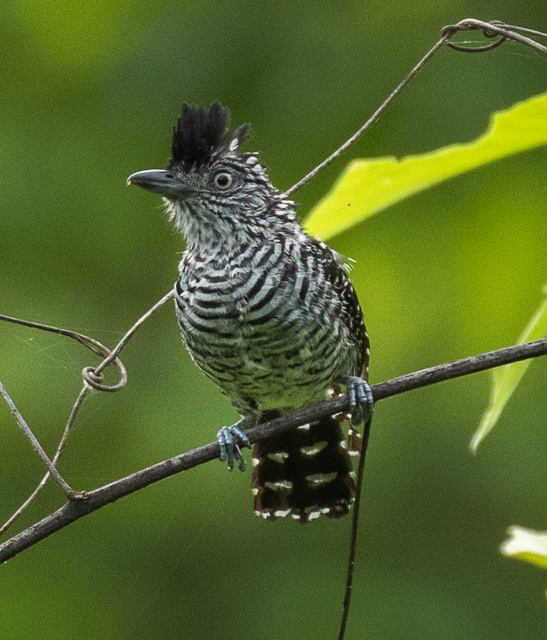 Barred AntshrikeThamnophilus doliatus
Compare
Questions and answers
What is the scientific name of the Rio Madeira Stipplethroat?
The scientific name of the Rio Madeira Stipplethroat is Epinecrophylla amazonica. Written with its author, the full name is Epinecrophylla amazonica (H. F. A. Ihering, 1905).
Which family does the Rio Madeira Stipplethroat belong to?
Epinecrophylla amazonica belongs to the family Thamnophilidae, in the order Passeriformes and the class Aves.
Where is the Rio Madeira Stipplethroat found?
Checklists and occurrence records place Epinecrophylla amazonica in 4 countries: Brazil, Peru, Bolivia and Venezuela.
What is the conservation status of the Rio Madeira Stipplethroat?
The IUCN Red List category recorded for Epinecrophylla amazonica is Least Concern (LC).
What other names does the Rio Madeira Stipplethroat have?
Epinecrophylla amazonica is also known in English as Eastern Stipple-throated Antwren, Madeira Antwren, Madeira Stipple-throated Antwren, Madeira Stipplethroat, Rio Madeira Antwren and Rio Madeira Stipple-throated Antwren.
Where does the Rio Madeira Stipplethroat occur?
The species occurs in Bolivia, Brazil, and Peru.[37]
What are the recognized subspecies?
The two recognized subspecies are E. a. amazonica and E. a. dentei.[38]
Where does the nominate subspecies occur?
The nominate subspecies occurs in south-central Amazonian Brazil between the Juruá and Madeira river watersheds, Peru's Department of Madre de Dios, and Bolivia's Pando Department.[39][40][41]
Where does E. a. dentei occur?
It occurs in Brazil's Aripuanã and Machado river watersheds, east of the Madeira River. Its range includes southern Amazonas, northwestern Mato Grosso, and northeastern Rondônia.[42][43]
Sources
Passages the profile rests on
- The species measures between 10 and 11 cm in length. Source passage: “The Rio Madeira stipplethroat is 10 to 11 cm (3.9 to 4.3 in) long” — English Wikipedia
- The species weighs between 8.7 and 9 g. Source passage: “weighs 8.7 to 9 g (0.31 to 0.32 oz).” — English Wikipedia
- Adult males of the nominate subspecies have mottled yellowish-brown faces and white throats marked with black streaks. Source passage: “Adult males of the nominate subspecies have a mottled yellowish brown face and a white throat with black streaks.” — English Wikipedia
- Adult males of the nominate subspecies have dark yellowish-brown crowns and slightly redder napes. Source passage: “They have a dark yellowish brown crown, a slightly redder nape” — English Wikipedia
- Adult males of the nominate subspecies have dark red mantles, backs, rumps, and uppertail coverts. Source passage: “and a dark red mantle, back, rump, and uppertail coverts.” — English Wikipedia
- The nominate subspecies has olive-gray tails. Source passage: “Their tail is olive-gray.” — English Wikipedia
- The primary wing coverts of nominate males are blackish with reddish tips. Source passage: “Their primary wing coverts are blackish with reddish tips” — English Wikipedia
- The remaining wing coverts of nominate males are dark brown with yellowish-buff tips, while their flight feathers are dark red. Source passage: “the rest of the wing coverts dark brown with yellowish buff tips, and the flight feathers dark red.” — English Wikipedia
- The underparts of nominate males are gray. Source passage: “Their underparts are gray.” — English Wikipedia
- The iris of nominate males is brownish red. Source passage: “Their iris is brownish red.” — English Wikipedia
- Adult females have duller red upperparts than adult males. Source passage: “Adult females have duller red upperparts than males.” — English Wikipedia
- Adult females have dull yellow-brown throats with indistinct dark markings. Source passage: “Their throat is dull yellow-brown with obscure dark marks.” — English Wikipedia
- Adult females have pale yellowish-brown underparts. Source passage: “Their underparts are pale yellowish brown.” — English Wikipedia
- The iris of adult females is grayish or pale beige. Source passage: “Their iris is grayish or pale beige.” — English Wikipedia
- Both sexes have dark gray bills, legs, and feet. Source passage: “Both sexes have a dark gray bill, legs, and feet.” — English Wikipedia
- Males of the subspecies E. a. dentei have buff-colored throats with black streaks. Source passage: “Males of subspecies E. a. dentei have a buffy throat with black streaks” — English Wikipedia
- Males of E. a. dentei have tails almost as red as their backs. Source passage: “and a tail that is almost as red as the back.” — English Wikipedia
- Females of E. a. dentei have paler and grayer bellies than females of the nominate subspecies. Source passage: “Females have a paler and grayer belly than the nominate.” — English Wikipedia
- The species primarily inhabits lowland terra firme evergreen forest. Source passage: “The species primarily inhabits lowland terra firme evergreen forest.” — English Wikipedia
- In Bolivia, the species also occurs in more upland forest. Source passage: “In Bolivia it also occurs in more upland forest.” — English Wikipedia
- The species occurs at elevations up to 400 m. Source passage: “In elevation it ranges only up to 400 m (1,300 ft).” — English Wikipedia
- The species feeds on arthropods, particularly insects and spiders. Source passage: “The Rio Madeira stipplethroat feeds on arthropods, especially insects and spiders.” — English Wikipedia
- The species is believed to remain in its range throughout the year. Source passage: “The Rio Madeira stipplethroat is believed to be a year-round resident throughout its range.” — English Wikipedia
- The species typically forages alone, in pairs, or in small family groups. Source passage: “It typically forages singly, in pairs, or in small family groups” — English Wikipedia
- The species usually forages as part of mixed-species feeding flocks. Source passage: “and usually as part of a mixed-species feeding flock.” — English Wikipedia
- The species mostly forages in the forest understory up to approximately 3 m above the ground. Source passage: “It mostly forages in the forest understory up to about 3 m (10 ft) above the ground.” — English Wikipedia
- The species obtains almost all its prey by gleaning dead leaves on trees. Source passage: “It takes its prey almost entirely by gleaning from dead leaves on trees” — English Wikipedia
- The species also gleans prey from dead leaves caught in vine tangles and small palms. Source passage: “but also from dead leaves caught in vine tangles and small palms.” — English Wikipedia
- The breeding biology of the species has not been documented in the cited account. Source passage: “Nothing is known about the Rio Madeira stipplethroat's breeding biology.” — English Wikipedia
- The IUCN classifies the species as Least Concern. Source passage: “The IUCN has assessed the Rio Madeira stipplethroat as being of Least Concern.” — English Wikipedia
- The species was most recently assessed for the IUCN Red List in 2024. Source passage: “has most recently been assessed for The IUCN Red List of Threatened Species in 2024.” — iucnredlist.org
- The species has a large geographic range. Source passage: “It has a large range;” — English Wikipedia
- The population size of the species is unknown and its population is believed to be stable. Source passage: “its population size is not known and is believed to be stable.” — English Wikipedia
- The species appears to be fairly common throughout its range. Source passage: “It appears to be fairly common throughout its range” — English Wikipedia
- No immediate threats to the species have been identified. Source passage: “No immediate threats have been identified.” — English Wikipedia
- The species' range contains extensive connected areas of intact habitat that appear to face minimal near-term development risk despite lacking formal protection. Source passage: “which contains large, contiguous expanses of intact habitat which, although not formally protected, appear to be at minimal risk of development in the near term” — English Wikipedia
- The species occurs in Bolivia, Brazil, and Peru. Source passage: “It is found in Bolivia, Brazil, and Peru.” — English Wikipedia
- The species has two recognized subspecies, E. a. amazonica and E. a. dentei. Source passage: “The Rio Madeira stipplethroat has two subspecies, the nominate E. a. amazonica (von Ihering, 1905) and E. a. dentei (Whitney, BM et al., 2013).” — English Wikipedia
- The nominate subspecies occurs in south-central Amazonian Brazil between the Juruá and Madeira river watersheds. Source passage: “is found in south-central Amazonian Brazil from the watershed of the Juruá River east to the Madeira River” — English Wikipedia
- The nominate subspecies occurs in Peru's Department of Madre de Dios. Source passage: “in Peru's Department of Madre de Dios” — English Wikipedia
- The nominate subspecies occurs in Bolivia's Pando Department. Source passage: “and in far northern Bolivia's Pando Department.” — English Wikipedia
- The subspecies E. a. dentei occurs in Brazil's Aripuanã and Machado river watersheds, east of the Madeira River. Source passage: “Subspecies E. a. dentei is found in Brazil in the watershed of the Aripuanã and Machado rivers east of the Madeira.” — English Wikipedia
- The range of E. a. dentei includes southern Amazonas, northwestern Mato Grosso, and northeastern Rondônia. Source passage: “The area spans southern Amazonas, northwestern Mato Grosso, and northeastern Rondônia states.” — English Wikipedia
- The species was previously classified as a subspecies of the Rufous-backed Stipplethroat. Source passage: “The Rio Madeira stipplethroat was long treated as a subspecies of the rufous-backed stipplethroat” — English Wikipedia
- Taxonomists began recognizing the species as a distinct species in 2014. Source passage: “Beginning in 2014 taxonomists recognized it as a full species.” — English Wikipedia
Data
- Catalogue of Life, 2026-10-16 XR cc by
- Global Biodiversity Information Facility CC BY 4.0
- Wikidata CC0
- GeoNames CC BY 4.0
- Wikimedia Commons per image; credit shown with each image
- Within the Catalogue of Life, this name comes from The Integrated Taxonomic Information System cc0
This species in other databases
Page built on 29 November 2026. See how the catalog is made and all sources and licences.
Cite this page
ScientificNames.org. (2026). Epinecrophylla amazonica (Rio Madeira Stipplethroat). Retrieved November 29, 2026, from https://scientificnames.org/species/epinecrophylla-amazonica
“Epinecrophylla amazonica (Rio Madeira Stipplethroat).” ScientificNames.org, 2026, scientificnames.org/species/epinecrophylla-amazonica. Accessed 29 Nov. 2026.
ScientificNames.org. “Epinecrophylla amazonica (Rio Madeira Stipplethroat).” Accessed November 29, 2026. https://scientificnames.org/species/epinecrophylla-amazonica.
@misc{scientificnames_epinecrophylla_amazonica_rio_madeira_stipplethroat,
  author = {{ScientificNames.org}},
  title = {Epinecrophylla amazonica (Rio Madeira Stipplethroat)},
  year = {2026},
  url = {https://scientificnames.org/species/epinecrophylla-amazonica},
  note = {Accessed 2026-11-29}
}