Species · Insects
Waterberg Copper Erikssonia edgei
The scientific name of the Waterberg Copper is Erikssonia edgei. It is a species of insect in the family Lycaenidae (blues), order Lepidoptera. The name dates from 2010.
- Scientific name
- Erikssonia edgei Gardiner & Terblanche, 2010
- Common name
- Waterberg Copper
- Genus
- Erikssonia
- Family
- Lycaenidae (Blues)
- Order
- Lepidoptera
- Class
- Insecta
- Red List category
- CR Critically Endangered
- Recorded in
- 1 country
- Name status
- accepted in the Catalogue of Life

Overview
The Waterberg Copper (Erikssonia edgei Gardiner & Terblanche, 2010) is an insect in the family Lycaenidae, order Lepidoptera and class Insecta. It occurs in high-altitude grasslands on sandy substrates in Limpopo, South Africa. Its larvae develop in nests of Lepisiota ants and are accompanied by ants that feed at their honey-glands.
Written 27 November 2026 from the sources listed below. Each statement was checked against the passage it cites; statements that could not be supported were removed.
Similar species
The species was originally considered a southern population of Erikssonia acraeina.[1]
Appearance
Male forewing length ranges from 12.3 to 16.8 mm, while female forewing length ranges from 16.1 to 19.1 mm.[2][3]
The larval head is dark with yellow markings. The sixth larval instar grows to more than 3 cm in length.[4][5]
Habitat
The species occurs in high-altitude grasslands growing on sandy substrates. The original population inhabited sparse mountain bushveld at 1,595 metres above sea level near Jan Trichardt's Pass in the central Waterberg.[6][7]
The original population occupied approximately 3 hectares at the northwestern base of Perdekop. The Bateleur Nature Reserve population occupies treeless grassland, with its colonies covering a 5-hectare area.[8][9][10]
Diet
The larvae feed on two species of Gnidia. The first and second larval instars feed on leaf surfaces, while the third and fourth consume leaf margins.[11][12][13]
The fifth and sixth larval instars feed exclusively on leaf edges. Adult butterflies often obtain nectar from flowers.[14][15]
Behaviour
Adults fly slowly and weakly near their host plants and dive into the grass when disturbed. Male butterflies defend territories during the warmer hours of the day.[16][17][18]
Adult butterflies bask in sunlight. During cool cloudy weather, they may rest on sand between grass tufts.[19][20]
Larvae shelter in host-ant nests during the day and emerge at night to feed. They are accompanied by ants that may stroke them with their antennae and feed at their honey-glands.[21][22]
The species is associated with ground-nesting ants. Its larvae and pupae develop in nests of Lepisiota ants.[23][24]
Reproduction and life cycle
The pupal stage takes place inside the host-ant nest.[25]
Conservation
The species is classified as critically endangered. The conservation status of the Bateleur Nature Reserve population remained indeterminate as of 2017.[26][27]
The original population became locally extinct approximately 12 years after its discovery. Its local extinction was attributed to habitat changes caused by altered grazing and fire management.[28][29]
The butterflies failed to appear as expected in November 2016 following the severe 2015–2016 drought.[30]
Classification of the Waterberg Copper
| Kingdom | Animalia |
|---|---|
| Phylum | Arthropoda |
| Subphylum | Hexapoda |
| Class | Insecta (Insect) |
| Order | Lepidoptera |
| Superfamily | Papilionoidea |
| Family | Lycaenidae (Blues) |
| Genus | Erikssonia |
| Species | Erikssonia edgei Gardiner & Terblanche, 2010 |
This name was added to the Catalogue of Life from a contributing dataset by automated merging and has not yet been reviewed by its editors.
Where the Waterberg Copper is found
Checklists and occurrence records place Erikssonia edgei in 1 country. GBIF holds 11 georeferenced records of it.
Countries
Regions and cities with the most records
Range as the checklists state it
Global
A number beside a place is its count of GBIF occurrence records. A place without a number comes from a checklist alone. Records show where a species has been observed or collected, which can include escapes and vagrants.
Common names
English
- Waterberg Copper
- Lost-And-Found Acraea Copper
- Waterberg Sunset Copper
- Waterburg Copper
Names in 1 other language
- Afrikaans
- Waterberg Kopervlerkie
Related species
-
 Erikssonia cooksoni
- Erikssonia acraina
-
 Common BluePolyommatus icarus
-
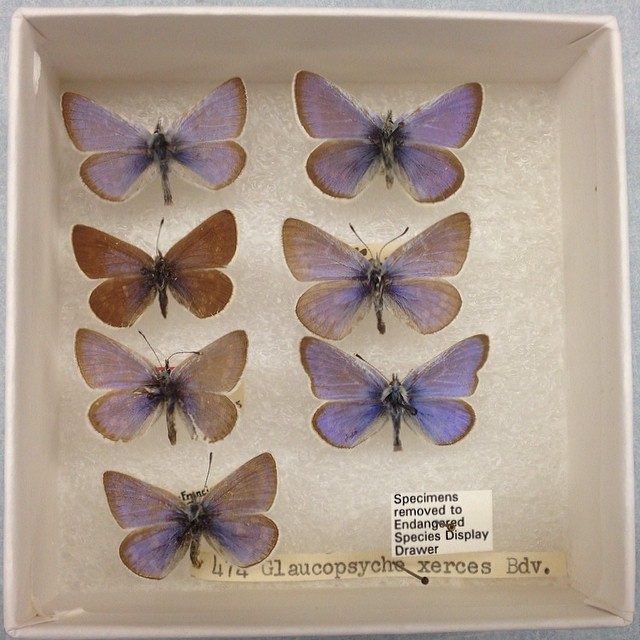 Xerces BlueGlaucopsyche xerces
-
 Adonis BlueLysandra bellargus
-
 Western Pygmy BlueBrephidium exilis
-
 AtalaEumaeus atala
-
 Holly BlueCelastrina argiolus
Compare
Questions and answers
What is the scientific name of the Waterberg Copper?
The scientific name of the Waterberg Copper is Erikssonia edgei. Written with its author, the full name is Erikssonia edgei Gardiner & Terblanche, 2010.
Which family does the Waterberg Copper belong to?
Erikssonia edgei belongs to the family Lycaenidae, in the order Lepidoptera and the class Insecta.
Where is the Waterberg Copper found?
Checklists and occurrence records place Erikssonia edgei in 1 country: South Africa.
What is the conservation status of the Waterberg Copper?
The IUCN Red List category recorded for Erikssonia edgei is Critically Endangered (CR).
What other names does the Waterberg Copper have?
Erikssonia edgei is also known in English as Lost-And-Found Acraea Copper, Waterberg Sunset Copper and Waterburg Copper.
Sources
Passages the profile rests on
- The species was originally considered a southern population of Erikssonia acraeina. Source passage: “was originally deemed to be a southern population of E. acraeina.” — English Wikipedia
- The forewing length of males ranges from 12.3 to 16.8 mm. Source passage: “The forewing length is 12.3-16.8 mm for males” — English Wikipedia
- The forewing length of females ranges from 16.1 to 19.1 mm. Source passage: “16.1–19.1 mm for females.” — English Wikipedia
- The larval head is dark with yellow markings. Source passage: “The head is dark with yellow markings” — English Wikipedia
- The sixth larval instar grows to more than 3 cm in length. Source passage: “The sixth and last instar takes about three weeks to grow to over 3 cm in length.” — English Wikipedia
- The species occurs in high-altitude grasslands growing on sandy substrates. Source passage: “The critically endangered butterfly occurs in high-altitude grasslands on sandy substrates” — English Wikipedia
- The original population inhabited sparse mountain bushveld at 1,595 metres above sea level near Jan Trichardt's Pass in the central Waterberg. Source passage: “The first known population was located at 1,595 m.a.s.l. in a sparse mountain bushveld near Jan Trichardt's Pass in the central Waterberg.” — English Wikipedia
- The Bateleur Nature Reserve population occupies treeless grassland. Source passage: “Vegetation at the new locality is treeless grassland” — English Wikipedia
- The original population occupied approximately 3 hectares at the northwestern base of Perdekop. Source passage: “They frequented 3 ha at the northwestern base of Perdekop” — English Wikipedia
- The Bateleur Nature Reserve colonies occupy a 5-hectare area. Source passage: “discovered two new colonies in a 5 ha area of the private Bateleur Nature Reserve” — English Wikipedia
- The larvae feed on two species of Gnidia. Source passage: “The larvae feed on two species of Gnidia, both poisonous” — English Wikipedia
- The first and second larval instars feed on leaf surfaces. Source passage: “The first two instars feed on the leaf surfaces” — English Wikipedia
- The third and fourth larval instars consume leaf margins. Source passage: “the third and fourth begin to consume the leaf margins.” — English Wikipedia
- Adult butterflies often obtain nectar from flowers. Source passage: “They like basking in the sun, and often feed on nectar” — English Wikipedia
- The fifth and sixth larval instars feed exclusively on leaf edges. Source passage: “The 5th and 6th instars feed only on leaf edges.” — English Wikipedia
- Adults fly slowly and weakly near their host plants. Source passage: “They fly slowly and weakly in the vicinity of their host plants” — English Wikipedia
- Adults dive into the grass when disturbed. Source passage: “dive into the grass when disturbed.” — English Wikipedia
- Male butterflies defend territories during the warmer hours of the day. Source passage: “The males are territorial during the warmer hours of the day” — English Wikipedia
- Adult butterflies bask in sunlight. Source passage: “They like basking in the sun” — English Wikipedia
- During cool cloudy weather, adults may rest on sand between grass tufts. Source passage: “In cool cloudy weather they may be found resting on the sand between grass tufts.” — English Wikipedia
- Larvae shelter in host-ant nests during the day and emerge at night to feed. Source passage: “The larvae shelter during the day in the nest of the host ant, and emerge at night” — English Wikipedia
- The larvae are accompanied by ants that may stroke them with their antennae and feed at their honey-glands. Source passage: “The ants may stroke them slowly with their antennae, and often feed at their honey-glands.” — English Wikipedia
- The species is associated with ground-nesting ants. Source passage: “like them, is associated with ground-nesting ants.” — English Wikipedia
- The larvae and pupae develop in nests of Lepisiota ants. Source passage: “shelter by day in the nests of Lepisiota ants, wherein the pupae also develop.” — English Wikipedia
- The pupal stage takes place inside the host-ant nest. Source passage: “It pupates inside the ant nest” — English Wikipedia
- The species is classified as critically endangered in document 1. Source passage: “The critically endangered butterfly” — English Wikipedia
- The conservation status of the Bateleur Nature Reserve population remained indeterminate as of 2017. Source passage: “As of 2017, it status is indeterminate as its continued presence at Bateleur Nature Reserve has not been confirmed.” — English Wikipedia
- The original population was locally extinct approximately 12 years after its discovery. Source passage: “About 12 years later it was locally extinct” — English Wikipedia
- The original population's local extinction was attributed to habitat changes caused by altered grazing and fire management. Source passage: “Its local extinction was ascribed to habitat changes induced by altered grazing and fire management practices.” — English Wikipedia
- The butterflies failed to appear as expected in November 2016 following the severe 2015–2016 drought. Source passage: “Following the severe 2015/2016 drought, the butterflies did not appear as expected in November 2016.” — English Wikipedia
Data
- Catalogue of Life, 2026-10-16 XR cc by
- Global Biodiversity Information Facility CC BY 4.0
- Wikidata CC0
- GeoNames CC BY 4.0
- Wikimedia Commons per image; credit shown with each image
- Within the Catalogue of Life, this name comes from The IUCN Red List of Threatened Species cc by
References
- Taxonomy, biology, biogeography, evolution and conservation of the genus Erikssonia Trimen (Lepidoptera: Lycaenidae). (2010). African Entomology, 18(1), 171–191. https://doi.org/10.4001/003.018.0114 Link where the name was published
This species in other databases
Page built on 27 November 2026. See how the catalog is made and all sources and licences.
Cite this page
ScientificNames.org. (2026). Erikssonia edgei (Waterberg Copper). Retrieved November 27, 2026, from https://scientificnames.org/species/erikssonia-edgei
“Erikssonia edgei (Waterberg Copper).” ScientificNames.org, 2026, scientificnames.org/species/erikssonia-edgei. Accessed 27 Nov. 2026.
ScientificNames.org. “Erikssonia edgei (Waterberg Copper).” Accessed November 27, 2026. https://scientificnames.org/species/erikssonia-edgei.
@misc{scientificnames_erikssonia_edgei_waterberg_copper,
  author = {{ScientificNames.org}},
  title = {Erikssonia edgei (Waterberg Copper)},
  year = {2026},
  url = {https://scientificnames.org/species/erikssonia-edgei},
  note = {Accessed 2026-11-27}
}