Species · Fishes
Skilfish Erilepis zonifer
The scientific name of the Skilfish is Erilepis zonifer. It is a species of fish in the family Anoplopomatidae (sablefishes), order Perciformes. The name dates from 1880.
- Scientific name
- Erilepis zonifer (Lockington, 1880)
- Common name
- Skilfish
- Genus
- Erilepis
- Family
- Anoplopomatidae (Sablefishes)
- Order
- Perciformes
- Class
- Teleostei
- Environment
- marine
- Recorded in
- 4 countries
- Name status
- accepted in the Catalogue of Life

Overview
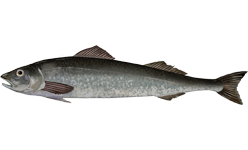
Skilfish (Erilepis zonifer) is a fish in the family Anoplopomatidae, order Perciformes and class Teleostei. Skilfish inhabit deep rocky bottoms in the North Pacific at depths reaching 440 metres. Skilfish have large blue eyes, a cavernous mouth, a bulky body and strong caudal fins.
Written 26 November 2026 from the sources listed below. Each statement was checked against the passage it cites; statements that could not be supported were removed.
Appearance
Young skilfish have prominent white blotches that become duller and less visible as they mature. Adults have dark-colored bodies and almost black fins.[1][2]
Skilfish have large blue eyes and a cavernous mouth resembling that of a grouper. Their large, bulky bodies have strong caudal fins that are at least as tall as their heads.[3][4][5]
Skilfish can reach 1.83 metres in length and a weight of 91 kilograms. A skilfish caught in 2018 measured 201 centimetres in length.[6][7][8]
Habitat
Skilfish inhabit deep rocky bottoms in the North Pacific and occur at depths reaching 440 metres.[9][10]
Diet
Skilfish prey on eels, capelin, Pacific cod, pollock, candlefish, herring, mackerel and mullets. Their diet also includes squid, octopuses and shrimp.[11][12][13][14][15][16][17][18][19][20][21]
Skilfish may also consume jellyfish and eel leptocephalus larvae. Rockfish may be preyed upon by skilfish, and a dissected specimen contained a stomach full of rockfish spines.[22][23][24][25]
Similar species
Skilfish resemble wreckfish, groupers and sea bass in body appearance.[26][27]
Classification of the Skilfish
| Kingdom | Animalia |
|---|---|
| Phylum | Chordata |
| Subphylum | Vertebrata |
| Infraphylum | Gnathostomata |
| Parvphylum | Osteichthyes |
| Gigaclass | Actinopterygii |
| Superclass | Actinopteri |
| Class | Teleostei (Teleost) |
| Order | Perciformes |
| Suborder | Cottoidei |
| Family | Anoplopomatidae (Sablefishes) |
| Genus | Erilepis (Skilfishes) |
| Species | Erilepis zonifer (Lockington, 1880) |
Where the Skilfish is found
Checklists and occurrence records place Erilepis zonifer in 4 countries. GBIF holds 92 georeferenced records of it.
Countries
Regions and cities with the most records
- Gohyakkoku, Japan 8
- Kamiichi, Japan 8
- Kurobe-shi, Japan 8
- Namerikawa, Japan 8
- Nyūzen, Japan 8
- Toyama, Japan 8
- Uozu, Japan 8
A number beside a place is its count of GBIF occurrence records. A place without a number comes from a checklist alone. Records show where a species has been observed or collected, which can include escapes and vagrants.
Common names
English
- Skilfish
Names in 5 other languages
- Czech
- chmurnatka velká
- French
- morue bariolée
- Japanese
- アブラボウズ
- Portuguese
- Gindara-gigante
- Russian
- Морской монах
Synonyms
3 other scientific names have been used for this species and are now treated as synonyms of Erilepis zonifer.
- Ebisus sagamius Jordan & Snyder, 1901
- Erilepsis zonifera (Lockington, 1880)
- Myriolepis zonifer Lockington, 1880
Related species
Compare
Questions and answers
What is the scientific name of the Skilfish?
The scientific name of the Skilfish is Erilepis zonifer. Written with its author, the full name is Erilepis zonifer (Lockington, 1880).
Which family does the Skilfish belong to?
Erilepis zonifer belongs to the family Anoplopomatidae, in the order Perciformes and the class Teleostei.
Where is the Skilfish found?
Checklists and occurrence records place Erilepis zonifer in 4 countries: Japan, United States, Canada and South Korea.
Sources
Passages the profile rests on
- Young skilfish have prominent white blotches that become duller and less visible as they mature. Source passage: “Young fish display striking white blotches on their body, however their colour changes to dark grey with maturity, and the bright markings become duller and less visible as they grow” — English Wikipedia
- Adult skilfish have dark-colored bodies and almost black fins. Source passage: “Skilfish have a dark colored body, with almost black fins” — English Wikipedia
- Skilfish have large blue eyes and a cavernous mouth resembling that of a grouper. Source passage: “large, blue eyes above a projectile, cavernous grouper-like mouth.” — English Wikipedia
- Skilfish have strong caudal fins that are at least as tall as their heads. Source passage: “They also have strong caudal fins, which are as tall or taller than the fish's head.” — English Wikipedia
- Skilfish have a large, bulky body shape. Source passage: “Skilfish are large and bulky fish” — English Wikipedia
- Skilfish can reach 1.83 metres in length. Source passage: “Skilfish can grow to a length of 1.83 m” — English Wikipedia
- Skilfish can reach a weight of 91 kilograms. Source passage: “and a weight of 91 kg.” — English Wikipedia
- A skilfish caught in 2018 measured 201 centimetres in length. Source passage: “The length of the caught specimen was 201 cm” — English Wikipedia
- Skilfish inhabit deep rocky bottoms in the North Pacific. Source passage: “Found on deep rocky bottoms in the North Pacific” — English Wikipedia
- Skilfish occur at depths reaching 440 metres. Source passage: “at depths of up to 440 metres” — English Wikipedia
- Skilfish prey on eels. Source passage: “such as eels, capelin, Pacific cod” — English Wikipedia
- Skilfish consume capelin. Source passage: “eels, capelin, Pacific cod” — English Wikipedia
- Skilfish consume Pacific cod. Source passage: “capelin, Pacific cod, pollock” — English Wikipedia
- Skilfish prey on pollock. Source passage: “Pacific cod, pollock, candlefish” — English Wikipedia
- Skilfish consume candlefish. Source passage: “pollock, candlefish, herring” — English Wikipedia
- Skilfish consume herring. Source passage: “candlefish, herring, mackerel” — English Wikipedia
- Skilfish prey on mackerel. Source passage: “herring, mackerel, mullets” — English Wikipedia
- Skilfish consume mullets. Source passage: “mackerel, mullets, cephalopods” — English Wikipedia
- Skilfish feed on squid. Source passage: “cephalopods like squid, octopus” — English Wikipedia
- Skilfish feed on octopuses. Source passage: “like squid, octopus, crustaceans” — English Wikipedia
- Skilfish consume shrimp. Source passage: “crustaceans such as shrimp, small crabs” — English Wikipedia
- Skilfish may also consume jellyfish. Source passage: “they may also consume jellyfishes” — English Wikipedia
- Skilfish may feed on eel leptocephalus larvae. Source passage: “and eel leptocephalus.” — English Wikipedia
- Rockfish may be preyed upon by skilfish. Source passage: “Rockfish may be also prey” — English Wikipedia
- A dissected skilfish specimen contained a stomach full of rockfish spines. Source passage: “one dissected specimen had a stomach full of rockfish spines.” — English Wikipedia
- Skilfish resemble wreckfish in body appearance. Source passage: “bear a resemblance to the wreckfish in the family Polyprionidae” — English Wikipedia
- Skilfish resemble groupers and sea bass in body appearance. Source passage: “and the groupers or sea bass in the family Serranidae” — English Wikipedia
- Skilfish is the only species in the genus Erilepis. Source passage: “the only species in the genus Erilepis.” — English Wikipedia
- Skilfish is one of two species belonging to the family Anoplopomatidae. Source passage: “one of two species belonging to the family Anoplopomatidae” — English Wikipedia
Data
- Catalogue of Life, 2026-10-16 XR cc by
- Global Biodiversity Information Facility CC BY 4.0
- Wikidata CC0
- GeoNames CC BY 4.0
- Wikimedia Commons per image; credit shown with each image
- Within the Catalogue of Life, this name comes from World Register of Marine Species cc by
This species in other databases
- Catalogue of Life 3B286
- Wikidata Q4959539
- iNaturalist 219463
- WoRMS urn:lsid:marinespecies.org:taxname:280700
- ITIS 167125
Page built on 27 November 2026. See how the catalog is made and all sources and licences.
Cite this page
ScientificNames.org. (2026). Erilepis zonifer (Skilfish). Retrieved November 27, 2026, from https://scientificnames.org/species/erilepis-zonifer
“Erilepis zonifer (Skilfish).” ScientificNames.org, 2026, scientificnames.org/species/erilepis-zonifer. Accessed 27 Nov. 2026.
ScientificNames.org. “Erilepis zonifer (Skilfish).” Accessed November 27, 2026. https://scientificnames.org/species/erilepis-zonifer.
@misc{scientificnames_erilepis_zonifer_skilfish,
  author = {{ScientificNames.org}},
  title = {Erilepis zonifer (Skilfish)},
  year = {2026},
  url = {https://scientificnames.org/species/erilepis-zonifer},
  note = {Accessed 2026-11-27}
}