Species · Flowering plants
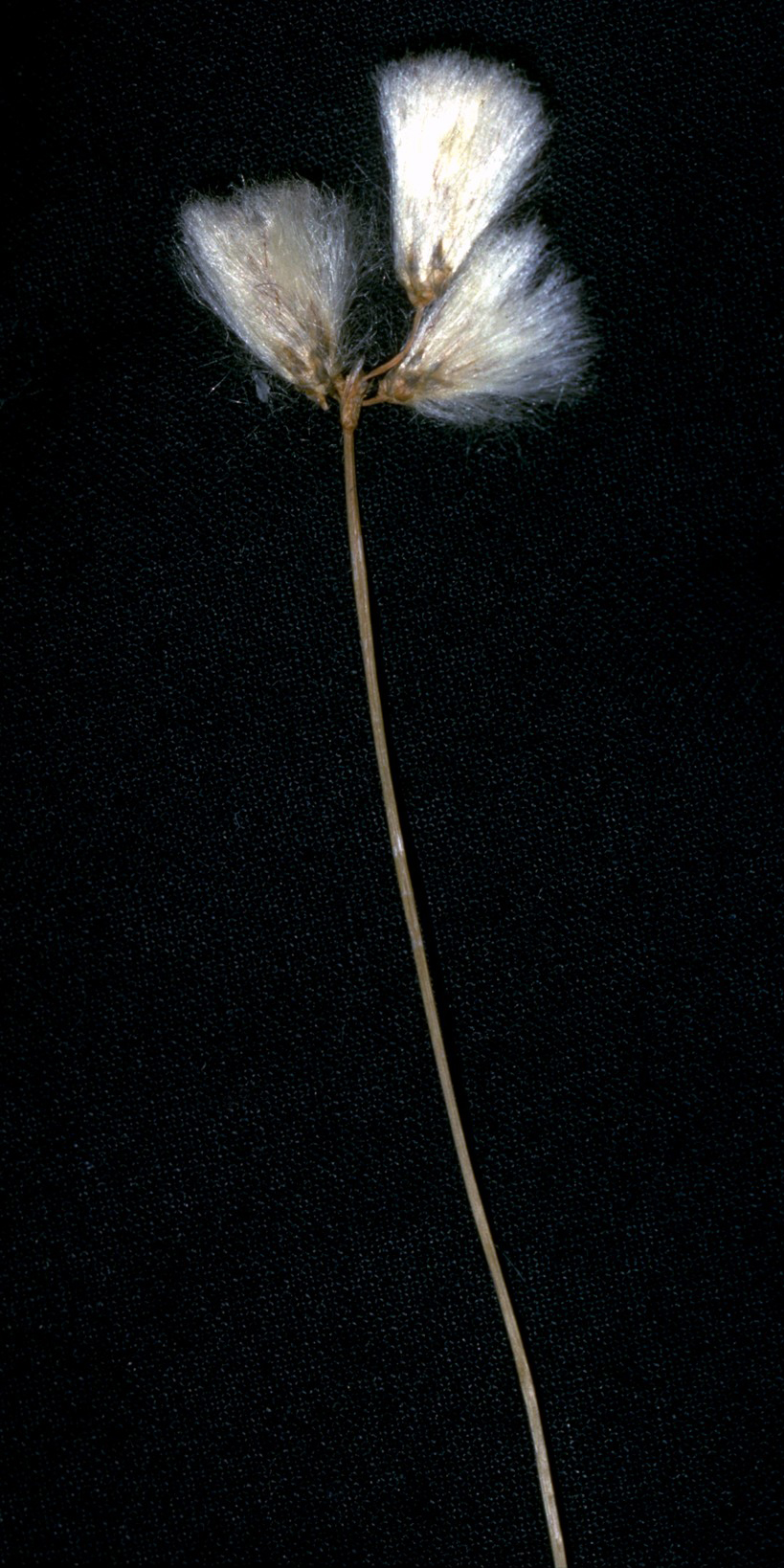
Common Cottongrass Eriophorum angustifolium
The scientific name of the Common Cottongrass is Eriophorum angustifolium. It is a species of flowering plant in the family Cyperaceae (sedge family), order Poales.
- Scientific name
- Eriophorum angustifolium Honck.
- Common name
- Common Cottongrass
- Genus
- Eriophorum
- Family
- Cyperaceae (Sedge Family)
- Order
- Poales
- Class
- Liliopsida
- Red List category
- LC Least Concern
- Recorded in
- 42 countries
- Name status
- accepted in the Catalogue of Life

Overview
Common cottongrass (Eriophorum angustifolium Honck.) is a hardy, herbaceous, rhizomatous perennial sedge in the family Cyperaceae. It grows in open bogs, heaths, wetlands and moorlands, particularly in areas with standing water and calcareous peat or acidic soil. It is distinguished by conspicuous white, cotton-like seed-heads consisting of numerous bristles.
Written 26 November 2026 from the sources listed below. Each statement was checked against the passage it cites; statements that could not be supported were removed.
Appearance
The plant has a tall, erect, smooth, green stem with a narrow cylindrical or triangular-prism shape. Its mature height generally ranges from 15 to 75 centimetres, with some specimens reaching 100 centimetres.[1][2]
Its leaves are long, narrow and dark green, with a single central groove. They narrow from a base measuring 2–6 millimetres wide towards a triangular tip.[3][4]
The plant produces between one and seven conspicuous inflorescences. Its white, cotton-like seed-heads consist of numerous bristles, and its mature white perianth measures approximately 5 centimetres long.[5][6][7]
Its aerial peduncles and chaffs are green and brown and measure approximately 4–10 millimetres.[8]
Habitat
Common cottongrass grows in open bogs, heaths, wetlands and moorlands. It occurs in areas with standing water and calcareous peat or acidic soil, and grows particularly well in freshly disturbed, cut or eroded peat.[9][10][11]
In cultivation, it can grow in water up to 5 centimetres deep. Suitable soils include poorly drained peat, sand, clay and loam with an acidic pH.[12][13]
Behaviour
Common cottongrass is a hardy, herbaceous, rhizomatous perennial sedge. It has creeping rhizomes and translucent pink roots.[14][15]
The species is perennial and lives for more than two years. The plant dies back at the end of its growing season.[16][17]
Reproduction and life cycle
The species is protogynous. Flowering generally begins in spring or early summer, around May, and groups of three to five brown flowers are produced.[18][19][20]
Fertilisation usually occurs in May or June through wind pollination. The white bristle-like seed structures generally persist from June until September.[21][22]
The plant's hairy pappi assist in wind dispersal of its seeds. They also provide thermal insulation for the reproductive organs by trapping solar radiation.[23][24]
Conservation
NatureServe assigns common cottongrass a global conservation status of G5, indicating that it is considered ecologically secure.[25]
Uses
The plant has historically been used in the Old World to treat diarrhoea. Its fibres have also been used in paper production and candle-wick manufacture in Germany.[26][27]
The plant's seed-head fibres have been used as a substitute for feathers in pillow stuffing in Sweden and Sussex, England. In Scotland, the plant was used to dress wounds during World War I.[28][29]
Similar species
Common cottongrass differs from Eriophorum vaginatum through its multiple flower heads and rhizomatous growth. Eriophorum vaginatum has a single flower head and grows in dense tussocks.[30][31]
Eriophorum latifolium differs in having laxly tufted growth and forked pappi. Eriophorum gracile has rough peduncles and grows in neutral-pH swamps.[32][33]
Classification of the Common Cottongrass
| Kingdom | Plantae |
|---|---|
| Subkingdom | Pteridobiotina |
| Phylum | Tracheophyta |
| Class | Liliopsida |
| Order | Poales |
| Family | Cyperaceae (Sedge Family) |
| Genus | Eriophorum (Bog Cotton) |
| Species | Eriophorum angustifolium Honck. |
This name was added to the Catalogue of Life from a contributing dataset by automated merging and has not yet been reviewed by its editors.
Where the Common Cottongrass is found
Checklists and occurrence records place Eriophorum angustifolium in 42 countries. GBIF holds 445,959 georeferenced records of it.
Countries
- Aland Islands 671
- Albania 14
- Andorra 136
- Austria 5,653
- Belarus 78
- Belgium 8,959
- Bulgaria 15
- Canada 4,780
- Czechia 4,815
- Denmark 42,317
- Estonia 1,494
- Faroe Islands 231
- Finland 26,616
- France 41,780
- Germany 24,486
- Greece 7
- Greenland 1,134
- Hungary 13
- Iceland 3,336
- Ireland 1,252
- Isle of Man 1,085
- Italy 636
- Jersey 6
- Latvia 62
- Liechtenstein 34
- Lithuania 30
- Luxembourg 342
- Norway 26,324
- Poland 6,160
- Portugal 103
- Romania 19
- Russia 6,097
- Slovakia 3,340
- Slovenia 20
- Spain 1,732
- Svalbard and Jan Mayen 15
- Sweden 49,854
- Switzerland 18,206
- The Netherlands 44,588
- Ukraine 115
- United Kingdom 114,834
- United States 4,570
Regions and cities with the most records
- Scotland, United Kingdom 56,487
- England, United Kingdom 36,383
- Auvergne-Rhône-Alpes, France 19,334
- Central Jutland, Denmark 15,485
- Bavaria, Germany 14,977
- South Denmark, Denmark 12,461
- Wales, United Kingdom 10,790
- Lapland, Finland 9,489
- Drenthe, The Netherlands 8,205
- Norrbotten, Sweden 7,493
- Overijssel, The Netherlands 6,884
- Friesland, The Netherlands 6,856
- Västra Götaland, Sweden 6,467
- Västerbotten, Sweden 5,052
- Assen, The Netherlands 5,019
- Bourgogne-Franche-Comté, France 4,451
- Gelderland, The Netherlands 4,052
- Steenwijk, The Netherlands 3,920
- Borne, The Netherlands 3,852
- Northern Ireland, United Kingdom 3,851
- Silkeborg, Denmark 3,734
- Hoogeveen, The Netherlands 3,687
- Drachten, The Netherlands 3,585
- Bern, Switzerland 3,572
- Jämtland, Sweden 3,319
- Wierden, The Netherlands 3,313
- Almelo, The Netherlands 3,279
- Occitanie, France 3,271
- Leek, The Netherlands 3,223
- Meppel, The Netherlands 3,164
- Nijverdal, The Netherlands 3,148
- Provence-Alpes-Côte d'Azur, France 3,121
- Tubbergen, The Netherlands 3,098
- Zonhoven, Belgium 3,068
- Peer, Belgium 3,044
- Koersel, Belgium 3,027
7 more countries have a few records outside this range
These countries hold a few records of Eriophorum angustifolium but lie outside the range the checklists give for it. Such records are often zoo or garden specimens, museum material or vagrants, so the species is not counted as occurring there.
A number beside a place is its count of GBIF occurrence records. A place without a number comes from a checklist alone. Records show where a species has been observed or collected, which can include escapes and vagrants.
Common names
English
- Common Cottongrass
- Bog-cotton
- Cotton Grass
- Common Cotton-grass
- Common Cottonsedge
- Many-spiked Cotton-grass
- Many-spiked Cottongrass
- Narrow-leaved Cotton-grass
- Narrow-leaved Cottongrass
- Narrowleaf Cotton-grass
- Narrowleaf Cottongrass
- Tall Cottongrass
- Thin-scale Cottongrass
Names in 28 other languages
- Catalan
- Cotonera de fulla estreta
- Chinese
- 棉花草, 窄葉羊鬍子草
- Czech
- suchopýr úzkolistý
- Danish
- Smalbladet kæruld
- Dutch
- Veenpluis
- Estonian
- ahtalehine villpea
- Faroese
- mýrifípa
- Finnish
- luhtavilla
- French
- linaigrette à feuilles étroites
- German
- Schmalblättriges Wollgras
- Hungarian
- Keskenylevelű gyapjúsás
- Icelandic
- Klófífa
- Irish
- Ceannbhán
- Italian
- Pennacchio a foglie strette
- Korean
- 참황새풀
- Lithuanian
- Siauralapis švylys
- Northern Sami
- gieddeullu, niitoullu, upmolsuoidni
- Norwegian Bokmål
- duskull, vanlig duskull
- Norwegian Nynorsk
- duskmyrull, stormyrull, vanleg duskull
- Polish
- Wełnianka wąskolistna
- Portuguese
- junça-do-algodão
- Russian
- Пушица многоколосковая, Пушица узколистная
- Slovak
- páperník úzkolistý
- Slovenian
- ozkolistni munec
- Spanish
- hierba algodonera
- Swedish
- ängsull
- Ukrainian
- Пухівка вузьколиста
- Welsh
- Eira'r Gors, Gwaunblu Culddail, Gweunblu, Gwlanwair Cyffredin, Plu'r Gweunydd, Plu'r Gweunydd Culddail, Plu'r Gweunydd Culddail Cyffredin, Sidan y Waun
Synonyms
16 other scientific names have been used for this species and are now treated as synonyms of Eriophorum angustifolium.
- Eriophorum angustifolium f. cracoviense (Zapal) Soó
- Eriophorum angustifolium f. dolichophyllum (Zapal) Soó
- Eriophorum angustifolium f. monostachyum (Stefánsson) Á.Löve
- Eriophorum angustifolium subsp. subarcticum (Vassil) Hultén
- Eriophorum angustifolium var. angustifolium
- Eriophorum angustifolium var. elatum Moritzi
- Eriophorum angustifolium var. majus C.F.Schultz
- Eriophorum angustifolium var. rubricaule Wender.
- Eriophorum polystachion f. angustifolium (Honck.) Regel
- Eriophorum polystachion f. monostachium Stefánsson
- Eriophorum polystachion subsp. angustifolium (Honck.) Hook.fil.
- Eriophorum polystachion var. angustifolium (Honck.) A.Gray
- Eriophorum polystachion var. cracoviense Zapał.
- Eriophorum polystachion var. dolichophyllum Zapał.
- Plumaria angustifolia (Honck.) Bubani
- Scirpus angustifolius (Honck.) T.Koyama
Subspecies and varieties
- Eriophorum angustifolium subsp. angustifolium (Tall Cottongrass) subspecies
- Eriophorum angustifolium subsp. komarovii subspecies
Related species
-
 Tussock CottongrassEriophorum vaginatum
-
 Arctic CottongrassEriophorum callitrix
-
 Scheuchzer's CottongrassEriophorum scheuchzeri
-
 Broad-Leaved CottongrassEriophorum latifolium
-
 Tawny CottongrassEriophorum virginicum
-
 Slender CottongrassEriophorum gracile
-
 Closed-sheath Cotton-grassEriophorum brachyantherum
-
 Rusty CottongrassEriophorum chamissonis
Compare
Questions and answers
What is the scientific name of the Common Cottongrass?
The scientific name of the Common Cottongrass is Eriophorum angustifolium. Written with its author, the full name is Eriophorum angustifolium Honck..
Which family does the Common Cottongrass belong to?
Eriophorum angustifolium belongs to the family Cyperaceae, in the order Poales and the class Liliopsida.
Where is the Common Cottongrass found?
Checklists and occurrence records place Eriophorum angustifolium in 42 countries, including United Kingdom, Sweden, The Netherlands, Denmark, France and Finland.
What is the conservation status of the Common Cottongrass?
The IUCN Red List category recorded for Eriophorum angustifolium is Least Concern (LC).
What other names does the Common Cottongrass have?
Eriophorum angustifolium is also known in English as Bog-cotton, Cotton Grass, Common Cotton-grass, Common Cottonsedge, Many-spiked Cotton-grass and Many-spiked Cottongrass.
What is cotton grass used for?
The seeds and stems are used as food in traditional cuisine among Alaska Native, Inuit and Inupiat communities. Other uses include medicinal treatments, paper production, candle-wick manufacture, pillow stuffing and wound dressing.[34][35][26][27][28][29]
Where does cottongrass grow?
Common cottongrass grows in open bogs, heaths, wetlands and moorlands. It is native to North America, North Asia and Europe, and occurs in areas with standing water and calcareous peat or acidic soil.[9][10][36]
Is cottongrass edible?
The seeds and stems are used as food in traditional cuisine among Alaska Native, Inuit and Inupiat communities.[34]
Sources
Passages the profile rests on
- The plant has a tall, erect, smooth, green stem with a narrow cylindrical or triangular-prism shape. Source passage: “Fully grown, it has a tall, erect stem shaped like a narrow cylinder or triangular prism; it is smooth in texture and green in colour.” — English Wikipedia
- Reported mature plant heights range from 15 to 75 centimetres, with some specimens reaching 100 centimetres. Source passage: “estimates include up to 60 cm (24 in), 15–75 cm (5.9–29.5 in), and up to 100 cm (39 in).” — English Wikipedia
- Its leaves are long, narrow, dark green and have a single central groove. Source passage: “long, narrow solidly dark green leaves, which have a single central groove” — English Wikipedia
- Its leaves narrow from a base measuring 2–6 millimetres wide towards a triangular tip. Source passage: “narrow from their 2–6-millimetre (0.08–0.24 in) wide base to a triangular tip.” — English Wikipedia
- The plant produces distinctive white, cotton-like seed-heads consisting of numerous bristles. Source passage: “hundreds of white pappi comparable to cotton, hair, tassels, and/or bristles” — English Wikipedia
- Its mature white perianth measures approximately 5 centimetres long. Source passage: “a distinctive white perianth around 5 centimetres (2.0 in) long.” — English Wikipedia
- The plant produces between one and seven conspicuous inflorescences. Source passage: “1–7 conspicuous inflorescences” — English Wikipedia
- Its aerial peduncles and chaffs are green and brown and measure approximately 4–10 millimetres. Source passage: “Up to seven green and brown aerial peduncles and chaffs, roughly 4–10 millimetres (0.16–0.39 in) in size” — English Wikipedia
- The species grows in open bogs, heaths, wetlands and moorlands. Source passage: “where there is open bog, heath, wetland and moorland” — English Wikipedia
- It occurs in areas with standing water and calcareous peat or acidic soil. Source passage: “with standing water and calcareous peat or acidic soil.” — English Wikipedia
- The species grows particularly well in freshly disturbed, cut or eroded peat. Source passage: “thrives particularly well in freshly disturbed, cut or eroded peat.” — English Wikipedia
- In cultivation, it can grow in water up to 5 centimetres deep. Source passage: “in water up to 5 centimetres (2.0 in) deep.” — English Wikipedia
- Suitable cultivated soils include poorly drained peat, sand, clay and loam with an acidic pH. Source passage: “Poorly-drained peat, sand, clay or loam with an acidic soil pH is required.” — English Wikipedia
- The species is a hardy, herbaceous, rhizomatous perennial sedge. Source passage: “Eriophorum angustifolium is a hardy, herbaceous, rhizomatous, perennial sedge” — English Wikipedia
- The plant has creeping rhizomes and translucent pink roots. Source passage: “a creeping rhizomatous perennial sedge, with an abundance of unbranched, translucent pink roots.” — English Wikipedia
- The species is perennial and lives for more than two years. Source passage: “lives for over two years.” — English Wikipedia
- The plant dies back at the end of its growing season. Source passage: “dies back at the end of its growing season” — English Wikipedia
- The species is protogynous. Source passage: “E. angustifolium is protogynous.” — English Wikipedia
- Flowering generally begins in spring or early summer, around May. Source passage: “Sexual reproduction in Eriophorum angustifolium begins with flowering in spring or early summer (in or around May)” — English Wikipedia
- Groups of three to five brown flowers are produced during flowering. Source passage: “when groups of 3–5 brown flowers are produced.” — English Wikipedia
- Fertilisation usually occurs in May or June through wind pollination. Source passage: “Fertilisation usually takes place in May or June, via anemophily (wind-pollination)” — English Wikipedia
- The white bristle-like seed structures generally persist from June until September. Source passage: “These pappi endure well into summer, lasting from around June to September.” — English Wikipedia
- The plant's hairy pappi assist in wind dispersal of its seeds. Source passage: “this aids in wind-dispersal” — English Wikipedia
- The pappi also provide thermal insulation for the plant's reproductive organs by trapping solar radiation. Source passage: “serves as thermal insulation, conserving the temperature of the plant's reproductive organs by trapping solar radiation.” — English Wikipedia
- NatureServe assigns the species a global conservation status of G5, indicating that it is considered ecologically secure. Source passage: “NatureServe conservation status of G5, meaning that the species is considered to be ecologically secure by NatureServe” — English Wikipedia
- The plant has historically been used in the Old World to treat diarrhoea. Source passage: “and in the Old World for the treatment of diarrhoea.” — English Wikipedia
- The plant's fibres have been used in paper production and candle-wick manufacture in Germany. Source passage: “it has been used in the production of paper and candle wicks in Germany” — English Wikipedia
- The plant's seed-head fibres have been used as a substitute for feathers in pillow stuffing in Sweden and Sussex, England. Source passage: “used as a feather substitute in pillow stuffing in Sweden and Sussex, England.” — English Wikipedia
- The plant was used to dress wounds in Scotland during World War I. Source passage: “In Scotland, during World War I, it was used to dress wounds.” — English Wikipedia
- The species differs from Eriophorum vaginatum through its multiple flower heads and rhizomatous growth. Source passage: “Its multiple flower heads and growth from rhizomes distinguish it from E. vaginatum” — English Wikipedia
- Eriophorum vaginatum has a single flower head and grows in dense tussocks. Source passage: “which has a single flower head and grows from dense tussocks.” — English Wikipedia
- Eriophorum latifolium differs in having laxly tufted growth and forked pappi. Source passage: “it has laxly caespitose (tufted) growth, and its pappi are forked.” — English Wikipedia
- Eriophorum gracile has rough peduncles and grows in neutral-pH swamps. Source passage: “which grows in swamp with a neutral pH and has scabrid (rough) peduncles.” — English Wikipedia
- The seeds and stems are used as food in traditional cuisine among Alaska Native, Inuit and Inupiat communities. Source passage: “Eriophorum angustifolium seeds and stems are edible and are used in traditional Native American cuisine by Alaska Natives, Inuit and Inupiat people.” — English Wikipedia
- The Yupik people use the leaves and roots medicinally to treat gastrointestinal ailments. Source passage: “used by the Yupik peoples for medicinal purposes, through a process of decoction, infusion or poultice, to treat ailments of the human gastrointestinal tract” — English Wikipedia
- The species is native to North America, North Asia and Europe. Source passage: “Native to North America, North Asia, and Europe” — English Wikipedia
Data
- Catalogue of Life, 2026-10-16 XR cc by
- Global Biodiversity Information Facility CC BY 4.0
- Wikidata CC0
- GeoNames CC BY 4.0
- Wikimedia Commons per image; credit shown with each image
- Within the Catalogue of Life, this name comes from Pinopsida from WFO cc0
References
- Verz. Gew. Teutschl. 1: 153 (1782) where the name was published
- Cyperaceae Working Group. (2025). [see How to cite]. Global Cyperaceae Database. Eriophorum angustifolium Honck.. Accessed through: World Register of Marine Species at: https://www.marinespecies.org/aphia.php?p=taxdetails&id=1680624 Link
This species in other databases
- Catalogue of Life 6GR5N
- Wikidata Q161783
- iNaturalist 127215
- World Flora Online wfo-0000414886
- GRIN 456006
Page built on 29 November 2026. See how the catalog is made and all sources and licences.
Cite this page
ScientificNames.org. (2026). Eriophorum angustifolium (Common Cottongrass). Retrieved November 29, 2026, from https://scientificnames.org/species/eriophorum-angustifolium
“Eriophorum angustifolium (Common Cottongrass).” ScientificNames.org, 2026, scientificnames.org/species/eriophorum-angustifolium. Accessed 29 Nov. 2026.
ScientificNames.org. “Eriophorum angustifolium (Common Cottongrass).” Accessed November 29, 2026. https://scientificnames.org/species/eriophorum-angustifolium.
@misc{scientificnames_eriophorum_angustifolium_common_cottongrass,
  author = {{ScientificNames.org}},
  title = {Eriophorum angustifolium (Common Cottongrass)},
  year = {2026},
  url = {https://scientificnames.org/species/eriophorum-angustifolium},
  note = {Accessed 2026-11-29}
}