Species · Birds
Large Scimitar Babbler Erythrogenys hypoleucos
The scientific name of the Large Scimitar Babbler is Erythrogenys hypoleucos. It is a species of bird in the family Timaliidae (old world babblers), order Passeriformes. The name dates from 1844.
- Scientific name
- Erythrogenys hypoleucos (Blyth, 1844)
- Common name
- Large Scimitar Babbler
- Genus
- Erythrogenys
- Family
- Timaliidae (Old World Babblers)
- Order
- Passeriformes
- Class
- Aves
- Red List category
- LC Least Concern
- Recorded in
- 9 countries
- Name status
- accepted in the Catalogue of Life

Overview
Erythrogenys hypoleucos occurs in Bangladesh, Cambodia, China, India, Laos, Malaysia, Myanmar, Thailand, and Vietnam. It inhabits wooded areas, thick fields, and bamboo tangles where extensive cover is available.
Written 27 November 2026 from the sources listed below. Each statement was checked against the passage it cites; statements that could not be supported were removed.
Habitat
Large Scimitar Babbler inhabits subtropical or tropical moist lowland forests and subtropical or tropical moist montane forests. It also occupies wooded areas, thick fields, and bamboo tangles where extensive cover is available.[1][2]
Conservation
Large Scimitar Babbler was assessed as Least Concern in the 2024 IUCN Red List assessment.[3]
Classification of the Large Scimitar Babbler
| Kingdom | Animalia |
|---|---|
| Phylum | Chordata |
| Subphylum | Vertebrata |
| Infraphylum | Gnathostomata |
| Parvphylum | Osteichthyes |
| Megaclass | Tetrapoda |
| Class | Aves (Bird) |
| Order | Passeriformes (Passerine) |
| Family | Timaliidae (Old World Babblers) |
| Genus | Erythrogenys (Greater Scimitar-Babblers) |
| Species | Erythrogenys hypoleucos (Blyth, 1844) |
Where the Large Scimitar Babbler is found
Checklists and occurrence records place Erythrogenys hypoleucos in 9 countries across Asia. GBIF holds 4,915 georeferenced records of it.
Countries
- Bangladesh 22
- Cambodia 288
- China 445
- India 1,036
- Laos 102
- Malaysia 266
- Myanmar 24
- Thailand 2,142
- Vietnam 590
Regions and cities with the most records
- Phetchaburi, Thailand 1,357
- Assam, India 657
- Nahorkatiya, India 326
- Digboi, India 324
- Duliajan, India 324
- Duliajan Oil Town, India 323
- Margherita, India 321
- Nakhon Ratchasima, Thailand 274
- Pahang, Malaysia 237
- Arunachal Pradesh, India 228
- Raub, Malaysia 215
- Kuala Kubu Baharu, Malaysia 211
- Dharmanagar, India 198
- Siem Reap, Cambodia 195
- Yunnan, China 192
- Hainan, China 152
- Ninh Binh, Vietnam 150
- Mākum, India 135
- Dong Nai, Vietnam 132
- Thị Trấn Vân Du, Vietnam 118
- Nakhon Nayok, Thailand 98
- Nāmrup, India 87
- Guangxi, China 75
- Guwahati, India 62
- North Guwāhāti, India 62
- Lam Dong, Vietnam 57
- Tripura, India 50
- Khon Kaen, Thailand 48
- Prachuap Khiri Khan, Thailand 41
- Sukhothai, Thailand 41
- Phetchabun, Thailand 39
- Nanfeng, China 36
- Kampot, Cambodia 34
- Kampot, Cambodia 33
- Thừa Thiên Huế Province, Vietnam 33
- Chaiyaphum, Thailand 32
Range as the checklists state it
Southern Asia
A number beside a place is its count of GBIF occurrence records. A place without a number comes from a checklist alone. Records show where a species has been observed or collected, which can include escapes and vagrants.
Common names
English
- Large Scimitar Babbler
- Large Scimitar-Babbler
Names in 26 other languages
- Bengali
- বড় কাস্তেছাতারে
- Catalan
- simitarra grossa
- Chinese
- 長嘴鉤嘴鶥, 長嘴鉤嘴鶥, 长嘴钩嘴鹛
- Croatian
- krivokljuni drozdalj
- Czech
- křivozobka velká
- Danish
- Stor Segltimalie
- Dutch
- Grote Kruiplijster
- Esperanto
- granda cimitartimalio
- Finnish
- isosirppitimali
- French
- Pomatorhin à long bec
- German
- Riesensäbler
- Icelandic
- keisaraslúðra
- Italian
- Garrulo scimitarra maggiore
- Japanese
- オオマルハシ
- Lithuanian
- didysis lenktasnapis plepys
- Norwegian
- storsigdtimal
- Polish
- sierpodziób wielki, łączniak długodzioby
- Portuguese
- cimitarra-grande, tagarela-grande
- Russian
- Большая кривоклювая тимелия, Большой саблеклюв
- Slovak
- šabľozob dlhozobý
- Spanish
- Cimitarra grande
- Swedish
- större sabeltimalia
- Thai
- นกระวังไพรปากยาว
- Turkish
- Büyük Kıvrıkgaga
- Ukrainian
- тимелія-криводзьоб велика
- Vietnamese
- Họa mi đất mỏ dài
Synonyms
3 other scientific names have been used for this species and are now treated as synonyms of Erythrogenys hypoleucos.
- Megapomatorhinus hypoleucos Blyth, E, 1844
- Orthorhinus hypoleucos Blyth, 1844
- Pomatorhinus hypoleucos (Blyth, 1844)
Subspecies and varieties
- Erythrogenys hypoleucos brevirostris subspecies
- Erythrogenys hypoleucos hainana subspecies
- Erythrogenys hypoleucos hypoleucos subspecies
- Erythrogenys hypoleucos tickelli subspecies
- Erythrogenys hypoleucos wrayi subspecies
Related species
-
 Rusty-cheeked Scimitar BabblerErythrogenys erythrogenys
-
 Black-necklaced Scimitar BabblerErythrogenys erythrocnemis
-
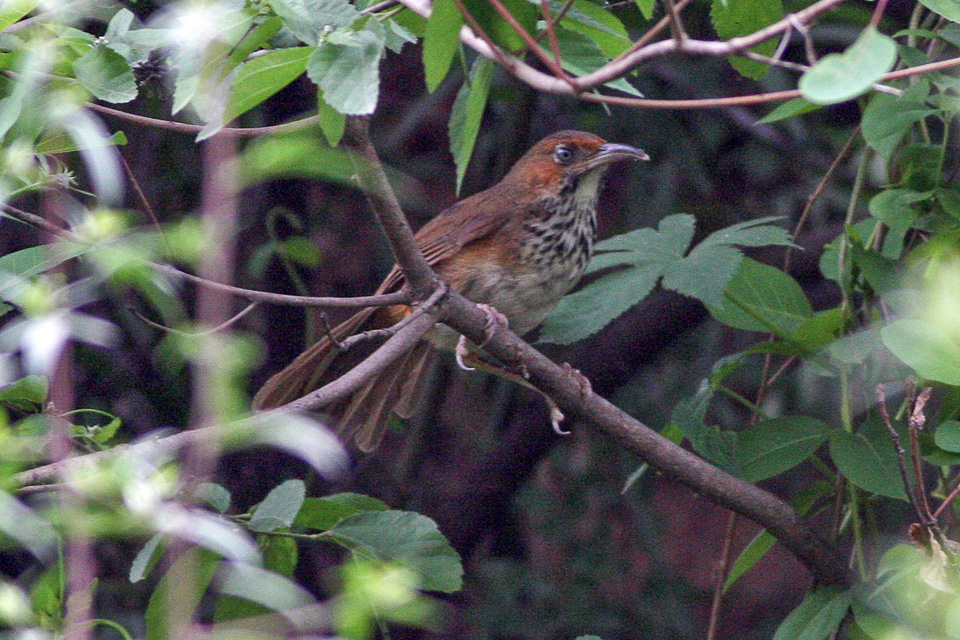 Black-streaked Scimitar BabblerErythrogenys gravivox
-
 Grey-sided Scimitar BabblerErythrogenys swinhoei
-
 Spot-breasted Scimitar BabblerErythrogenys mcclellandi
-
 Red-eyed Scimitar BabblerErythrogenys imberbis
-
 Fluffy-backed Tit-babblerMacronus ptilosus
-
 Pin-striped Tit-babblerMixornis gularis
Compare
Questions and answers
What is the scientific name of the Large Scimitar Babbler?
The scientific name of the Large Scimitar Babbler is Erythrogenys hypoleucos. Written with its author, the full name is Erythrogenys hypoleucos (Blyth, 1844).
Which family does the Large Scimitar Babbler belong to?
Erythrogenys hypoleucos belongs to the family Timaliidae, in the order Passeriformes and the class Aves.
Where is the Large Scimitar Babbler found?
Checklists and occurrence records place Erythrogenys hypoleucos in 9 countries, including Thailand, India, Vietnam, China, Cambodia and Malaysia.
What is the conservation status of the Large Scimitar Babbler?
The IUCN Red List category recorded for Erythrogenys hypoleucos is Least Concern (LC).
What other names does the Large Scimitar Babbler have?
Erythrogenys hypoleucos is also known in English as Large Scimitar-Babbler.
Where does Large Scimitar Babbler occur?
It occurs in Bangladesh, Cambodia, China, India, Laos, Malaysia, Myanmar, Thailand, and Vietnam.[4]
What habitat does Large Scimitar Babbler occupy?
It inhabits subtropical or tropical moist lowland forests and subtropical or tropical moist montane forests. It also occupies wooded areas, thick fields, and bamboo tangles where extensive cover is available.[1][2]
What is the conservation status of Large Scimitar Babbler?
It was assessed as Least Concern in the 2024 IUCN Red List assessment.[3]
Sources
Passages the profile rests on
- The species inhabits subtropical or tropical moist lowland forests and subtropical or tropical moist montane forests. Source passage: “Its natural habitats are subtropical or tropical moist lowland forest and subtropical or tropical moist montane forest.” — English Wikipedia
- The species occupies wooded areas, thick fields, and bamboo tangles where extensive cover is available. Source passage: “A handsome and slightly primal-looking babbler of wooded areas, thick fields, and bamboo tangles, wherever there is extensive cover.” — ebird.org
- The species was assessed as Least Concern in the 2024 IUCN Red List assessment. Source passage: “Large Scimitar-babbler Erythrogenys hypoleucos has most recently been assessed for The IUCN Red List of Threatened Species in 2024. listed as Least Concern.” — iucnredlist.org
- The species occurs in Bangladesh, Cambodia, China, India, Laos, Malaysia, Myanmar, Thailand, and Vietnam. Source passage: “It is found in Bangladesh, Cambodia, China, India, Laos, Malaysia, Myanmar, Thailand, and Vietnam.” — English Wikipedia
Data
- Catalogue of Life, 2026-10-16 XR cc by
- Global Biodiversity Information Facility CC BY 4.0
- Wikidata CC0
- GeoNames CC BY 4.0
- Wikimedia Commons per image; credit shown with each image
- Within the Catalogue of Life, this name comes from The Integrated Taxonomic Information System cc0
This species in other databases
Page built on 29 November 2026. See how the catalog is made and all sources and licences.
Cite this page
ScientificNames.org. (2026). Erythrogenys hypoleucos (Large Scimitar Babbler). Retrieved November 29, 2026, from https://scientificnames.org/species/erythrogenys-hypoleucos
“Erythrogenys hypoleucos (Large Scimitar Babbler).” ScientificNames.org, 2026, scientificnames.org/species/erythrogenys-hypoleucos. Accessed 29 Nov. 2026.
ScientificNames.org. “Erythrogenys hypoleucos (Large Scimitar Babbler).” Accessed November 29, 2026. https://scientificnames.org/species/erythrogenys-hypoleucos.
@misc{scientificnames_erythrogenys_hypoleucos_large_scimitar_babbler,
  author = {{ScientificNames.org}},
  title = {Erythrogenys hypoleucos (Large Scimitar Babbler)},
  year = {2026},
  url = {https://scientificnames.org/species/erythrogenys-hypoleucos},
  note = {Accessed 2026-11-29}
}